
Job seekers are drowning in tasks.
Find the right roles. Interpret vague job descriptions. Research employers. Rewrite the resume. Update LinkedIn. Contact recruiters. Track applications. Prepare stories. Practice interviews. Negotiate compensation. Follow up without sounding desperate. Learn from rejection while protecting confidence.
Most career technology breaks that journey into isolated transactions. One tool scans a resume. Another lists jobs. Another drafts a cover letter. A spreadsheet tries to remember the rest. The candidate becomes the integration layer, carrying the same history and strategy across every system.
GPT-6 Astra creates the possibility of a more coherent career operating system. OpenAI describes Astra as its most capable model for complex end-to-end work across reasoning, research, files, browsers, code, computer use, and professional software. ChatGPT Work can combine approved sources and tools to produce reviewable documents, spreadsheets, presentations, websites, and workflows. Official Astra model guidance | Official ChatGPT Work overview
Possibility is the right word. Access to a model does not establish that a specific career platform, employer site, job board, CRM, or messaging service is connected or reliable. Any such integration requires authorization, testing, and safeguards. The opportunity is nevertheless significant: one intelligent system could maintain a candidate's goals, evidence, market research, documents, pipeline, and decisions as parts of the same campaign.
The job search is a reasoning problem
Candidates often believe they have a writing problem. Their resume needs stronger language. Their LinkedIn profile needs better keywords. Their cover letter needs more personality.
Those outputs matter, although they sit downstream from harder questions:
- Which roles offer the strongest alignment with the candidate's actual evidence and ambitions?
- Which accomplishments matter to each market?
- Which gaps require explanation, development, or a different target?
- Which employer signals deserve attention?
- Which networking path has a credible reason for contact?
- Which interview examples prove the required competencies?
- Which offer supports the candidate's financial, professional, and personal priorities?
Astra is designed for complex reasoning and multistep workflows. That makes it more useful as a career campaign coordinator than as a sentence generator.
The Astra capabilities that matter for careers
A larger working context
OpenAI publishes a 1.05 million-token context window and a 128,000-token maximum output for Astra through the API. These figures are API specifications; they do not establish the limits of an individual ChatGPT Work account. Official Astra model specifications
A large context can hold a much richer career record: prior resumes, performance reviews, project histories, quantified achievements, writing samples, certifications, target roles, employer research, interview notes, compensation priorities, and the candidate's decisions over time. The system can connect evidence that would otherwise remain scattered.
That record must be governed. Old resumes may contain obsolete facts. Job descriptions may disappear. AI-generated claims can accidentally enter later drafts as if they were verified history. Every factual achievement should retain a source and confidence status.
Current research and file intelligence
Astra supports web search and file search through the Responses API, while ChatGPT Work can research websites and analyze uploaded or connected files when those tools are available. Official Astra model page | Official ChatGPT capability overview
In a career workflow, this can support employer research, job-description comparison, market mapping, interview preparation, and document development. Current facts still require current sources. A model knowledge cutoff is not a substitute for live research.
Structured outputs
Astra supports structured outputs and function calling in the Responses API. A career application can request dependable fields such as employer, role, location, compensation when stated, required experience, preferred qualifications, deadlines, source URL, verification date, and next action. Official Astra model specifications
Structured data can turn scattered job descriptions into a usable opportunity ledger. It can also help detect duplication, missing information, and changes. The extraction still needs validation, especially when a posting is ambiguous or dynamically generated.
Steering as the campaign changes
Candidates change direction. A new interview reveals a stronger narrative. A location constraint appears. A compensation floor changes. A recruiter supplies information that reshapes the target.
ChatGPT Work supports ongoing direction, and Astra supports mid-turn steering through the Responses API over WebSockets. New requirements can be introduced without discarding all valid work already completed. Official mid-turn steering guide
This supports a living strategy. Resume variants, interview examples, target lists, and outreach priorities can evolve from the same verified foundation.
Skills for consistency
A tested skill can preserve how a career workflow should be performed: which sources control, how accomplishments are validated, which questions must be asked, how documents are reviewed, what language to avoid, and how final quality is checked. Plugins can connect approved services and context. Official Skills and Plugins guide
For candidates, this means fewer arbitrary changes from one session to the next. For a career platform, it creates a way to encode professional standards and continuously improve them.
Scheduled intelligence
Scheduled tasks can run recurring workflows, and eligible plans can respond to supported app events. A tested task could prepare a daily target-role brief, flag meaningful changes in a pipeline, collect interview preparation materials, or remind a candidate about approved follow-ups. Official scheduled tasks guide
The task should filter aggressively. Ten excellent opportunities with clear reasons for relevance are more useful than a thousand undifferentiated listings.
What a living career system could do
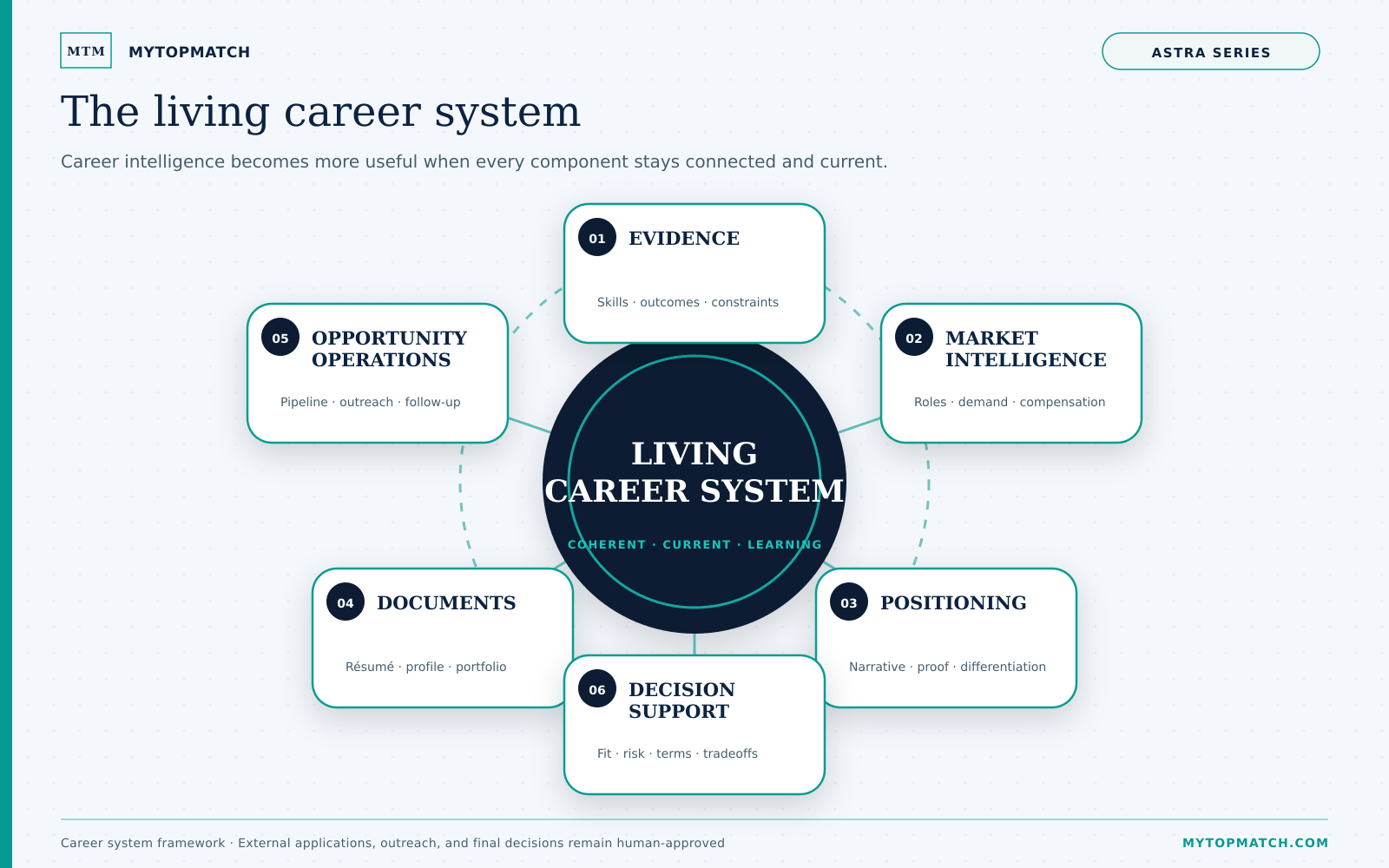
A well-designed system could maintain six connected layers.
1. Professional evidence
The foundation contains verified responsibilities, achievements, skills, credentials, projects, preferences, and career history. It preserves the distinction between facts, interpretations, and claims that still need confirmation.
2. Target-market intelligence
The system maps role families, titles, industries, employers, locations, compensation information when available, qualification patterns, and emerging skill requirements. Each time-sensitive fact carries a source and review date.
3. Positioning
The candidate's value proposition, executive narrative, keywords, accomplishment portfolio, and career-transition explanation evolve from the same evidence. Different markets receive different emphasis while the underlying facts remain stable.
4. Documents and communication
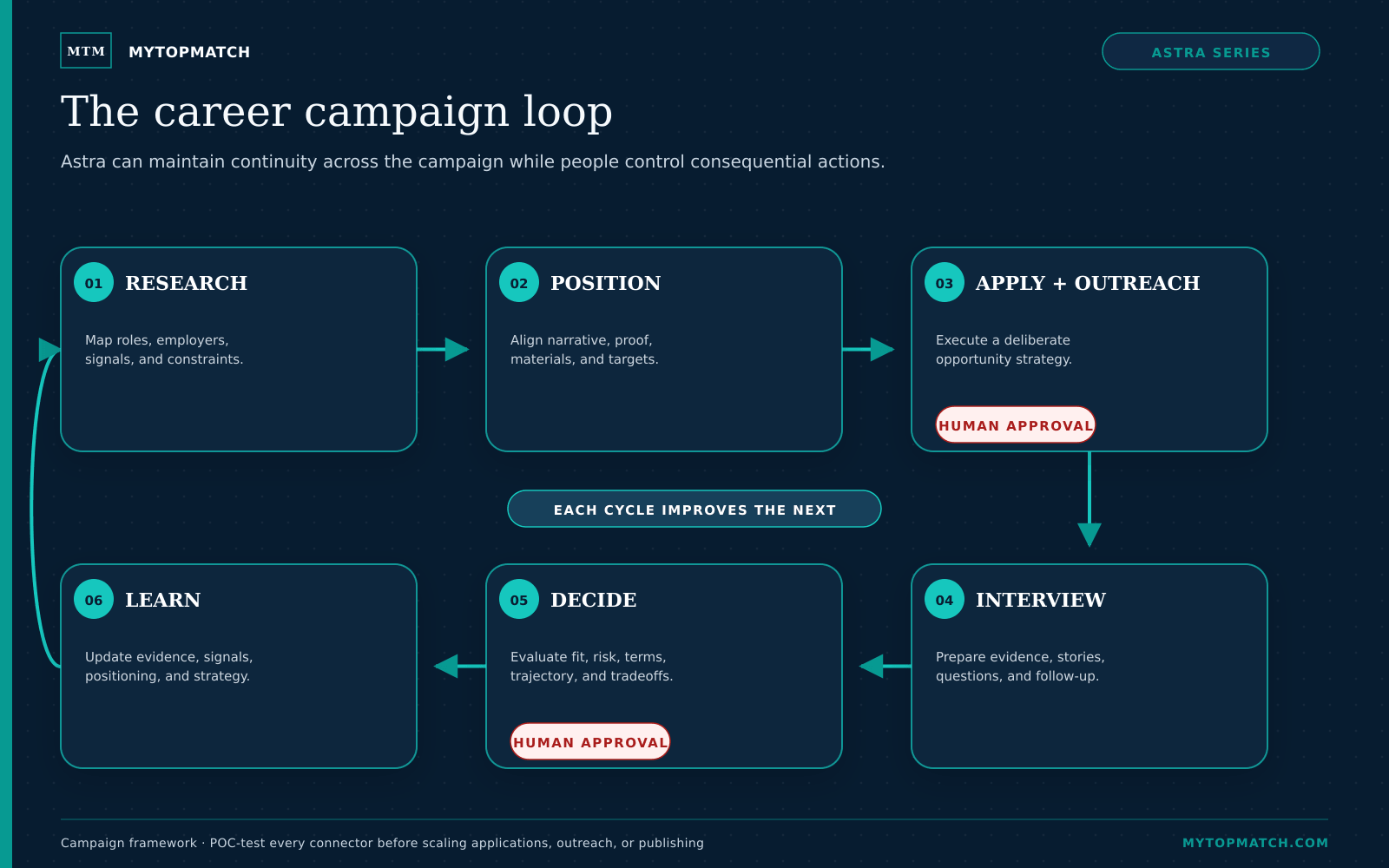
Resume variants, LinkedIn content, cover letters, recruiter outreach, networking notes, interview stories, thank-you messages, and negotiation briefs can be generated from the approved strategy. The candidate reviews every external communication before it is sent.
5. Opportunity operations
The system tracks roles, contacts, status, deadlines, next actions, interviews, decisions, and outcomes. Structured records make follow-up more reliable and allow the strategy to learn from the campaign.
6. Decision support
The system can compare opportunities against the candidate's stated priorities and surface tradeoffs. It should present evidence and questions rather than pretend to make an employment decision for the person.
The guardrails are part of the product
Career information is intimate. It can contain identity data, compensation, health or family constraints, employer conflicts, references, work history, and private correspondence. A responsible system needs explicit rules.
- Never invent an achievement, credential, employer fact, or relationship.
- Preserve the source behind every material career claim.
- Keep VERIFIED facts separate from INFERRED interpretations, ESTIMATED values, UNTESTED workflows, and UNKNOWN information.
- Require the candidate's approval before sending a message, submitting an application, changing a public profile, or sharing private data.
- Respect job-board rules, employer systems, and access boundaries.
- Avoid automated volume that damages the candidate's reputation or creates misleading applications.
- Keep assessment results descriptive and developmental; they should not become unsupported percentiles or employment recommendations.
- Test every unfamiliar connector with a small, reviewable proof-of-concept before broader use.
The strongest career system will earn trust through provenance, consent, and transparency.
The opportunity for MyTopMatch
This is the direction MyTopMatch is built to pursue: a career system that connects professional evidence, market intelligence, positioning, documents, opportunities, interviews, negotiation, and follow-through.
Astra expands what may be technically and operationally possible within that vision. It could help analyze larger career records, coordinate more complex campaigns, create higher-quality personalized artifacts, maintain structured opportunity data, and support recurring intelligence workflows.
This article does not claim that MyTopMatch currently has a production Astra integration. Any future implementation would need a scoped proof-of-concept, verified API access, privacy review, measurable acceptance criteria, and live testing before scale.
The business potential is substantial because career services have traditionally forced a choice between high-touch expertise and scalable technology. A carefully designed Astra workflow could allow expert standards to reach more people while preserving human review at the decisions that matter.
A better way to ask Astra for career help
A career prompt should function as a campaign brief:
Build a career campaign for [target]. Use only the attached verified career record and current cited market sources. Preserve all factual claims exactly unless I confirm a correction.
Deliver a target-market map, role criteria, employer shortlist, positioning statement, resume strategy, LinkedIn plan, outreach sequence, interview evidence bank, negotiation framework, and weekly pipeline structure.
Label VERIFIED, INFERRED, ESTIMATED, UNTESTED, and UNKNOWN information. Ask for missing facts that materially affect the strategy. Show the source and review date for time-sensitive claims.
You may research, analyze, draft, and organize. Stop before sending messages, changing public profiles, submitting applications, sharing private data, or accepting any offer.
Verify consistency across every deliverable and identify the three decisions I need to make next.
This request gives Astra a whole campaign to coordinate. It also protects the candidate's authorship and agency.
Careers will become more dynamic and more human
As Astra and similar systems assume more of the research, production, coordination, and monitoring around a job search, the human contribution becomes easier to see. The candidate brings ambition, values, courage, relationships, judgment, lived experience, and the responsibility to choose.
Technology can maintain the map. The person still decides where to go.
The future of career services will belong to systems that understand both sides of that equation: intelligent execution and human agency. Astra brings us closer to building them.
Author note
Keith Lawrence Miller, M.A., is an organizational and business psychology practitioner, executive coach, author, and founder of Ivy League Coaching and MyTopMatch. He has supported more than 5,000 professionals and leaders across résumé development, career strategy, leadership, and professional growth.
Capability disclosure
The author received access to GPT-6 Astra in ChatGPT on September 5, 2026. Product capabilities cited here come from official OpenAI documentation reviewed on the same date. Proposed career-platform applications are strategic use cases. No production MyTopMatch-Astra integration is asserted.
THE ASTRA SERIES
One model. Three operating lenses.
This essay is the career-system lens in a three-part series on translating Astra’s capacity into responsible execution.