

AI Career Impact Week in Review
A MyTopMatch Career Intelligence Publication
New evidence on AI skills, restructuring, career transitions, and the human work behind reliable output.
Reporting period: October 1–7, 2026
Publication date: October 8, 2026
Original AI-generated editorial artwork with a typeset MyTopMatch treatment. Conceptual architecture, not an actual employer’s workplace.
A job can remain on the organization chart while the work inside it changes. Skills that once helped someone stand out can become ordinary expectations. A department can lose management layers while the company continues investing. A growing occupation can remain difficult to enter from the job next door.
This week’s evidence puts those career problems in focus. Workday reported a shift toward applied AI skills. HubSpot announced a restructuring around customer outcomes and fewer organizational layers. Revelio Labs documented a narrowing call-center employment pathway. Research from Templafy and Stack Overflow highlighted review burdens and conditional trust in AI output. [1] [2] [4] [5] [7]
The practical response is to examine the work an employer needs now, identify where your contribution fits, and build evidence that you can deliver it. Waiting for a new title or a formal announcement leaves too much of that work to someone else.
1. Employers are getting more specific about AI skills
Workday’s October 5 report analyzed skill mentions in requisitions from more than 550 enterprise employers using its recruiting software. Demand for applied capabilities, including building AI tools, automating workflows, and AI engineering, rose 51% between September 2025 and July 2026. Basic AI skill demand, including simple prompting, peaked in January and then declined 25%. The comparison periods differ; these are requisition signals, not measured hiring or wage outcomes. [1]
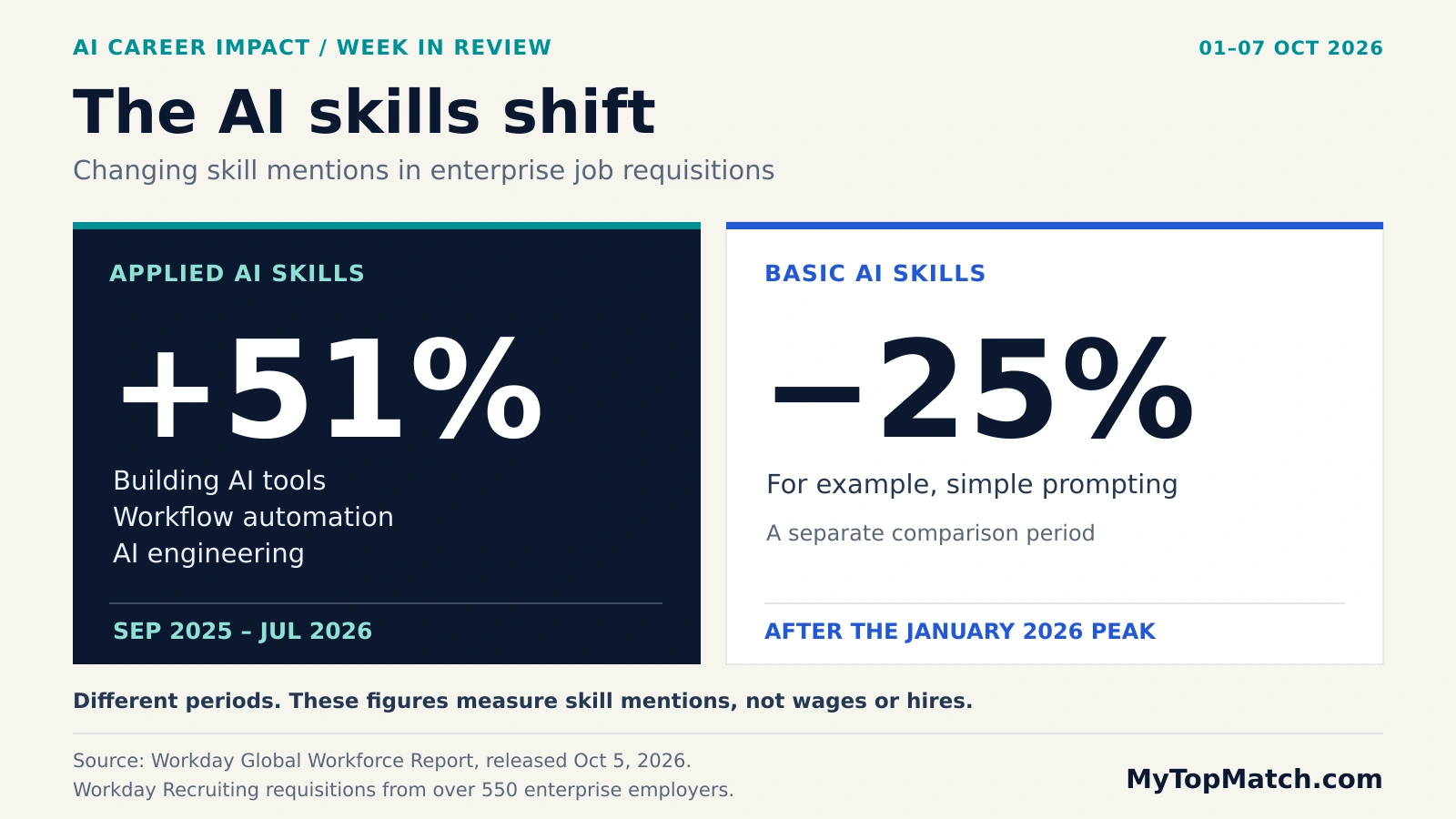
Workday Recruiting customer data. The two figures use different starting periods and do not measure wages or completed hires.
For professionals, the useful distinction is between naming a tool and demonstrating a capability. A résumé entry that lists an AI application tells an employer very little about the work you can own. A clear example showing how you improved a process, checked the output, and delivered a useful result gives the employer something to evaluate.
That does not require every professional to become an AI engineer. Consider an illustrative operations example: a specialist documents a recurring reporting task, identifies which inputs must be reliable, uses an approved assistant for an appropriate step, and records the corrections needed before the report can support a decision. The value is visible in the complete process and its result.
Workday also reported that internal moves declined year over year at 57% of employers in its matched customer panel. That finding describes a customer sample, not every U.S. employer. [1]
The career implication is straightforward: make development specific. Identify a capability, a project that would demonstrate it, a person who can assess the work, and a date to review progress. A general promise of future opportunity is difficult to act on. A defined assignment gives both employee and manager a practical commitment.
2. AI strategy can change the organization around you
On October 6, HubSpot announced a planned workforce reduction of approximately 7%, affecting nearly 660 employees. CEO Yamini Rangan described a shift toward product teams organized around customer outcomes, fewer management layers, and clearer ownership. She explicitly said the decision was not driven by AI-related efficiencies. [2]
The company’s SEC filing says the board authorized the plan on October 1 and expects role eliminations to be substantially complete by the end of the first quarter of 2027. The announcement does not establish that all affected employees departed this week. [3]
The distinction matters. Calling these positions “replaced by AI” would go beyond the evidence and contradict the company’s stated explanation. The documented career event is a restructuring connected to a changed business strategy.
For someone inside an organization pursuing a similar change, the immediate task is to understand how responsibility is being redistributed. Identify the customer outcome your work supports, the decisions you make, the dependencies you resolve, and the capabilities a redesigned team would still need.
For managers, that means explaining the contribution of management in concrete terms. Show how you develop people, resolve competing priorities, improve decisions, and create the conditions for reliable execution. Describe the work your leadership makes possible. Headcount supervised is a measure of scope; the case for your contribution needs substance beyond it.
For job seekers, investigate the role’s actual place in the new structure. Establish who owns the outcome, what authority accompanies the responsibility, and how success will be assessed. A broad job description can conceal fragmented ownership or expectations that several people have interpreted differently.
None of this guarantees protection from a restructuring. It does help a professional understand the organization they are in and describe the value they can bring to the next one.
3. A growing occupation still needs an accessible route into it
Revelio Labs’ October 6 analysis reported global call-center employment 5.3% below its December 2023 peak. In a separate examination of 12 middle-income countries, only 10.8% of observed movers entered technical support, customer success, or software and data roles in their first observed job within 12 months of leaving a call center. Those destinations were growing, but most observed movers did not reach them. [4]
The study also found that hiring entries into call-center work in those countries had fallen faster than exits. Its authors could not observe which companies replaced employees with chatbots and identified other possible contributors to the decline. These findings are not U.S. transition rates, and they do not isolate AI as the cause. [4]
For a U.S. reader, the useful lesson is about the transition itself. Identifying an attractive destination is only the beginning. You need to establish what the destination requires and how your existing experience can meet those requirements.
A customer-service professional considering technical support can start by comparing the troubleshooting, product knowledge, and escalation responsibilities in current openings with work they have actually performed. Someone considering customer success can examine onboarding, account relationships, adoption, and retention responsibilities. These are illustrative directions to investigate, not claims that either move is available to every worker.
Build the bridge before presenting the destination as a plan. Select one missing capability, find a way to demonstrate it, and obtain informed feedback on the result. A relevant work example can make a skills gap more concrete than another broad statement about being adaptable.
Employers have a corresponding responsibility when they promise redeployment. Define the destination roles, the entry requirements, the training time, the assessment, and the actual openings. Employees need a route they can follow and criteria they can understand.
4. The first draft is only part of the work
Templafy released an October 1 survey of 2,000 U.S. and U.K. knowledge workers at employers with at least 100 employees who already used AI for business documents at least monthly. Conducted by Sapio Research in August, it found that 95% edited AI-generated documents before use. Respondents reported spending an average of almost four hours a week reviewing, correcting, and validating them; 48% said the required review can leave little actual time saved. This was a vendor-sponsored survey of reported experience, not a controlled productivity experiment. [5]
Stack Overflow’s developer survey, released October 6, provides a related view of trust. Among 14,304 respondents to its optional trust question, 48.0% selected trust when output is easy to verify. Only 6.6% selected trust across many tasks including important work decisions. The voluntary global survey was fielded June 23–August 5 and is not representative of the U.S. workforce. [6] [7] [8]
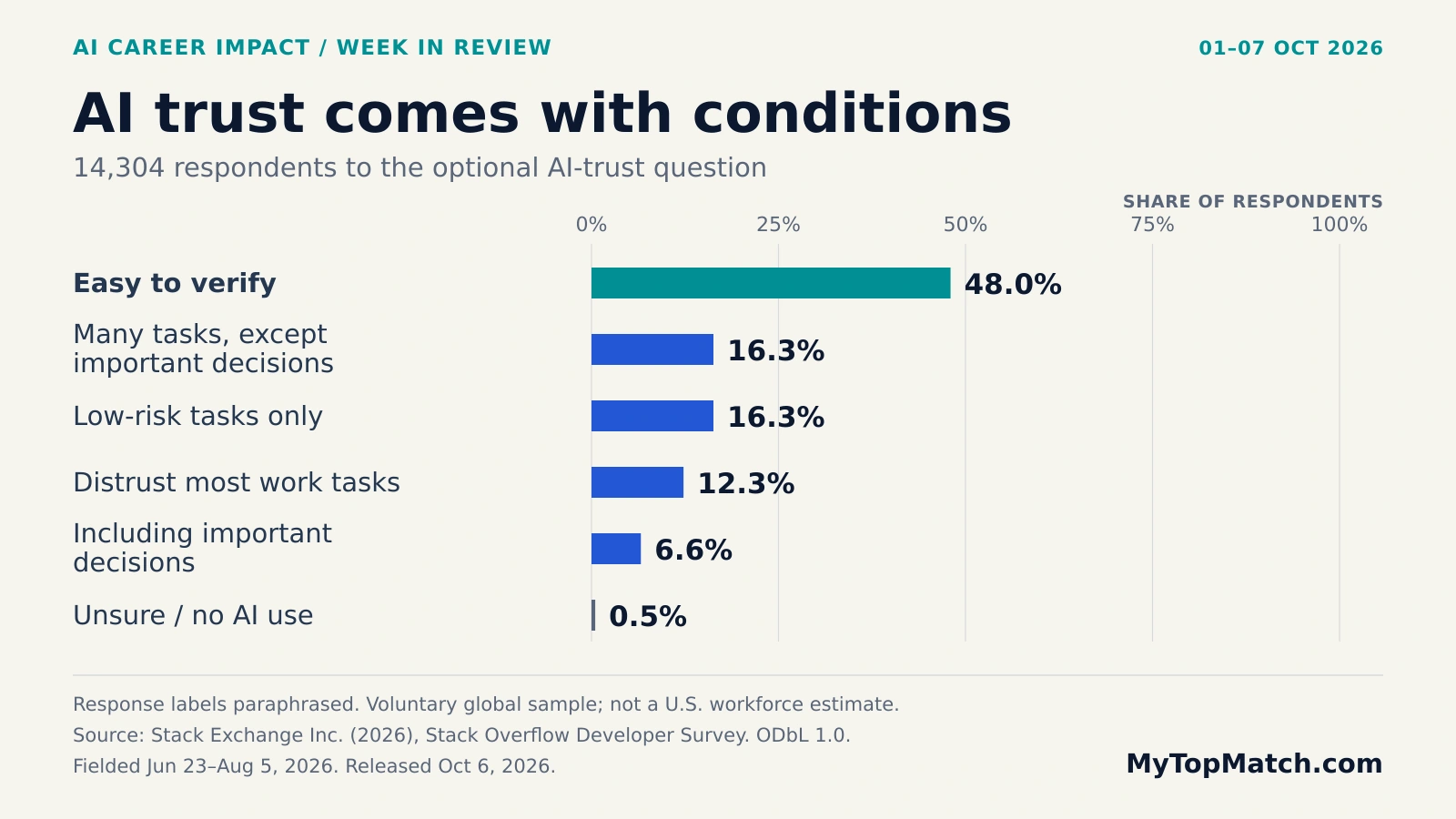
Stack Exchange Inc., Stack Overflow Developer Survey 2026. Optional question; voluntary global sample. Data: ODbL 1.0. Labels are shortened; values are unchanged.
These findings concern different populations and different questions. Together, they make a useful issue visible: the work after generation deserves attention.
For professionals, review is part of the deliverable. Record how you checked sources, reconciled discrepancies, corrected errors, applied relevant standards, and determined that the result was ready to use. If you cannot explain the check, an employer has little basis for judging the reliability of the output.
For managers, count the full process before claiming a gain. Include preparation, generation, review, corrections, handoffs, and any work pushed downstream. A fast draft can still require a slow completion process. The comparison should reach the point where a customer, colleague, or decision-maker can actually use the result.
This also affects professional development. Give less experienced employees a chance to understand why an answer is accepted or rejected. Asking them to produce more output without teaching them how to assess it leaves an important capability undeveloped.
The practical standard is finished work that someone can trust and use. Demonstrate how you reach that standard.
Build evidence for the work ahead
The response should fit your career stage.
Early-career professionals: Build a small, relevant work example and have a knowledgeable person review it. Be prepared to explain the reasoning, identify a limitation, and correct an error. Keep the scope narrow enough to understand the work yourself.
Experienced specialists and career changers: Compare the work you have done with the responsibilities employers now describe. Select evidence that transfers to those responsibilities. Where the gap is real, name it and define a way to address it.
Managers and executives: Clarify the outcomes, decision rights, and development opportunities in the teams you lead. Include review capacity when assigning AI-assisted work. If responsibilities have changed, update the expectations people are being asked to meet.
In each case, professional positioning starts with the work. The résumé, interview, and development conversation should make that work understandable to someone deciding where you fit.
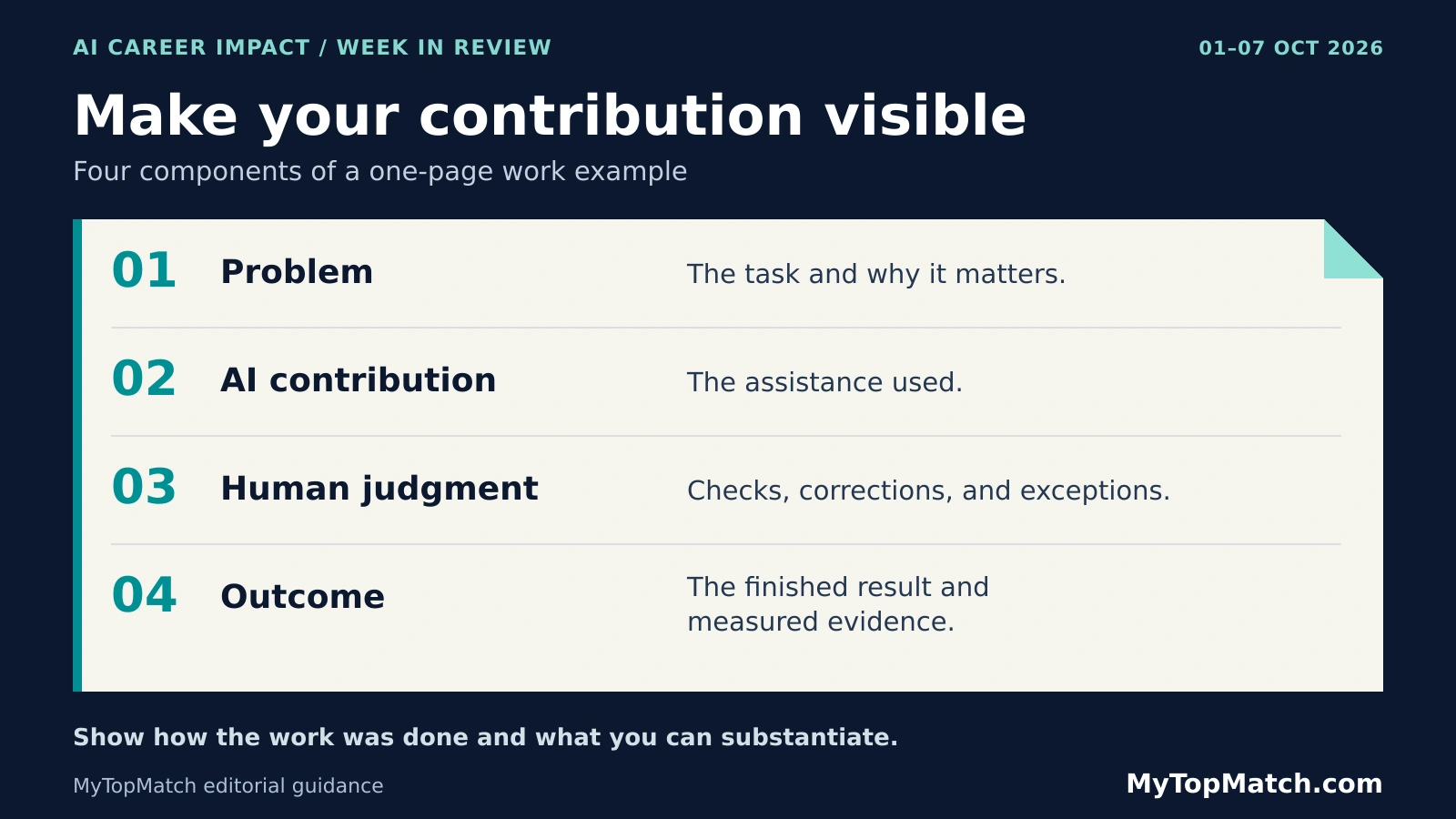
MyTopMatch editorial guidance. An illustrative structure for presenting a work example, not a scored assessment or research finding.
Four career actions for the coming week
1. Compare five current role descriptions. Choose openings relevant to your present role or intended direction. Identify recurring responsibilities, separate tools from capabilities, and note where your existing evidence is strong or incomplete. Keep the findings specific to that small sample.
2. Audit one completed AI-assisted task. Reconstruct the preparation, review, corrections, and final result. Record what can be verified and what remains unknown. Use an existing approved work example rather than buying a new tool to create one.
3. Write a one-page contribution example. Explain the problem, the AI assistance used, the human judgment applied, and the outcome. Include measurements only when supported. Remove confidential material before sharing it outside its authorized audience.
4. Secure one concrete development step. Request a relevant assignment, a supervised project, or feedback from someone familiar with your target work. Agree on the capability to demonstrate and a date for review. Leave the conversation with a defined next step.
What to watch next
Whether skill demand becomes hiring opportunity. Watch for evidence connecting applied AI requirements to completed hiring, internal moves, and compensation. More skill mentions alone do not answer those questions.
How announced reorganizations operate in practice. Watch for completed changes, clarified responsibilities, and evidence about customer and employee outcomes. An announced structure is the start of that story.
Whether organizations measure completed work. Look for evaluations that include quality, correction time, and downstream effort. Those measures can strengthen or challenge productivity claims based on generation speed.
Keep your professional evidence current
A useful career strategy connects your capabilities with work that needs to be done. It identifies where your experience still applies, where expectations have changed, and what you need to demonstrate next.
Do not let your professional story describe a version of the job your organization has already moved beyond. Document what you contribute now. Build the capability the next assignment requires. Make that connection clear to the people making decisions about your future.
The work has moved. Your evidence needs to move with it.
Explore MyTopMatch’s Professional Passport to see how your experience, capabilities, and career direction can be organized in one professional profile. [9]
https://mytopmatch.com/professional-passport
Sources and research notes
Research cutoff: October 8, 2026, 12:35 a.m. EDT (04:35 UTC). This edition covers October 1–7. Studies released during the week use earlier data as identified above. Company statements and publisher findings are attributed; recommendations and examples are MyTopMatch analysis. The underlying proprietary data and paid product performance were not independently tested for this article.
1. Workday, “Workday Global Workforce Report: AI Is Rewriting Jobs More Than It’s Cutting Them.”
October 5, 2026. Requisition data: September 2025–July 2026; additional workforce measures use separate customer panels.
2. HubSpot, “A message from our CEO: Important HubSpot team and business changes.”
https://www.hubspot.com/company-news/company-update
October 6, 2026. Employer announcement and explanation.
3. HubSpot, Form 8-K.
https://www.sec.gov/Archives/edgar/data/1404655/000119312526414965/d183135d8k.htm
Signed October 6, 2026; earliest reported event October 1. Announced restructuring and expected implementation timing.
4. Revelio Labs, “After a Decade of Growth, Global Call Center Employment Is Shrinking.”
October 6, 2026. Global headcount and a separate 12-country transition analysis. Individual charts do not all state a precise final observation date.
5. Templafy, “Templafy Report Finds 95% of Knowledge Workers Edit AI-Generated Documents Before They’re Business-Ready.”
https://www.templafy.com/news/knowledge-workers-edit-ai-generated-documents/
October 1, 2026. Sapio Research survey, August 2026, among monthly AI document users at employers with at least 100 employees.
6. Stack Overflow, 2026 Developer Survey release.
October 6, 2026.
7. Stack Exchange Inc., “Trust in AI tools,” Stack Overflow Developer Survey 2026.
https://survey.stackoverflow.co/2026/ai/data/ai-trust
Optional question, 14,304 respondents. Data licensed under ODbL 1.0.
https://opendatacommons.org/licenses/odbl/1-0/
8. Stack Overflow, 2026 survey methodology.
https://survey.stackoverflow.co/2026/methodology
Fielding June 23–August 5, 2026; voluntary community recruitment.
9. MyTopMatch, Professional Passport.
https://mytopmatch.com/professional-passport
Public description checked October 8, 2026; account creation and member workflows were not tested.