
AI Career Impact Week in Review | November 2–5, 2026
Coverage through Thursday morning, November 5. This edition examines U.S. labor-market data and major international workforce announcements. Earlier research is dated where it provides context.
Your employer can be growing and still eliminate your position. Your industry can attract investment while the work you do loses priority. The economy can add jobs while the opportunities that fit your experience become harder to find.
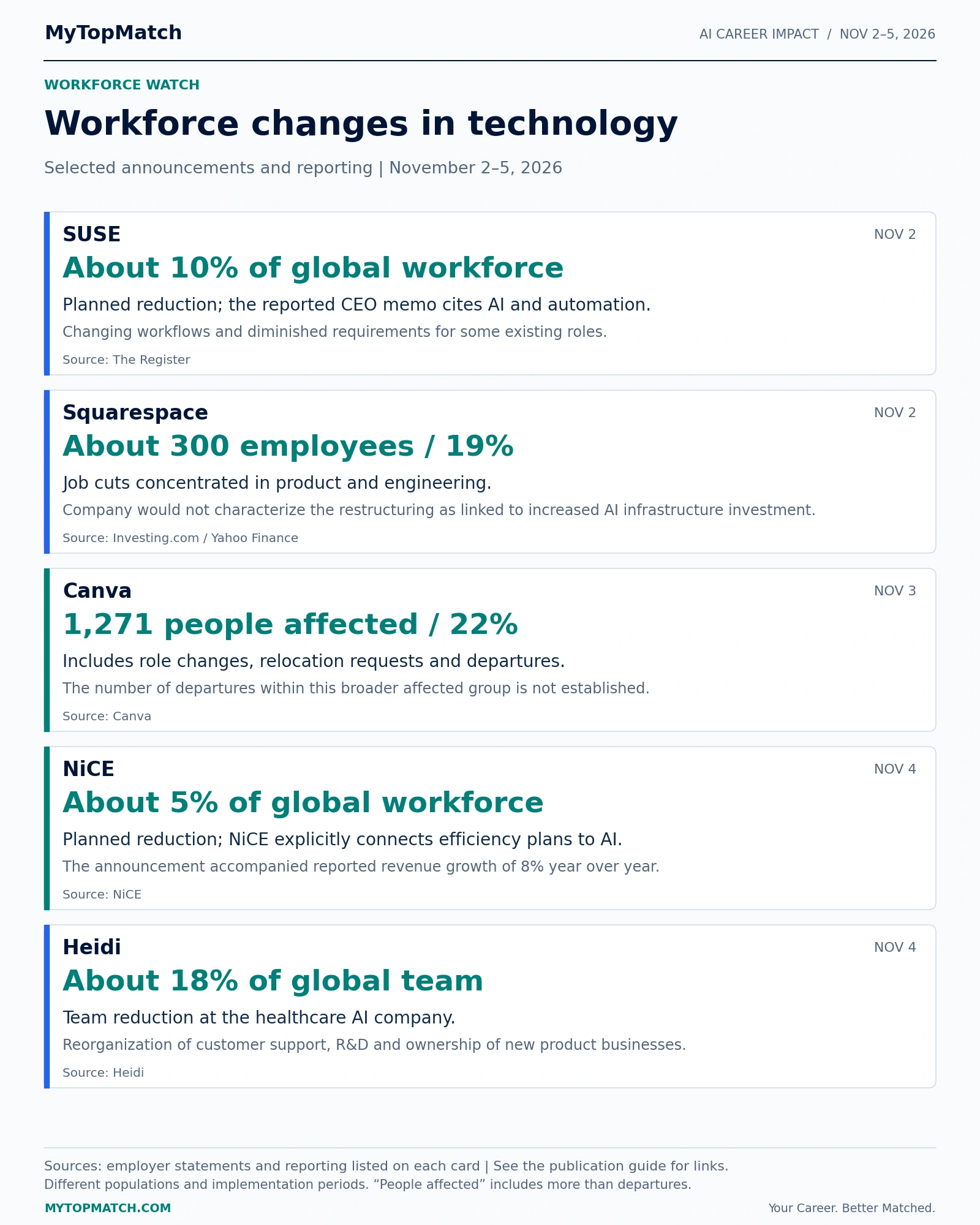
This week offered a concrete example. On November 4, customer-experience software company NiCE reported 8% annual revenue growth while announcing plans to reduce its global workforce by approximately 5%. The company explicitly connected its efficiency plans to greater use of AI. [1]
For workers, that combination deserves attention. Company growth and personal job security are separate questions. So are the existence of job openings and the availability of work that fits your qualifications, income needs, and location.
The evidence this week points to selective disruption: employers are cutting some positions, broadening others, and continuing to recruit for specific priorities. Understanding those choices is more useful than treating every announcement as a verdict on the entire job market.
The major workforce announcements, with the details that matter
The following developments were announced or newly reported this week. Several involve plans that will unfold over time; others disclose actions that began months earlier.
| Employer and date | What was announced or disclosed | Stated context |
|---|---|---|
| SUSE, November 2 | A planned reduction of approximately 10% of its global workforce. | The Register reported a CEO memo explicitly citing automation and AI, changing workflows, and diminished requirements for some existing roles. [2] |
| Squarespace, November 2 | Approximately 300 employees, or 19% of its global workforce, affected by job cuts, primarily in product and engineering. | The company cited a simpler organization and clearer priorities. It told Investing.com it would not characterize the restructuring as linked to increased AI infrastructure investment. [3] |
| Canva, November 3 | 1,271 people, or 22% of the company, affected by organizational changes. | Canva's figure includes role changes and relocation requests as well as departures. Its statement cites slower growth, broader responsibilities, fewer organizational layers, and more work concentrated in hubs. [4] |
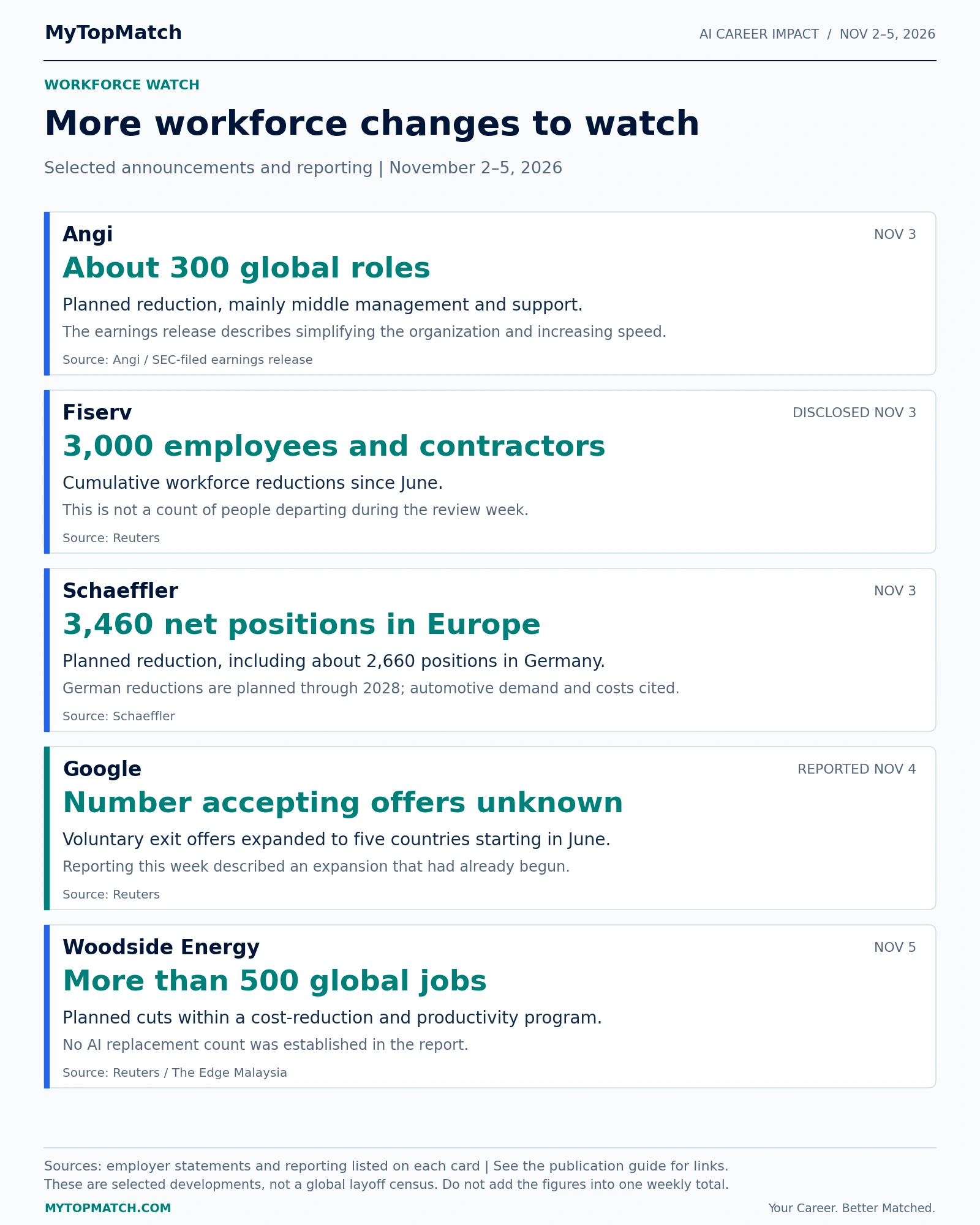
| Angi, November 3 | A planned reduction of approximately 300 global roles, mostly in middle management and support functions. | Its earnings release describes a move to simplify the organization and increase speed. [5] |
| Fiserv, November 3 | A reduction of 3,000 employees and contractors since June, disclosed on its earnings call. | Reuters reported an efficiency program that also reduced senior management by more than 10%. This is a cumulative figure, rather than 3,000 departures occurring this week. [6] |
| Schaeffler, November 3 | A planned net reduction of 3,460 positions in Europe, including approximately 2,660 in Germany. | The company cited automotive overcapacity, weak combustion-engine demand, a slower electric-vehicle transition, and costs. German reductions are planned through 2028. [7] |
| Google, reported November 4 | Voluntary exit offers expanded to employees in five countries, beginning in June. The number accepting was not established. | Google confirmed the expansion to Reuters, which reported it in the context of cost management and AI investment. [8] |
| Heidi, November 4 | An approximately 18% reduction in its global team. | The healthcare AI company said it was reorganizing customer support, research and development, and ownership of new product businesses while continuing to grow. [9] |
| Woodside Energy, November 5 | Plans to cut more than 500 jobs globally. | Reuters reported a broader cost-reduction and productivity program. [10] |
These figures cover different countries, worker categories, and implementation periods. Adding them together would obscure what happened. The AI connection also varies: some employers expressly cite automation, while others point to demand, operating costs, or organizational structure.
For someone evaluating an employer, the useful question is where that company is reducing work, where it is investing, and how the specific position fits those decisions.
The work inside the job is changing
Canva's announcement reaches beyond the number of people affected. The company described combining narrower specialties into broader roles, consolidating overlapping responsibilities, and reducing management layers. It also expects most hybrid employees to spend approximately two to three days in the office each week from January. [4]
SUSE's reported internal explanation similarly described changing workflows and reduced need for some existing roles. Angi identified middle management and support functions as the main areas of its planned reduction. [2][5]
MyTopMatch's analysis: These announcements make the scope of a job increasingly important. A familiar title may come with a wider set of responsibilities, a different reporting structure, or different location expectations.
That matters both to people searching for work and to those remaining after a reorganization. Before accepting a role, establish what you will own, which decisions you can make, how performance will be evaluated, and what support will be available. Employees whose responsibilities expand should seek the same clarity.
For managers, career evidence should explain the decisions you improved, problems you resolved, people you developed, and results your team delivered. For specialists, explain how your expertise connects to a business outcome.
A restructuring announcement also does not establish that the people affected performed poorly. A company can remove a role because its priorities changed. Your career presentation should preserve the evidence of what you contributed.
The national data show a different picture from the biggest headlines
The broader U.S. releases do not show a nationwide surge in layoffs. They show continued hiring alongside uneven conditions across industries.
| Release this week | Period measured | Main finding |
|---|---|---|
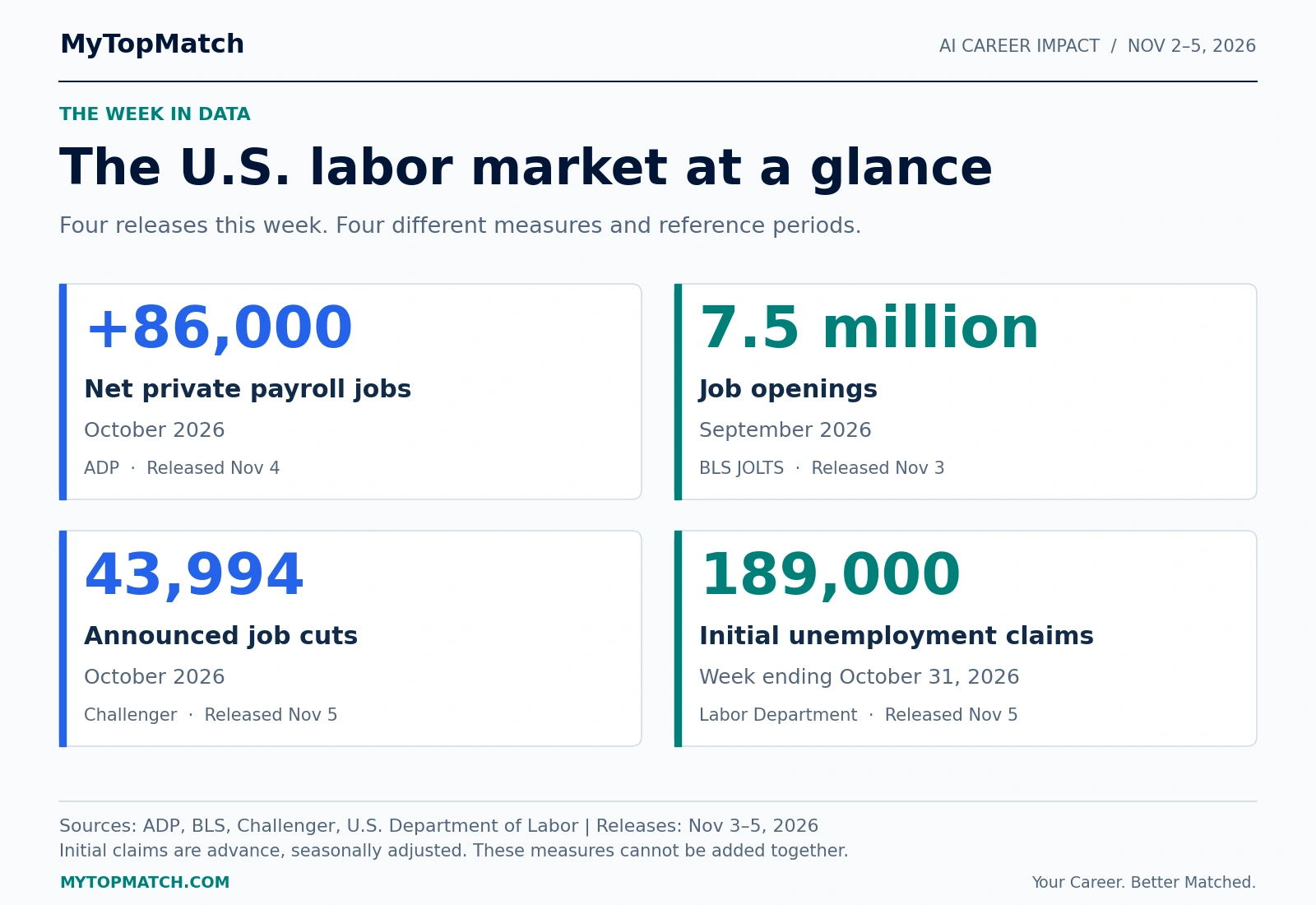
| BLS JOLTS, November 3 | September 2026 | 7.5 million job openings and 5.4 million hires. BLS described both as little changed. [13] |
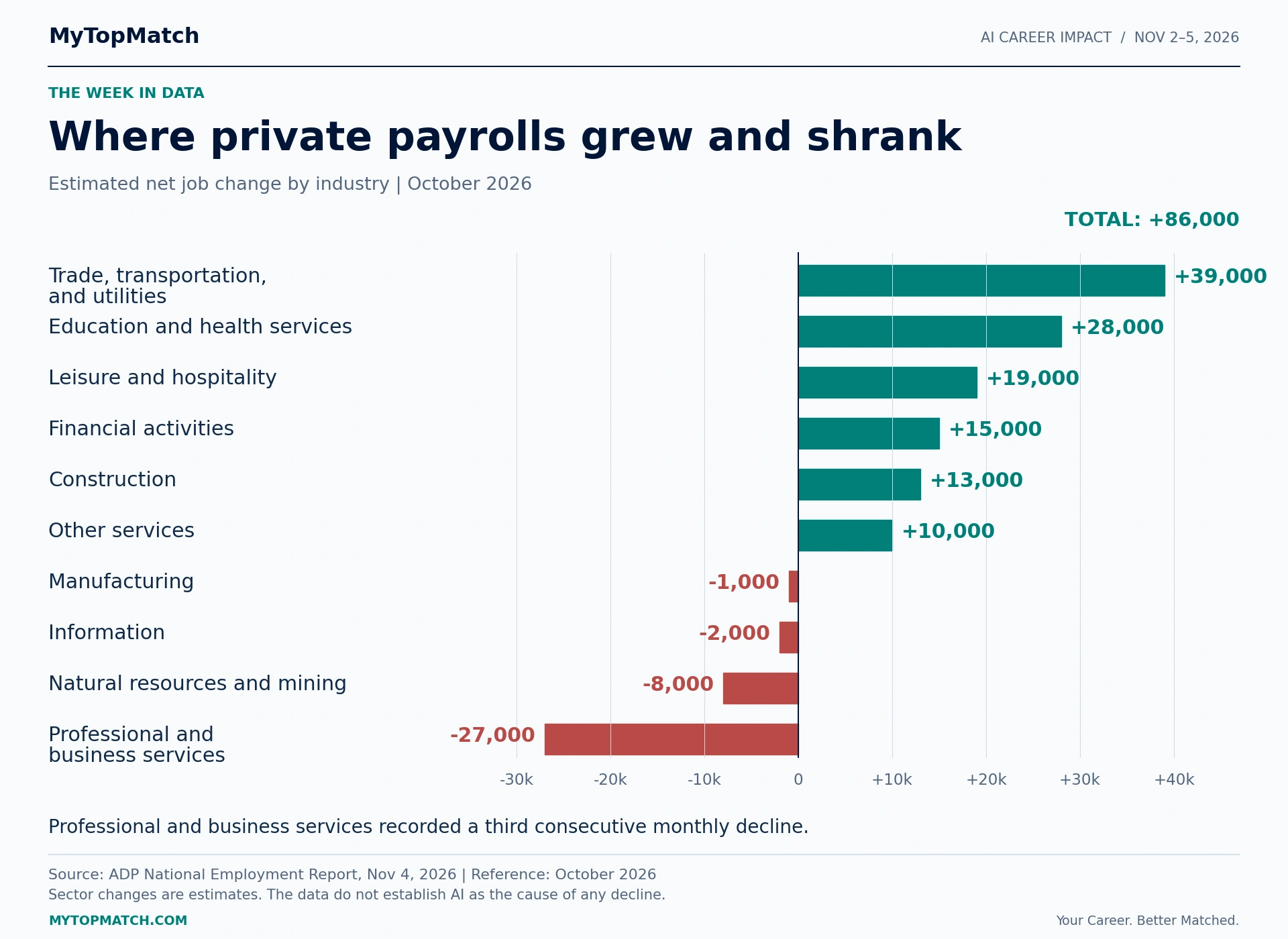
| ADP, November 4 | October 2026 | An estimated 86,000 net private-sector jobs added. [14] |
| Challenger, November 5 | October 2026 | 43,994 announced job cuts, down 71% from October 2025. [11] |
| Labor Department claims, November 5 | Week ending October 31 | 189,000 initial unemployment claims, down 6,000 from the revised previous week, seasonally adjusted. [12] |
Each release measures something different. A company's announced reduction is different from a completed separation. A job opening is different from a hire. Initial unemployment claims measure applications for benefits, rather than everyone who is looking for work.
Continuing insured unemployment rose by 23,000 to 1.718 million in the week ending October 24, according to the same Labor Department release. That measure refers to a different week from the initial-claims figure. [12]
Challenger also reported that employers cited AI in 1,265 October job-cut announcements, bringing its 2026 total to 121,401, approximately one-fifth of announced cuts. These are employer-attributed reasons, not an independent count of positions proven to have been replaced by AI. [11]
The practical implication is that national stability can coexist with serious disruption in a particular occupation or company. Job seekers need to investigate the market for the work they can realistically pursue.
Hiring continued, but the gains were uneven
ADP's October estimates show where employment expanded and where one major category weakened. [14]
| Private-sector category | Estimated net job change |
|---|---|
| Trade, transportation, and utilities | +39,000 |
| Education and health services | +28,000 |
| Leisure and hospitality | +19,000 |
| Financial activities | +15,000 |
| Construction | +13,000 |
| Professional and business services | −27,000 |
Professional and business services lost jobs for the third consecutive month in ADP's data. The category is broad; its decline does not establish that every occupation within it is contracting or that AI caused the losses. [14]
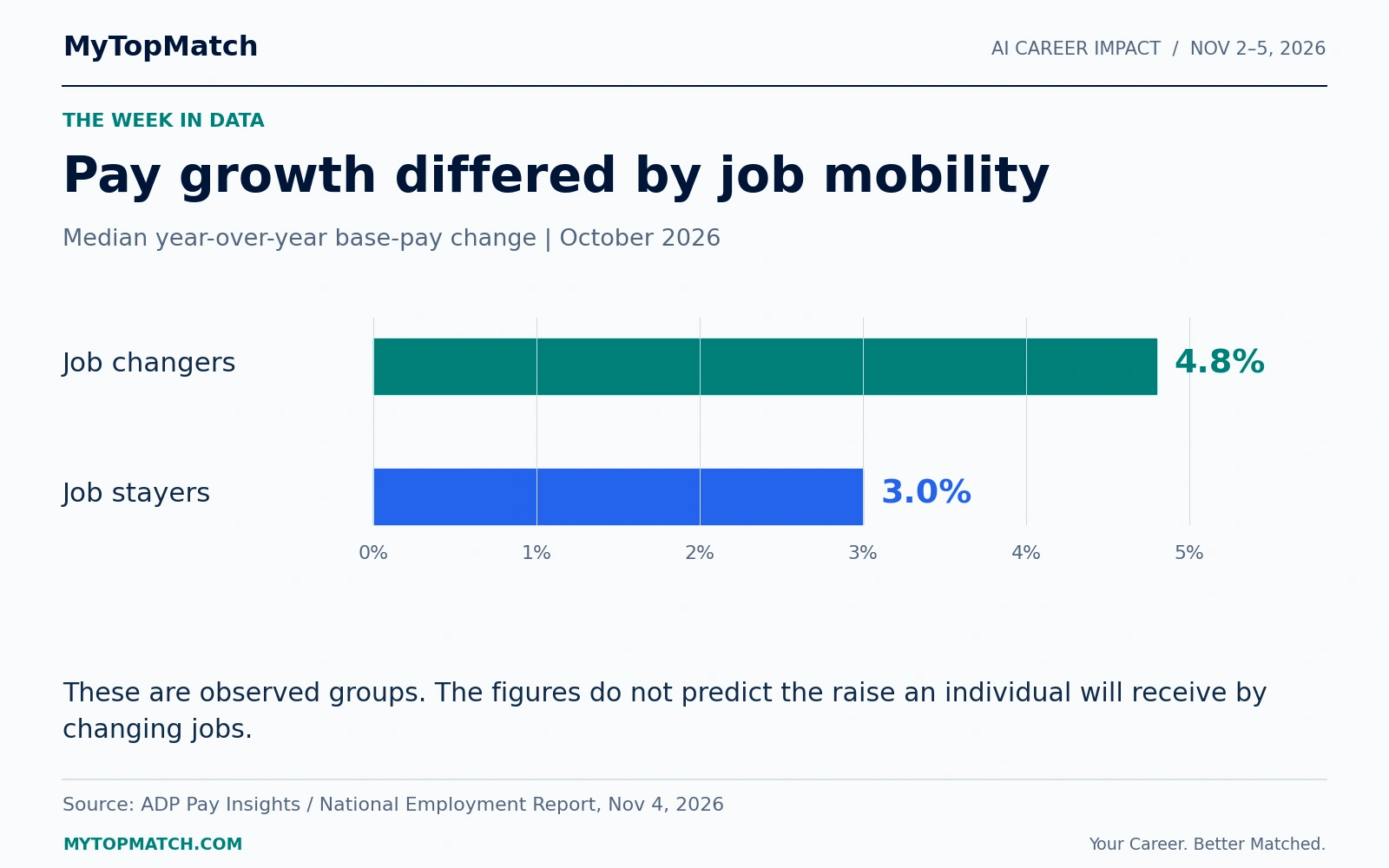
ADP also reported annual median base-pay growth of 4.8% for job changers, compared with 3.0% for job stayers. Those figures describe observed groups, rather than the raise any individual can expect from moving. [14]
For a career decision, examine the actual offer: responsibilities, guaranteed compensation, benefits, hours, location, and prospects. A sector's hiring growth is a starting point for research. Your eligibility and the quality of the specific opportunity still determine whether it is useful to you.
Holiday hiring offers income, but its duration matters
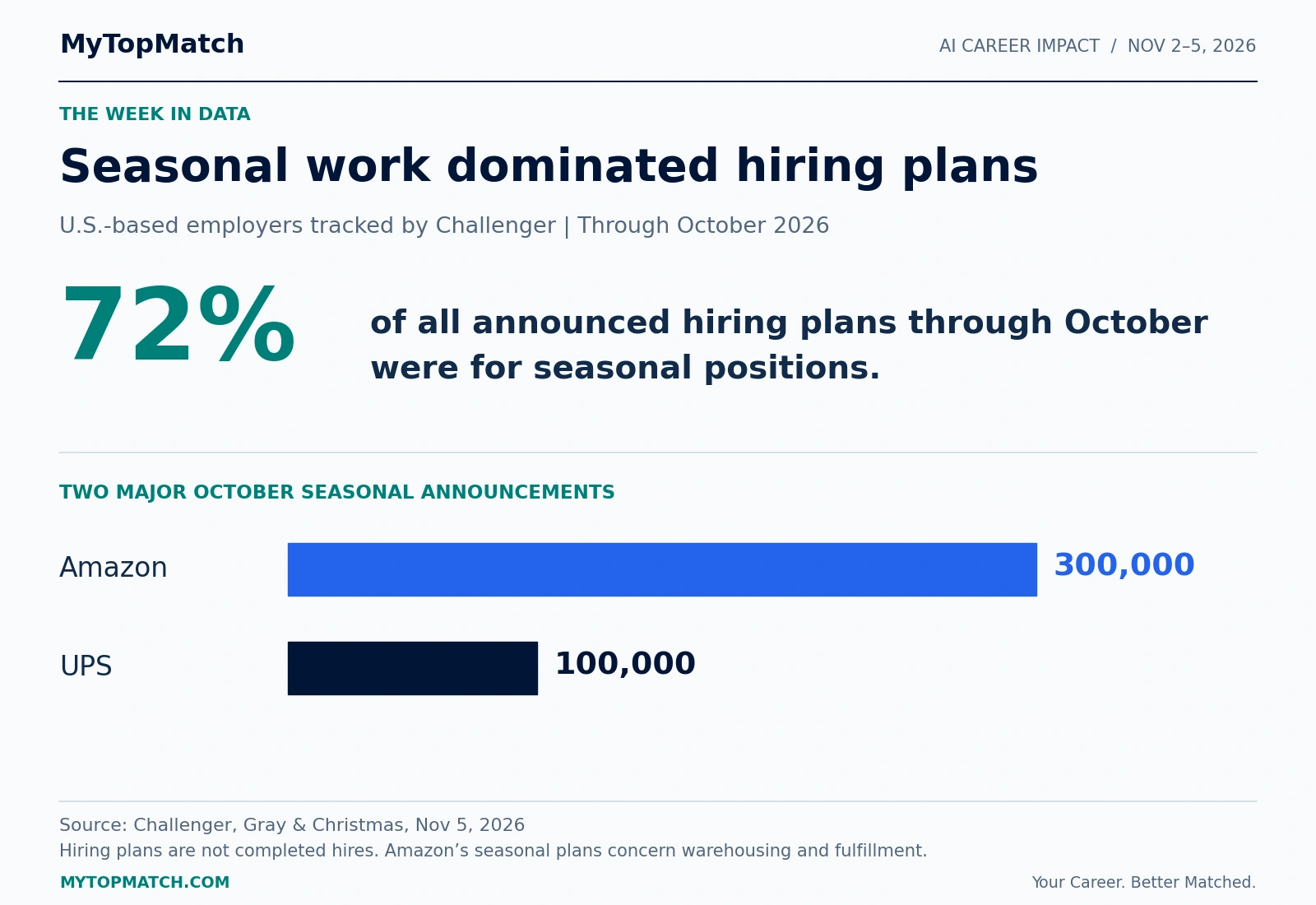
Challenger reported that seasonal positions accounted for 72% of announced hiring plans through October. Amazon's plans for 300,000 seasonal workers and UPS's 100,000 dominate the holiday figures. The report also explains that it classifies Amazon in technology, even though these seasonal jobs are in warehousing and fulfillment. [11]
That classification matters when interpreting a headline about technology hiring. The occupations behind the total determine who can benefit.
Seasonal work can provide income during a longer search. Evaluate the expected end date, schedule, hours, and any stated route into permanent employment. If your objective is a lasting career move, keep building that search while considering temporary work that meets your immediate needs.
The same principle applies to contract assignments. Understand the work, the term, and the conditions before treating the opportunity as a substitute for permanent employment.
Productivity rose while working hours barely increased
One of Thursday's most consequential releases was the preliminary third-quarter productivity report.
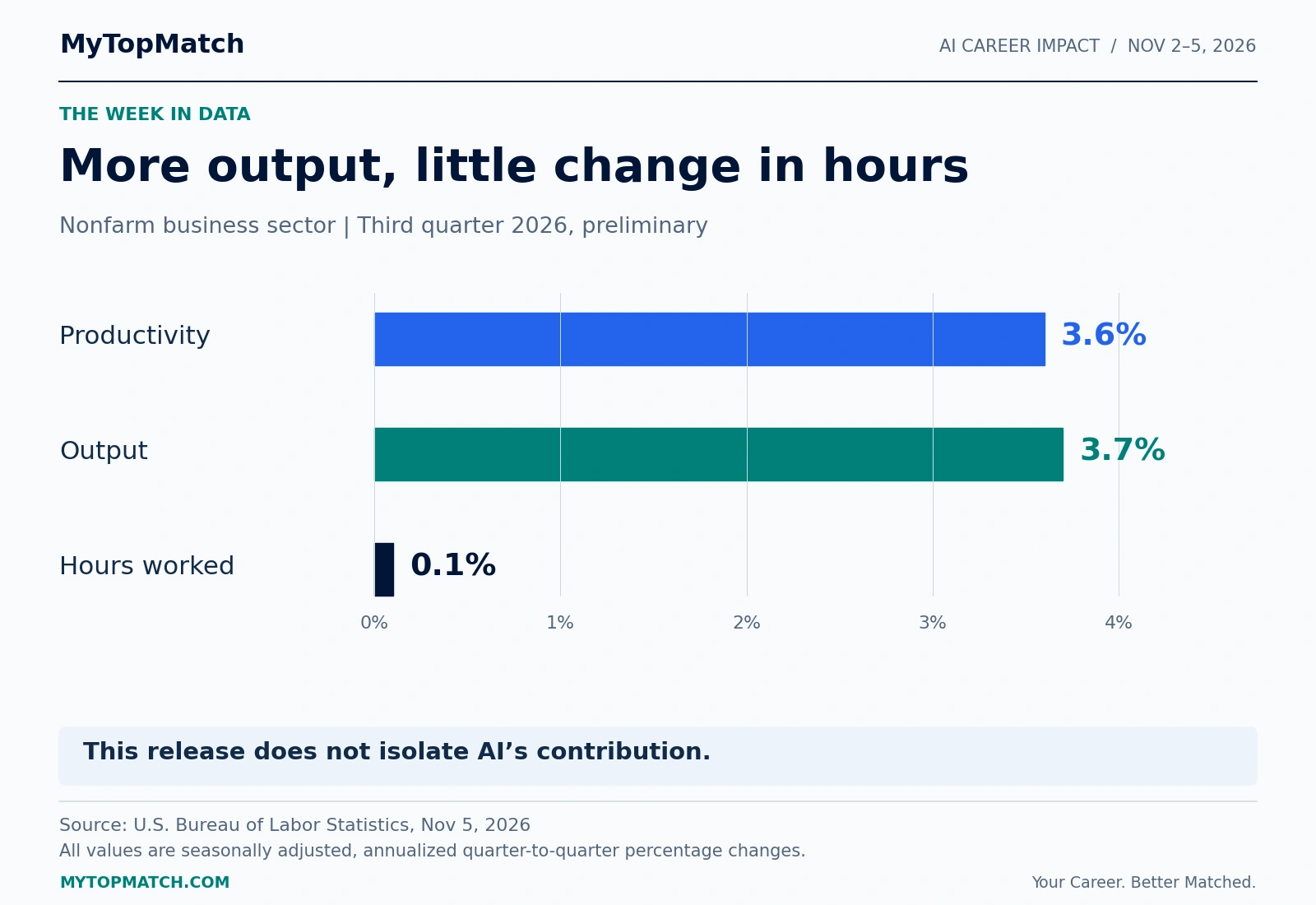
BLS reported that nonfarm business labor productivity increased at a 3.6% annualized rate, with output increasing 3.7% and hours worked increasing 0.1%. All three figures are seasonally adjusted annualized quarter-to-quarter changes. [15]
The report does not isolate how much, if any, of the increase came from AI. It does show that output can expand with very little additional labor time.
For professionals, the relevant question is how to make their contribution visible when an organization is trying to produce more efficiently. Evidence might include a faster process, fewer errors, better customer retention, or a decision that prevented an expensive problem.
Measure the result you actually achieved. Explain your role, the tools involved, and the judgment required. A claim that you “use AI” gives an employer less information than a clear account of what improved and how you checked the quality.
For leaders, productivity also raises a management question: how will gains be used? Clarify whether the objective is more capacity, better service, reduced costs, or a combination, then align responsibilities and evaluation with that objective.
Business costs and demand still influence hiring
AI is one influence on staffing decisions. This week's business surveys also documented the operating pressures employers face.
ISM's November 4 services report showed continued expansion, with a 54.5 Services PMI and a 51.4 employment index. Its prices index remained elevated at 73.0, while respondents described pressure from tariffs, fuel costs, and delivery delays. These are survey index readings, not percentage changes in prices or employment. [16]
Monday's manufacturing report likewise showed expansion, with a 55.5 PMI, while ISM described widespread concern about costs and the operating environment. [17]
Our interpretation: A business can have customer demand and still closely control its expenses. Career research should therefore examine the employer's customers, costs, investment priorities, and recent organizational decisions.
During an interview, ask why the position is open and what it must accomplish during the first six months. Establish whether the company is adding capacity, replacing someone, consolidating responsibilities, or building a new capability.
The answer can help you judge both the opportunity and the expectations attached to it.
AI opportunities remain, with specific requirements
There is also evidence of targeted recruitment.
Microsoft Research's careers pages listed several AI for Science positions dated November 2, including senior research engineering and data-and-cloud engineering roles. Angi's own careers page listed a Staff AI Product Analyst and commercial positions such as Business Development Manager when checked for this article. These are advertised opportunities, not evidence that hiring has been completed. [19][20]
The combination is instructive: an employer announcing cuts can still advertise positions connected to other priorities.
Earlier research helps explain the direction of demand. In an October 27 analysis, LinkedIn reported that the share of job postings requiring AI literacy had risen approximately 65% over the previous 12 months. It identified demand beyond technical occupations, including marketing, design, project management, administration, and writing. This is prior-week context, rather than a new November release. [18]
For job seekers, “learn AI” is too broad to guide a useful decision. Start with the positions you want. Identify the tasks, tools, judgment, and domain knowledge those employers are requesting.
Someone targeting a research engineering role needs a different development plan from someone targeting customer operations. The useful overlap is the ability to apply tools to relevant work and explain the quality of the result.
Review several current employer postings before deciding which skill to develop. Look for requirements that repeat across suitable positions. Then create a small, credible work sample that demonstrates that capability.
A stronger application makes the connection between your existing experience and the employer's present needs easy to see.
Reskilling needs a route into an actual role
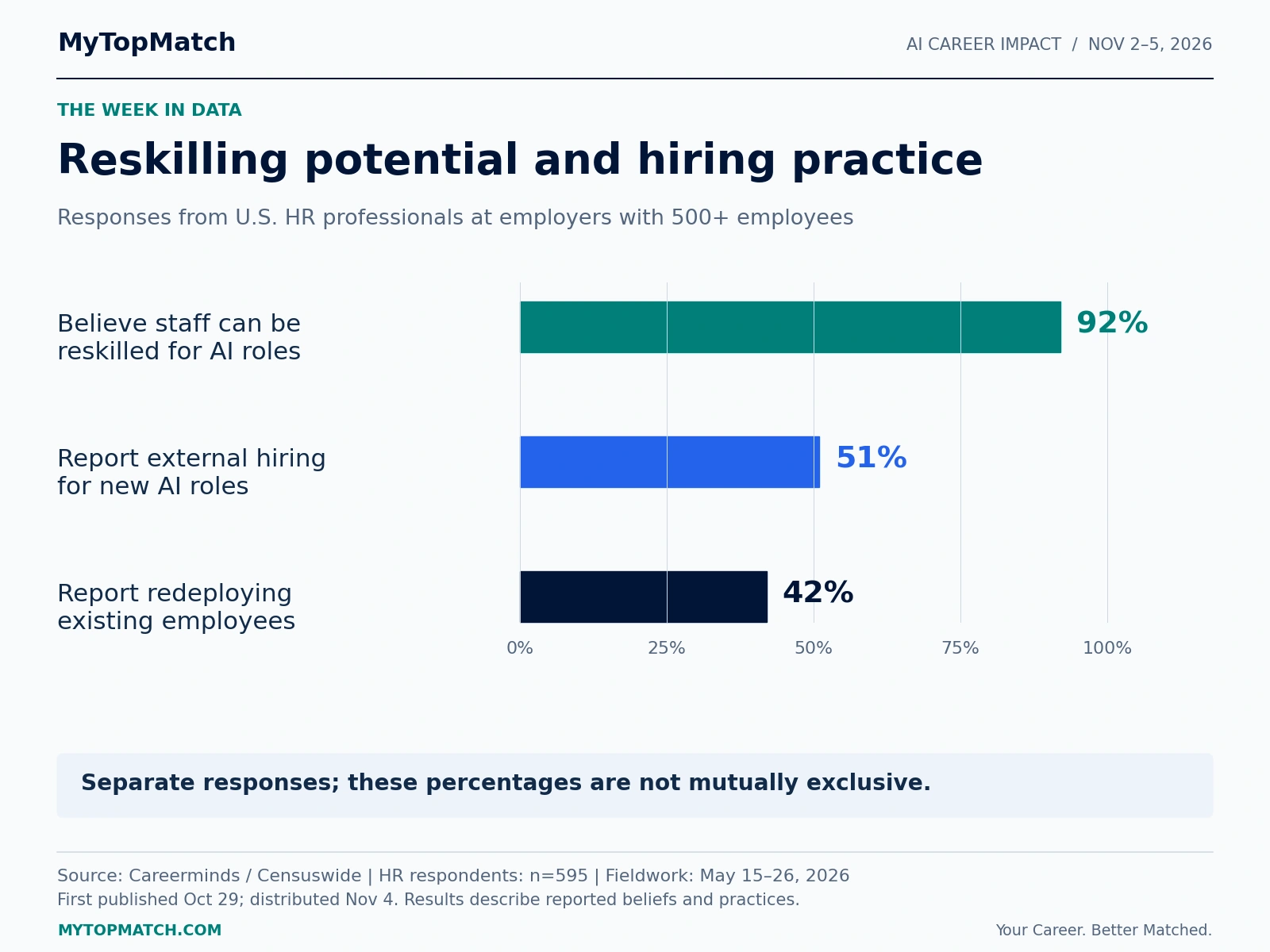
Careerminds distributed research on November 4 that it had first posted on October 29. Its survey covered 1,142 U.S. HR professionals and people managers at employers with at least 500 employees, with fieldwork conducted in May. [21][22]
Among HR respondents, 92% believed existing employees could be reskilled for AI-related roles. Yet 51% reported external hiring for new AI positions, compared with 42% reporting redeployment of existing employees. These are respondents' reports of employer practices, rather than an audit of hiring outcomes. [21]
The gap makes a practical point: confidence in employees' potential does not by itself create an internal opportunity.
If your employer is encouraging AI training, connect the discussion to a named role or responsibility. Ask which capabilities are required, who will evaluate them, what work would demonstrate readiness, and when an internal move could be considered.
For employers, give employees enough information to act. A development program becomes more useful when it identifies the destination, the evaluation criteria, and the person responsible for making the decision.
What professionals should do with this week's information
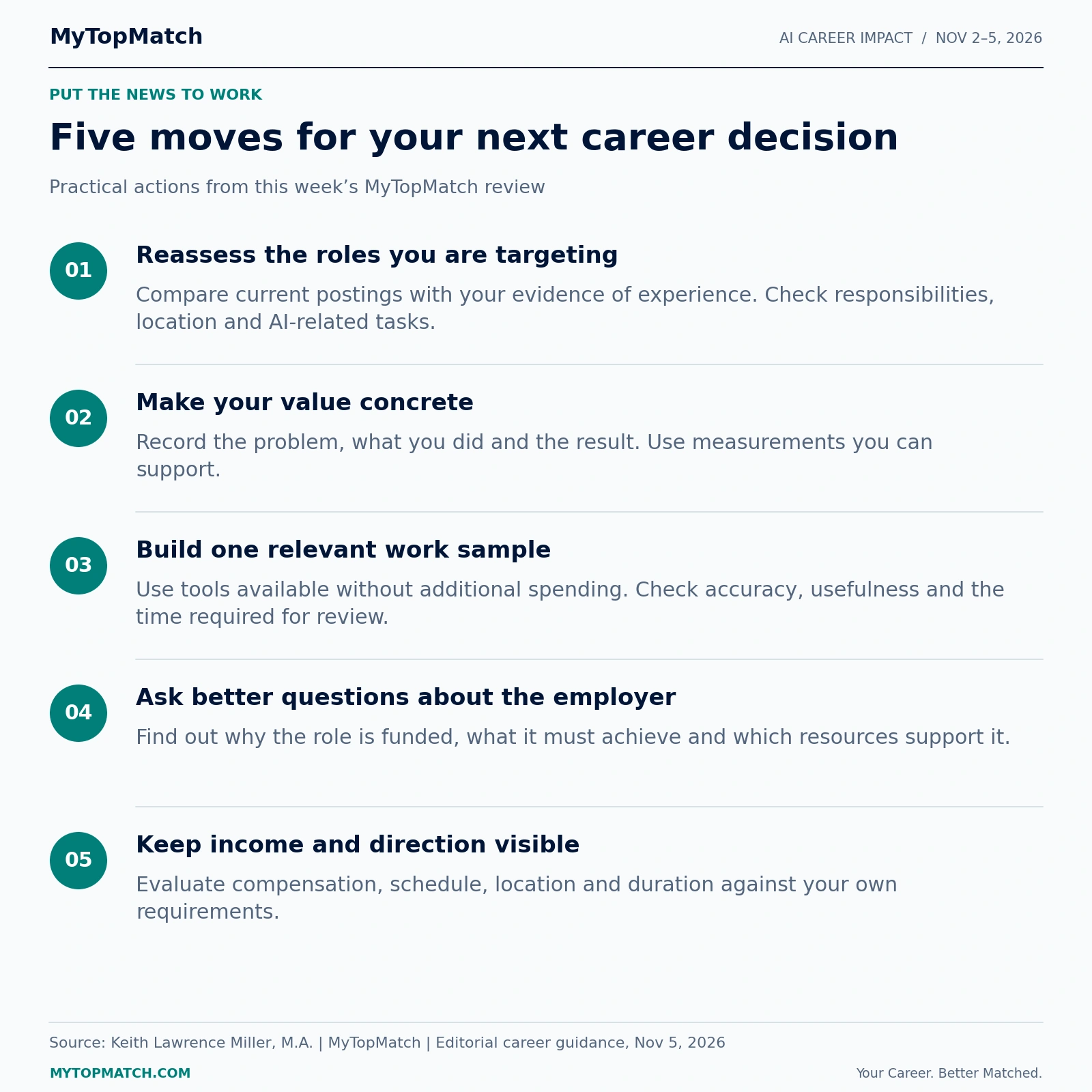
1. Reassess the roles you are targeting
Read current postings from the employers you would consider joining. Compare the work described with your résumé and LinkedIn profile.
Pay attention to broader responsibilities, location requirements, AI-related tasks, and the level of independence expected. Decide where your evidence already fits and where you need to close a specific gap.
If a requirement is unclear, make it an interview question. A title alone will not tell you whether the position fits your experience or priorities.
2. Make your value concrete
Keep a record of achievements you can explain and support. Include the original problem, what you did, and the result.
Use accurate measurements where available. When an outcome cannot be quantified, explain the scope, complexity, stakeholders, or decision involved. Preserve confidentiality and your employer's ownership of materials.
The objective is a professional account of your contribution that remains useful even if your current role changes.
3. Demonstrate relevant AI capability through a small work sample
Choose one task connected to your target work and use tools available to you without additional spending. Define a useful result before starting.
Assess whether the output is accurate, whether it saves time after review and correction, and whether you can explain its limitations. Keep the exercise small enough to evaluate properly.
This gives you something more credible to discuss than a list of software names. It also helps you decide what further learning would actually improve your performance.
4. Ask better questions about the employer
Research recent restructuring, business performance, and the department's purpose. In interviews, establish why the role is being funded and what success will require.
Ask about the team, decision authority, resources, and location expectations. If the position combines responsibilities previously held by several people, understand how the workload and priorities will be managed.
Use the answers to evaluate the opportunity against your own goals, rather than allowing a recognizable employer name to make the decision for you.
5. Keep near-term income and long-term direction visible
Temporary work, a contract, or a permanent move may each serve a different need. Evaluate them accordingly.
Define your compensation requirements, travel and commuting limits, schedule needs, and development priorities. Review opportunities against those requirements before investing substantial time in an application process.
A clearer search gives you a better basis for deciding where to concentrate your effort.
The next report to watch
The federal October Employment Situation report is scheduled for Friday, November 6, at 8:30 a.m. Eastern. It had not been released at this article's research cutoff. [23]
The useful questions will be whether payroll growth is broadening, how unemployment and participation are moving, what is happening to hours and wages, and whether revisions change the picture of recent months.
That release will add evidence. It will not replace the need to understand the particular work you are pursuing.
Job security now requires attention to the organization, the role, and your own evidence of value. Keep that evidence current, understand where your capabilities fit, and make your next move with a clear view of what the employer actually needs.
Build your next move around your experience and priorities. Explore MyTopMatch for free career resources and assessment mini reports, plus information about the Professional Passport and Link AI career assistant. [24]

Sources
- NiCE, November 4, 2026. Third-quarter 2026 earnings and restructuring announcement.
- The Register, November 2, 2026. SUSE to cut one in ten employees because of AI. Reporting based on the CEO's internal memo.
- Investing.com, syndicated by Yahoo Finance, November 2, 2026. Squarespace layoffs fall mostly on product and engineering. Includes the company's response on AI infrastructure.
- Canva, November 3, 2026. An important update on our team. Publication date also listed on Canva's newsroom index.
- Angi, SEC-filed earnings release, November 3, 2026. Angi reports Q3 2026.
- Reuters, November 3, 2026. Fiserv cuts 3,000 employees and contractor jobs under new CEO.
- Schaeffler, November 3, 2026. Further performance improvement program.
- Reuters, November 4, 2026. Google extends voluntary buyout offers to employees in several countries.
- Heidi, November 4, 2026. Changes to our team at Heidi.
- Reuters, syndicated by The Edge Malaysia, November 5, 2026. Woodside Energy flags new dividend payout policy and job cuts.
- Challenger, Gray & Christmas, November 5, 2026. October layoffs at three-year low; seasonal hiring plans up 26%.
- U.S. Department of Labor, November 5, 2026. Unemployment Insurance Weekly Claims. The URL is updated as later reports are issued; the figures here refer to the November 5 release.
- U.S. Bureau of Labor Statistics, November 3, 2026. September 2026 JOLTS.
- ADP, November 4, 2026. October 2026 National Employment Report.
- U.S. Bureau of Labor Statistics, November 5, 2026. Third-quarter 2026 productivity and costs, preliminary.
- Institute for Supply Management, November 4, 2026. October 2026 Services PMI report.
- Institute for Supply Management, November 2, 2026. October manufacturing report roundup.
- LinkedIn, October 27, 2026. Where opportunity is emerging as work changes. Earlier context, clearly dated.
- Microsoft Research, checked November 5, 2026. Open positions. AI for Science listings discussed in the article were dated November 2.
- Angi, checked November 5, 2026. Current job openings.
- Careerminds, October 29, 2026. AI reskilling and redeployment research. Includes survey methodology.
- Careerminds press release through PR Newswire, syndicated by Yahoo Finance, November 4, 2026. Research distribution this week.
- U.S. Bureau of Labor Statistics, checked November 5, 2026. November release calendar.
- MyTopMatch, checked November 5, 2026. Public homepage and service descriptions.