
A company can continue producing software, answering customers, analyzing information, and serving clients with fewer people on the payroll.
For the people whose positions disappear, the consequences are immediate. A salary ends. A job search begins. Experience that once provided security has to compete for a place in an organization that has decided it needs fewer employees.
AI is already part of those decisions.
Block completed a workforce reduction of more than 40% in the second quarter of 2026, after its chief executive connected a substantially smaller organization to the capabilities of AI tools. Atlassian eliminated roles affecting approximately 10% of its workforce while acknowledging that AI changes both the skills it needs and the number of roles required. These are documented company actions. 1 2 3 4
My position is that the displacement of repeatable knowledge work is an opening stage of a larger change. As employers connect individual automated tasks into complete processes, they gain more opportunities to consolidate responsibilities, reduce hiring, and eliminate positions.
That is what I mean by this is just the beginning. It is my argument about where these incentives and capabilities can lead. The evidence already shows workforce reductions; the scale and pace of what follows remain uncertain.
For professionals, the consequential question is how much of the work supporting their employment can be performed without the same number of people—and what they can do while they still have choices.
AI-related job elimination is already happening
The strongest evidence comes from what organizations have done and what they disclose about those decisions.
Block: a completed reduction of more than 40%
In its February 2026 shareholder letter, Block announced that more than 4,000 people would leave or enter consultation as it moved toward a much smaller organization. Management said AI tools were allowing smaller teams to do more. Its subsequent quarterly filing confirmed that the workforce reduction exceeded 40% and that the plan concluded during the second quarter. 1 2
The company also identified prioritization, performance management, and centralization as parts of its operating approach. The accurate conclusion is that Block implemented an AI-linked workforce restructuring; the filing does not establish a separate automated replacement for every departing employee. 2
For a worker affected by that decision, however, the job loss is concrete.
Atlassian: fewer roles in an organization adapting to AI
Atlassian announced a reduction of approximately 1,600 employees, or 10%, in March 2026. Its chief executive connected the decision to changes in required skills and role counts, investment in AI and enterprise sales, and organizational efficiency. The company’s annual filing subsequently reported that the role eliminations affected approximately 10% of its workforce and that execution was substantially completed by June 30. 3 4
The employment consequence matters alongside the company’s explanation of its strategy. An organization can be investing in its future while removing positions that people built their lives around.
Klarna: fewer employees through an AI and efficiency strategy
Klarna reported approximately 4,352 full-time employees at the end of 2023, 3,422 at the end of 2024, and 2,831 at the end of 2025. That is a decline of 1,521 employees, or about 35%. Its annual report connects the reduction to its AI and efficiency strategy and describes normal employee attrition. 5
This is a net headcount decline, not a count of 1,521 layoffs. It demonstrates another way opportunities disappear: employees leave and the organization operates with fewer replacements.
The effect reaches the next applicant as well as the current employee. A position that is never refilled provides no opportunity for the person who would otherwise have been hired.
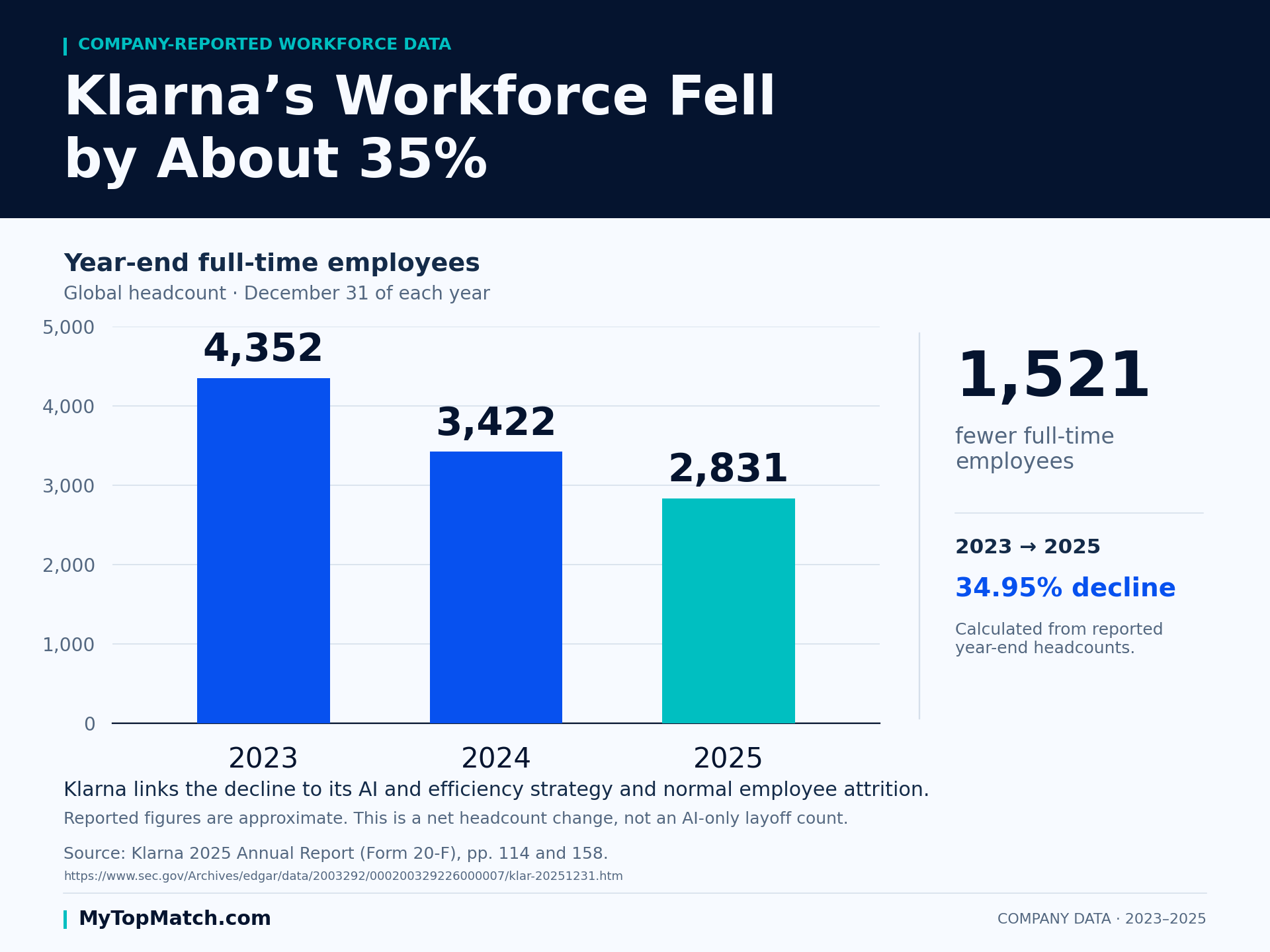
Chart data
| Year-end | Full-time employees |
|---|---|
| 2023 | 4,352 |
| 2024 | 3,422 |
| 2025 | 2,831 |
The scale of AI-cited job cuts is increasing
Challenger, Gray & Christmas recorded 17,375 U.S. announced job cuts citing AI during January–September 2025, compared with 120,136 during the same nine months of 2026. The latter is approximately 6.9 times the former. AI accounted for about 21% of all announced cuts in the 2026 period. 6 7
These are employer-attributed announcements. They are not a count of completed separations independently proven to have been caused solely by AI. They nevertheless show that AI is becoming a much more prominent stated reason for removing positions.
The context sharpens the point: total announced cuts were lower in the first nine months of 2026 than in the same period of 2025, even as the AI-cited count rose substantially. 7
The concern cannot be reduced to every employer cutting back for the same reason. The composition of workforce decisions is changing.
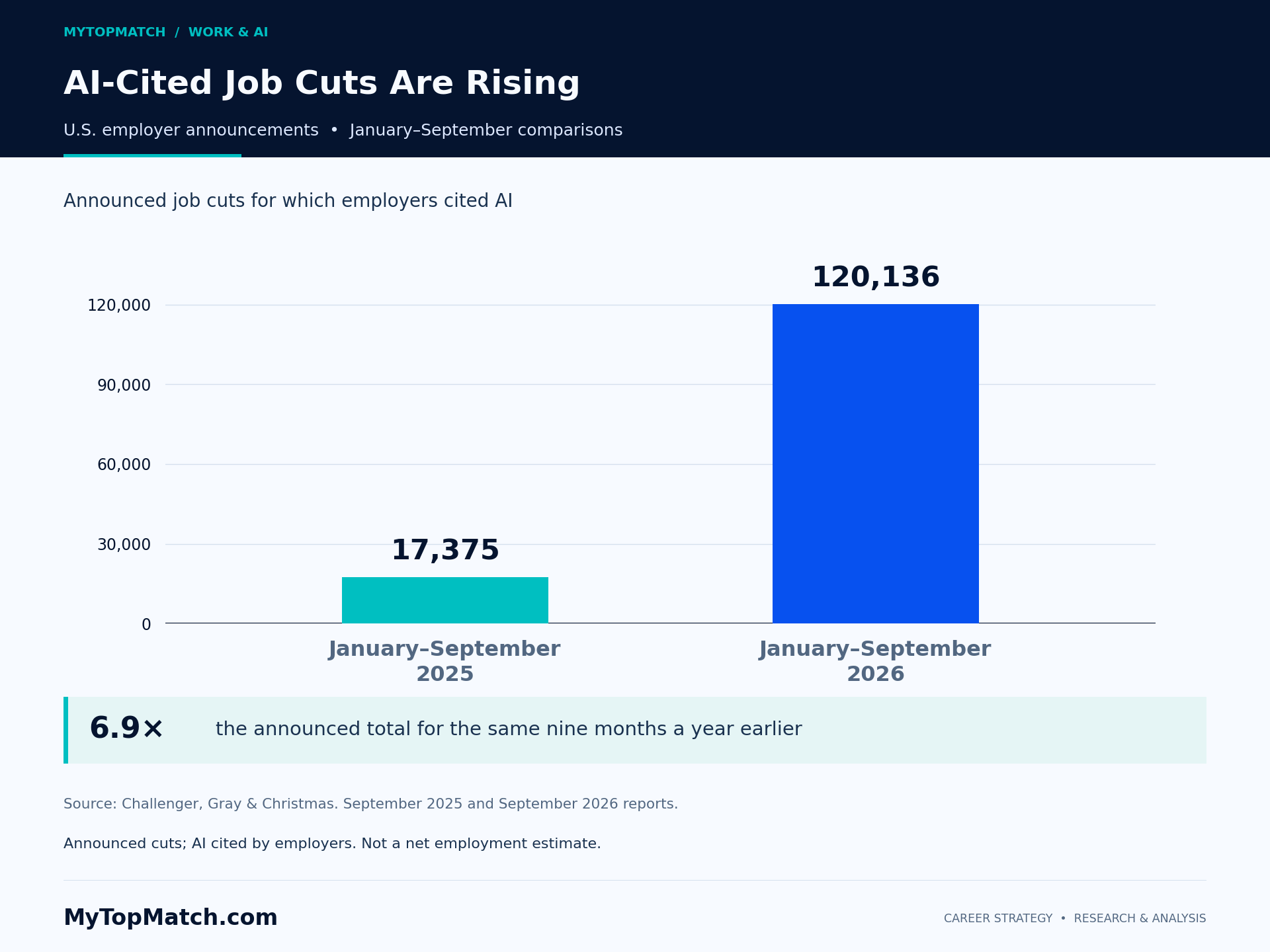
Chart data
| Period | AI-cited announced U.S. job cuts |
|---|---|
| January–September 2025 | 17,375 |
| January–September 2026 | 120,136 |
Repetitive knowledge work is still repetitive work
When people hear “repetitive work,” they may picture an assembly line or a person entering the same information into a database. Repetition also exists inside professional work.
Consider recurring research summaries, standard customer responses, document preparation, routine comparisons, template-based analysis, and repeated steps in producing or checking code. These activities may require education and experience. They can also contain patterns, instructions, and outputs that are amenable to automation.
A professional title does not describe how much of the working week follows a repeatable process.
Microsoft’s occupational research helps identify where AI assistance overlaps with work activities. Its revised dataset includes translators, writers, service sales representatives, customer service representatives, data scientists, financial advisors, web developers, and numerous other occupations. 8 9
The distinction is important: repetitive does not mean worthless, unskilled, or unimportant. It means that parts of the work may be specified, repeated, and evaluated consistently enough for an organization to consider automating them.
A task can remain essential to the business after the business reduces the number of people employed to perform it.
How task automation becomes job elimination
The transition can begin with a single activity.
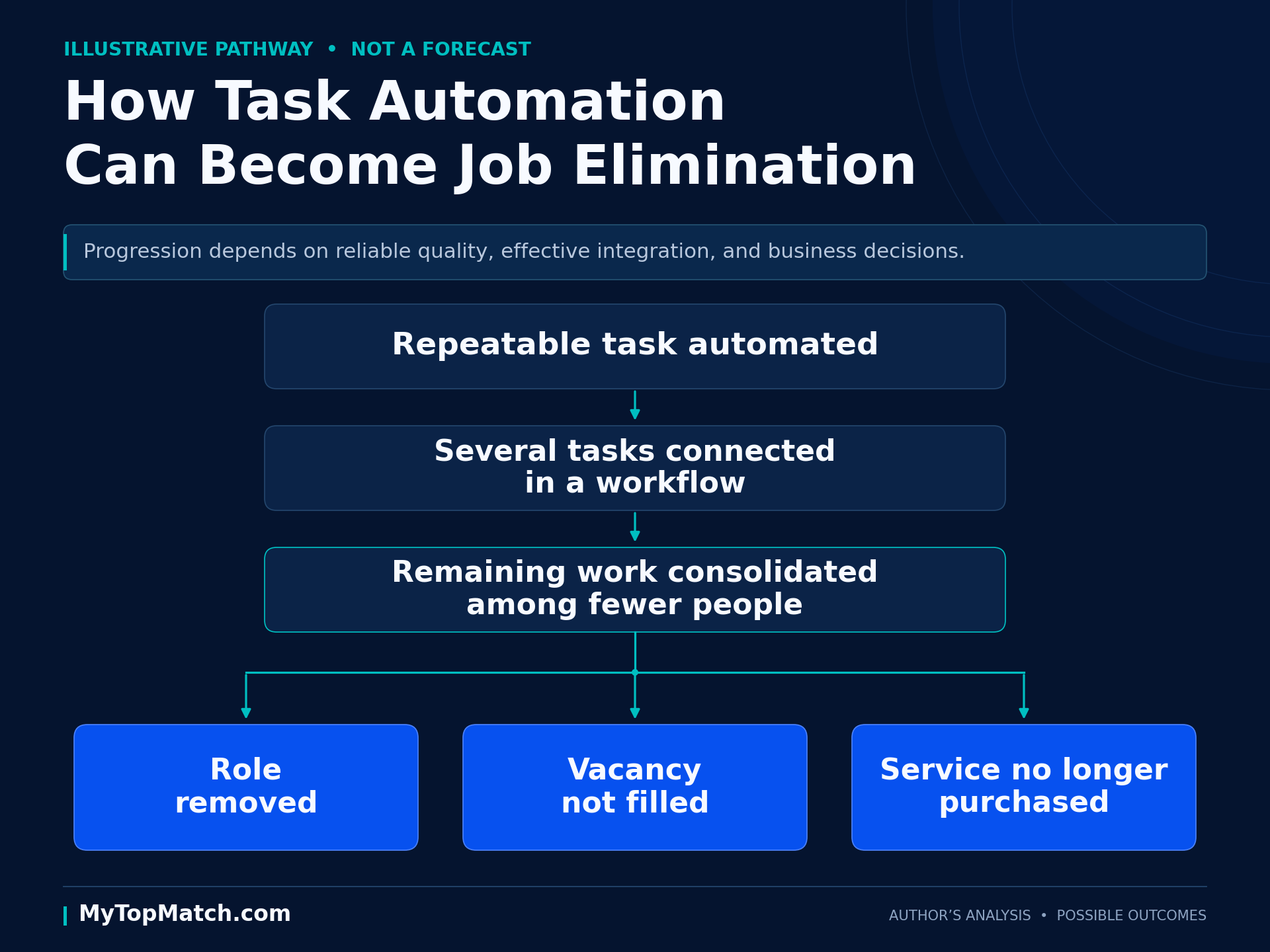
A system drafts a response. Another step retrieves the relevant information. A further step checks required fields, updates a record, and routes exceptions to a person.
If those steps become reliable enough to operate together, the employer is evaluating more than the speed of a draft. It is evaluating how many people are still needed across the process.
The remaining work might be consolidated among a smaller team. A vacancy might remain unfilled. A contractor’s assignment might end. A service previously purchased from an outside provider might be handled internally.
This is an illustrative pathway, not a sequence every organization will follow. Quality, integration, customer demand, and business decisions determine whether it happens. But the economic possibility is clear: automating a sufficient portion of the work can remove the justification for a separate position even while some human responsibilities remain.
Displacement can also come from changes in what customers buy. In October 2025, Chegg linked falling traffic and revenue to AI and reduced Google referrals, announced a restructuring affecting 388 roles, and described a move to automatically answer new Chegg Study questions. That announcement combined pressure on a knowledge-based business with a change in how its service would be delivered. The 388 figure is an announced reduction, not a verified completed-departure count. 10
A professional’s exposure therefore includes both how the work is produced and whether buyers continue purchasing the service in its existing form.
Why I believe repetitive tasks are only the beginning
My concern is that treating today’s visible task automation as the outer boundary of the problem understates what employers are trying to achieve.
Once one task can be automated, there is an incentive to connect it to the next task, reduce the handoffs, and shrink the amount of labor required for the complete result. That incentive does not stop because the remaining work carries a professional title.
Research on AI agents provides evidence of movement into longer technical tasks. METR evaluates performance on software engineering, machine learning, and cybersecurity tasks using their difficulty expressed in human-expert completion time. Its work tracks agents’ ability to complete increasingly lengthy tasks at specified success probabilities. These are controlled capability evaluations, not measurements of entire jobs or future layoffs. 11
The relevance to employment is my analysis: as more connected work becomes dependable and economical, employers have more options to redesign how that work is staffed.
Progress will be uneven. Some uses will fail. Some will require more review than expected. Other processes will be sufficiently reliable to change the number and type of employees an organization needs.
The fact that a system cannot perform every responsibility of a particular professional does not establish that the current staffing arrangement will survive.
That is why I would not advise someone to base a long-term career plan on the limitations of one tool observed today.
The first lost opportunity may be the job you never get
A reduction in hiring can be less visible than a layoff announcement. It can still alter a person’s future.
The August 2026 revision of Stanford’s Canaries in the Coal Mine? study examined workers aged 22–25 in an ADP employment sample. Between November 2022 and June 2026, employment in the two most AI-exposed occupational groups fell about 11%, while employment in the three less-exposed groups rose about 10%. The authors identify reduced hiring as a central part of the pattern. 12
These are descriptive findings; the study does not isolate AI as the cause of the entire difference or establish economy-wide job displacement. The results do show a meaningful contraction for a particular group of young workers in exposed occupations. 12
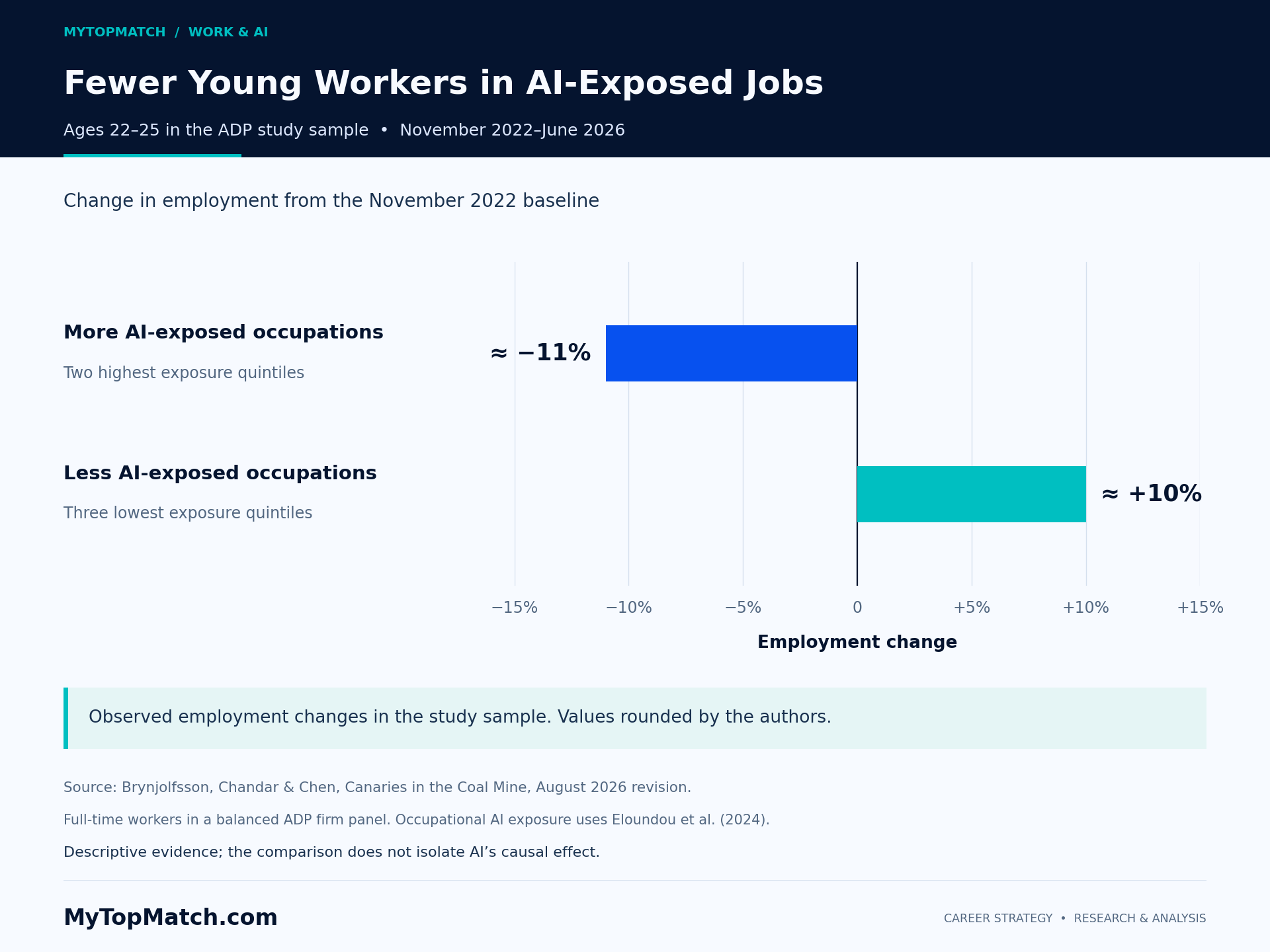
Chart data
| Occupational exposure group | Employment change |
|---|---|
| Two highest AI-exposure quintiles (Q4–Q5) | −11% (approximately) |
| Three lowest AI-exposure quintiles (Q1–Q3) | +10% (approximately) |
For someone completing a degree or entering a new field, a missing opening has practical consequences. It can delay income, postpone experience, and force a search across roles or industries that were not part of the original plan.
There is also a development problem for employers. Routine research, drafting, and checking can give junior employees practice in recognizing patterns, finding errors, and understanding how detailed work supports decisions.
If organizations remove that work, they need to decide how people will acquire the experience they continue to demand. Supervised projects, review discussions, and exposure to substantive decisions become more important.
For early-career professionals, a useful portfolio should show the question, the information examined, the decisions made, and the limitations of the result. A polished output alone may tell an employer too little about what the person can actually do.
Which occupations deserve closer examination?
The Microsoft research behind the original viral graphic measures AI applicability. It does not supply a probability that a worker will lose a job.
Its revised results draw on consumer Bing Copilot conversations collected during January–September 2024. The paper’s October 2026 revision date should not be confused with new conversation data. 8
Here are selected occupations from the dataset:
| Occupation | AI applicability score |
|---|---|
| Interpreters and translators | 0.492 |
| Writers and authors | 0.454 |
| Sales representatives of services | 0.449 |
| Customer service representatives | 0.408 |
| Data scientists | 0.357 |
| Personal financial advisors | 0.355 |
| Web developers | 0.353 |
| Market research analysts and marketing specialists | 0.350 |
| Computer user support specialists | 0.334 |
| Software quality assurance analysts and testers | 0.328 |
| Software developers | 0.278 |
| Accountants and auditors | 0.195 |
These are selected occupations, not a complete ranking. The score range is 0–1. A score of 0.492 is not a 49.2% probability of replacement or a measured share of working time that can be removed. The accompanying full chart includes 21 selected occupations. 8 9
The useful response is to inspect the activities inside a role: what is repeatable, what can be specified, what requires context, and what an employer is already changing.
A job title alone is an inadequate basis for deciding where to invest years of education or professional development.
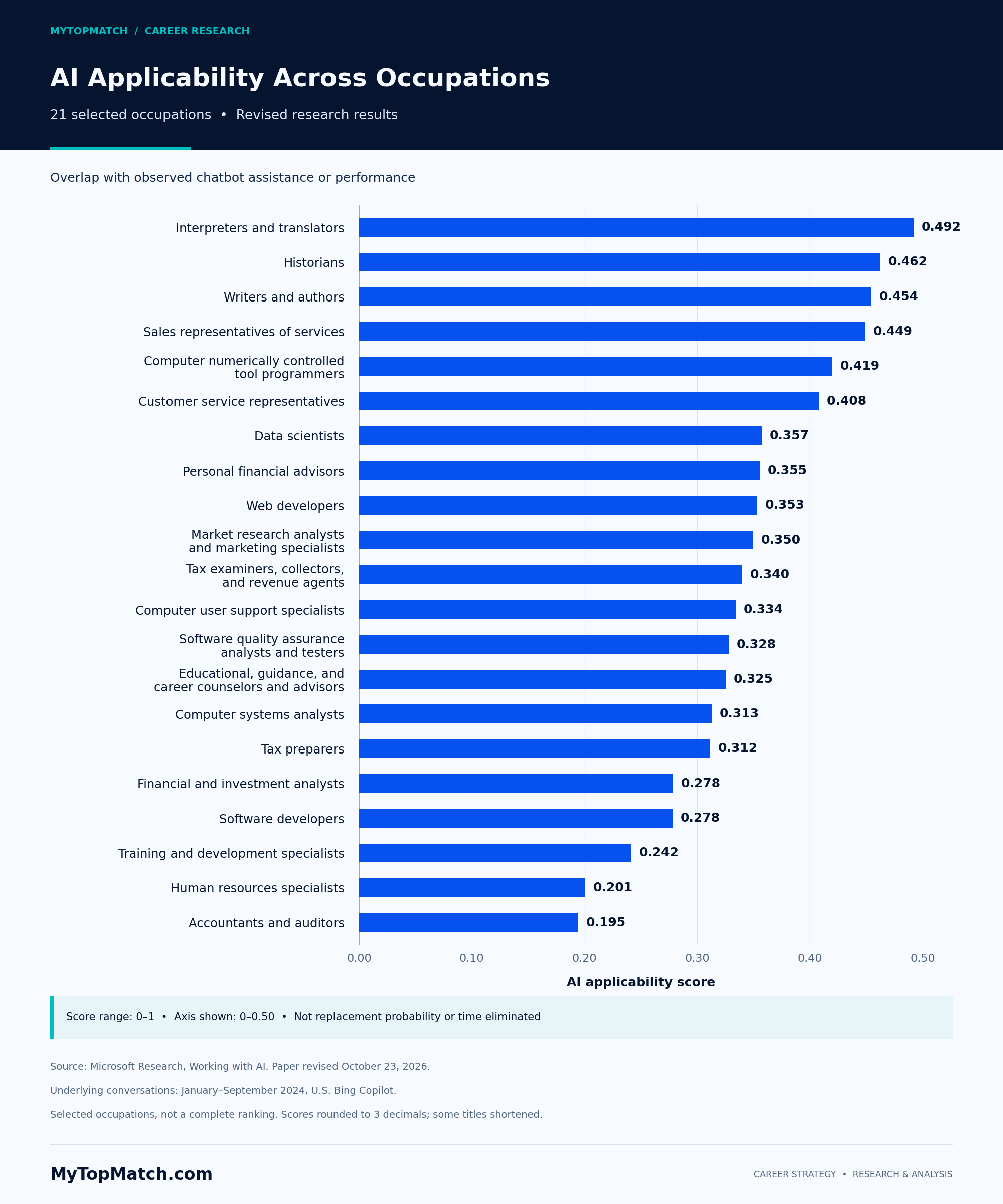
Chart data
| Occupation | AI applicability score |
|---|---|
| Interpreters and Translators | 0.492 |
| Historians | 0.462 |
| Writers and Authors | 0.454 |
| Sales Representatives of Services, Except Advertising, Insurance, Financial Services, and Travel | 0.449 |
| Computer Numerically Controlled Tool Programmers | 0.419 |
| Customer Service Representatives | 0.408 |
| Data Scientists | 0.357 |
| Personal Financial Advisors | 0.355 |
| Web Developers | 0.353 |
| Market Research Analysts and Marketing Specialists | 0.350 |
| Tax Examiners and Collectors, and Revenue Agents | 0.340 |
| Computer User Support Specialists | 0.334 |
| Software Quality Assurance Analysts and Testers | 0.328 |
| Educational, Guidance, and Career Counselors and Advisors | 0.325 |
| Computer Systems Analysts | 0.313 |
| Tax Preparers | 0.312 |
| Financial and Investment Analysts | 0.278 |
| Software Developers | 0.278 |
| Training and Development Specialists | 0.242 |
| Human Resources Specialists | 0.201 |
| Accountants and Auditors | 0.195 |
Keeping your job can still mean losing ground
Job elimination is the central concern. The effects also reach people who remain employed.
When an organization believes fewer people can produce the required output, it may increase assignments, change hiring requirements, or reconsider the price of a service. A professional can remain employed while facing a narrower path to promotion, a more demanding workload, or weaker negotiating options.
The distribution of gains matters. Greater efficiency could support lower prices, increased margins, improved employee compensation, or additional business growth. Employees should not assume their own compensation will rise automatically.
This is why bargaining power belongs inside the discussion. It is one consequence of changing demand for human work.
A person needs to understand which contributions the organization still needs, whether those contributions are recognized, and what alternatives are available elsewhere.
Remaining busy is not the same as maintaining a strong position in the labor market.
Expertise must change the outcome
For experienced professionals, the response should be concrete.
Show the problem you recognized. Explain the decision you made. Establish what changed because of your contribution.
In my field, a résumé illustrates the issue clearly. A finished document contains decisions about target positions, the relevance of past experience, the evidence supporting achievements, and the accuracy of the candidate’s representation.
A polished sentence can overstate responsibility. An accurate achievement can be irrelevant to the role being pursued. A document can sound impressive while leaving an employer unsure why the candidate is qualified.
My standard is whether the person is represented accurately and positioned credibly for the opportunity they want. Technology should be evaluated against that standard.
Recruiting requires similar discipline: assessing a candidate against actual requirements, testing assumptions in conversation, and communicating the opportunity accurately. Career guidance must account for compensation needs, experience, location, family commitments, and willingness to retrain.
These responsibilities deserve to be demonstrated through the work. Simply naming experience, judgment, or human connection does not explain what the client receives.
Nor should professionals assume that describing work as complex makes it immune to automation. They should be able to show the decisions they own, the conditions they understand, and the results they can substantiate.
A practical career response
The aim is to act while you still have options.
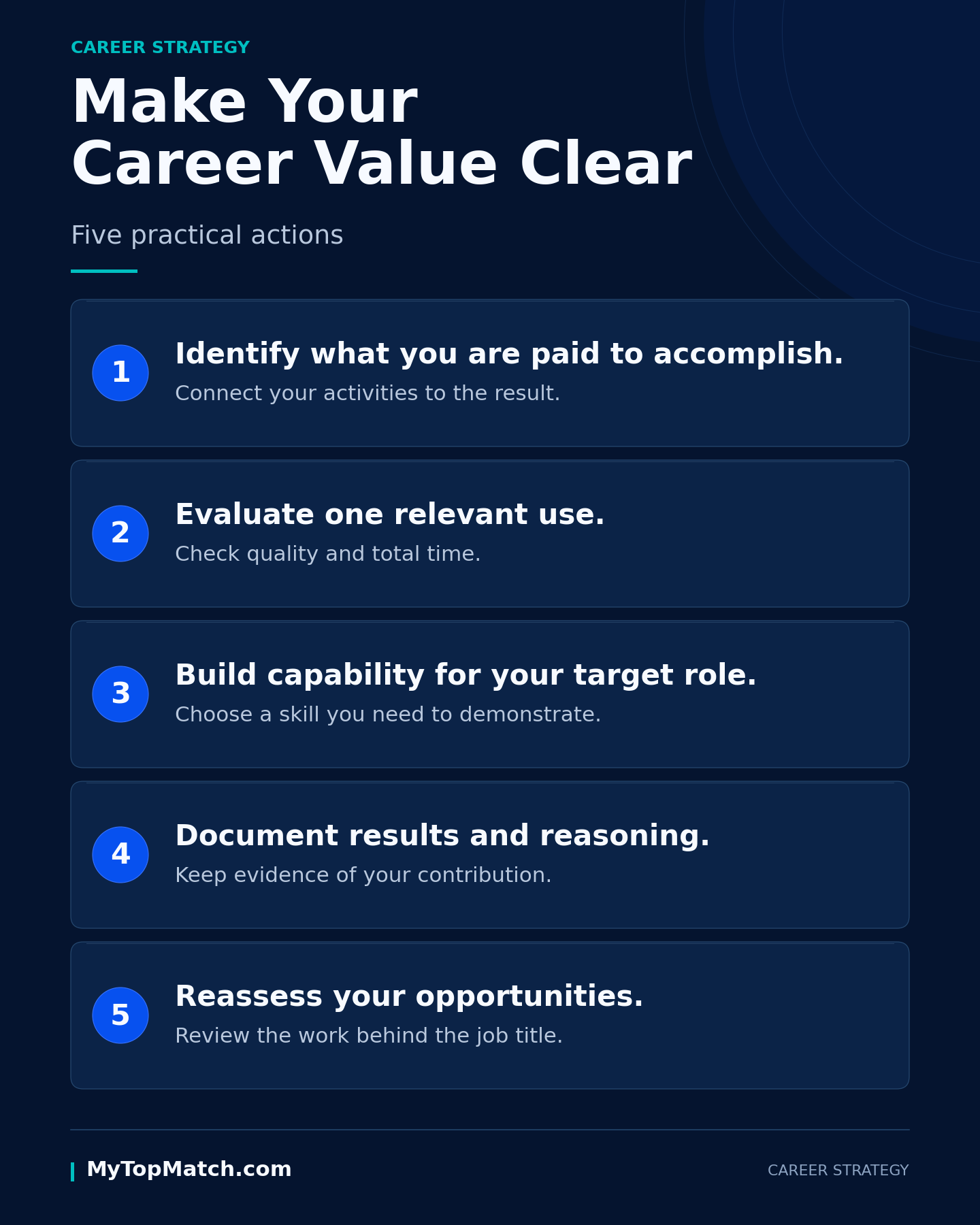
1. Identify what you are actually paid to accomplish
Review a representative week. List your activities, deliverables, decisions, and the business result each supports.
A report may support a budget decision. A customer conversation may resolve a problem and preserve a relationship. A hiring process may help a team acquire a capability it lacks.
Then examine which parts are repeatable and which parts depend on information, responsibility, or judgment you can demonstrate. This gives you a concrete basis for deciding what to strengthen.
2. Evaluate one relevant use before making large commitments
Choose a recurring task with a clear quality standard. Where an appropriate approved free option is available, use a small comparison before committing money or making the process dependent on it.
Define success beforehand. The result must meet the required standard, material errors must be resolved, and total time must include review and correction.
This helps you understand what the technology can actually take over in your work. If the comparison fails, identify why before expanding its use.
3. Build capability for the roles you intend to pursue
Read actual job requirements. Identify the capability you cannot yet demonstrate convincingly.
It may involve financial analysis, process design, industry knowledge, stakeholder management, or a relevant technology. Choose a project or learning experience that produces evidence of improvement.
A course label or a general claim that you “use AI” provides little information about whether you can do the work. Show the problem, the method, the review, and the result.
4. Document results and reasoning
Keep a record of the original problem, your actions, the checks you performed, and the outcome.
Use numbers when they were measured. Describe qualitative benefits accurately. Explain your own contribution to team results.
This record supports stronger résumé content, substantive interview answers, and clearer performance discussions. It also helps you distinguish between being involved in a process and making a contribution that matters to the result.
5. Reassess your opportunities before you need an urgent exit
Review changing responsibilities, experience requirements, and the availability of relevant roles. Speak with people doing the work and test your assumptions against credible information.
A familiar title can conceal changed expectations. A different title may describe work you are already qualified to perform.
If a transition is necessary, make it purposeful. Understand the requirements, the likely cost of preparation, and the opportunities your existing experience can realistically support.
Employers should measure the complete result
A staffing decision should follow dependable performance.
A faster first draft is only part of a process. Reviewing material, correcting errors, integrating the result, and dealing with downstream consequences also require resources.
If those costs erase the apparent saving, the initial demonstration has not established the expected business benefit. If the process does work reliably, management should account for the human consequences of changing how it is staffed.
Employees also need a reason to report failures honestly. Treating every concern as resistance makes it harder to discover weaknesses before customers, operations, or remaining employees absorb the cost.
Responsible evaluation and a serious view of job displacement belong together.
The employment relationship is being rewritten
AI is already involved in decisions that remove positions, reduce headcount, and change the work employers expect a smaller team to perform.
My concern is that repetitive task automation can develop into broader changes in how organizations produce and purchase knowledge work. The next stage may reach responsibilities that currently appear too specialized or connected to be consolidated.
That is a reason to pay attention now.
The career you built deserves a strategy based on what is happening to the work itself. Understand what can be automated, what your employer or clients still need, and what you can demonstrate that makes a meaningful difference.
The work can continue while the position disappears. Prepare for that possibility before someone else makes the decision for you.
For support with your career positioning and next steps, visit MyTopMatch.com.