
Where hiring is growing and what candidates need to show
November 16–20, 2026
By Keith Lawrence Miller | Founder, MyTopMatch
A job search becomes difficult to interpret when national headlines and personal experience seem to describe different economies. A professional can read about business expansion in the morning and receive a rejection from a shrinking department that afternoon. Both developments can be real.
The career news released this week offers a more useful way to assess opportunity. Labor-market data showed relatively little change in new unemployment claims. Employer announcements identified specific places where work is expanding or being reorganized. New research showed how much hiring demand varies by location and experience level. [1] [3] [4] [7] [10]
For people considering their next move, the practical task is to get closer to the work itself: which employers have a reason to hire, what they need someone to accomplish, and whether the position supports the career and life the candidate wants to build.
National figures need local context
The Labor Department's November 19 release reported 203,000 initial unemployment claims for the week ending November 14, up 1,000 from the previous week's revised figure. The four-week average was 197,750. Continuing claims increased by 70,000 to 1.763 million for the week ending November 7. These are seasonally adjusted figures, and the two measures cover different weeks. [1]
The small change in new claims does not establish how readily a particular applicant can find work. Claims describe applications for unemployment benefits; they do not count vacancies or measure an individual's prospects. A single week's increase in continuing claims also provides too little evidence to declare a new trend.
Friday's state employment report added geographic detail. BLS found statistically significant October payroll increases in California, Indiana, Kansas, and Iowa. Employment was essentially unchanged in the other 46 states and Washington, D.C. California's estimated gain was 47,100 jobs. Those findings describe October employment, although the report was released November 20. [2]
State totals combine the results of expanding and contracting employers. Small estimated changes may also fall within statistical uncertainty.
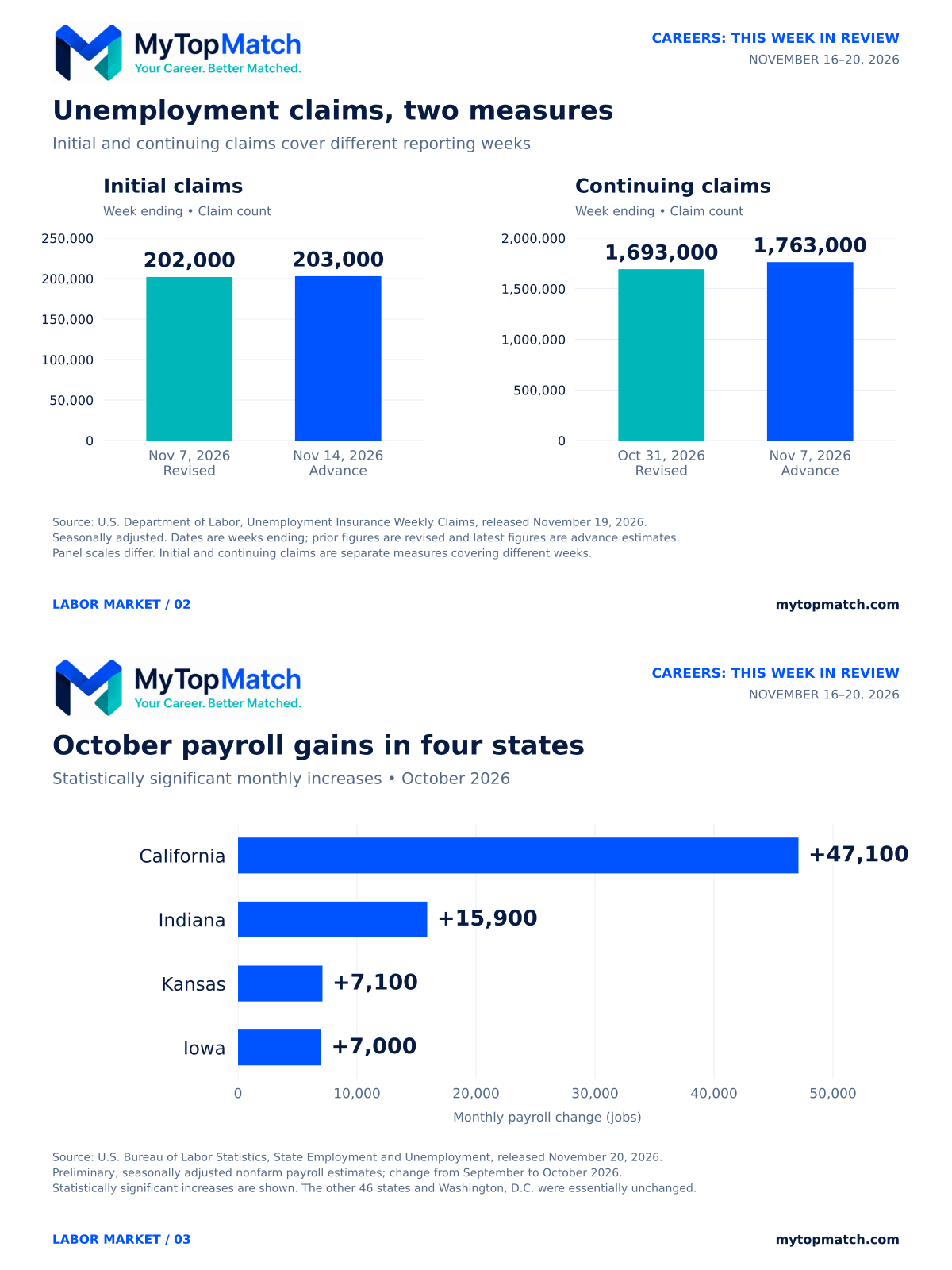
Initial and continuing claims describe different reporting weeks. The two panels use separate zero-based scales. Source: U.S. Department of Labor (https://www.dol.gov/ui/data.pdf).
These are the states with statistically significant monthly payroll increases, not a ranking of the four largest estimates. Source: U.S. Bureau of Labor Statistics (https://www.bls.gov/news.release/laus.nr0.htm).
Indeed and Glassdoor's November 18 research showed another layer of variation. As of September 30, Indeed job postings exceeded their February 2020 baseline in 299 of 385 metropolitan and micropolitan areas analyzed. The share of areas with year-over-year posting growth had risen from roughly one in ten at the beginning of 2026 to 49% by September. [3]
Yet the levels differed considerably. Dallas, Austin, and Houston were approximately 12%–15% above their pre-pandemic baselines, while Seattle and San Francisco were roughly 30% below. These are measures of postings on Indeed, rather than completed hiring, and the analysis covers areas with at least 100,000 residents. [3]
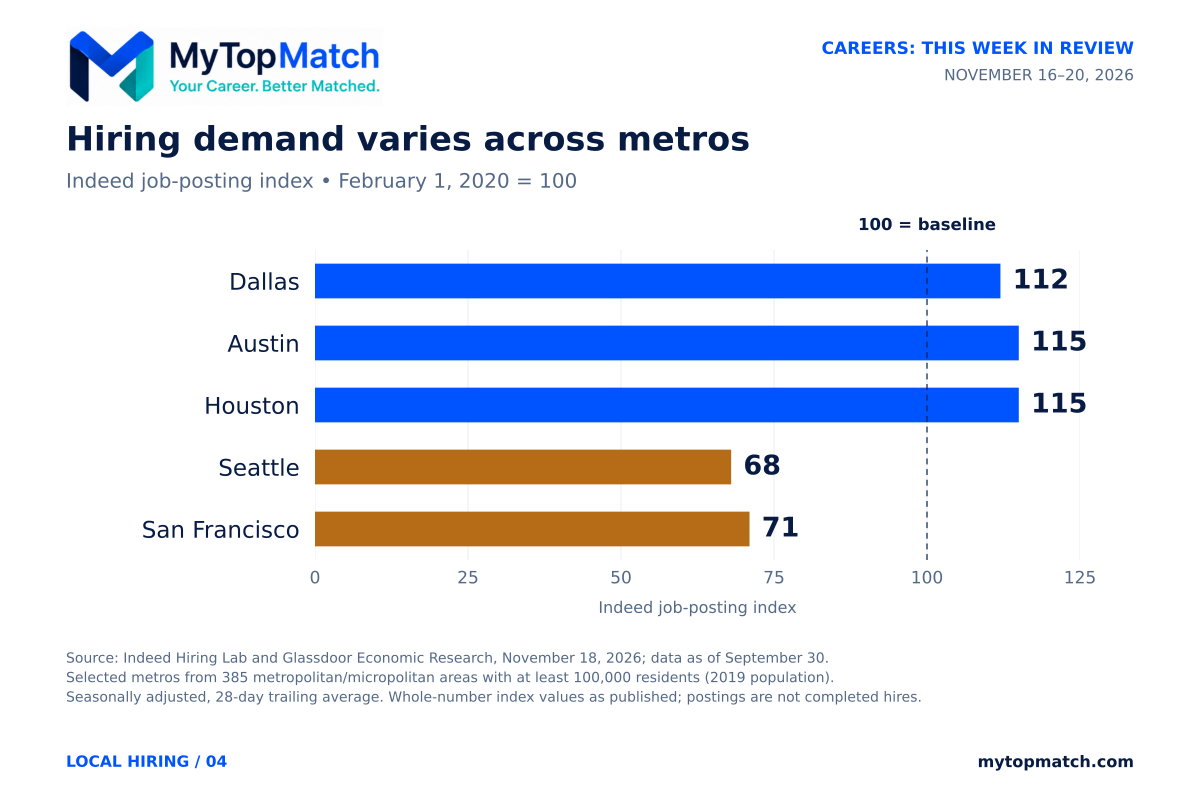
Selected metros sit on different sides of the February 2020 posting baseline. The index measures postings on Indeed, not completed hiring. Source: Indeed Hiring Lab and Glassdoor Economic Research (https://hiringlab.indeed.com/2026/11/18/a-national-market-shaped-by-local-dynamics/).
For job seekers, the useful question is where demand exists for their particular work. Before interpreting a slow search as a verdict on their experience, candidates can compare the same occupation across employers, industries, and locations they would realistically consider. That comparison can reveal whether to change the target, strengthen the application, or continue pursuing a well-supported direction.
Employer announcements show where work is moving
This week's company disclosures illustrated both contraction and expansion.
On November 20, Enphase Energy announced headcount reductions and the relocation of some functions affecting approximately 320 employees, or 12% of its workforce. Its employee letter described a global reduction, and the filing said the employee restructuring was expected to be substantially complete in the first half of 2027. The company tied the plan to market conditions, operating costs, investment priorities, productivity, and facilities changes. [4] [5]
Cellebrite's November 16 SEC filing disclosed a recently implemented restructuring that reduced its global workforce by approximately 85 employees, or 7%. The company also said it expected to reinvest part of the anticipated savings in AI-native technologies and software development professionals. The filing supplied no headcount or location for that planned reinvestment. [6]
For candidates and employees, these examples make the business purpose of a role especially relevant. A company can reduce overall staffing while directing resources toward particular capabilities. Someone evaluating an opportunity should ask why the position exists, what changed in the business, and how the team fits the employer's priorities.
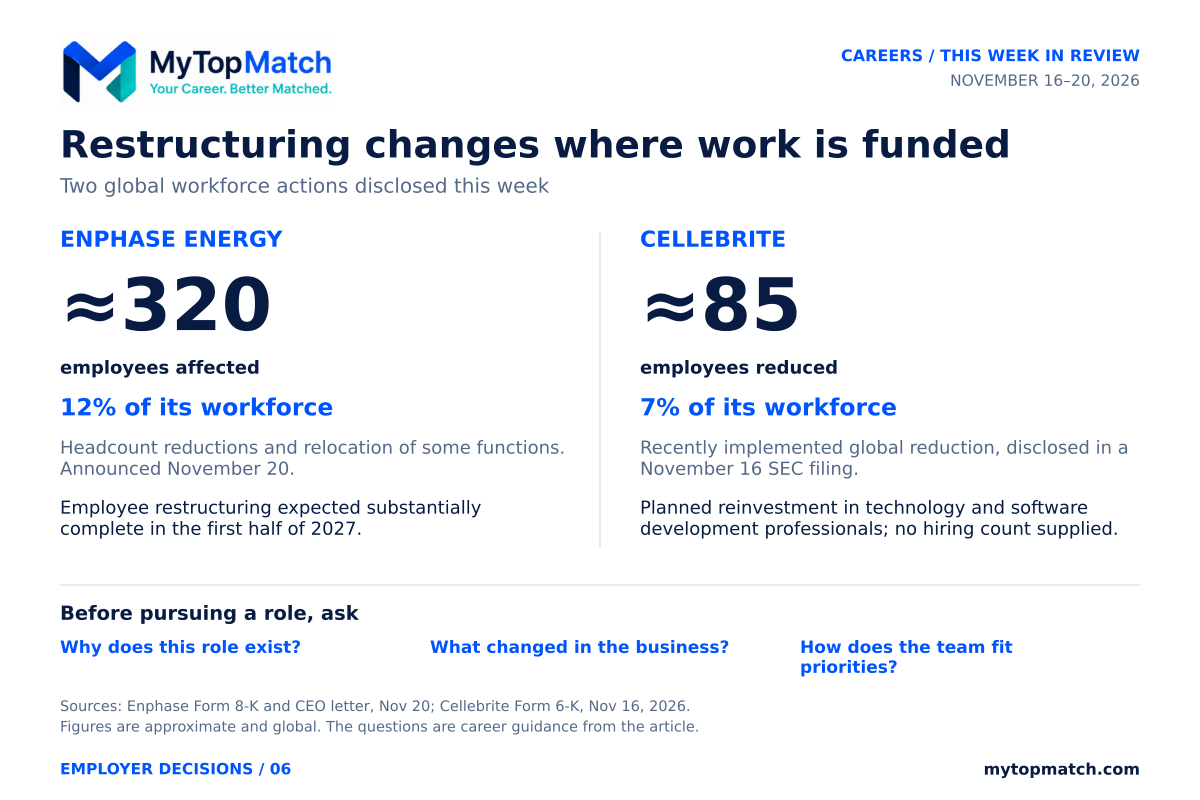
Sources: Enphase Energy SEC Form 8-K (https://www.sec.gov/Archives/edgar/data/1463101/000146310126000112/enph-20261120.htm); Enphase CEO letter (https://www.sec.gov/Archives/edgar/data/1463101/000146310126000112/ex991_q426.htm); Cellebrite SEC Form 6-K (https://www.sec.gov/Archives/edgar/data/1854587/000121390026120590/ea0312441-6k_cellebrite.htm).
Three expansion announcements offered more specific places to investigate:
Employer: DDN. Development reported this week: A November 17 announcement identified 233 planned new full-time jobs associated with a flagship office. Location and scope: Midtown Manhattan. Most new roles will involve sales, marketing, sales engineering, and product marketing, with additional hiring across corporate functions. No hiring completion date was provided. [7]
Employer: Stoughton Trailers. Development reported this week: Its November 17 recruitment release described plans to add approximately 700 employees in 2027, following 450 additions since the second quarter of 2026. Location and scope: Wisconsin and Texas operations. Recruitment includes production and skilled-trade positions, along with professional roles at headquarters. The 700 represents planned future additions. [8]
Employer: Alpitronic Americas. Development reported this week: A November 18 announcement identified 70 planned new jobs at a new operation. Location and scope: Fort Mill, South Carolina. The site will include EV charger manufacturing, warehousing, testing, repair, logistics, and offices. Initial operations are expected in February 2027. [9]
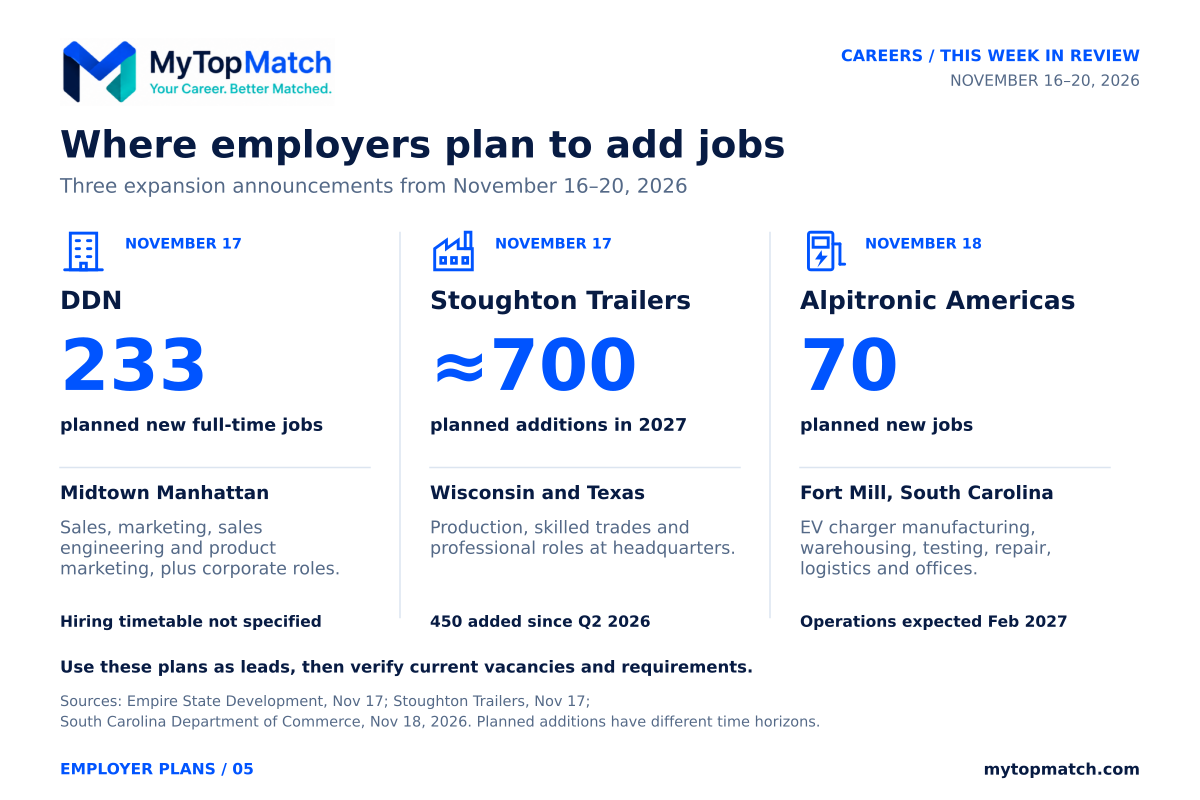
Sources: Empire State Development (https://esd.ny.gov/esd-media-center/press-releases/empire-state-development-announces-california-based-ai); Stoughton Trailers (https://www.stoughtontrailers.com/Portals/0/Stoughton%20Hiring%20Press%20Release%20Final%2011%2017%202026_1.pdf); South Carolina Department of Commerce (https://www.sccommerce.com/newsroom/alpitronic-americas-selects-york-county-first-south-carolina-operation).
Treat these announced hiring plans as leads, then check each employer's current vacancies, locations, and requirements.
DDN's announcement is particularly relevant to professionals whose experience sits outside software development. It expressly identifies commercial roles and functions including legal, finance, people and culture, data and analytics, and IT. [7]
The broader career lesson is to connect existing experience with an employer's stated need. Selling a technical product, managing a growing operation, and supporting a new facility are different kinds of work. Each deserves a targeted explanation of what the candidate can contribute.
Experience is gaining weight in job advertisements
Another chapter of the Indeed and Glassdoor report, published November 18, found that senior-level postings were 19.2% above their January 2025 level by September 2026. Entry- and mid-level postings were each approximately 4% lower over the same period. These categories reflect Indeed's classification of advertised roles. [10]
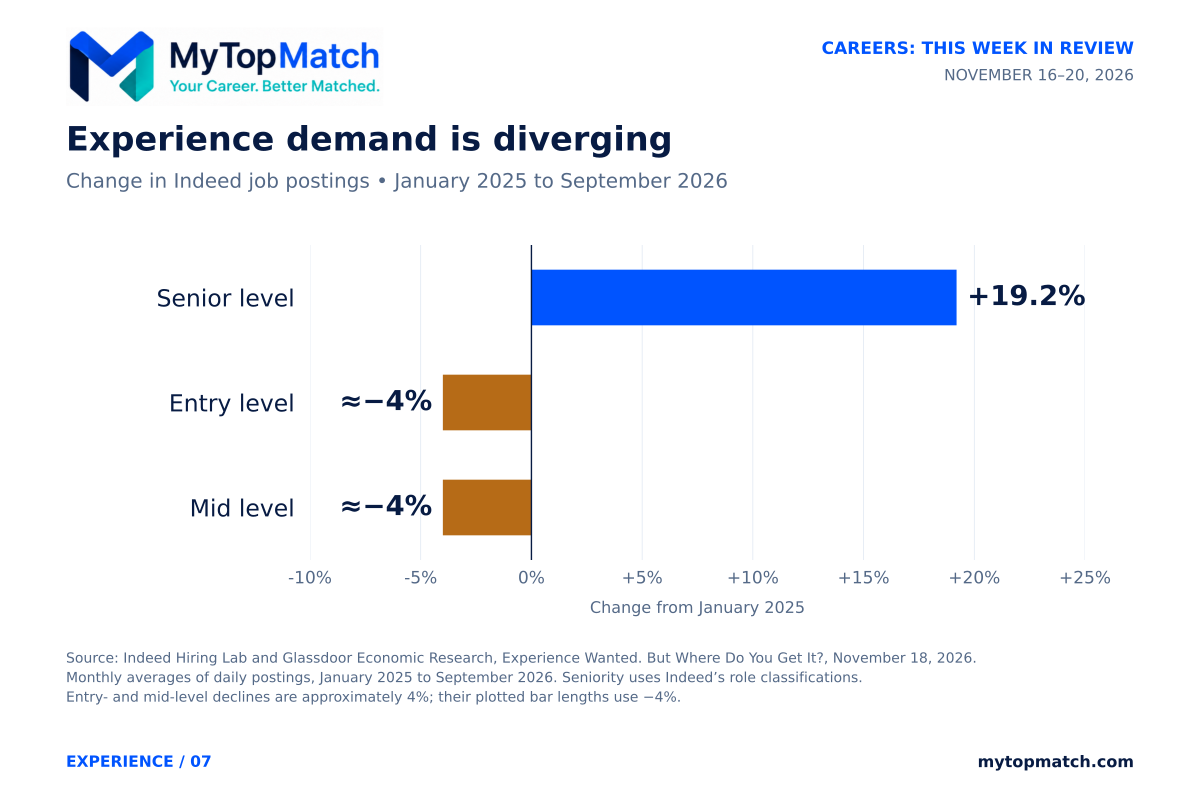
Senior-level postings increased while entry- and mid-level postings were each approximately 4% below January 2025 levels. Source: Indeed Hiring Lab and Glassdoor Economic Research (https://hiringlab.indeed.com/2026/11/18/experience-wanted-but-where-do-you-get-it/).
The figures help explain why two qualified candidates can experience very different searches. They also raise a practical question for experienced professionals: does the application make the relevance of that experience easy to recognize?
A résumé can describe years of responsibility while leaving the employer uncertain about what the person actually accomplished. Stronger evidence connects a business need with the candidate's decisions, contribution, and result. When a number is available and supportable, use it. When the result is qualitative, describe it accurately rather than manufacturing a metric.
For example, an operations professional might explain a process change and its result. A commercial leader might describe how they developed a market. An executive might explain the scope of a decision, the people involved, and the outcome.
The same principle applies to someone entering a field. Academic projects, internships, employment in another industry, and volunteer work can supply relevant examples. The task is to show what was learned and applied while representing the level of responsibility honestly.
Graduate recruiting has its own calendar
The National Association of Colleges and Employers released findings from its Job Outlook 2027 research on November 18. Among responding employers, 56% expected to maintain graduate hiring, 34% planned an increase, and 10% anticipated a decrease. These are employers' intentions, collected from August 6 through September 11, rather than completed hiring outcomes. [11] [12]
The survey also identified what employers wanted to see on recent graduates' résumés: problem-solving skills at 89%, teamwork at 83%, a strong work ethic at 82%, written communication at 80%, and verbal communication at 79%. [11]
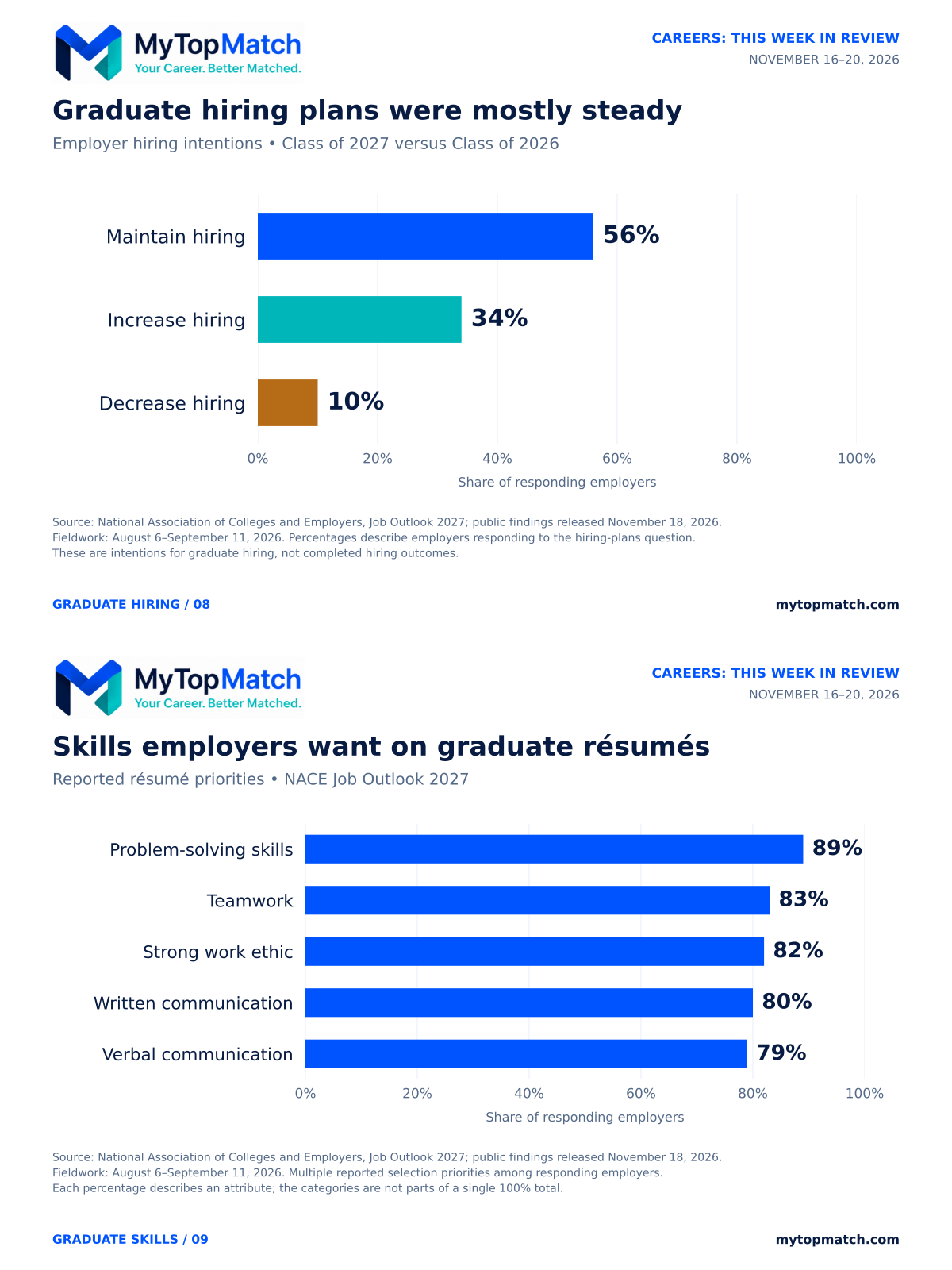
Among responding employers, 56% expected to maintain graduate hiring for the Class of 2027 versus the Class of 2026. NACE collected these intentions August 6–September 11, 2026. Sources: National Association of Colleges and Employers (https://www.naceweb.org/research/reports/job-outlook/2027); National Association of Colleges and Employers (https://www.naceweb.org/job-market/trends-and-predictions/degrees-of-difference-how-company-size-is-shaping-the-2027-job-market).
Employers reported multiple résumé priorities, with problem-solving skills most frequently selected among these five attributes. Sources: National Association of Colleges and Employers (https://www.naceweb.org/research/reports/job-outlook/2027); National Association of Colleges and Employers (https://www.naceweb.org/job-market/trends-and-predictions/degrees-of-difference-how-company-size-is-shaping-the-2027-job-market).
That gives graduates a concrete preparation task. Select a few experiences that demonstrate those capabilities and be ready to explain them in detail. For a team project, describe the problem, the candidate's own contribution, how people coordinated, and what the work produced. A list of desirable traits leaves those questions unanswered.
Timing matters as well. NACE reported that large employers concentrated nearly two-thirds of full-time recruiting in the fall. Smaller employers, defined as having fewer than 500 employees, divided full-time recruiting approximately evenly between fall and spring. [12]
A graduate who missed a large employer's fall cycle therefore has reason to investigate smaller organizations and their recruiting schedules.
The research also gives hiring managers a useful question to consider: which requirements are essential on the first day, and which can be developed through instruction and supervised work? A position designed with that question in mind can provide a clearer starting point for both the employer and the person learning the job.
Compare the full value of an offer
The week's compensation research supplied a reason to look closely at an offer's economics. Indeed and Glassdoor reported 2.5% annual growth in advertised wages as of September 1, compared with 3.7% annual CPI inflation in September and 3.1% growth in private-sector wages and salaries in the third-quarter Employment Cost Index. The measures track advertised pay, consumer prices, and employer wage costs, respectively. [13]
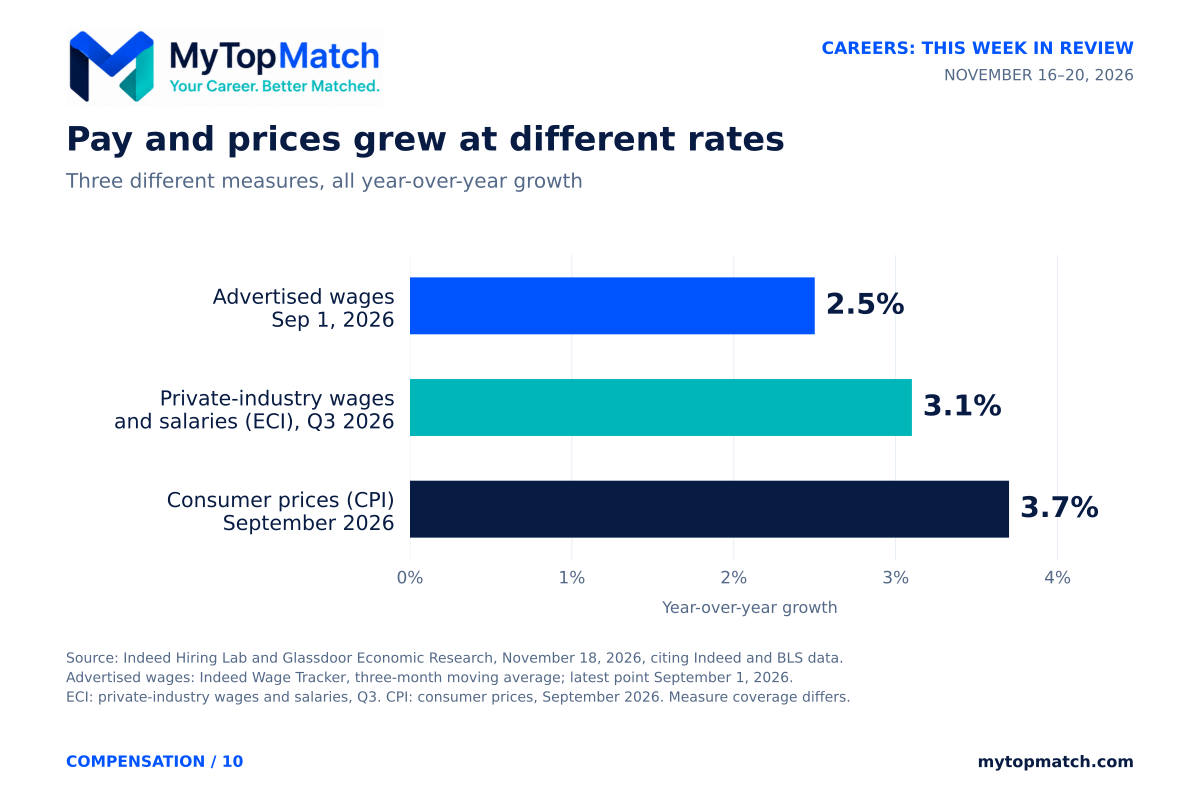
Advertised pay, employer wage costs, and consumer prices are different measures. Each percentage shown is year-over-year growth. Source: Indeed Hiring Lab and Glassdoor Economic Research (https://hiringlab.indeed.com/2026/11/18/total-compensation-is-under-pressure/).
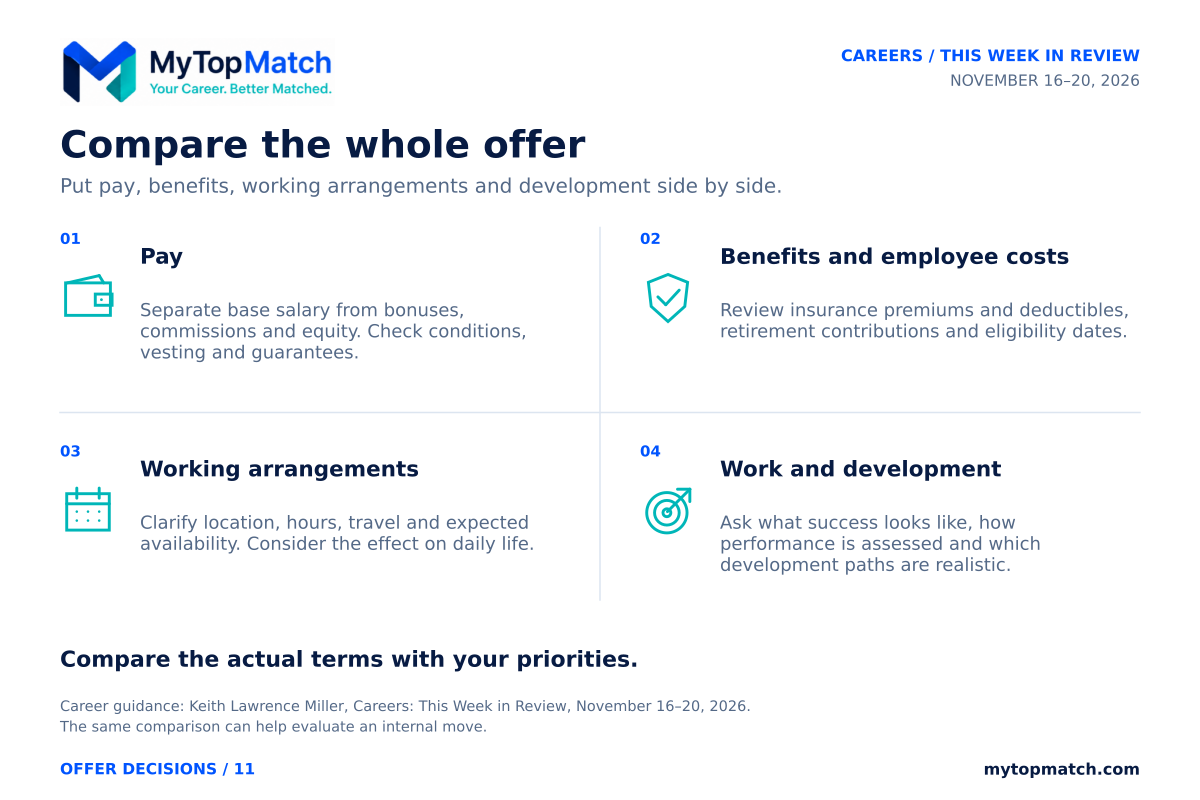
For someone weighing a move, a higher salary deserves to be considered alongside the costs, conditions, and opportunities attached to it. Compare:
Guaranteed and variable pay. Separate base salary from target bonuses, commissions, and equity. Establish what is guaranteed and what depends on performance, vesting, or other conditions.
Benefits and employee costs. Review insurance premiums, deductibles, employer retirement contributions, and eligibility dates.
Working arrangements. Clarify location, schedule, travel, and expected availability, then consider how those requirements affect daily life.
The work and its direction. Ask what success looks like, how performance is evaluated, and what development or advancement could reasonably follow.
Source: Keith Lawrence Miller / MyTopMatch.
People considering an internal move can apply the same comparison. The right choice depends on the actual options and personal priorities.
A contractor classification change is approaching
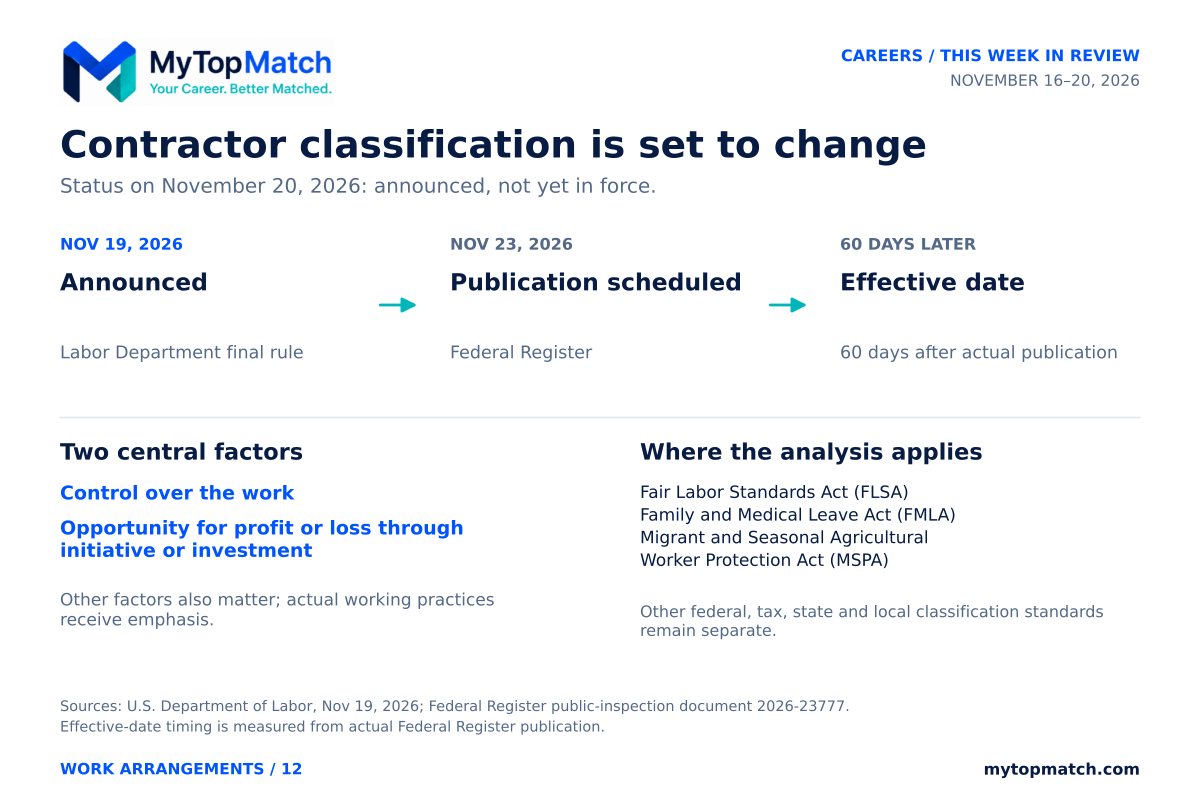
On November 19, the Labor Department announced a final rule revising its employee-versus-independent-contractor analysis. The framework gives particular weight to control over the work and the opportunity for profit or loss through initiative or investment. It also considers other factors and emphasizes actual working practices over arrangements that exist only on paper. [14]
The rule applies to the Fair Labor Standards Act, the Family and Medical Leave Act, and the Migrant and Seasonal Agricultural Worker Protection Act. It does not change classification standards under other federal laws, including tax law, or preempt state and local laws. [14]
As of November 20, the new rule had not taken effect. Its public-inspection text was scheduled for Federal Register publication on November 23 and specified an effective date 60 days after publication. [15]
Sources: U.S. Department of Labor (https://www.dol.gov/agencies/whd/flsa/misclassification/2026rulemaking); Federal Register public inspection (https://public-inspection.federalregister.gov/2026-23777.pdf).
For professionals considering consulting, freelance, or contract work, the development makes the terms and actual operation of the relationship worth understanding. The announcement does not determine the status of any individual arrangement, and a contract's label alone is not the full analysis.
What to take into next week
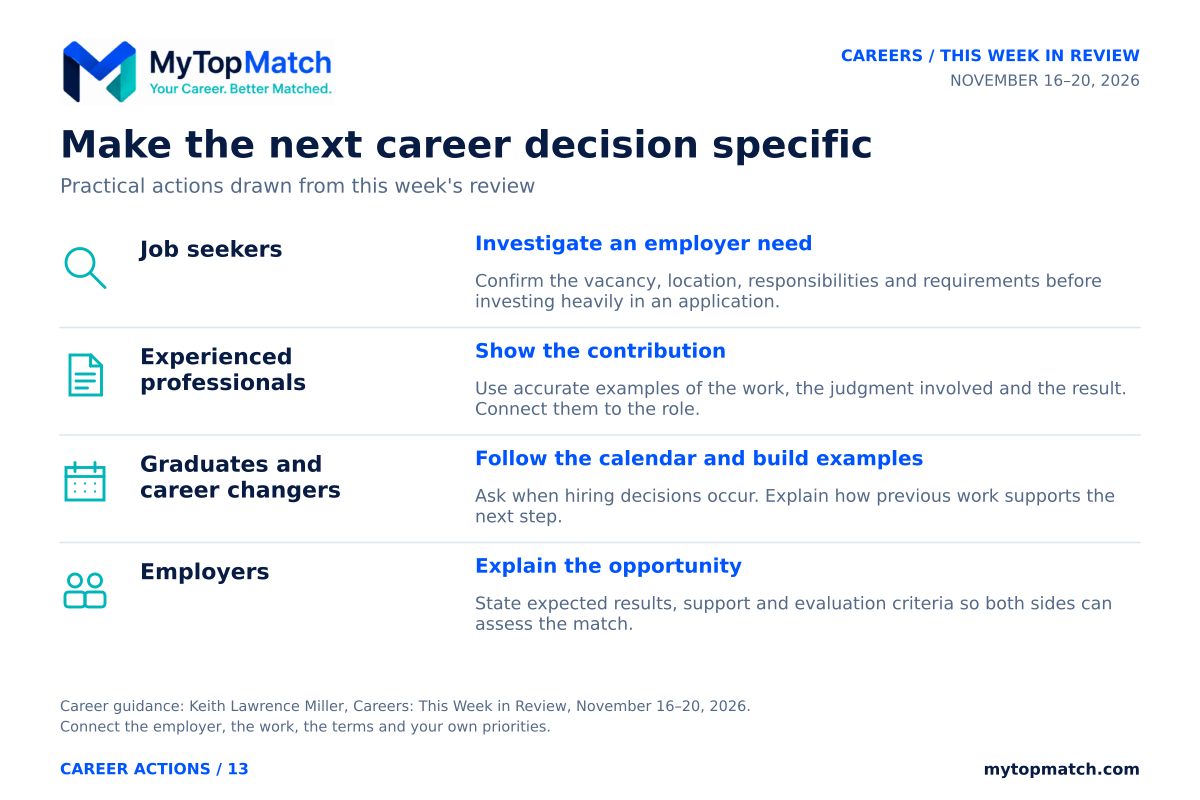
The most useful response to this week's news is a more focused set of career decisions.
For job seekers, investigate a specific employer need. Use expansion announcements and current job descriptions to identify work that fits, then verify the vacancy, location, responsibilities, and requirements before investing heavily in an application.
For experienced professionals, make the contribution visible. Choose examples that show the scope of the work, the judgment involved, and the result. Keep the evidence accurate and relevant to the position under consideration.
For graduates and career changers, follow the recruiting calendar and build credible examples. Look beyond one group of employers, ask when hiring decisions occur, and prepare to explain how previous work supports the next step.
For employers, explain the opportunity clearly. State what the person will be expected to accomplish, how the role will be supported, and how candidates will be evaluated. Those details help both sides assess whether the match is worth pursuing.
Source: Keith Lawrence Miller / MyTopMatch.
This week's releases support a practical conclusion: a national employment headline is a starting point for research. A sound career decision requires a closer look at the employer, the work, the terms, and the person who will do it.

Explore more career resources at MyTopMatch (https://mytopmatch.com/).
Source links
1. U.S. Department of Labor. Unemployment Insurance Weekly Claims, released November 19, 2026. Initial claims cover the week ending November 14; continuing claims cover November 7. Release (https://www.dol.gov/ui/data.pdf)
2. U.S. Bureau of Labor Statistics. State Employment and Unemployment for October 2026, released November 20, 2026. Release (https://www.bls.gov/news.release/laus.nr0.htm)
3. Indeed Hiring Lab and Glassdoor Economic Research. A National Market, Shaped by Local Dynamics, November 18, 2026. Posting levels are as of September 30. Analysis (https://hiringlab.indeed.com/2026/11/18/a-national-market-shaped-by-local-dynamics/)
4. Enphase Energy. Form 8-K, November 20, 2026, Item 2.05. SEC filing (https://www.sec.gov/Archives/edgar/data/1463101/000146310126000112/enph-20261120.htm)
5. Enphase Energy. Message from the CEO to Enphase Employees, November 20, 2026. SEC exhibit (https://www.sec.gov/Archives/edgar/data/1463101/000146310126000112/ex991_q426.htm)
6. Cellebrite. Form 6-K, November 16, 2026. The restructuring was described as recently implemented and had already been reflected in November 12 guidance. SEC filing (https://www.sec.gov/Archives/edgar/data/1854587/000121390026120590/ea0312441-6k_cellebrite.htm)
7. Empire State Development. DDN to Establish Flagship New York City Office, Creating 233 New Jobs, November 17, 2026. Announcement (https://esd.ny.gov/esd-media-center/press-releases/empire-state-development-announces-california-based-ai)
8. Stoughton Trailers. Stoughton Trailers Launches Major Hiring Initiative to Support Strong Growth, November 17, 2026. Company release (https://www.stoughtontrailers.com/Portals/0/Stoughton%20Hiring%20Press%20Release%20Final%2011%2017%202026_1.pdf)
9. South Carolina Department of Commerce. Alpitronic Americas Selects York County for First South Carolina Operation, November 18, 2026. Announcement (https://www.sccommerce.com/newsroom/alpitronic-americas-selects-york-county-first-south-carolina-operation)
10. Indeed Hiring Lab and Glassdoor Economic Research. Experience Wanted. But Where Do You Get It?, November 18, 2026. Seniority comparisons cover January 2025 through September 2026. Analysis (https://hiringlab.indeed.com/2026/11/18/experience-wanted-but-where-do-you-get-it/)
11. National Association of Colleges and Employers. Job Outlook 2027, November 2026; accompanying findings released November 18. Percentages describe employer responses rather than population estimates for all U.S. businesses. Public findings (https://www.naceweb.org/research/reports/job-outlook/2027)
12. National Association of Colleges and Employers. Degrees of Difference: How Company Size Is Shaping the 2027 Job Market, November 18, 2026. Fieldwork ran August 6–September 11. There were 311 total respondents; the aggregate hiring projection used a narrower group of 150, while other findings used the expanded sample and question-specific response counts. This article reports the hiring-direction split, not the aggregate growth projection. Analysis and methodology (https://www.naceweb.org/job-market/trends-and-predictions/degrees-of-difference-how-company-size-is-shaping-the-2027-job-market)
13. Indeed Hiring Lab and Glassdoor Economic Research. It's Not Just the Paycheck: Total Compensation Is Under Pressure, November 18, 2026. Analysis (https://hiringlab.indeed.com/2026/11/18/total-compensation-is-under-pressure/)
14. U.S. Department of Labor. 2026 Employee or Independent Contractor Final Rule, announced November 19, 2026. Rule overview (https://www.dol.gov/agencies/whd/flsa/misclassification/2026rulemaking)
15. Federal Register. Employee or Independent Contractor Status, public-inspection document 2026-23777. Scheduled publication November 23, 2026; timing checked November 20. Public-inspection text (https://public-inspection.federalregister.gov/2026-23777.pdf)