
For years, the dominant question about artificial intelligence and work has been simple: Will AI take my job?
That question is becoming too small. A more consequential transformation is beginning inside organizations: companies are learning that productive capacity can grow much faster than headcount.
That distinction matters because the traditional growth equation linked more demand to more work and, eventually, more employees. AI introduces another possibility: more demand can be met by technology-assisted capacity that allows existing employees to produce more.
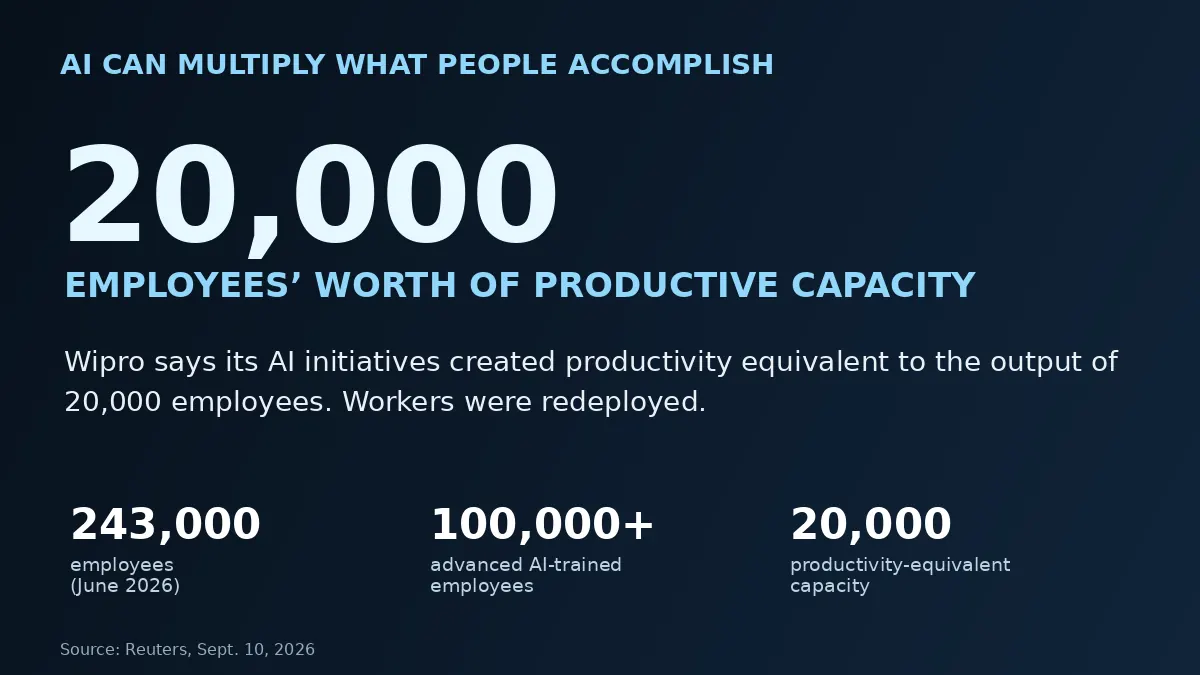
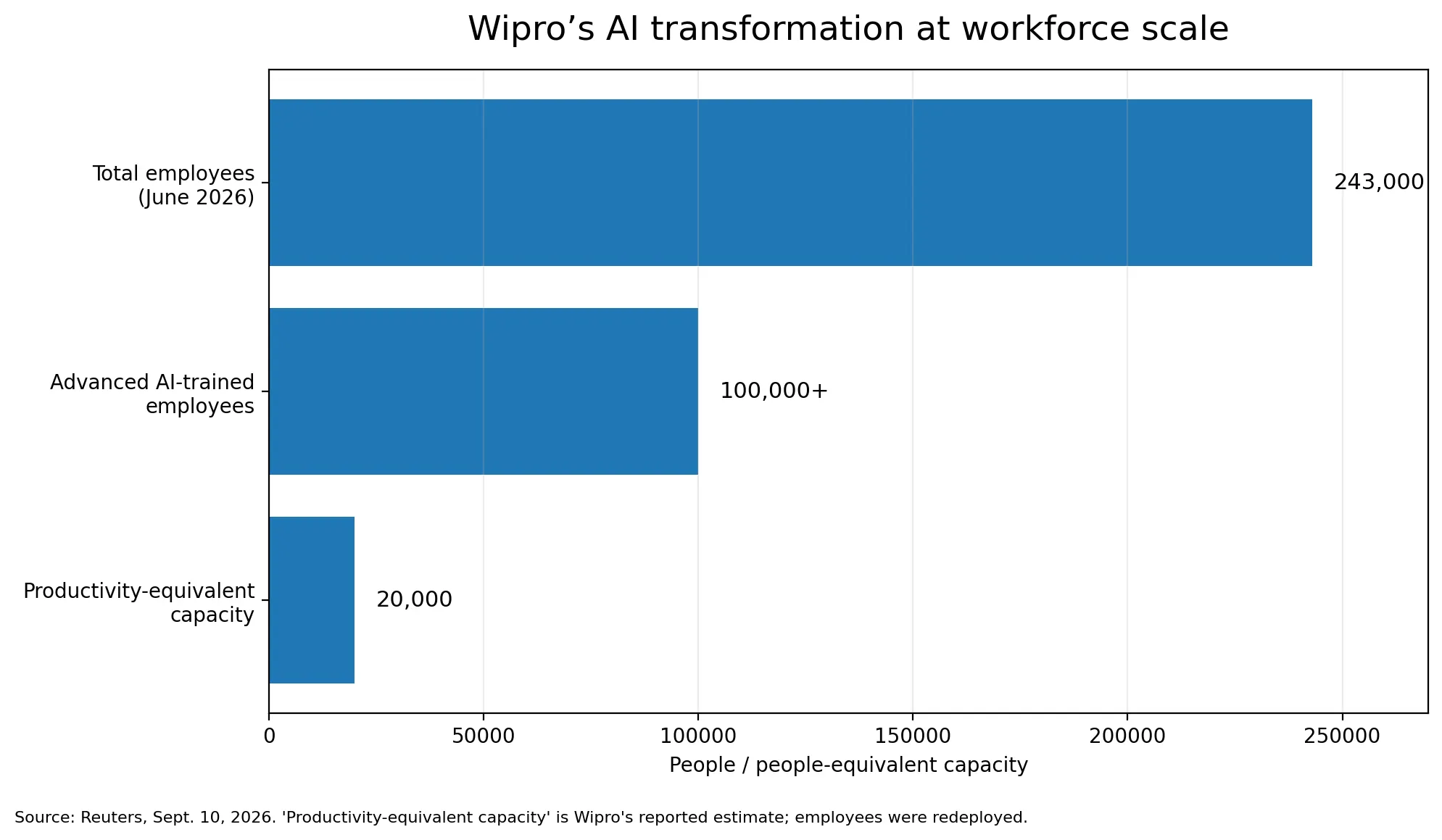
One number reported this week makes the shift unusually concrete. Wipro says its AI initiatives have created productivity equivalent to the output of approximately 20,000 employees. The company says those employees were redeployed rather than simply replaced, and more than 100,000 workers have received advanced AI-related training and certifications. [S01]
Productivity no longer has to move with headcount
Historically, when an organization needed substantially more output, it often needed substantially more people. More customer volume required more service representatives. More software projects required more developers. More analysis required more analysts.
AI changes the relationship. An analyst may supervise workflows that examine far more information. A recruiter can research and qualify more candidates. A project manager can coordinate more workstreams. A manager can oversee information flows that once required layers of administrative support.
The underlying job can remain recognizable while its productive radius becomes much larger.
That creates opportunity, but it also changes expectations. Once organizations know that one employee can command significantly greater productive capacity, they begin asking a new question: How much output should this position now be capable of producing?
The job market can look healthy while becoming harder to reenter
The U.S. labor market does not currently resemble an economy experiencing broad-based mass layoffs. Initial claims for unemployment benefits fell to a seasonally adjusted 206,000 for the week ending September 5, and nonfarm payrolls increased by 162,000 in August. [S02]
Yet another measure points to a more difficult reality for people who do become unemployed. The median duration of unemployment rose to 11.4 weeks in August from 10.5 weeks in July, near a four-and-a-half-year high. [S02][S03]
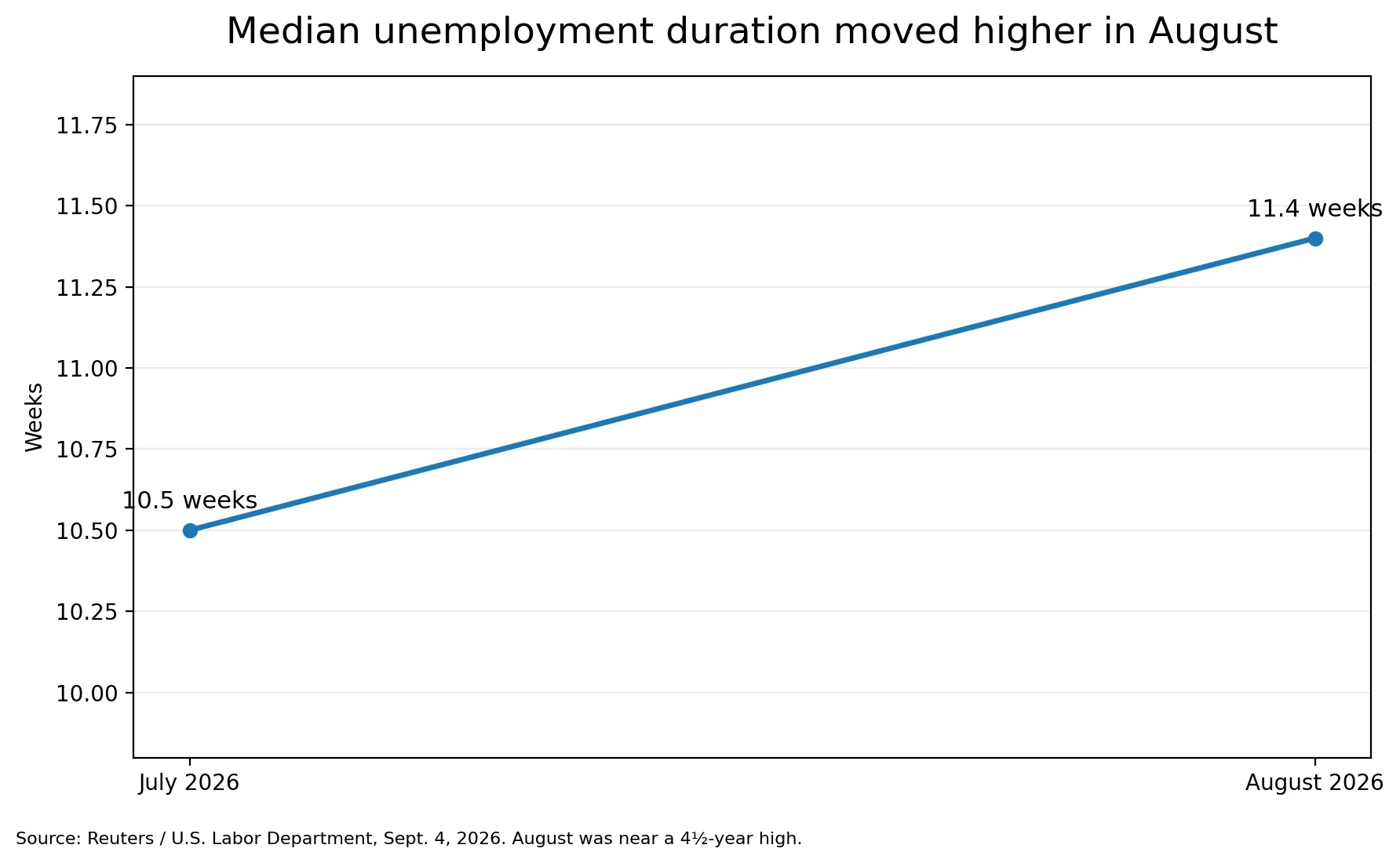
That creates an important contradiction: relatively few people may be losing jobs, while the people who do lose them can face a more difficult journey back into employment.
For career strategy, the risk can no longer be captured by asking only, 'Am I likely to be laid off?' A second question matters just as much: 'If my position disappeared tomorrow, how quickly could I convince another employer that my capabilities are valuable in the economy that exists now?'
Employment security depends heavily on the current organization. Career security depends on the portability of professional value.
Volkswagen shows what happens when yesterday's capacity exceeds tomorrow's needs
Volkswagen offers a different side of the same capacity equation. Reuters reported that the automaker is undertaking the biggest restructuring in its 89-year history, with plans that could affect as many as 100,000 jobs as it confronts weak profitability, Chinese competition, U.S. tariffs and excess capacity. [S04]
Volkswagen is not simply an AI story. That is exactly why it matters here. Organizations continually reorganize around the capacity they expect to need next.
Technology changes. Competition changes. Consumer behavior changes. Production changes. Capital moves. When those forces alter what an organization needs, even highly experienced employees can discover that yesterday's valuable capacity has become tomorrow's excess capacity.
Performance alone cannot eliminate that risk. A professional can be excellent at work the market needs less of.
AI investment is building a new physical economy around work
The transformation also extends beyond software. AI demand is driving investment in chips, data centers, networking, optical interconnects and the systems needed to run models at large scale.
This week, Qualcomm and Amazon announced a long-term AI data-center partnership under which Amazon could purchase up to $60 billion in chips and related products, while the companies also work on high-speed optical connectivity. [S05]
D-Matrix separately announced plans to integrate its inference-focused processors into Nvidia data-center systems using NVLink Fusion, targeting services such as coding assistants, chatbots and voice agents. [S06]
These developments matter for career strategy because the AI economy creates opportunity far beyond jobs with 'AI' in the title. Electrical engineers, construction managers, cybersecurity professionals, procurement executives, project managers, finance professionals, data-center operators and network specialists can all participate in the infrastructure behind AI.
The better career question is therefore not merely, 'Do I work in AI?' It is: 'Where is investment moving, and what capabilities will those investments require?'
The employee is becoming a leveraged unit of capability
The employee economy may be moving away from measuring value primarily through labor supplied and toward measuring value through capability controlled.
Two professionals can hold the same title. One completes work mainly through individual effort. The other understands the business problem, directs multiple AI systems, evaluates their output, detects errors, communicates with stakeholders and converts technological speed into measurable organizational outcomes.
Those employees may eventually have radically different economic value.
The differentiator is not simply whether someone uses AI. AI use will become ordinary. The differentiator is whether someone can convert AI into trusted outcomes.
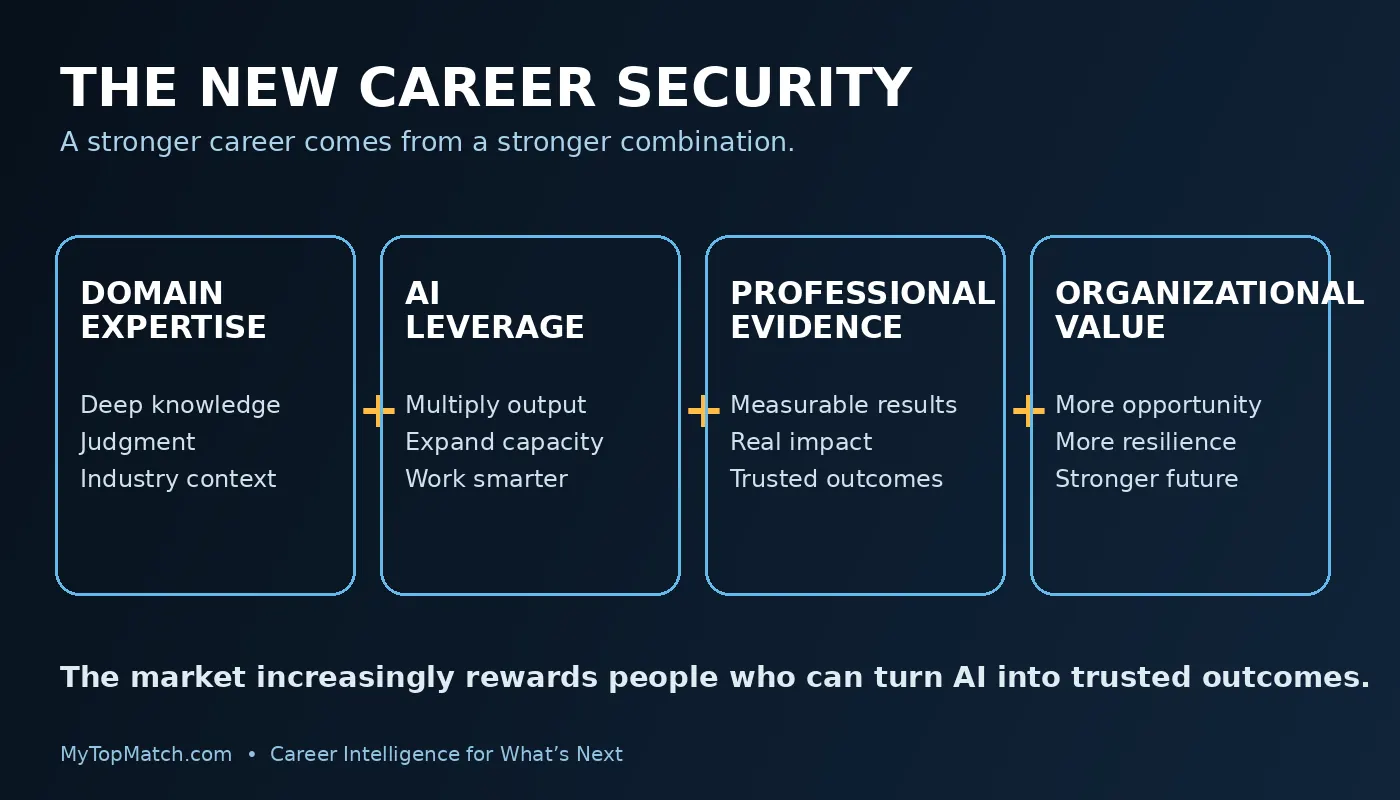
That requires capabilities machines do not automatically supply: judgment, context, prioritization, accountability, relationship management, communication, ethical reasoning, decision-making and organizational influence.
AI can increase capacity. Professionals still determine what that capacity should accomplish and whether the result is trustworthy.
Career development now requires evidence of leverage
Traditional career development emphasizes acquiring skills. Skills remain important, but the AI economy raises the standard. A skill by itself is increasingly less persuasive than evidence that the skill creates value.
Compare 'I know how to use generative AI' with 'I redesigned our client-research workflow using AI-assisted analysis and reduced preparation time by 60% while maintaining human review.' The first identifies a tool. The second demonstrates professional leverage.
Professionals should begin documenting how technology changes their performance: time reduced, throughput increased, revenue influenced, costs avoided, customers served, decisions accelerated, errors prevented, workflows automated, teams supported and capacity created.
Those outcomes become professional evidence.
Your résumé will need to change too
The résumé of the AI era cannot become a collection of AI keywords. Employers do not need millions of candidates claiming familiarity with the same tools. They need evidence.
Instead of writing 'Used AI to improve productivity,' demonstrate the business result that followed. If AI helps you accomplish substantially more, quantify what changed and explain where human judgment remained essential.
The market will increasingly reward people who can make their leverage visible.
Managers face an even bigger challenge
Installing AI tools is relatively easy. Redesigning an organization around dramatically different productive capacity is much harder.
Imagine a department of 100 employees becoming 30% more productive. Leadership must decide what to do with the capacity: increase output, move people into higher-value work, expand into new markets, improve customer service, shorten cycle times, reduce costs or create new products.
If leadership cannot answer that question, productivity gains can simply create organizational confusion.
The managerial challenge therefore becomes one of role design, decision rights, performance expectations, training, organizational structure and workforce planning.
Technology produces capacity. Leadership decides what to do with it.
The most dangerous career strategy is waiting
Many professionals are waiting for the labor market to tell them exactly what AI will do to their occupation. By then, some of the important decisions may already have been made.
Organizations transform gradually. A team discovers a faster process. Another team automates part of a workflow. A competitor operates with fewer people. Leadership notices. Expectations change. Hiring requirements change. Eventually, the new standard becomes ordinary.
Professionals should experiment before their organizations require it. Identify repetitive cognitive work, research tasks, administrative friction and information-synthesis work. Then test how much additional capacity can be created responsibly while maintaining quality and judgment.
Build career security before you need it
The increase in unemployment duration provides a final warning. Career development becomes much harder when it begins after a job disappears.
Professional relationships take time. Achievements take time. Market visibility takes time. New capabilities take time. A strong résumé requires evidence that already exists.
Ask yourself: What evidence proves I am more valuable today than I was two years ago? Which parts of my role can AI multiply? Which capabilities would remain valuable if my current job title disappeared? Who outside my organization understands the value I create? Where is investment moving in my industry?
The defining career advantage of the next decade may belong to people who can demonstrate a simple proposition: I know how to combine human judgment, professional expertise and artificial intelligence to create substantially greater results.
When technology changes what one employee can accomplish, it eventually changes what organizations expect from an employee. Once that happens, the employee economy itself begins to change.