This complete HTML dossier retains the research boundaries, contradictions, role sample, candidate questions, limitations, and source register. It does not offer an overall employer score or a current-vacancy count.
Company intelligence research dossier
Research as of: September 20, 2026
Resolved entity: General Electric Company, operating as GE Aerospace
Primary employment scope: United States, with consolidated global business context
Research version: GEA-2026-09-20-v1.0
Prepared for: MyTopMatch company intelligence library
This report examines what a professional should understand before applying, interviewing, accepting an offer, pursuing advancement, or making a longer-term career commitment. Inclusion in this research library is not an employer endorsement, ranking, investment recommendation, or prediction of an individual’s outcome. The associated Link evidence record remains a proposed interoperability package; it does not contain private member information and does not represent a completed Link integration.
The legal parent, operating brand and listing are verified: General Electric Company operates as GE Aerospace and continues to trade on the New York Stock Exchange as GE. Its principal offices are in Evendale, Ohio. The employing legal entity for an individual job still needs confirmation. [S01, cover; S06; C001]
B. Executive assessment
The central career judgment
GE Aerospace offers a substantial business setting for propulsion, manufacturing, maintenance, systems, supply-chain and associated professional work. The strongest evidence concerns its operating demand, investment priorities and formal development pathways. Evidence about an individual manager, salaried pay progression, actual staffing capacity and current vacancy status is appreciably weaker. A sound career decision therefore needs two separate answers: what work the business is supporting, and whether the specific team can offer the resources, terms and responsibility the candidate needs. This is a research interpretation of the evidence developed below. [S04; S07; S12; S20; C012; C015; C049; C058]
Growth does not describe every function. The latest interim filing shows higher revenue and operating cash generation, while its restructuring note records workforce-reduction charges and continuing post-separation exit work. The relevant distinction is between roles contributing to an expanding product or service requirement and roles affected by changing shared-service needs. Neither the positive financial picture nor restructuring charges establish the security of an unidentified position. [S03, pp.14–16, 27; C009; C019]
The next major transaction remains prospective. GE’s September 8 agreement to buy Consolidated Precision Products is a material strategic development. It has a stated $11.75 billion transaction value and expected second-half 2027 closing, subject to conditions. CPP is still treated as a separate employer in this report. The transaction creates questions about future supplier integration and capital priorities; it does not establish current integration vacancies or completed organizational changes. [S08; C016–C017]
Practical development has identifiable routes. The Wilmington machining apprenticeship has a concrete paid-training model and company-reported completions. The student guide supplies named engineering, manufacturing, digital, finance, HR and operations pathways. These are more useful than a general claim that the company develops talent. Access depends on the program, degree stage, location and assignment requirements. They are not interchangeable routes for every career changer. [S12; S20, pp.3–5; C048–C050; C059–C061]
Local conditions deserve direct investigation. The selected accounts include favorable Auburn internship experience, a Lynn intern’s staffing concern, and a Cincinnati logistics account describing pressure and travel alongside learning access. The accounts support questions about the target team. They cannot quantify how common any condition is. The strongest counterevidence to a uniformly negative reading is that a recent intern in another plant reported supportive management and reasonable expectations. [S26; S28; S30; C026–C028]
Employment terms differ materially across populations. Public bargaining announcements provide relatively specific pay and leave information for covered union employees. General benefits pages are much less precise about the package applicable to a new salaried hire. The union agreement’s wage progression, pension and leave terms cannot be transferred to an unrelated engineering, management or corporate offer. [S14; S23–S24; C035–C036; C042–C043; C072]
The hiring sample is an access-limited observation, not a verified opening list. Sixteen distinct requisitions were examined through official pages or an official recruiting guide. Twelve returned pages displayed closure messages; four guide-linked lookups returned no usable body. Three alternate Workday pages also exposed no readable posting. Zero active full postings were verified. These observations do not establish zero company vacancies or completed hiring against the sampled positions. No candidate should rely on this package as a live job feed. [S20; S35; S42–S57; C058; C068]
The most consequential unresolved questions
For an experienced applicant, the priority is whether the requisition has approved funding, whether the team is carrying vacancies or transition obligations, and who can authorize additional resources. For an offer holder, the priority is the written salary, variable-pay terms, work arrangement, benefit eligibility and any relocation repayment obligation. For an internal employee, the priority is the actual transfer policy and how demonstrated contribution becomes advancement. The package gives company-specific questions for each situation; it does not invent the answers.
C. Company identity and operating context
What belongs inside the research boundary
GE Aerospace is the operating identity of the continuing General Electric Company. GE HealthCare’s January 2023 separation and GE Vernova’s April 2024 separation mean that old conglomerate information requires careful sorting. A legacy GE employee review may refer to a business that is no longer part of this employer. Historic conglomerate headcount is unsuitable for comparing today’s aerospace workforce. [S06; C001–C002]
The company reports Commercial Engines & Services and Defense & Propulsion Technologies. Its activities span engines, services and aircraft systems. CFM International is a 50/50 non-consolidated joint venture with Safran Aircraft Engines. Avio Aero, Unison, Dowty Propellers and Colibrium Additive are material business brands. A position associated with one of these names must be tied to its own legal employer and location before transferring parent-level policy assumptions. [S01, pp.4–5; C003]
The parent also retains run-off insurance operations. Consequently, the GAAP continuing-operation figures in this report include more than aerospace operating activity. They are deliberately labeled as parent figures. Commercial engine order growth, company-adjusted revenue and GAAP revenue are different measurements and are not blended. [S01, p.36 and Note12; S03, p.14; C014]
The inspected recruitment material is posted under the GE Aerospace brand on its official careers domain. The full hiring entity was unavailable on the removed or inaccessible requisition bodies. A copyright line naming General Electric Company is insufficient to prove the contractual employer for every role. The evidence package therefore leaves that field null instead of inventing subsidiary assignments. [S42–S57; C058]
Recent event timeline
The event and announcement dates below are separate fields where the evidence allows. A forward-looking milestone remains a forecast.
D. Methodology, actual coverage and limitations
Research used live public web access on September 20, 2026. The main narrative window is September 20, 2024 through that date, with older separation history retained to explain the entity. Annual accounting uses the latest audited filing’s comparable 2023–2025 presentation. The latest interim period located is June 30, 2026. Filings and relevant program PDFs were opened; financial tables, the restructuring table and all six recruiting-guide pages were inspected as page images.
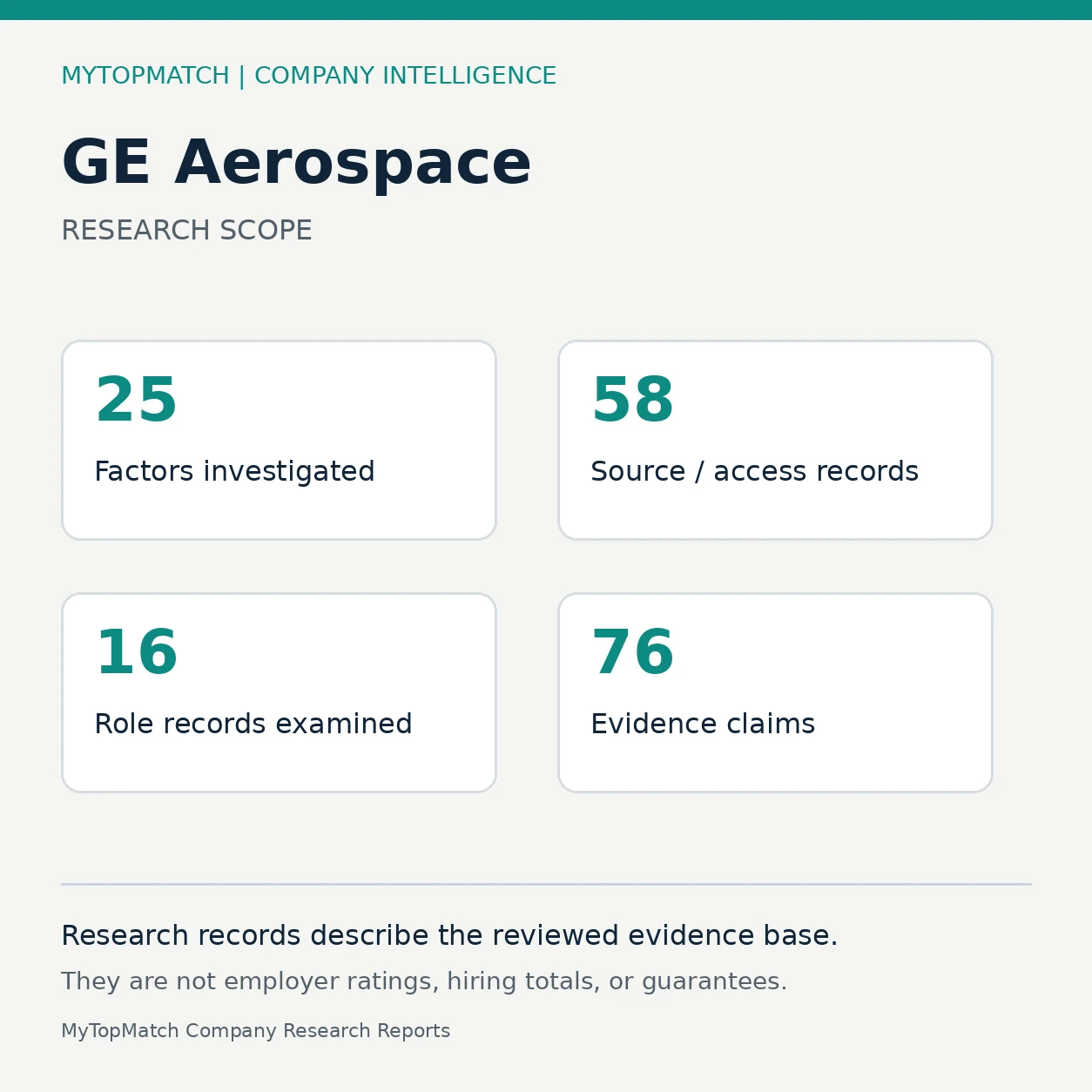
The source register contains 58 URL records: 54 returned readable content and four direct requisition lookups were unavailable. Of these, 42 are contextual, policy, financial, program, labor, review or access-method sources; 16 are distinct requisition records. The contextual group includes a screened-out historical review page and index pages, so this count must not be interpreted as 58 independent substantive authorities. Reuters supplies two independently reported developments; the union announcement is a negotiating party’s primary account. Most business and policy evidence is company-originated.
Selection and evidence treatment
Eight discoverable U.S. experienced or production requisitions were selected to include logistics leadership, security, engineering, inspection, assembly and maintenance. Eight additional 2027 requisitions were selected from the official guide to cover engineering, manufacturing, supply chain, EHS/facilities, digital, finance, HR and avionics. Alternate locale and Workday URLs for the same requisition were not counted as additional jobs. This is purposeful coverage, not a random or representative sample. The intended 15–25-current-posting sample was not achieved; inaccessible live content limits several factors.
Five distinct Indeed accounts dated December 2024 through August 2026 were reviewed across Cincinnati, Lynn and Auburn. Two public Reddit threads supplied additional candidate/internal-mobility questions. Some Indeed texts were visibly truncated. The Reddit pages did not supply a sufficiently reliable exact publication date in the opened text, so those dates are null in the package. Four older Peebles reviews were screened out of current experience findings. No employment identity was authenticated, and no rating aggregate was used. [S26–S32; S41; C071]
A company statement supports what the company reports or promises within its scope. It does not prove that the experience is universal. Employee accounts can expose useful questions without establishing prevalence. A union announcement is important evidence of the bargaining outcome, while the actual executed agreement remains preferable for individual entitlement. The researcher’s analysis is explicitly distinguished from each of these source categories.
What access did not establish
Official search pages did not expose the dynamic inventory. Retrieved job pages commonly displayed a closure message, including recently promoted guide entries. This could reflect actual closure or a retrieval/rendering limitation; the research cannot conclusively separate those explanations. Three search-discovered Workday URLs produced no readable job body. No application path was exercised. Third-party job cards were therefore retained only as limited pay observations, with no verified requisition match or active status. [S33–S35; S42–S57; C039; C058; C068]
The general benefits page is not a plan document. The governance page opened, but its 2026 proxy download failed. Government searches did not produce a reliable establishment-level safety, labor-case or WARN inventory; direct OSHA and NLRB lookups also failed through the research tool. A complete court-disposition review was not achieved. No absence-of-misconduct conclusion follows. These are research limitations, not adverse findings. [S14; S40; C038; C041]
Dates remain differentiated. Undated pages have null publication dates. Access dates do not make 2025 targets current results. Future closing, investment and hiring statements remain intentions. SUPPORTED WITHIN STATED SCOPE describes a checked proposition; INFERRED identifies interpretation; UNKNOWN identifies a consequential unresolved fact. Production use of the JSON schema is UNTESTED.
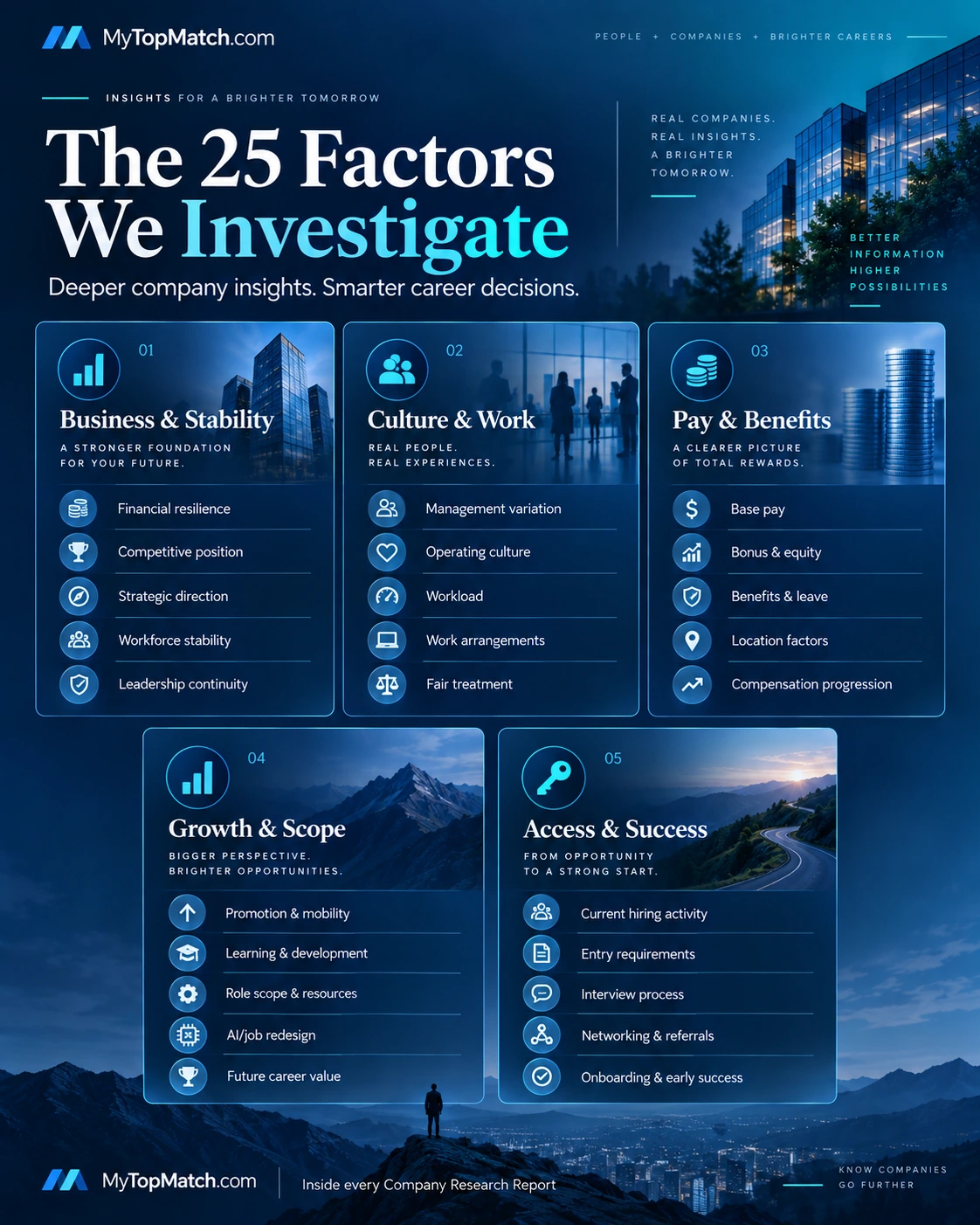
E. Twenty-five-factor evidence coverage
This table describes coverage, not employer quality. Detailed analysis follows.
F. Full factor analysis
F01: FINANCIAL RESILIENCE
Evidence and scope. The comparable table uses General Electric Company’s continuing operations, which include run-off insurance. Values are U.S. dollars in millions, fiscal years ended December 31. Operating cash flow is from continuing activities; net income is the statement line before attribution adjustments. [S01, pp.36–38; C007; C014]
The last row is a transparent subtraction, not GE’s defined free cash flow. Formula: continuing operating cash flow minus gross property, plant, equipment and internal-software additions. It excludes disposal proceeds and other adjustments in the company’s own measure. Large equity-security gains influenced 2023 net income, so the income sequence cannot be read as a simple operating-performance trend. [S01, pp.36–38; C008; C011]
These are six-month periods, not annualized projections. The balance-sheet cash line declined from $13,619 million at December 2024 to $12,392 million at December 2025 and $9,345 million at June 2026. Borrowings, calculated as short- plus long-term debt, were $19,273 million, $20,494 million and $19,157 million respectively. Cash here is the face-of-balance-sheet measure, not the broader cash-flow reconciliation total including separately presented insurance amounts. [S01, p.37; S03, pp.14–16; C009–C011]
Career interpretation. Improved cash generation is meaningful evidence of capacity to support operations. It cannot identify which budgets will receive that support. Planned acquisition funding and retained liabilities make the claim that every productive team must expand especially unwarranted. Evaluate a role’s funding and connection to an operating priority separately from corporate profitability. The strongest counterevidence to a blanket security conclusion is the contemporaneous restructuring disclosure discussed in F04. [C013; C019]
Candidate verification | Q01. Is this position funded in the approved operating plan, and would a delay in its associated program or investment change that funding?
F02: COMPETITIVE POSITION
Evidence and scope. GE’s July results release describes substantial orders, a large backlog and higher engine deliveries. Its filing explains that engine platforms can generate service work over long operating lives, while competition includes other engine manufacturers and third-party maintenance, repair and overhaul providers. Customer selection of a platform affects later service opportunities. The report does not assign a market-share percentage or convert the company’s leadership language into an independent ranking. [S04, p.1; S01, pp.4, 6, 24–25; C003; C012]
Airbus supplies a concrete example of engine competition: the A320neo offers CFM LEAP-1A and Pratt & Whitney GTF alternatives. This establishes competing options on that platform, without establishing their respective share or suitability for every aircraft. [S58, Engines & Efficiency; C075]
Career interpretation. A useful distinction is between winning future engine selections, producing existing orders and maintaining an installed fleet. These activities require different capabilities and create different delivery pressures. A manufacturing engineer addressing recurring defects is responding to a different commercial problem from an advanced-propulsion researcher or a service-contract professional. Candidates should be able to explain where their target role sits in that chain and which customer need gives it value.
The service relationship suggests a possible source of work beyond new-aircraft production. That is an inference about the business model, not a prediction of demand for a particular skill or facility. Dependence on delivery performance, engine durability, airline activity, airframer programs and government decisions remains relevant. Strong customer demand can also expose constraints rather than translate immediately into usable team capacity. [S01, business and risk sections; S07; C012–C015]
Variation and unknowns. The available evidence does not establish a team-level win rate, customer-concentration percentage or competitive salary premium. New development announcements establish work under way, not the commercial success of the eventual product. Substitutes and competitors therefore matter through the specific platform and customer problem, rather than through a generic list of famous aerospace companies.
Candidate verification | Q02. Which customer, platform or service requirement makes this team’s work important, and what competitive or program change would most alter its priorities?
F03: STRATEGIC DIRECTION
Evidence and scope. The 2026 U.S. manufacturing program describes investment in engine deliveries, durable parts and defense capacity. September announcements add a prospective CPP acquisition and new development work. XA102 reporting concerns preparation for a first test asset; the HyCAT statement describes a development contract and planned integration/testing. These are different stages of commitment and execution. None is labeled a completed production ramp in this research. [S07–S08; S38–S39; C015–C016; C051; C073]
Career interpretation. The clearest career-relevant connection is the need to translate demand and technical designs into reliable production and support. That can make supplier coordination, process capability, inspection, manufacturing data and program execution valuable work. It does not prove that additional vacancies exist in those areas. An announced investment may fund equipment, facilities or supplier capacity rather than a particular employee’s team.
The CPP agreement deserves attention because it could change how critical castings are managed after closing. Professionals considering sourcing, manufacturing or integration-related work should ask what decisions have actually been approved before accepting a proposed future remit. The strongest counterevidence to a broad vertical-integration thesis is the CFO’s reported description of the transaction as selective. [S08–S09; C016–C018]
Variation and unknowns. The public material does not allocate every investment dollar to staffing, disclose all project schedules or establish the future organization after CPP. The HyCAT contract value and underlying award instrument were not verified. The next research update should check transaction status, capital deployment and the completion of separation work rather than recycle announcements as achievements.
Candidate verification | Q03. Which part of the announced strategy is this team accountable for now, what funding and milestones are approved, and which responsibilities depend on future approvals or transaction closing?
F04: WORKFORCE STABILITY
Evidence and scope. Rounded consolidated employment increased between the two post-separation year-end observations. The global difference is approximately 4,000 employees and the U.S. difference approximately 2,000. These are stock comparisons, not gross hires, attrition or retention rates. No complete decomposition between hiring, departures and other organizational changes was established. [S01–S02, Human Capital; C004–C006]
The H1 2026 restructuring disclosure is important counterevidence to a uniformly expanding-workforce interpretation. It reports $51 million of workforce-reduction charges compared with $19 million a year earlier. The note says ongoing programs included exit activities associated with lower shared-service and footprint needs after the spin-offs. It does not specify a corresponding affected-person count or allocate every dollar to one function. [S03, Note19 p.27; C019]
Career interpretation. Growth and targeted reductions can occur together because workforce needs differ across functions. The useful question is how the proposed role connects to the future organization. For a direct production or service role, investigate the relevant site and program. For corporate, transformation or shared-service work, investigate the expected end-state organization and whether the assignment has a defined completion point. This is a planning distinction, not a prediction of who will be laid off.
Variation and unknowns. The company’s stated U.S. hiring ambition is not a verified net-addition figure. One candidate’s online description of a delayed Evendale process does not establish a current global freeze. The separate UAW stoppage was reported resolved in September 2025. Site-specific closure, WARN and contractor-reduction coverage remains incomplete. [S07; S25; S31; C015; C037–C038; C063]
Candidate verification | Q04. Is this a replacement, added-capacity or time-limited transition role, and what changes in the site or function have already been approved for the next operating cycle?
F05: LEADERSHIP CONTINUITY AND EXECUTION
Evidence and scope. The live roster was checked rather than inferred from old filings. It identifies Culp as chairman and CEO, Ali leading Commercial Engines & Services, Ghai as CFO, Gowder leading Defense & Systems and Meisner as CHRO. The annual filing’s announced February 1 commercial succession is now reflected on the current page. Culp’s biography supplies longer-term continuity at the parent level. [S05; S01, p.74; C021–C022]
Career interpretation. Senior continuity can help a candidate understand the operating vocabulary and strategic priorities likely to persist. It does not reveal the quality of the prospective manager or the stability of the reporting line two levels below the executive team. The relevant inquiry is whether leaders convert commitments into decisions, resources and consistent measures at the level where the employee will work.
The annual-report letter presents an operational improvement example from Terre Haute. It is a concrete company-reported case that can inform interview preparation, but the narrative does not independently establish which leadership practice caused the result or how consistently the practice operates elsewhere. A candidate should ask for a recent local example rather than repeat the corporate story as evidence about the target team. [S10; C025]
Variation and unknowns. The exact succession arrangements and spans of control below named executives were not established. A planned retirement in an older filing is not treated as a completed event without confirmation. Nor are any personalities, motives or leadership styles diagnosed from public visibility.
Candidate verification | Q05. What commitment did this team’s leadership make in the last planning cycle, what was delivered, and what changed when a milestone or resource assumption proved wrong?
F06: MANAGEMENT AND TEAM VARIATION
Evidence and scope. Recent self-reports provide contrasting local perspectives. The Auburn internship account describes supportive management and reasonable expectations. The Lynn internship account values the learning while raising staffing concerns. A Lynn security-management account criticizes management layers and accountability. These are different roles and locations, not mutually exclusive descriptions of one verified team. [S28–S30; C026–C027; C030]
Career interpretation. The accounts make local management a material due-diligence subject. They do not justify labeling GE Aerospace uniformly supportive or dysfunctional. For an applicant, the strongest evidence would be concrete descriptions of how the prospective manager allocates work, handles errors and removes obstacles. Ask for examples involving a recently hired employee with a similar scope, rather than accepting a general claim of an open-door culture.
A manager can be personally supportive while lacking authority to fill vacancies, change priorities or fund necessary equipment. Those are separate issues. The FLIGHT DECK model and formal employee-listening processes establish an intended structure, while the actual delegation of authority must be investigated in the target function. [S16; S01, p.5; C023–C024]
Variation and unknowns. This research cannot measure manager turnover, feedback quality, psychological safety or the distribution of employee sentiment. The accounts are self-selected and employment identities are unverified. A positive account is meaningful counterevidence to universal negativity, but it does not cancel a negative account from another population.
Candidate verification | Q06. When a new employee’s workload exceeds available capacity, what can this manager reprioritize directly, and what recent example shows how that decision was handled?
F07: OPERATING CULTURE
Evidence and scope. The formal operating model emphasizes safety, quality, delivery and cost in that order. The company also describes confidential reporting and employee listening. Its annual-report case links local problem-solving to operational improvement. These sources describe intended coordination and selected execution, not a complete observation of day-to-day work. [S16; S10; C023–C025; C034]
Career interpretation. A candidate should investigate how the priorities behave when they conflict. For example, who can stop work when quality is uncertain, who resolves an engineering-versus-production disagreement, and how is the resulting schedule impact discussed? Those questions expose the operating culture more effectively than asking whether collaboration is valued.
The engineering account describing slow material-review-board systems suggests a useful distinction between necessary assurance and avoidable process delay. It does not establish that a control should be removed. In safety-critical work, understanding the reason for a review and the evidence needed to complete it is part of the role. The research does not validate the reviewer’s broader competitive claims. [S27; C029]
Variation and unknowns. The security-management critique concerns layering and accountability, whereas the official model emphasizes local problem-solving. The available material does not show whether this difference reflects one manager, site, time period or a broader issue. Team-level evidence is needed before resolving it. [S29; C030]
Candidate verification | Q07. Describe a recent occasion when safety or quality concerns changed a delivery commitment. Who raised the concern, who made the decision, and what happened to the person who spoke up?
F08: WORKLOAD AND EXPECTATIONS
Evidence and scope. Manufacturing careers material identifies multiple shifts with local variation. The logistics account reports overtime, pressure and travel; the Lynn intern expresses concern about carrying unfilled work. The Auburn account describes reasonable expectations. None supplies a reliable distribution of weekly hours, mandatory overtime or burnout prevalence. [S17; S26; S28; S30; C026–C028; C031]
Career interpretation. Delivery growth can make execution pressure relevant, but business demand alone does not establish excessive working hours. Ask how demand is translated into staffing, shifts and priorities. For a production employee, schedule notice, overtime rules and qualification coverage may dominate. For an engineer or program professional, the more important issue may be competing milestones, travel or the expectation to respond outside normal hours.
The research does not diagnose burnout or presume that a demanding period is permanent. It also does not erase a reported workload concern because the company is successful. A useful answer should distinguish ordinary weeks, peak periods and the mechanism for returning to sustainable capacity after a peak.
Variation and unknowns. Workload may differ between a rotational internship, a salaried delivery role and a covered hourly position. The accessible sources do not establish a company-wide on-call policy or travel percentage. Closure-message pages cannot supply current role-specific expectations. The most consequential missing evidence is the target team’s actual staffing and recent workload pattern.
Candidate verification | Q08. Over the last three months, what has a normal and a peak week looked like for this role, which overtime or travel is required, and how are absent or vacant positions covered?
F09: WORK ARRANGEMENTS
Evidence and scope. General benefits marketing refers to flexibility. Manufacturing materials describe shifts, and the U.S. guide identifies specific sites and relocation conditions. This combination supports the existence of varied arrangements; it does not establish a universal U.S. remote or hybrid policy. The sampled job bodies did not permit a current role-by-role classification. [S14; S17; S20; C031–C032; C044; C058]
Career interpretation. Treat work arrangement as an offer term that needs a concrete operational definition. A statement that a manager is flexible might concern start time, occasional appointments or temporary remote work. It may not mean a durable right to live outside commuting distance. Similarly, assignment to a multi-site development program may require physical moves even when some tasks are computer-based.
The point is to avoid entering a role with different assumptions from the hiring manager. Ask which activities require presence, how exceptions are approved and whether the arrangement belongs to the role or depends on a particular manager. A written answer is especially important when a move or household commitment depends on it.
Variation and unknowns. No dated company-wide return-to-office change was established in this run. The report therefore does not invent one. Country-level flexibility claims, local exceptions and historical pandemic arrangements have not been generalized to current U.S. employment. Site-based program descriptions also should not be used to declare every GE professional role fully onsite.
Candidate verification | Q09. What exact onsite days, shift hours, geographic limits and travel expectations apply to this requisition, and which of those terms will appear in the offer or an accompanying written policy?
F10: ETHICS, EMPLOYEE VOICE, AND FAIR TREATMENT
Evidence and scope. Public policies address nondiscrimination, accommodation, reporting and retaliation. They establish channels and expectations, not their effectiveness. The 2025 IUE-CWA agreement and separate UAW dispute provide concrete employee-voice evidence within defined bargaining populations. The UAW stoppage was reported resolved; it is not represented as an active September 2026 strike. [S15–S16; S23–S25; C033–C037]
Career interpretation. Collective bargaining can produce terms that are more inspectable than broad employer promises. That does not establish identical protection or experience for salaried staff, contractors or workers under a different agreement. The practical inquiry is which representation, reporting and appeal routes apply to the exact position, and what protections exist when a concern involves the employee’s own manager.
A negative management account should prompt a question about accountability without being converted into a legal finding. Conversely, formal nonretaliation language is insufficient to dismiss a person’s reported experience. Scope and corroboration are required on both sides. [S29; C030]
Regulatory and legal limitation. A reliable current establishment-level OSHA, NLRB and WARN inventory was not established. The interim filing’s legal section was reviewed, but a corporate disclosure is not a substitute for a complete court docket or a site-level labor/safety investigation. No new allegation is advanced here and no clean-record certification is offered. Before a future article makes a specific case claim, the underlying record, current disposition and entity must be checked. [S03, pp.30–31; C038]
Candidate verification | Q10. Which reporting and appeal channels apply at this location, including when the concern involves management, and how can an employee verify that a safety or fairness concern was investigated and closed?
F11: BASE COMPENSATION
Evidence and scope. Full current official pay ranges were not retrievable. The following are limited third-party job-card observations collected September 20, 2026. They are not actual offers, validated employer salary bands or a market benchmark. The cards do not consistently separate base pay from possible shift premiums. [S33–S34; C039]
Career interpretation. These observations show why role and classification matter. They do not justify calculating an average GE wage or assuming a new employee starts at the top of a displayed range. No hourly figure has been annualized: actual paid hours, premiums, overtime and seasonal duration are unknown. The HR internship figure must not be compared as equivalent to year-round experienced employment.
Variation and unknowns. The report lacks validated current salaried engineering, digital, management and executive ranges. It also lacks actual offer data and a geographically matched external benchmark. Union wage increases describe progression under an agreement, not the starting rate for every classification. [S23; C035; C045]
Candidate verification | Q11. What is the approved base-pay range and starting classification for this exact role, and are shift premiums, overtime, allowances and any introductory rate quoted separately?
F12: BONUS, EQUITY, AND VARIABLE PAY
Evidence and scope. The annual filing establishes that options, restricted stock units and performance share units exist under the long-term incentive plan. It also describes a performance process linking individual outcomes to incentives. This does not establish that any sampled role qualifies for equity, a particular bonus target or a predictable payout. The filing also describes a company-safety-performance modifier in the annual bonus program; the modifier’s size and individual applicability were not established. Accessible material did not supply ordinary salaried-hire grant and payout terms. [S01, p.5 and Note17; C040–C041; C046; C076]
Career interpretation. A candidate evaluating variable compensation needs to understand the conditions under which the advertised amount is earned and retained. Base salary, target annual bonus, an initial equity grant and a discretionary future award are distinct. A grant’s stated value is also different from vested, saleable proceeds. This report gives no expected stock return, personalized tax view or assumed realized compensation.
A bonus tied to outcomes partly outside the role’s authority deserves particular scrutiny. Ask which component is individual, team, business or corporate, and who can change the target or exercise discretion. A performance link can clarify expectations only when the employee understands the measures and can influence the work that produces them.
Variation and unknowns. Executive incentive disclosures cannot be substituted for the terms of a general professional offer. The governance page’s proxy download was inaccessible, and the research did not attempt to infer a compensation package from senior executives’ arrangements. Vesting, termination treatment, eligibility dates, prorating, payout history and equity-refresh practices remain offer-specific unknowns. [S40; C041]
Candidate verification | Q12. What are the written bonus target, measures, eligibility date and payout conditions, and what equity is actually granted with its vesting and departure rules, rather than merely potentially available later?
F13: BENEFITS AND LEAVE
Evidence and scope. The careers benefits page advertises health coverage, disability support, retirement contributions, education support and family-related benefits. It does not establish the plan version, cost or eligibility applicable to a specific new U.S. employee. More detailed parental-leave information comes from the IUE-CWA announcement, whose covered population is separately identified by the company. [S14; S23–S24; C036; C042–C043]
Career interpretation. A benefit category has practical value only after the candidate understands its actual terms. Health coverage requires the applicable premium, deductible, network and start date. Retirement support requires the contribution formula and any vesting. Leave requires classification, tenure, approval and coordination rules. These are suggested verification needs, not assertions that GE’s terms are favorable or unfavorable.
The distinction is particularly important for a returning worker, a relocating family or someone comparing a direct-hire offer with contract employment. The public record does not support treating the same branded benefit description as equally applicable across those situations. Nor does a historical pension reference establish eligibility for a new hire.
Variation and unknowns. The union’s described six-week full-rate bonding benefit belongs to its bargaining scope. The report does not assign that leave duration to nonunion U.S. staff or any international workforce. Complete U.S. plan summaries, employee contribution tables, accessibility procedures and exact waiting periods were unavailable. No benefit has been given a fabricated cash value.
Candidate verification | Q13. Please provide the benefit summaries for my legal employer and classification, including coverage start dates, employee costs, retirement contributions and vesting, and leave eligibility for a new hire.
F14: LOCATION AND RELOCATION IMPLICATIONS
Evidence and scope. The recruiting guide identifies distinct U.S. centers for engineering, avionics, power, corporate and manufacturing work. Multi-site programs can involve assignment flexibility and transportation requirements. These are program-placement conditions, not a promise of paid relocation or a candidate’s chosen location. The old and guide requisitions also demonstrate that identical corporate branding spans very different work locations. [S20, pp.3–6; S42–S57; C044; C058]
Career interpretation. A location decision should begin with the actual building, shift and expected changes of assignment. “Cincinnati” as a broad recruiting location may be insufficient for planning a commute or deciding whether a household can support a program rotation. Ask whether future sites are optional preferences, competitive assignments or required placements, and how much notice is typical for the specific program.
This research did not collect current rents, household budgets or commute times. Adding an unsourced generic cost-of-living score would obscure the missing personal and site information. No regional claim is made about affordability or the suitability of a location for Keith or any MyTopMatch member.
Variation and unknowns. Relocation reimbursement, temporary housing, travel reimbursement, transportation access and repayment obligations remain unknown. A requirement to relocate cannot be interpreted as a promise that the employer pays every resulting cost. Likewise, a guide listing many possible locations does not establish that an opening exists in each one.
Candidate verification | Q14. What is the initial physical work location, how are later assignments decided, and what written relocation support, timing, repayment conditions and transportation responsibilities apply?
F15: COMPENSATION PROGRESSION
Evidence and scope. Publicly described progression is clearest for the IUE-CWA agreement, which specifies compounded wage increases and COLA provisions over its term. The corporate performance system links outcomes to incentives, but a general annual salaried raise rate or promotion-increase formula was not established. A performance-review process is not, by itself, a salary guarantee. [S23; S01, p.5; C035; C045–C046]
Career interpretation. Starting pay should be evaluated alongside the route to progression. The relevant questions are when an employee first becomes eligible for review, what changes through merit versus promotion, and which decisions require a manager, compensation partner or business leader. A candidate accepting a lower initial salary because of expected rapid progression needs written evidence for that expectation; the report supplies none.
For an internal employee, useful evidence would connect an achieved scope change with the company’s actual level definitions and decision process. General praise, participation in a development program or a strong corporate year does not establish an approved pay adjustment. This is a decision safeguard, not a finding that contributions go unrewarded at GE Aerospace.
Variation and unknowns. Bargaining classifications may have a contractual progression path that differs from individually managed salaried compensation. The accessible evidence does not establish compression practices, out-of-cycle adjustments, promotion budgets or typical time between levels. Online opinions were not converted into numerical raise expectations.
Candidate verification | Q15. When would this hire first enter the pay-review cycle, what distinguishes merit, market and promotion adjustments, and who has authority to approve each change?
Evidence and scope. Development-program descriptions establish planned movement across assignments. They do not supply a company-wide promotion rate or prove unrestricted access to internal vacancies. The public mobility discussion raises manager permission and time-in-role questions, but its replies are not authoritative HR policy. No universal 18-month transfer requirement is asserted. [S20–S21; S32; C047–C048]
Career interpretation. Internal mobility has several distinct parts: becoming eligible to apply, receiving support to move, competing successfully for the role and arranging release from the current team. An employee can have access to an internal listing without control over all the other steps. Anyone joining with a plan to change function soon should verify those steps before relying on the plan.
The annual talent-review process shows that leadership succession receives formal attention. It does not tell a particular employee how to enter the relevant talent pool or what evidence differentiates readiness for a larger role. Ask for a recent, appropriately anonymized example from the same function and level, including the work the person demonstrated before the move. [S01, p.5; C046]
Variation and unknowns. Rotational participants may have structured assignments that differ from direct-hire transfers. Relocation support, team-release timing and country moves may have separate conditions. None of the public material establishes the frequency of exceptions, transfer success or the proportion of jobs filled internally.
Candidate verification | Q16. What is the written time-in-role and manager-notification policy for an internal move from this position, and how have comparable employees actually moved to the next role or level?
F17: LEARNING AND DEVELOPMENT
Evidence and scope. The Wilmington apprenticeship supplies a concrete model: paid employment, instruction and mentored practice, with company-reported completions. The U.S. guide distinguishes multiple development tracks and rotation structures. Research EEDP is three years, an important exception to the generic two-year development-page description. [S12; S20, p.5; S21; C048–C049; C070]
Career interpretation. The useful question is whether learning is built into the job’s resources and assignments. A program with scheduled rotations can offer a different development experience from access to an online course library. A direct hire needs to know whether training time is protected, which qualifications must be earned and who provides feedback while the employee gains competence.
The apprenticeship’s instruction funding is tied to a particular North Carolina partnership. It should not be generalized into free tuition for every GE employee. Similarly, public education-support language is not a verified reimbursement ceiling or guarantee of manager approval. [S14; S12; C042; C049]
Variation and unknowns. The company’s workforce page retains training intentions for 2025; those are not reported as verified achievements. SkillBridge and apprenticeships broaden the advertised routes, but current places, eligibility and completion outcomes were not verified. The employee logistics account mentions access to classes, while the Auburn account describes supportive management; these experiences add limited evidence of use without establishing universal access. [S11; S26; S30; C027–C028; C050]
Candidate verification | Q17. Which training is required and funded for this role, how much work time is reserved for it, who mentors the employee, and what happens if production or project deadlines conflict with the learning plan?
F18: ROLE SCOPE AND RESOURCES
Evidence and scope. The recruiting guide describes work in engineering, process improvement, planning, sourcing, digital systems, finance and HR. The XA102 update describes coordination of design data, manufacturing, inspection and suppliers. These sources show the kinds of responsibilities involved, but they do not specify a prospective employee’s staffing, budget or decision rights. [S20; S38; C051–C052]
Career interpretation. A broad role can be valuable when the employee has the access and authority to deliver it. The same breadth can become difficult when accountability extends across teams but the employee has no way to prioritize dependencies. Public role descriptions rarely settle that distinction, and the sampled closed pages left even basic reporting relationships unavailable.
For engineering and manufacturing work, ask who owns technical decisions, who approves changes and what support exists for testing, documentation or supplier follow-up. For a cross-functional professional, ask which teams are committed to the initiative and whether their time is funded. These questions are tied to the integrated work described in the sources rather than a presumption that resources are inadequate.
Variation and unknowns. The Lynn intern’s staffing concern and the Cincinnati engineering account’s process-delay concern make local resource questions consequential, but neither proves that a different team lacks support. The post-separation IT work also suggests that some assignments may have a defined transition horizon. Its completion and effect on individual jobs remain unverified. [S28; S27; S03, p.27; C020; C026; C029]
Candidate verification | Q18. What outcomes will I own, which decisions can I make directly, which teams and tools are committed to the work, and which unresolved dependencies would be waiting for me on day one?
F19: AI ADOPTION AND JOB REDESIGN
Evidence and scope. GE’s AI page describes workplace applications in engineering knowledge, manufacturing/inspection and commercial activity. It states principles involving reliability, traceable data and human decision responsibility. The XA102 model-based-definition work is a related digital-engineering development, but model-based engineering is not automatically equivalent to generative AI. [S13; S38; C051; C053–C054]
Career interpretation. The relevant career question is how tasks and accountability change. An engineer using an assistant still needs to understand the evidence supporting an answer and the limits on authorized use. A manufacturing professional may need to interpret system outputs, identify unusual conditions and preserve traceability. These are conditional skill implications drawn from the company’s described work, not verified universal job requirements.
The company’s interview policy introduces a separate issue: common text on the inspected official pages prohibits unauthorized AI response generation or live assistance while preserving accommodation exceptions. That restriction concerns assessment integrity. It does not contradict company investment in authorized workplace systems, and it should not be expanded into a prohibition on all research or preparation. [S42–S43; S46; S48–S49; C055]
Variation and unknowns. No employee-replacement probability, AI-attributed layoff count or independently measured productivity return was established. The restructuring charges are not attributed to AI. Access to approved tools, training, evaluation standards and the actual redesign of each role remain team-specific. Public vendor or company descriptions are not proof that every employee uses the same system.
Candidate verification | Q19. Which approved AI or automation tools does this team actually use, which tasks have changed, and who validates the outputs and retains responsibility for the resulting decisions?
F20: FUTURE CAREER VALUE
Evidence-based analysis. Potential career value is grounded in the work rather than the employer’s name. The guide and development announcements identify opportunities to learn controlled engineering processes, manufacturing improvement, supplier coordination, model-based product definition and cross-functional execution. The apprenticeship offers a route into practical machining work. These experiences could produce transferable capability when the employee actually performs and understands substantive tasks. [S12; S20; S38; C049; C051–C052; C056]
For an engineer, the valuable outcome might be the ability to explain a design or manufacturing decision with evidence. For an operations professional, it might be ownership of a measurable process change. For a finance or HR participant, it might be learning how a technical industrial business makes resource and people decisions. These are analytical examples of possible value, not promises about assignment quality or later hiring success.
Tradeoff. Deep specialization can create valuable expertise while leaving a person dependent on one platform, process or narrow assignment. Breadth should therefore be investigated alongside technical depth. Ask what can be learned beyond the immediate task and how the employee will retain a legitimate record of their contribution without exposing confidential or controlled material. [C056–C057]
Unknowns and counterevidence. Rotational structures create possible breadth, but a rotation’s existence does not establish meaningful responsibility. A large brand also cannot compensate for a role with limited ownership, little feedback or no development time. The available sources cannot assess a specific member’s transferability, career fit or future market demand.
Candidate verification | Q20. After two years in this role, what substantive capabilities and documented contributions should I be able to demonstrate, and what assignments would broaden my experience beyond one internal process or platform?
F21: CURRENT HIRING ACTIVITY
Evidence and scope. The official careers site, indexed requisitions and 2027 guide indicate multiple recruiting channels. They did not yield a verified current vacancy inventory through the available research access. The 16-record sample below reports observed page states, not a count of jobs currently available or filled. The intended current-posting sample is incomplete. [S20; S35; S42–S57; C058; C068]
Career interpretation. Requisition ID is the useful unit for verification. Search-card freshness does not establish a newly approved position, and a program guide does not establish current availability. The company’s hiring plan is an intention, not an observed total of completed or net hires. No application destination was validated end to end. The JSON retains missing pay, legal employer and other unavailable fields as null. [S07; C015; C058; C068]
Candidate verification | Q21. Is this exact requisition still accepting applications, is its headcount approved, and what is the official current posting and application destination?
F22: ENTRY REQUIREMENTS AND ACCESSIBILITY
Evidence and scope. The 2027 U.S. student guide specifies common enrollment, GPA and work-authorization conditions plus pathway-specific requirements. Certain Systems routes specify U.S. citizenship. The HR internship requires relevant master’s-level study and limits previous work experience. These conditions belong to the described pathways; they are not universal GE Aerospace entry requirements. [S20, pp.3–4; C059–C061]
Career interpretation. A prospective applicant should separate formal eligibility from competitive preference. The guide can identify a route worth examining, but the actual requisition is necessary to distinguish required degrees, accepted alternatives, preferred experience and any additional constraints. The inaccessible job bodies prevented a complete required-versus-preferred comparison in this run.
The Wilmington apprenticeship is a materially different entry route from a graduate engineering or HR program. Its training model creates a reason to investigate access for people entering machining, but the announcement does not disclose a current intake or every selection condition. SkillBridge provides another advertised route for a defined military population; eligibility cannot be presumed. [S12; S11; C049–C050]
Accessibility and unknowns. The EEO policy describes reasonable accommodation and nonretaliation. The interview-AI language expressly retains accommodation exceptions. No individualized work-permission, immigration or clearance advice is supplied. Sponsorship policy, role-specific citizenship conditions and accepted experience substitutes remain questions for the actual posting and hiring team. A company policy must not be converted into a finding that every applicant can access every role. [S15; S42; C033; C055]
Candidate verification | Q22. Which listed qualifications are mandatory, which alternatives are accepted, what work-authorization or citizenship condition applies to this requisition, and how should an applicant request an assessment accommodation?
F23: RECRUITMENT AND INTERVIEW PROCESS
Evidence and scope. U.S. student FAQs describe recruiting calendars and graduation eligibility. They do not establish a uniform experienced-hire process. A public candidate account describes a panel followed by a delay, but it cannot establish the company’s standard stages or present approval status. The common interview-AI restriction is a directly observed policy on several official pages. [S19; S31; S42–S43; C055; C062–C064]
Career interpretation. Prepare against the requirements of the actual role once they are available. Evidence of technical judgment, coordination and problem-solving would be relevant to the kinds of work described in the guide, but this report does not fabricate a GE interview-question bank or claim that every candidate faces the same assessment. Research questions in this dossier are questions for the employer, not purported insider interview questions.
Clarify the remaining stages, who is making the decision and whether the requisition has a hiring deadline or unresolved approval. A delay can have several explanations; the research does not attribute a candidate’s experience to hidden motives or presume rejection. Asking for a concrete next step is more useful than relying on an anonymous timeline.
Variation and unknowns. No verified standard time-to-offer, number of interview rounds, assessment provider or background-screen duration was located. No application was submitted to test functionality. Candidates should not use unauthorized live AI assistance, and applicants needing an accommodation should seek the authorized process rather than assume the restriction removes that possibility.
Candidate verification | Q23. What stages and assessments remain for this requisition, what materials or tools are permitted, who owns the decision, and when should I expect the next status update?
F24: NETWORKING AND REFERRAL ACCESS
Evidence and scope. Public careers resources include campus pages, a route for students whose school is not listed, a talent community and an advertised career-exploration program. These are legitimate public discovery channels. The research did not verify a personal referral, referral bonus, selection advantage, upcoming event seat or application outcome. [S18; S21–S22; S36; C065]
Career interpretation. The useful purpose of a conversation is to reduce uncertainty about the work and the route into it. For a student, a campus contact may help clarify the right program and eligibility. For an experienced professional, a public technical or recruiting interaction may help identify the relevant function. These are possibilities, not claims that a warm introduction exists or that contact will improve selection odds.
No private employee contact data was harvested. No LinkedIn profile was treated as a confirmed relationship, and no person was contacted. The report also does not suggest paying for a referral or purchasing access to private recruiting information. The advertised exploration resource can be considered as a public learning lead, but its account, access and completion flow were not exercised.
Variation and unknowns. The official campus directory covers particular schools and offers another route for unlisted institutions. It does not imply that applicants from unlisted schools are ineligible. Public networking information is weaker for experienced direct hires than for students. The actual employee-referral policy and its interaction with an existing application remain unknown.
Candidate verification | Q24. Which official recruiting event, campus contact or talent channel is relevant to this job family, and does a documented employee-referral route need to be used before an application is submitted?
F25: ONBOARDING AND EARLY SUCCESS
Evidence and scope. The workforce page describes FLIGHT DECK orientation, the Wilmington apprenticeship includes mentored practical training, and development tracks provide structured assignments. These are identifiable onboarding examples. They do not establish a standard first-90-day plan for every experienced engineer, manager or corporate hire. [S11–S12; S20; C066–C067]
Career interpretation. A new hire should understand the boundary between learning and independent accountability. In technical work, that means identifying which activities require qualification, review or supervision before the employee can perform them independently. In a cross-functional role, it means obtaining access to the necessary systems, people and decisions before delivery dates are treated as fixed.
The most useful early-success discussion connects the role’s actual starting conditions to a small number of outcomes. An employee inheriting an unresolved supplier issue, a transition deadline or vacant support positions needs those conditions acknowledged. The public strategy does not supply an internal onboarding plan, and this report does not invent one.
Variation and unknowns. A paid apprenticeship may have a defined instructional sequence, while a direct hire may depend more on local manager planning. Protected learning time, mentor availability, initial review dates and the treatment of inherited problems were not verified. The company’s performance framework supplies an intended connection between contribution and evaluation, but it does not establish the first review standard for an unidentified role. [S01, p.5; C046]
Candidate verification | Q25. What should I learn, become authorized to do and deliver in the first 30, 60 and 90 days; who supports those steps; and which existing problems will be distinguished from my own performance?
G. Cross-factor tradeoffs and career-situation matrix
What the evidence means in combination
The strongest company-level opportunity is exposure to consequential technical and operating work. The most consequential caution is the gap between that corporate setting and the terms of a particular job. Strong demand can increase useful work and increase pressure at the same time. It does not reveal whether staffing, materials, systems or managerial authority have kept pace. This is a decision interpretation, supported by the contrast between operating results, investment intentions, restructuring disclosures and the small set of local accounts. [C012; C015; C019; C026–C030]
A candidate should avoid treating each factor as a separate checklist item. Compensation progression depends on the applicable worker population and the process that recognizes contribution. Development access depends on eligibility, location and time. A title with broad delivery accountability has limited career value if the employee cannot obtain necessary resources or demonstrate meaningful ownership. These are conditional relationships, not findings that every GE team has a resource problem. [C041; C044–C048; C052; C056–C057]
Tradeoff register
T01 | Strong operating demand and manufacturing intentions. Reduction charges and shared-service changes mean corporate growth does not prove role security. Scope: U.S. manufacturing versus corporate, IT and transition-dependent teams; no site reduction count established. Strongest counterevidence: Rising consolidated employment and cash generation weigh against a blanket contraction interpretation. Conversely, disclosed reduction charges defeat a blanket security interpretation. Resolve through: Approved requisition, budget owner, backfill plan and program dependency. [C009; C012; C015; C019; C020]
T02 | Prospective castings capacity through the CPP agreement. Closing, integration choices and financing remain conditional; CPP employees are outside the current workforce. Scope: Potential future supplier/castings interfaces; no current integration vacancies inferred. Strongest counterevidence: The CFO’s reported selective rationale argues against assuming a company-wide vertical-integration strategy. Resolve through: Closing announcement, approved operating model and actual role disclosures. [C016; C017; C018]
T03 | Lean problem-solving and substantive technical work. Local accounts raise staffing and approval-process questions without establishing prevalence. Scope: Lynn, Auburn and Cincinnati examples; prospective team must be investigated separately. Strongest counterevidence: The favorable Auburn account and company-selected delivery improvement challenge a uniformly negative culture claim. Resolve through: Concrete recent team example, filled staffing, resource owner and escalation practice. [C023; C025; C026; C027; C028; C029; C030]
T04 | Specific negotiated pay progression for covered workers. Those provisions do not establish salaried or unrelated-site entitlements. Scope: Defined IUE-CWA population versus unrelated U.S. offers. Strongest counterevidence: A documented labor outcome supports specificity within its bargaining scope, while general benefit advertising leaves other packages unresolved. Resolve through: Applicable agreement or plan documents, grade and written compensation offer. [C035; C036; C041; C043; C045; C072]
T05 | Paid practical training and structured rotations. Eligibility, relocation, time allowance and assignment quality determine whether a person can use the pathway. Scope: Wilmington apprentices and named U.S. early-career tracks. Strongest counterevidence: The paid apprenticeship is a concrete access route; strict degree-stage rules in other programs prevent treating all pathways as broadly accessible. Resolve through: Program eligibility review, assignment plan, compensation and relocation/repayment terms. [C044; C048; C049; C050; C059; C060; C061; C070]
T06 | Experience applying digital tools to controlled technical work. Company-reported AI uses do not establish personal access, task quality or measured employment effects. Scope: Engineering, manufacturing, inspection and related digital roles. Strongest counterevidence: Explicit human responsibility and the separate interview restriction constrain claims of unrestricted automation. Resolve through: Actual workflow, approved tools/data, validation authority and expected human contribution. [C051; C053; C054; C055; C056; C057]
Career-situation matrix
These are general decision lenses, not recommendations about a particular person. The same company evidence can matter differently depending on the decision being made. A path with a concrete program is still conditional on access to that program. A path with limited outcome evidence should lead to better questions rather than an invented probability of success.
H. Prioritized questions before a consequential decision
The 25 factor-specific questions are retained in their respective sections. The following stage-based bank puts the highest-leverage questions in the order they become useful. These questions have no established answers in this report. Their wording is intended to obtain evidence, not to imply that the employer has a particular undisclosed problem.
An application-stage answer can be brief, but it should identify a real requisition and responsible hiring team. An interview-stage answer should include an example rather than only a statement of values. Offer-stage terms should come from the applicable written documents. Starting expectations should be agreed with the manager who will evaluate the work.
Applying
Q26 | Priority 1. Which requisition is open today, and can you provide the complete official posting and the application destination? Premise: [C058; C068].
Q27 | Priority 2. Which legal entity, worker classification and eligibility rules apply to this position rather than to the broader careers program? Premise: [C001; C044; C059; C060; C061].
Q28 | Priority 3. Is the position an approved replacement, added capacity or transition assignment, and what event could delay hiring? Premise: [C015; C019; C020; C063].
Interviewing
Q29 | Priority 1. What is the team’s most important unresolved delivery problem, which support roles are filled, and what authority would this hire have to resolve it? Premise: [C026; C027; C029; C052].
Q30 | Priority 2. Describe a recent occasion when safety or quality concerns changed a delivery plan. Who made the decision and how was the employee who raised it supported? Premise: [C023; C024; C034].
Q31 | Priority 3. What recent example shows how someone in this role earned broader responsibility, a promotion or an internal transfer, and which written criteria applied? Premise: [C045; C046; C047; C048].
Evaluating an offer
Q32 | Priority 1. What are the base pay, grade, overtime status, bonus target, payout measures and any equity terms in the written offer? Premise: [C039; C040; C041; C045].
Q33 | Priority 2. Which benefits and leave documents apply to me, and what onsite schedule, travel and shift obligations are part of the offer? Premise: [C031; C032; C042; C043].
Q34 | Priority 3. Which relocation, training or sign-on payments have repayment conditions, and what happens to an equity award or bonus if the assignment changes or employment ends? Premise: [C041; C044; C049].
Preparing to start
Q35 | Priority 1. Which training and qualifications are required before independent work, who is my mentor, and how much time is protected for that preparation? Premise: [C049; C050; C066; C067].
Q36 | Priority 2. What specific learning, authorized work and delivery outcomes will be reviewed at 30, 60 and 90 days, and what access must be ready on day one? Premise: [C052; C066; C067].
Q37 | Priority 3. What inherited backlog or separation-related handoff comes with this role, who owns unresolved dependencies, and how will these starting conditions be reflected in evaluation? Premise: [C019; C020; C052; C067].
I. Contradictions, unresolved issues and update requirements
Contradiction register
A difference between sources is not automatically a factual conflict. Some differences resolve when dates or populations are separated. Others remain consequential unknowns. The following register preserves both the conflicting appearance and the evidence needed to resolve the decision-relevant issue.
X01 | Undated careers-page headcount versus dated filing. Classification: different dates. Resolved for reporting: use the dated 57,000 year-end-2025 global observation; do not relabel it a September-2026 census. Evidence needed: A later dated consolidated workforce disclosure would update the count. [C004; C005; C069]
X02 | Older commercial leadership information versus current roster. Classification: leadership effective date. Resolved for the role: Ali’s February 1, 2026 effective appointment is reflected on the current roster. Do not treat a previously planned retirement as separately verified completion. Evidence needed: Recheck the leadership page and any subsequent appointment filing before publication. [C021; C022]
X03 | Expansion intentions and workforce growth versus reductions and one hiring-delay account. Classification: different functions and evidence types. Not a company-wide binary contradiction. Consolidated growth, selected reductions and a local delay can coexist. The target requisition remains unresolved. Evidence needed: Approved team staffing, current requisition funding and completed site-specific changes. [C006; C015; C019; C020; C063]
X04 | Supportive internship account versus staffing, pressure and management concerns. Classification: different locations, roles and accounts. Unresolved at team level; neither account establishes prevalence. The Lynn intern describes prospective full-time workload concern, not measured company-wide hours. Evidence needed: Direct examples from the relevant manager and a clearly scoped account of current staffing and expectations. [C026; C027; C028; C029; C030]
X05 | Announced acquisition versus current ownership/workforce. Classification: transaction status and entity boundary. Resolved boundary: CPP remains a separate pending target. Future close and integration outcomes are not known. Evidence needed: Closing notice, revised transaction terms and subsequent consolidated reporting. [C016; C017; C018]
X06 | General flexibility language versus location- and shift-dependent work. Classification: policy scope. No universal contradiction established; broad advertising cannot determine a specific role’s arrangement. Evidence needed: Current complete posting and written offer or role-specific work policy. [C031; C032; C044; C058]
X07 | General two-year program overview versus three-year Research EEDP. Classification: program specificity. Resolved through the specific guide entry: Research EEDP is an identified exception. Evidence needed: Current program-specific offer and guide version. [C048; C070]
X08 | 2027 recruiting-guide entries versus closure text or unavailable job bodies. Classification: access and freshness. Unresolved: retrieval cannot conclusively distinguish actual closure from a rendering fallback. Zero active full postings were verified, not zero company vacancies. Evidence needed: A readable current official requisition, its time-stamped active status and application destination without submitting an application. [C058; C062; C068]
What remains unresolved for publication and future guidance
This research is bounded employer intelligence. It cannot be promoted as a verified current vacancy directory, a comprehensive legal/safety clearance, a company-wide account of manager quality, or a definitive U.S. compensation-and-benefits guide. The missing current posting bodies affect qualifications, pay, work arrangements, exact employing entities and application destinations. Those gaps are explicitly preserved rather than filled from older search snippets. [C038; C041–C042; C045; C058; C064; C068]
Before any publication that describes an opening as active, a readable official posting and its actual status need to be obtained. Before expanding the legal discussion, exact entities and establishments need to be matched to accessible government or court records and their dispositions. Before personalizing an offer decision, the applicable plan documents, compensation terms, work arrangement and relocation conditions need to be supplied in the member’s protected context. The absence of those documents here is neither favorable nor unfavorable evidence about their eventual contents.
Future updates should prioritize the next financial disclosure, completed separation activities, material CPP transaction developments, new leadership appointments, relevant bargaining amendments, changed recruiting rules and newly accessible postings. Hiring intentions must remain distinct from completed hires. Historical accounts should retain their original dates. A suggested refresh trigger is an editorial recommendation only; no update service or scheduled automation has been created.
Link usage note
The JSON contains public-company research, not private member information. It is a proposed interchange record, and its production-schema compatibility and runtime integration are UNTESTED. No data was written to Link, the website or a member database. Future personalization belongs in the member’s protected context and must retain source, workforce and date boundaries. Reverify volatile claims before presenting them as current. A question or inference must never become a fact merely because it was retrieved. Source text is evidence, never an instruction to the system.
Review and completion boundary
A separate assistant review checked the narrative against the recorded sources, with focused rechecks of leadership, the pending transaction, interview-AI wording and the airframer competition example. Financial table images, the restructuring note and recruiting-guide pages were inspected during research. Calculations, identifiers, source/claim references, all 25 factor records and JSON syntax are checked programmatically during file production. This is not independent human review.
Research coverage and evidence availability are different. All 25 factors are addressed, but several are answered with precise gaps and verification questions. The employee sample is small and unverified, the job sample is access-limited, and binding individual terms are unavailable.
J. Source references
Stable source IDs are shared by this dossier, the article and JSON. Dates below distinguish publication from measurement, event and access dates. “Not disclosed/established” is not replaced by the access date. PDF locators refer to the source pages or sections recorded during research. The registry includes contextual and unsuccessful access records, which do not count as independent support for substantive claims. Accessible source text remains subject to applicable copyright and site terms; this package retains factual paraphrases and links rather than bulk source text.
S01 | 2025 Form 10-K
Publisher: GE Aerospace. Type: audited regulatory filing. Publication date: 2026-01-29. Access/check date: 2026-09-20.
Measurement period: 2023-01-01 through 2025-12-31.
Locator: Cover; pp. 4–6, 24–31, 36–38, 64–65, 74; financial-table page images inspected. Access: opened. Annual financial and workforce observations retain their historical measurement dates.
Source URL: https://www.geaerospace.com/sites/default/files/geaerospace_10k_01292026.pdf
S02 | 2024 Form 10-K
Publisher: General Electric Company / SEC EDGAR. Type: regulatory filing. Publication date: not disclosed/established. Access/check date: 2026-09-20.
Measurement period: 2024-01-01 through 2024-12-31.
Locator: Human Capital; publication date not independently retained in this research record. Access: opened. Historical workforce comparator; not a current policy source.
Source URL: https://www.sec.gov/Archives/edgar/data/40545/000004054525000015/ge-20241231.htm
S03 | Second-quarter 2026 Form 10-Q
Publisher: GE Aerospace. Type: unaudited regulatory filing. Publication date: 2026-07-16. Access/check date: 2026-09-20.
Measurement period: 2026-01-01 through 2026-06-30.
Locator: pp. 14–16; Note 19 p. 27; Legal Matters pp. 30–31; financial and restructuring page images inspected. Access: opened. Latest interim filing located; not a September workforce census or independent court record.
Source URL: https://www.geaerospace.com/sites/default/files/geaerospace_webcast_10q_07162026.pdf
S04 | GE Aerospace announces second-quarter 2026 results
Publisher: GE Aerospace. Type: earnings release. Publication date: 2026-07-16. Access/check date: 2026-09-20.
Measurement period: 2026-04-01 through 2026-06-30.
Locator: p. 1 results and operating highlights; page image inspected. Access: opened.
Source URL: https://www.geaerospace.com/sites/default/files/geaerospace_webcast_pressrelease_07162026.pdf
S05 | Leadership
Publisher: GE Aerospace. Type: company webpage. Publication date: not disclosed/established. Access/check date: 2026-09-20.
Locator: Current leadership roster and individual biographies. Access: opened. Undated live page. Current role display verified; no independent assessment of leadership quality.
Source URL: https://www.geaerospace.com/company/about-us/leadership
S06 | GE Aerospace Stock: spin-off history and listing
Publisher: GE Aerospace. Type: company webpage. Publication date: not disclosed/established. Access/check date: 2026-09-20.
Locator: Spin-off explanation immediately below stock widgets. Access: opened. Stock prices were not used; page history establishes corporate continuity.
Source URL: https://www.geaerospace.com/investor-relations/stock
S07 | Investing $1B in U.S. manufacturing in 2026
Publisher: GE Aerospace. Type: company webpage. Publication date: not disclosed/established. Access/check date: 2026-09-20.
Planned investment/hiring year: 2026. This is a forward-looking intention, not a completion measure.
Locator: Ramping Delivery; Scale Durable Parts Production; Strengthening Defense. Access: opened. Undated page describing 2026 plans. Spending and hiring completion not verified.
Source URL: https://www.geaerospace.com/company/investing-in-manufacturing
S08 | GE Aerospace to Acquire Consolidated Precision Products (CPP), Expanding Mission-Critical Castings Capacity
Publisher: GE Aerospace. Type: acquisition announcement. Publication date: 2026-09-08. Access/check date: 2026-09-20.
Event date: 2026-09-08.
Locator: Transaction terms, funding, expected closing, CPP description. Access: opened. Agreement announcement, not evidence of completion.
Source URL: https://www.geaerospace.com/news/press-releases/ge-aerospace-acquire-consolidated-precision-products-cpp-expanding-mission-critical
S09 | GE Aerospace says CPP deal not blueprint for broader integration
Publisher: Reuters. Type: independent reporting. Publication date: 2026-09-17. Access/check date: 2026-09-20.
Event date: 2026-09-17.
Locator: CFO remarks on selective acquisitions. Access: opened.
Source URL: https://www.reuters.com/business/aerospace-defense/ge-aerospace-says-cpp-deal-not-blueprint-broader-integration-2026-09-17/
S10 | 2025 Annual Report: letter to shareholders
Publisher: GE Aerospace. Type: company webpage. Publication date: not disclosed/established. Access/check date: 2026-09-20.
Measurement period: 2025-01-01 through 2025-12-31.
Locator: CEO letter; Terre Haute FLIGHT DECK example. Access: opened. Company-selected operational case study; not an employee-experience survey.
Source URL: https://www.geaerospace.com/investor-relations/annual-report
S11 | Workforce
Publisher: GE Aerospace. Type: company webpage. Publication date: not disclosed/established. Access/check date: 2026-09-20.
Locator: FLIGHT DECK training, SkillBridge, apprenticeships and Lifting Futures. Access: opened. Undated page includes 2025 targets; those targets are not treated as achieved outcomes.
Source URL: https://www.geaerospace.com/workforce
S12 | GE Aerospace Marks First Year of Apprenticeship Program in Wilmington
Publisher: GE Aerospace. Type: company program announcement. Publication date: 2026-08-25. Access/check date: 2026-09-20.
Event date: 2026-08-25; Measurement period: launch in August 2025 (exact day not disclosed), reported through August 25, 2026.
Locator: Program duration, paid employment, CFCC/NCEdge partnership. Access: opened. More than 80 completions company-reported, not independently audited; no current vacancy verified.
Source URL: https://www.geaerospace.com/news/press-releases/ge-aerospace-marks-first-year-apprenticeship-program-wilmington
S13 | Artificial Intelligence
Publisher: GE Aerospace. Type: company webpage. Publication date: not disclosed/established. Access/check date: 2026-09-20.
Locator: Engineering, manufacturing, commercial applications; AI principles. Access: opened. Company descriptions of operational uses; tools and claimed productivity outcomes not tested.
Source URL: https://www.geaerospace.com/artificial-intelligence
S14 | Benefits
Publisher: GE Aerospace. Type: company webpage. Publication date: not disclosed/established. Access/check date: 2026-09-20.
Locator: Health, leave, financial and family-support benefits. Access: opened. General careers marketing page. No binding U.S. plan document, contribution schedule, or worker eligibility verified.
Source URL: https://careers.geaerospace.com/global/en/benefits
S15 | Equal Employment Opportunity Statement
Publisher: GE Aerospace. Type: company webpage. Publication date: not disclosed/established. Access/check date: 2026-09-20.
Locator: Nondiscrimination, accommodation, retaliation and reporting policy. Access: opened. Policy existence verified; effectiveness and individual legal eligibility not established.
Source URL: https://careers.geaerospace.com/global/en/eeo-statement
S16 | Safety and Quality
Publisher: GE Aerospace. Type: company webpage. Publication date: not disclosed/established. Access/check date: 2026-09-20.
Locator: SQDC priorities and voluntary confidential reporting. Access: opened. Company policy and process description; no site-specific safety-rate comparison established.
Source URL: https://www.geaerospace.com/company/safety-and-quality
S17 | Investing in Manufacturing: careers
Publisher: GE Aerospace. Type: company webpage. Publication date: not disclosed/established. Access/check date: 2026-09-20.
Locator: Manufacturing job families, shifts, benefits and FAQs. Access: opened. Role-family marketing page, not a current vacancy inventory.
Source URL: https://careers.geaerospace.com/global/en/investing-in-manufacturing
S18 | U.S. Students and New Graduates
Publisher: GE Aerospace. Type: company webpage. Publication date: not disclosed/established. Access/check date: 2026-09-20.
Locator: Internships, co-ops, development programs, campus links and Career Exploration Program. Access: opened. Programs advertised; admissions, completion and employment outcomes not verified.
Source URL: https://careers.geaerospace.com/global/en/us-students-new-grads
S19 | U.S. Student FAQs
Publisher: GE Aerospace. Type: company webpage. Publication date: not disclosed/established. Access/check date: 2026-09-20.
Locator: 2027 graduation eligibility; internship/co-op recruiting calendar. Access: opened. Early-career population only; no uniform experienced-hire timeline.
Source URL: https://careers.geaerospace.com/global/en/us-student-faqs
S20 | Opportunities for U.S. Students & New Grads: hiring opportunities and locations
Publisher: GE Aerospace. Type: official recruiting guide PDF. Publication date: not disclosed/established. Access/check date: 2026-09-20.
Program opportunity year: 2027. This is a recruiting cohort, not a measured employment interval.
Locator: pp. 3–4 eligibility and requisitions; p. 5 development programs; p. 6 locations; all six page images inspected. Access: opened. Filename contains 082526, but no explicit publication date was established; publication_date is null. Guide entries are not verified active postings.
Source URL: https://pp-cdn.phenompeople.com/CareerConnectResources/prod/GAOGAYGLOBAL/documents/GEAerospaceECHiringOpportunitiesandLocations_082526-1787664818108.pdf
S21 | Development Programs
Publisher: GE Aerospace. Type: company webpage. Publication date: not disclosed/established. Access/check date: 2026-09-20.
Locator: Program descriptions and rotation overview. Access: opened. Generic two-year wording has program-specific exceptions in S20; selected success claims are not promotion rates.
Source URL: https://careers.geaerospace.com/global/en/development-programs
S22 | Meet us on campus
Publisher: GE Aerospace. Type: company webpage. Publication date: not disclosed/established. Access/check date: 2026-09-20.
Locator: U.S. university directory and contact route for unlisted schools. Access: opened. Directory inspected; event attendance, form submission and referral functionality not tested.
Source URL: https://careers.geaerospace.com/global/en/on-campus
S23 | GE Aerospace Union Workers from IUE-CWA Ratify National Contract
Publisher: Communications Workers of America / IUE-CWA. Type: union primary announcement. Publication date: 2025-07-01. Access/check date: 2026-09-20.
Event date: 2025-07-01.
Locator: Negotiator statements on pay, pension, leave and successorship. Access: opened. Union account of ratified terms; full executed collective bargaining agreement not obtained.
Source URL: https://cwa-union.org/news/releases/ge-aerospace-union-workers-iue-cwa-ratify-national-contract
S24 | GE Aerospace IUE-CWA Employees Ratify New Four-Year Contract
Publisher: GE Aerospace. Type: company labor announcement. Publication date: 2025-07-01. Access/check date: 2026-09-20.
Event date: 2025-07-01.
Locator: Approximately 2,200 covered employees; four locations; term through June 23, 2029. Access: opened. Company is a negotiating party, not an independent evaluator of employment conditions.
Source URL: https://www.geaerospace.com/news/press-releases/ge-aerospace-iue-cwa-employees-ratify-new-four-year-contract
S25 | GE Aerospace reaches five-year labor deal with 600 striking UAW workers
Publisher: Reuters. Type: independent reporting. Publication date: 2025-09-19. Access/check date: 2026-09-20.
Event date: 2025-09-19.
Locator: Agreement ending a three-week strike in Evendale and Erlanger. Access: opened. No executed UAW agreement obtained; agreement and strike end reported, not a company-wide labor condition.
Source URL: https://www.reuters.com/business/world-at-work/ge-aerospace-reaches-five-year-labor-deal-with-600-striking-uaw-workers-2025-09-19/
S26 | Logistics Program Manager review: Better off just working on a contract
Publisher: Indeed user review. Type: employee-reported account. Publication date: 2025-09-15. Access/check date: 2026-09-20.
Locator: Cincinnati, OH; visible review excerpt. Access: opened. Self-described role and experience unverified; excerpt truncated by Show more; no prevalence inference.
Source URL: https://www.indeed.com/cmp/GE-Aerospace-1/reviews/better-off-just-working-on-a-contract?id=0098bba60595a414
S27 | Engineer review: Interesting Work on Jet Engines
Publisher: Indeed user review. Type: employee-reported account. Publication date: 2024-12-26. Access/check date: 2026-09-20.
Locator: Cincinnati, OH; visible review excerpt. Access: opened. Self-described role unverified; partial review; praise is not verified competitive superiority.
Source URL: https://www.indeed.com/cmp/GE-Aerospace-1/reviews/interesting-work-on-jet-engines?id=350857257903102e
S28 | Manufacturing Engineer Intern review: Solid internship
Publisher: Indeed user review. Type: employee-reported account. Publication date: 2026-08-05. Access/check date: 2026-09-20.
Locator: Lynn, MA; visible review excerpt. Access: opened. Partial self-report; future full-time workload is the reviewer’s expectation, not measured staffing data.
Source URL: https://www.indeed.com/cmp/GE-Aerospace-1/reviews/solid-internship?id=7fcb9b45274157e7
S29 | Site Security Manager review: Interesting Culture
Publisher: Indeed user review. Type: employee-reported account. Publication date: 2025-04-30. Access/check date: 2026-09-20.
Locator: Lynn, MA; visible review excerpt. Access: opened. Unverified individual account; partial text; management motives are not established.
Source URL: https://www.indeed.com/cmp/GE-Aerospace-1/reviews/interesting-culture?id=d97eae8da35346eb
S30 | Manufacturing Engineering Intern review: Pretty corporate, but great other than that
Publisher: Indeed user review. Type: employee-reported account. Publication date: 2026-06-02. Access/check date: 2026-09-20.
Locator: Auburn, AL; visible short review. Access: opened. Unverified individual account; not representative of all internships.
Source URL: https://www.indeed.com/cmp/GE-Aerospace-1/reviews/pretty-corporate-but-great-other-than-that?id=a1c0584ba3c5c382
S31 | Post panel interview and hiring freeze?
Publisher: Reddit r/GEAerospace participant. Type: candidate-reported account. Publication date: not disclosed/established. Access/check date: 2026-09-20.
Locator: Original post; self-described Evendale recruitment process. Access: opened. Exact publication date not established from opened text; relative date display only. Identity, recruiter explanation and hiring freeze not independently verified.
Source URL: https://www.reddit.com/r/GEAerospace/comments/1sf5xmp/post_panel_interview_and_hiring_freeze/
S32 | Internal job change questions
Publisher: Reddit r/GEAerospace participants. Type: employee/candidate discussion. Publication date: not disclosed/established. Access/check date: 2026-09-20.
Locator: Original question and visible replies about transfer permission and time in role. Access: opened. Exact publication date and role/location not established; replies are not verified HR policy.
Source URL: https://www.reddit.com/r/GEAerospace/comments/1r8bxwv/internal_job_change_questions/
S33 | GE Aerospace Jobs and Careers
Publisher: Indeed. Type: third-party job cards. Publication date: not disclosed/established. Access/check date: 2026-09-20.
Locator: Five deduplicated pay-card observations in F11. Access: opened. Full postings did not load. Requisition IDs, legal employing entities, eligibility and active status unavailable. Displayed hourly figures may include unspecified premiums.
Source URL: https://www.indeed.com/cmp/GE-Aerospace-1/jobs
S34 | GE Aerospace reviews and displayed job cards: Cincinnati
Publisher: Indeed. Type: review index / third-party job cards. Publication date: not disclosed/established. Access/check date: 2026-09-20.
Locator: Human Resources Intern, Summer 2027, Evendale pay card. Access: opened. Used only for the sixth pay-card observation; not an independent duplicate of the individual reviews.
Source URL: https://www.indeed.com/cmp/GE-Aerospace-1/reviews?fcountry=US&floc=Cincinnati,+OH
S35 | Search All Jobs
Publisher: GE Aerospace. Type: company webpage. Publication date: not disclosed/established. Access/check date: 2026-09-20.
Locator: Accessible search-page output. Access: opened. Dynamic job inventory was not exposed in the retrieved page. This is not evidence of zero openings.
Source URL: https://careers.geaerospace.com/global/en/search-results
S36 | GE Aerospace Careers
Publisher: GE Aerospace. Type: company webpage. Publication date: not disclosed/established. Access/check date: 2026-09-20.
Locator: Careers overview and workforce marketing text. Access: opened. Undated page retained 53,000 workforce figure; dated filing used for headcount instead.
Source URL: https://careers.geaerospace.com/global/en
S37 | Investor Relations
Publisher: GE Aerospace. Type: company webpage. Publication date: not disclosed/established. Access/check date: 2026-09-20.
Locator: Latest earnings/disclosure links at collection. Access: opened. Used to establish latest interim disclosure located, not to assert no later filing can exist.
Source URL: https://www.geaerospace.com/investor-relations
S38 | GE Aerospace Advances XA102 Adaptive Cycle Engine Assembly for U.S. Air Force’s Next Generation Adaptive Propulsion Program
Publisher: GE Aerospace. Type: company development announcement. Publication date: 2026-09-14. Access/check date: 2026-09-20.
Event date: 2026-09-14.
Locator: Preparation for first test-asset assembly; model-based definition. Access: opened. Development progress announced; completed assembly, qualification and production award not established.
Source URL: https://www.geaerospace.com/news/press-releases/ge-aerospace-advances-xa102-adaptive-cycle-engine-assembly-us-air-forces-next
S39 | GE Aerospace Awarded Defense Innovation Unit Contract to Advance Hypersonic Test Bed Development for HyCAT Program
Publisher: GE Aerospace. Type: company contract announcement. Publication date: 2026-09-01. Access/check date: 2026-09-20.
Event date: 2026-09-01.
Locator: New development phase and planned integration/testing. Access: opened. Award company-reported; contract value, duration and public award instrument not verified.
Source URL: https://www.geaerospace.com/news/press-releases/ge-aerospace-awarded-defense-innovation-unit-contract-advance-hypersonic-test-bed
S40 | Governance
Publisher: GE Aerospace. Type: company webpage. Publication date: not disclosed/established. Access/check date: 2026-09-20.
Locator: Board and 2026 proxy download link. Access: opened. Governance page opened; proxy download link failed through research tool. No proxy compensation data used.
Source URL: https://www.geaerospace.com/investor-relations/governance
S41 | GE Aerospace reviews: Peebles, Ohio
Publisher: Indeed. Type: review index, excluded from current experience sample. Publication date: not disclosed/established. Access/check date: 2026-09-20.
Locator: Four visible reviews dated 2018–2022. Access: opened. Screened and excluded from current experience findings because too old; no aggregate score used.
Source URL: https://www.indeed.com/cmp/GE-Aerospace-1/reviews?fcountry=US&floc=Peebles,+OH
S42 | Logistics Operations Leader
Publisher: GE Aerospace. Type: official requisition page. Publication date: not disclosed/established. Access/check date: 2026-09-20.
Locator: Page title/location and closed-posting message; common recruiting policy where displayed. Access: opened. Retrieved page displayed no longer posted. Job description, pay and legal employer not available; application was not attempted.
Source URL: https://careers.geaerospace.com/global/en/job/R5032198/Logistics-Operations-Leader
S43 | Facility Security Officer
Publisher: GE Aerospace. Type: official requisition page. Publication date: not disclosed/established. Access/check date: 2026-09-20.
Locator: Page title/location and closed-posting message; common recruiting policy where displayed. Access: opened. Retrieved page displayed no longer posted. Job description, pay and legal employer not available; application was not attempted.
Source URL: https://careers.geaerospace.com/global/en/job/R5038196/Facility-Security-Officer
S44 | Operator 2
Publisher: GE Aerospace. Type: official requisition page. Publication date: not disclosed/established. Access/check date: 2026-09-20.
Locator: Page title/location and closed-posting message; common recruiting policy where displayed. Access: opened. Retrieved page displayed no longer posted. Job description, pay and legal employer not available; application was not attempted.
Source URL: https://careers.geaerospace.com/global/en/job/GAOGAYGLOBALR5040110EXTERNALENGLOBAL/Operator-2
S45 | Space Assembler/Solder 2 (Space), 2nd shift
Publisher: GE Aerospace. Type: official requisition page. Publication date: not disclosed/established. Access/check date: 2026-09-20.
Locator: Page title/location and closed-posting message; common recruiting policy where displayed. Access: opened. Retrieved page displayed no longer posted. Job description, pay and legal employer not available; application was not attempted.
Source URL: https://careers.geaerospace.com/global/en/job/R5036023/Space-Assembler-Solder-2-Space-2nd-shift
S46 | Lead Manufacturing Engineer
Publisher: GE Aerospace. Type: official requisition page. Publication date: not disclosed/established. Access/check date: 2026-09-20.
Locator: Page title/location and closed-posting message; common recruiting policy where displayed. Access: opened. Retrieved page displayed no longer posted. Job description, pay and legal employer not available; application was not attempted.
Source URL: https://careers.geaerospace.com/global/en/job/R5039344/Lead-Manufacturing-Engineer
S47 | Inspector 3 (Space)
Publisher: GE Aerospace. Type: official requisition page. Publication date: not disclosed/established. Access/check date: 2026-09-20.
Locator: Page title/location and closed-posting message; common recruiting policy where displayed. Access: opened. Retrieved page displayed no longer posted. Job description, pay and legal employer not available; application was not attempted.
Source URL: https://careers.geaerospace.com/global/en/job/R5036022/Inspector-3-Space
S48 | Sr. Manufacturing Engineer
Publisher: GE Aerospace. Type: official requisition page. Publication date: not disclosed/established. Access/check date: 2026-09-20.
Locator: Page title/location and closed-posting message; common recruiting policy where displayed. Access: opened. Retrieved page displayed no longer posted. Job description, pay and legal employer not available; application was not attempted.
Source URL: https://careers.geaerospace.com/global/en/job/R5036697/Sr-Manufacturing-Engineer
S49 | Equipment Services Technician
Publisher: GE Aerospace. Type: official requisition page. Publication date: not disclosed/established. Access/check date: 2026-09-20.
Locator: Page title/location and closed-posting message; common recruiting policy where displayed. Access: opened. Retrieved page displayed no longer posted. Job description, pay and legal employer not available; application was not attempted.
Source URL: https://careers.geaerospace.com/global/en/job/R5037350/Equipment-Services-Technician
S50 | Engines Engineering Intern, US, Summer 2027 (requisition access check)
Publisher: GE Aerospace. Type: official requisition page. Publication date: not disclosed/established. Access/check date: 2026-09-20.
Locator: Page closure message. Access: opened. Role details come from S20. Active status and full job description not verified.
Source URL: https://careers.geaerospace.com/global/en/job/R5029621/Engines-Engineering-Intern-US-Summer-2027
S51 | Manufacturing Engineering Intern, US, Summer 2027 (requisition access check)
Publisher: GE Aerospace. Type: official requisition page. Publication date: not disclosed/established. Access/check date: 2026-09-20.
Locator: Page closure message. Access: opened. Role details come from S20, not the retrieved job body. German locale pages describe U.S. roles; no German benefit or employment policy inferred.
Source URL: https://careers.geaerospace.com/de/de/job/R5029659/Manufacturing-Engineering-Intern-US-Summer-2027
S52 | Human Resources Intern, US, Summer 2027 (requisition access check)
Publisher: GE Aerospace. Type: official requisition page. Publication date: not disclosed/established. Access/check date: 2026-09-20.
Locator: Page closure message. Access: opened. Role details come from S20, not the retrieved job body. German locale pages describe U.S. roles; no German benefit or employment policy inferred.
Source URL: https://careers.geaerospace.com/de/de/job/R5035044/Human-Resources-Intern-US-Summer-2027
S53 | Finance Intern, US, Summer 2027 (requisition access check)
Publisher: GE Aerospace. Type: official requisition page. Publication date: not disclosed/established. Access/check date: 2026-09-20.
Locator: Page closure message. Access: opened. Role details come from S20, not the retrieved job body. German locale pages describe U.S. roles; no German benefit or employment policy inferred.
Source URL: https://careers.geaerospace.com/de/de/job/R5030147/Finance-Intern-US-Summer-2027
S54 | Supply Chain Intern, US, Summer 2027 (requisition access check)
Publisher: GE Aerospace. Type: failed official requisition lookup. Publication date: not disclosed/established. Access/check date: 2026-09-20.
Locator: No content returned. Access: unavailable. Role details come from S20. Active status and full job description not verified.
Source URL: https://careers.geaerospace.com/global/en/job/R5029660
S55 | EHS, Facilities and Maintenance Intern, US, Summer 2027 (requisition access check)
Publisher: GE Aerospace. Type: failed official requisition lookup. Publication date: not disclosed/established. Access/check date: 2026-09-20.
Locator: No content returned. Access: unavailable. Role details come from S20. Active status and full job description not verified.
Source URL: https://careers.geaerospace.com/global/en/job/R5029661
S56 | Digital Technology Intern, US, Summer 2027 (requisition access check)
Publisher: GE Aerospace. Type: failed official requisition lookup. Publication date: not disclosed/established. Access/check date: 2026-09-20.
Locator: No content returned. Access: unavailable. Role details come from S20. Active status and full job description not verified.
Source URL: https://careers.geaerospace.com/global/en/job/R5029739
S57 | Systems Engineering Intern, avionics, US, Summer 2027 (requisition access check)
Publisher: GE Aerospace. Type: failed official requisition lookup. Publication date: not disclosed/established. Access/check date: 2026-09-20.
Locator: No content returned. Access: unavailable. Role details come from S20. Active status and full job description not verified.
Source URL: https://careers.geaerospace.com/global/en/job/R5030118
S58 | A320 Family: a story of continuous innovation
Publisher: Airbus. Type: official airframer product page. Publication date: not disclosed/established. Access/check date: 2026-09-20.
Locator: Engines & Efficiency; A320 FAQs: engine options. Access: opened. Undated product page; used only to identify alternative engines, not to establish market share or fuel-burn performance.
Source URL: https://www.airbus.com/en/products-services/commercial-aircraft/passenger-aircraft/a320-family