
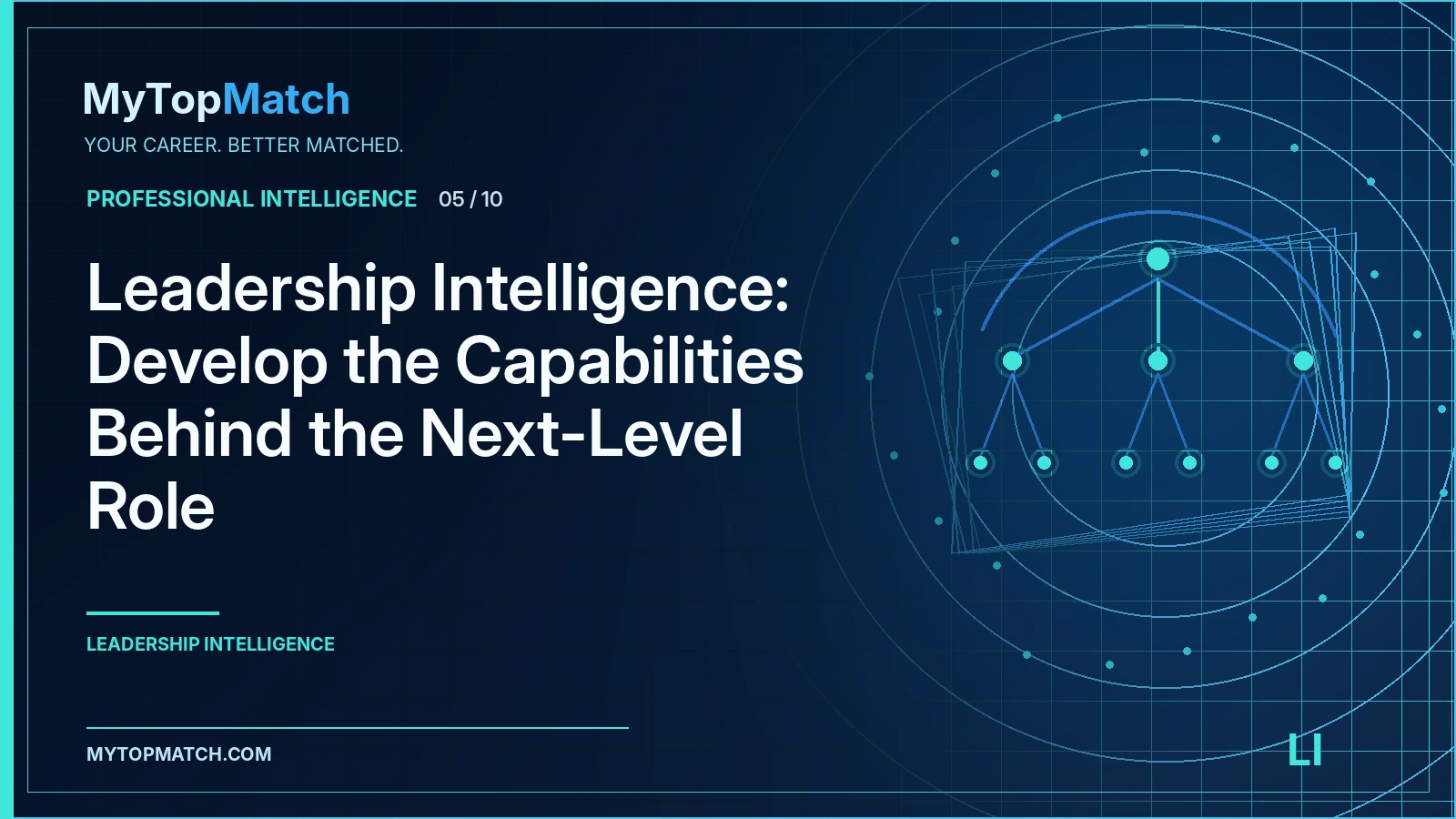
A higher title can bring a different kind of work. Moving from expert to manager, manager to director or director to executive requires more than a larger version of yesterday’s technical skills.
That is where Leadership Intelligence becomes useful. This Professional Intelligence assessment examines patterns that can support more informed choices about work, development and opportunity. The assessment is free for MyTopMatch members, with a personalized mini report included.
What the assessment measures
The assessment examines 16 leadership capabilities. Its defined areas cover direction and mobilization (purpose, priority, change sensemaking, ownership and commitment.); empowerment and development (delegated responsibility, coaching, development, motivation, recognition and shared leadership.); trust, voice and accountability (credibility, inclusion, psychological safety, fair process and constructive challenge.); organizational influence and stewardship (stakeholder alignment, boundary spanning, ethical role modeling, resource mobilization, adaptation and learning.).
These dimensions are interpreted within this assessment's own evidence boundaries. They are not blended into an overall Professional Intelligence score or a prediction of career success. Understanding a pattern is the beginning of analysis, not an instruction to take a particular job.
What the result means for your next decision
A professional seeking a director role may have strong delivery experience but limited examples of stakeholder alignment or delegated ownership. Leadership Intelligence cannot approve or reject the career move. It can help identify development practices and evidence the candidate should gather before making the case.
Use the report to identify which professional question has become clearer and which question still requires evidence. The strongest conclusions combine assessment insight with actual work examples, role requirements, market conditions, preferences and constraints. The assessment cannot replace any of those sources.
Situational understanding and work-environment compatibility
An appealing company and an appealing job title are not enough information. Examine how the work is organized, what the manager expects, which decisions the role controls, how conflict is handled, and which capabilities the job will require every week.
The assessment may help you articulate what to investigate and where you want to improve. It cannot measure an organization's culture from your responses, make a hiring recommendation or determine whether you will be successful in a particular workplace.
Turn the result into career mobility
Review target-role descriptions for expectations involving direction, people development, accountability and cross-functional influence. Pair your assessment reflections with actual leadership examples. Where the evidence is thin, build experience through a stretch assignment and document the result.
Keep the distinction between your demonstrated capabilities, the orientations you report and the skills you intend to build. That protects the credibility of your career story and makes the development plan more useful. Consider your Professional Passport and career intent as additional context rather than treating any assessment as an automatic matching verdict.
The right boundary for interpretation
The assessment is research-informed and undergoing empirical refinement. It is intended for development, reflection, learning and coaching, not employment selection. It does not provide population percentiles, a master Professional Intelligence score, a hiring or promotion recommendation, a clinical diagnosis, or a guaranteed outcome.
All ten Professional Intelligence assessments and their personalized mini reports are included in the MyTopMatch member assessment library. Full reports are optional.
Explore the assessment library: https://mytopmatch.com/assessments
Your next move should be informed by what you know about yourself, what you can demonstrate, and what the opportunity actually requires.