
MyTopMatch’s public resources extend beyond individual tools and document services. Its Career Intelligence Library provides guides to matching, professional evidence, positioning and job-search decisions. Its research section publishes analysis of careers and the labor market, and its Weekly AI Briefing provides a framework for interpreting developments in AI and work. These are distinct resources with different purposes. [1] [2] [3]
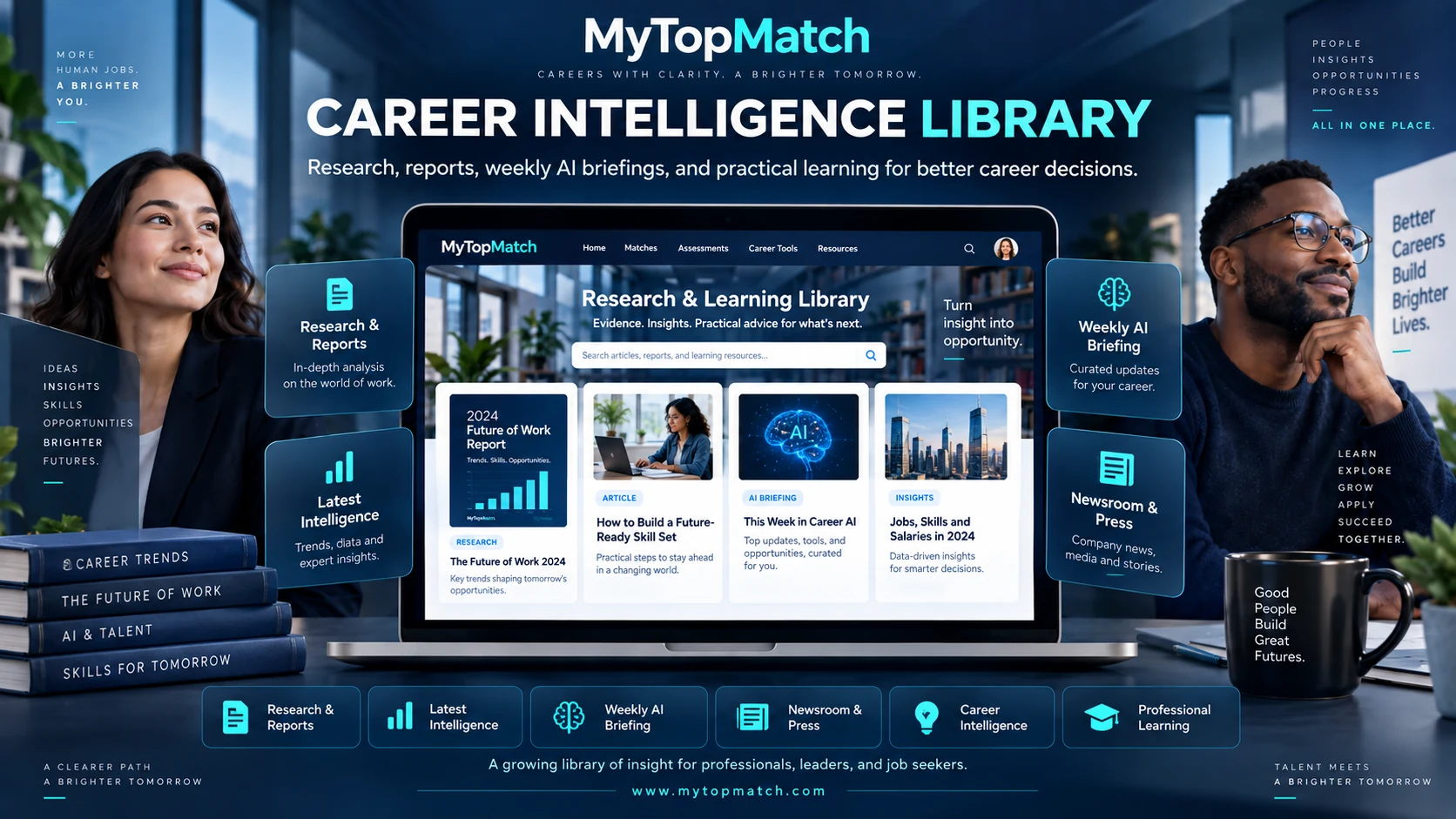
For a professional, the value of a resource begins with the question it helps answer. An explanation of match scores can improve the way a person reads recommendations. A study of occupational pay can provide context. An article about AI can suggest a question about work design. Each becomes more useful when its scope remains clear.
Use the learning library to understand the method
The Career Intelligence Library includes foundational guides on personalized job matching, interpreting a match score, transferable skills, career positioning, job-search burnout and responsible AI in hiring. The index emphasizes fit, evidence, professional direction and decision quality. [1]
These topics support practical distinctions. A job title does not contain a complete account of someone’s work. A match score does not explain itself. A larger application count does not answer whether the opportunities deserve the person’s attention. Readers can use the guides to identify the information they need before taking the next step.
For example, someone considering a career change could examine which achievements travel across industries and which qualifications remain specific to the destination. That exercise creates a clearer basis for reviewing a job description or asking for professional advice. It is an illustrative use of the library, not a reported result.
Read original research for what it establishes
The research index presents analyses involving compensation, education, geography, occupational access and career mobility. Its published standard calls for identifying sources, methods, calculations, limitations and interpretation boundaries. Some listed releases expressly withhold rankings or recommendations when the evidence does not support them. [2]
A reader should distinguish a population-level observation from an individual forecast. An occupation’s reported pay distribution does not establish what a specific person will be offered. An association between educational categories and occupational pay does not, by itself, measure the causal return from enrolling in a program.
The same care applies to rankings. A ranking depends on what is measured, how the components are weighted and how missing information is handled. Before acting on one, ask whether its method matches the decision being made. The highest-scoring option under a formula may not match the person’s constraints.
Connect research to a personal decision carefully
MyTopMatch’s Professional Passport and Career Intent provide individual context, while public research addresses broader questions. These should remain distinguishable. A professional’s actual experience, location, responsibilities, preferences and evidence still matter when interpreting a market finding. [4] [5]
A useful sequence is to identify the public finding, examine its boundary and formulate a personal question. A study of geographic differences might lead someone to compare relocation costs and work arrangements. A finding about role requirements might prompt a closer review of target postings. The research informs the inquiry; the personal conclusion requires additional information.
Follow AI developments with an editorial standard
The Weekly AI Briefing page describes an approach that separates sources, observations, interpretation, implications and possible actions. It calls for attributable evidence, visible uncertainty and owner review before release. The page describes the editorial product and its standards; it does not establish a delivery history or guarantee that every subscriber has received every issue. [3]
For readers, that approach creates a useful habit: ask what changed, what is supported and what might matter for their own work. A technology announcement can be relevant without justifying a dramatic prediction about a particular occupation.
Use the public resources before committing to a service
The learning library, methodology pages and research index let readers examine how MyTopMatch frames career questions. The tools methodology also makes explicit that some capabilities are directional or restricted and that unsupported predictive claims should be withheld. [6]
That transparency gives a prospective member something concrete to evaluate. Does an explanation make its assumptions visible? Does a source support the claim? Does the article help the person identify a better question? Those are meaningful standards for career content.
Begin with the resource closest to the decision in front of you. Read the method and limitations, connect the information to your own evidence, and choose additional support only when it serves a defined need. MyTopMatch’s library and research index provide the current public starting points. [1] [2]
Public descriptions and prices checked September 9, 2026. Features, eligibility and prices can change. This is a MyTopMatch-branded guide, not an independent product test.