

This Week in Work, October 19–23, 2026. Editorial illustration for MyTopMatch.
Strong business results, pressure on younger workers, and investment in specialized knowledge are changing the questions professionals need to ask.
By Keith Lawrence Miller, M.A. MyTopMatch Career Intelligence Week of October 19, 2026 | Reporting through October 23, 2026
A company can report stronger results and still decide that thousands of positions should disappear.
American Express illustrated that on October 23. The company reported quarterly revenue growth of 9% and a 13% increase in adjusted earnings per share, while announcing plans to eliminate about 3,500 jobs. Its full-year adjusted earnings outlook improved. [1][2]
For an employee, those developments raise a difficult question: if business is growing, what makes a position secure?
This week's evidence suggests a more useful way to approach that question. Examine the work an organization intends to fund, the capabilities it expects from the people doing it, and the opportunities available to develop those capabilities.
Financial performance matters. So do organizational priorities, the design of a role, and the reasons an employer believes that role is necessary.
The following developments show why a career strategy needs to account for all of them.
Profitable Companies Are Still Redesigning Their Workforces
American Express's announcement was part of a broader week of organizational change. At eBay, the company described a plan announced October 20 to reduce approximately 9% of its global workforce. An SEC filing signed October 22 also said it expected third-quarter results above its previous guidance ranges.
The restructuring is expected to be substantially complete by the end of the first quarter of 2027, subject to local consultation requirements and business needs. The company said it intended to use the savings to support strategic and operating initiatives. The filing did not attribute the reductions to AI. [3]
Barclays supplied a more explicit connection between technology and staffing. On October 22, the bank said approximately 5,000 roles would be eliminated during 2026, including about 1,000 already removed. Roughly 60% concern support functions, including developers. Management linked the changes to both organizational simplification and effects emerging from AI. The announcement accompanied a 12% increase in third-quarter pretax profit. [4]
These announcements cover different implementation periods. Their figures should not be combined into a count of jobs lost this week.
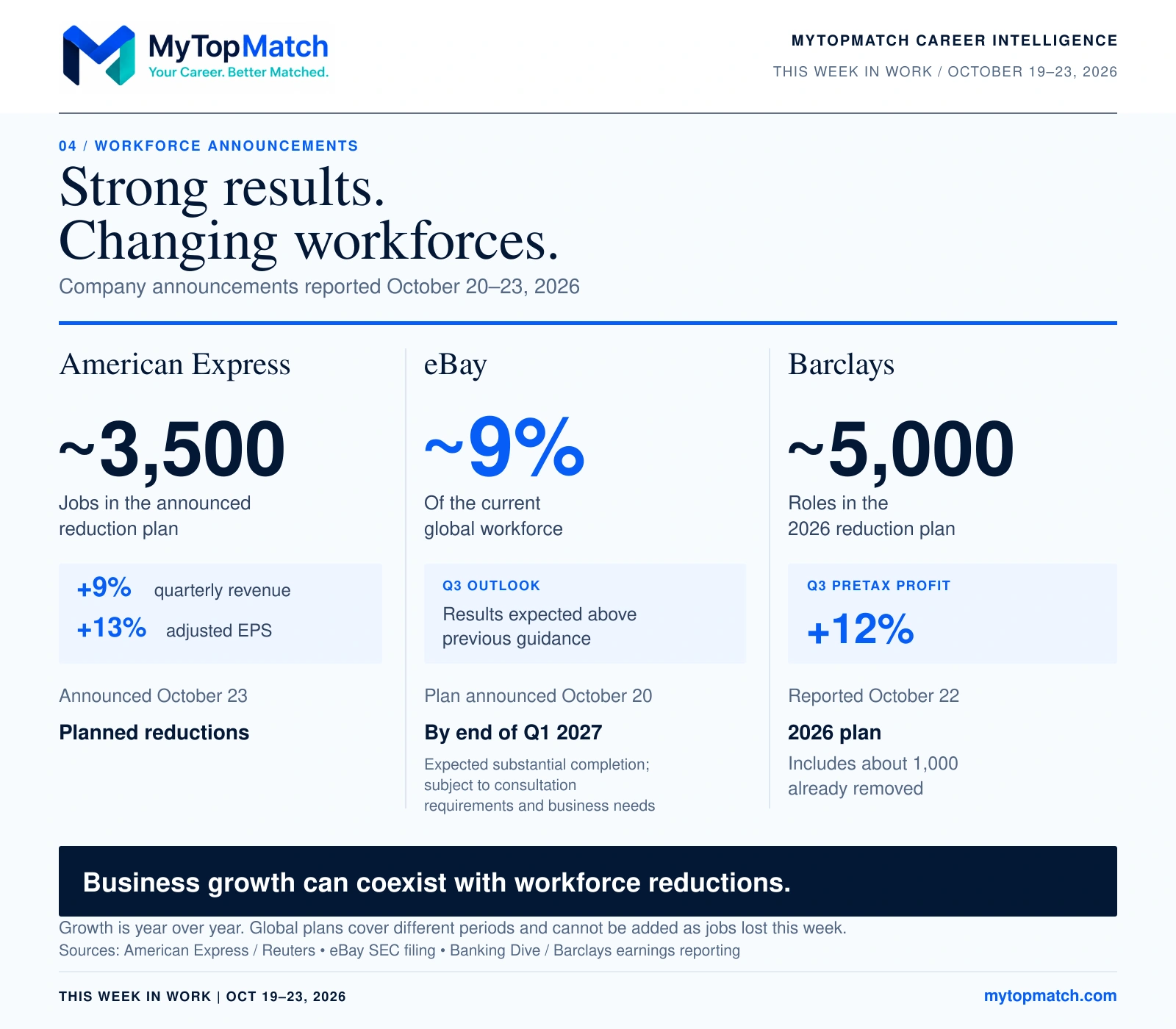
American Express, eBay and Barclays announced workforce plans alongside strong results or an improved outlook. The figures cover different global plans and implementation periods.
MyTopMatch analysis: A successful company can still decide to fund a different organizational structure. Revenue growth does not require every department to expand, and stronger earnings do not guarantee that an existing management layer, process, or position will remain.
For professionals, this makes the relationship between their work and the employer's priorities especially important.
Which customer need does the position serve? What would deteriorate if the work were performed poorly? Is the organization investing in that responsibility, consolidating it, or transferring it elsewhere?
These questions are useful for someone considering a new employer and for someone who has worked at the same organization for years.
They also support a more accurate interpretation of a layoff. The elimination of a position does not, by itself, establish that the person occupying it lacked competence. A restructuring decision and an evaluation of an individual's professional ability require different evidence.
The task after displacement is to understand what happened, identify where the person's capabilities remain useful, and communicate that value clearly to the next employer.
The National Numbers Describe a Different Part of the Story
The Labor Department's October 22 release reported 194,000 seasonally adjusted initial unemployment claims for the week ending October 17, down 6,000 from the previous week's revised figure. Continuing insured unemployment increased by 25,000 to 1.728 million for the week ending October 10. Both are advance figures subject to revision. [5]
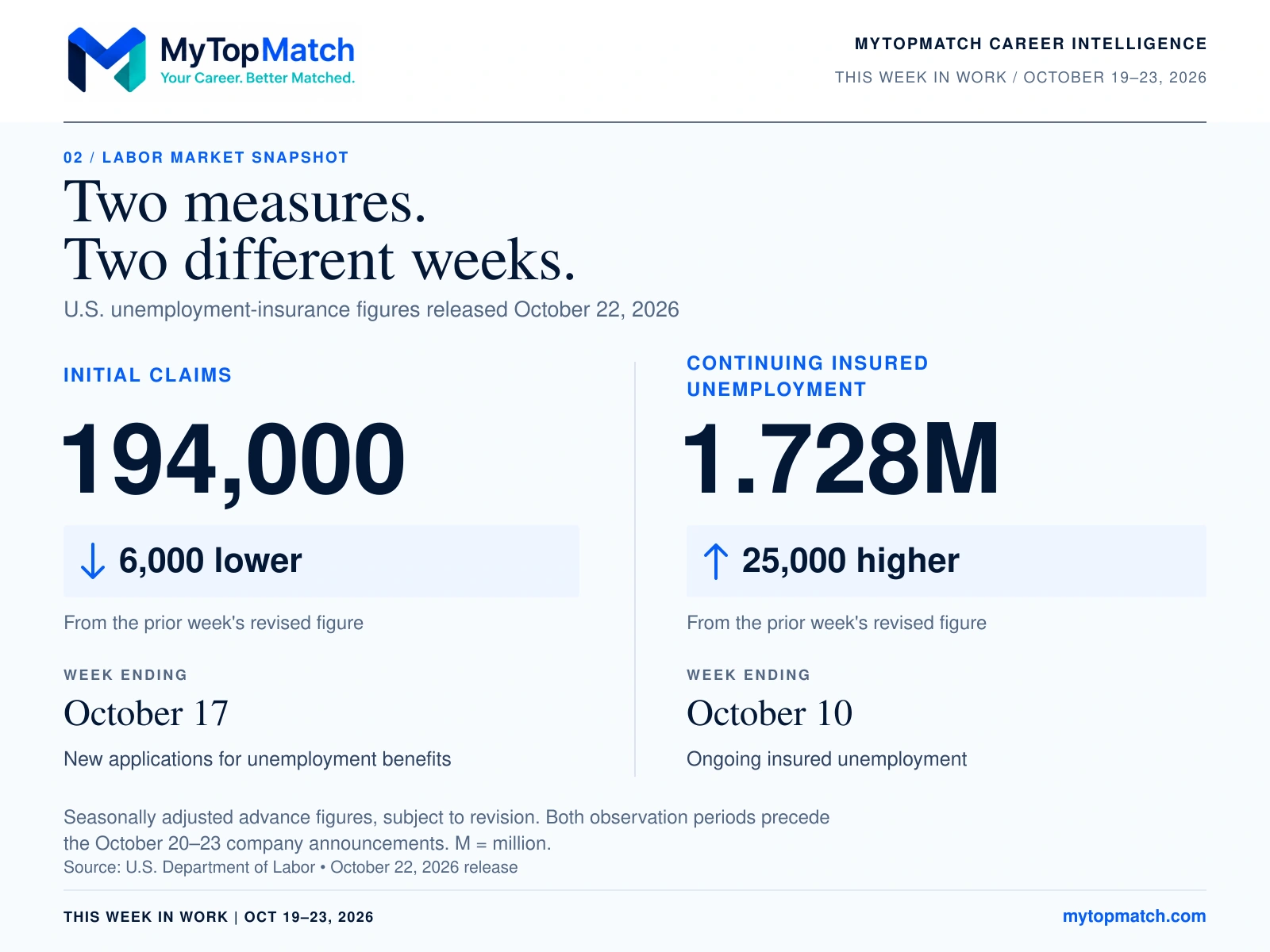
The October 22 Labor Department release covers initial claims for the week ending October 17 and continuing insured unemployment for the week ending October 10. Both are advance, seasonally adjusted figures.
Those observation periods precede the company announcements discussed above. They cannot show the eventual effect of reductions that have not yet occurred.
They also measure different things. Initial claims concern new applications for unemployment benefits. Continuing claims concern ongoing insured unemployment. Neither directly measures a particular professional's chances of obtaining a suitable offer.
MyTopMatch analysis: A relatively low level of initial claims can coexist with a frustrating search. Someone seeking a specialized position, a particular salary, or a role within a limited geographic area faces a narrower market than the national totals describe.
That makes precise diagnosis more useful than a general verdict about the economy.
The economic environment provides context. The pattern of results helps identify what needs attention in an individual search.
New AI Employment Data Raises the Stakes for Younger Workers
An October 21 update from ADP Research and the Stanford Digital Economy Lab provides a more detailed view of where pressure is appearing.
The Canaries Dashboard reported the following year-over-year employment changes for September within its research sample: [6]
Worker group: All ages Occupations with high AI exposure: −0.5% Occupations with the least AI exposure: +1.0%
Worker group: Ages 22–25 Occupations with high AI exposure: −3.7% Occupations with the least AI exposure: +0.2%
Comparison: September 2026 against September 2025. These are employment changes, not unemployment rates or percentages of workers laid off.
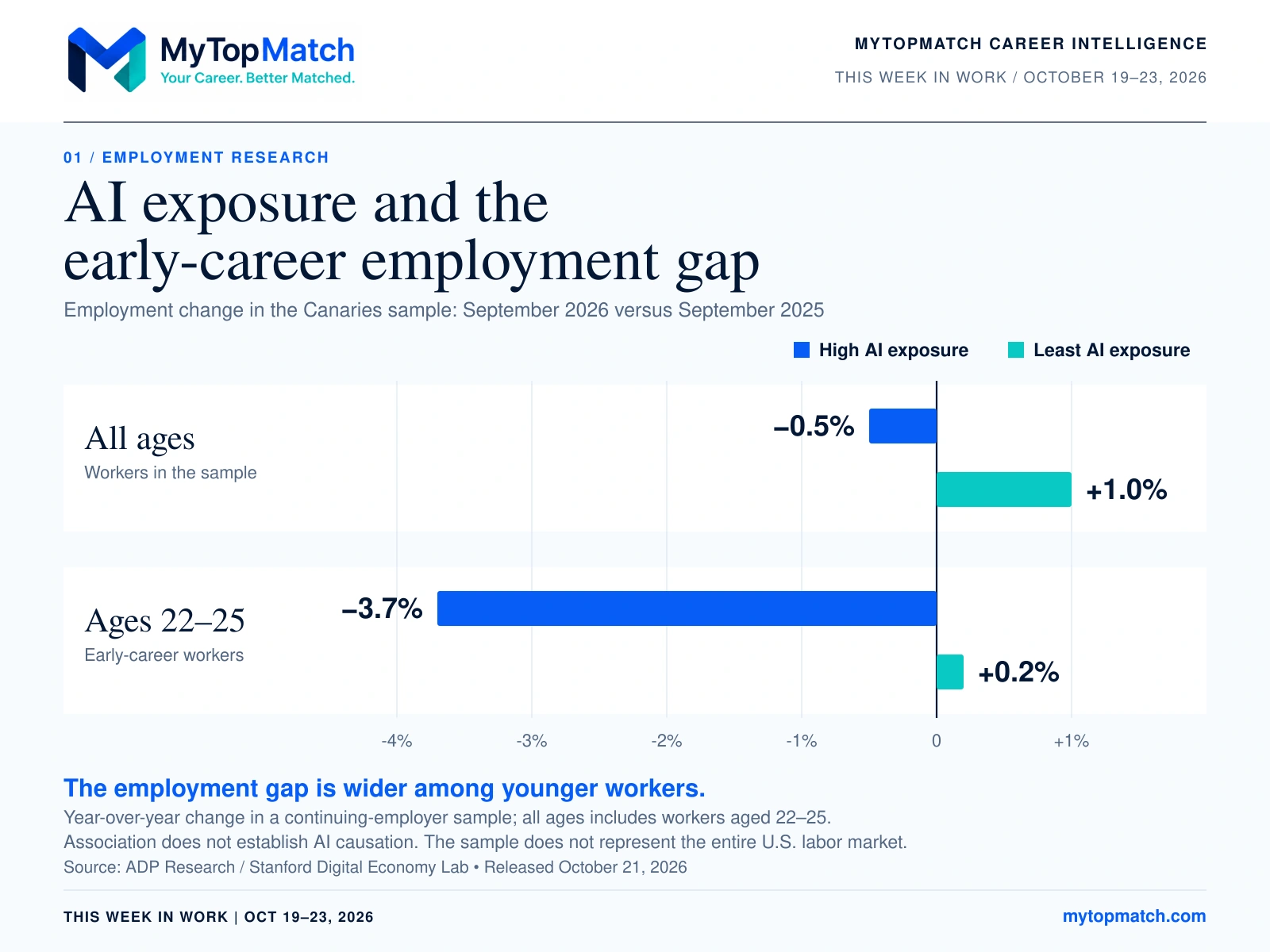
September employment changes in the ADP/Stanford Canaries sample show a larger gap between high- and least-AI-exposure occupations among workers aged 22–25. The findings show association and do not establish causation.
The dashboard uses a continuing sample of employers with five years of ADP payroll history and workers matched to occupation codes. It is not representative of the entire U.S. labor market. Stanford explicitly states that the dashboard measures correlation between occupational AI exposure and employment trends, rather than establishing a causal relationship. [7]
The findings therefore identify a pattern requiring attention. They do not count how many people were individually replaced by AI.
MyTopMatch analysis: For younger workers, a central career issue is access to the assignments through which professional judgment develops.
Consider a hypothetical junior analyst whose team uses AI to prepare an initial report. The employee still needs opportunities to examine the underlying information, identify an unsupported conclusion, understand a customer's problem, and explain why a recommendation is appropriate.
Those responsibilities can be taught. They need deliberate practice, feedback, and progressively greater ownership.
A useful early-career work sample should make that thinking visible. It can explain the problem, the information considered, the choices made, the errors corrected, and the reasoning behind the final recommendation. If AI contributed, the sample should accurately describe that contribution and the review performed.
For employers, the corresponding responsibility is to maintain a credible path from beginner to experienced professional.
If a company reduces introductory assignments, it should explain how employees will acquire the knowledge previously developed through those assignments. Otherwise, an efficiency decision today may create a capability problem later.
Employees and Leaders Are Looking at AI From Different Positions
Microsoft research released this week revealed a substantial gap in expectations.
Censuswide surveyed 5,000 UK employees and 1,000 senior business decision-makers for Microsoft. Eighty-four percent of the leaders were confident that the UK could become a world-leading AI economy within five years, compared with 41% of employees.
Among employees using AI at work, 35% worried that the technology had reduced their own job security, and 57% were concerned about fewer opportunities for young people and new entrants. The survey was conducted October 2–12; Microsoft's page is dated October 20 and describes the findings being unveiled October 21. These are reported attitudes in a UK survey, rather than measurements of job losses or evidence about the U.S. workforce. [8]
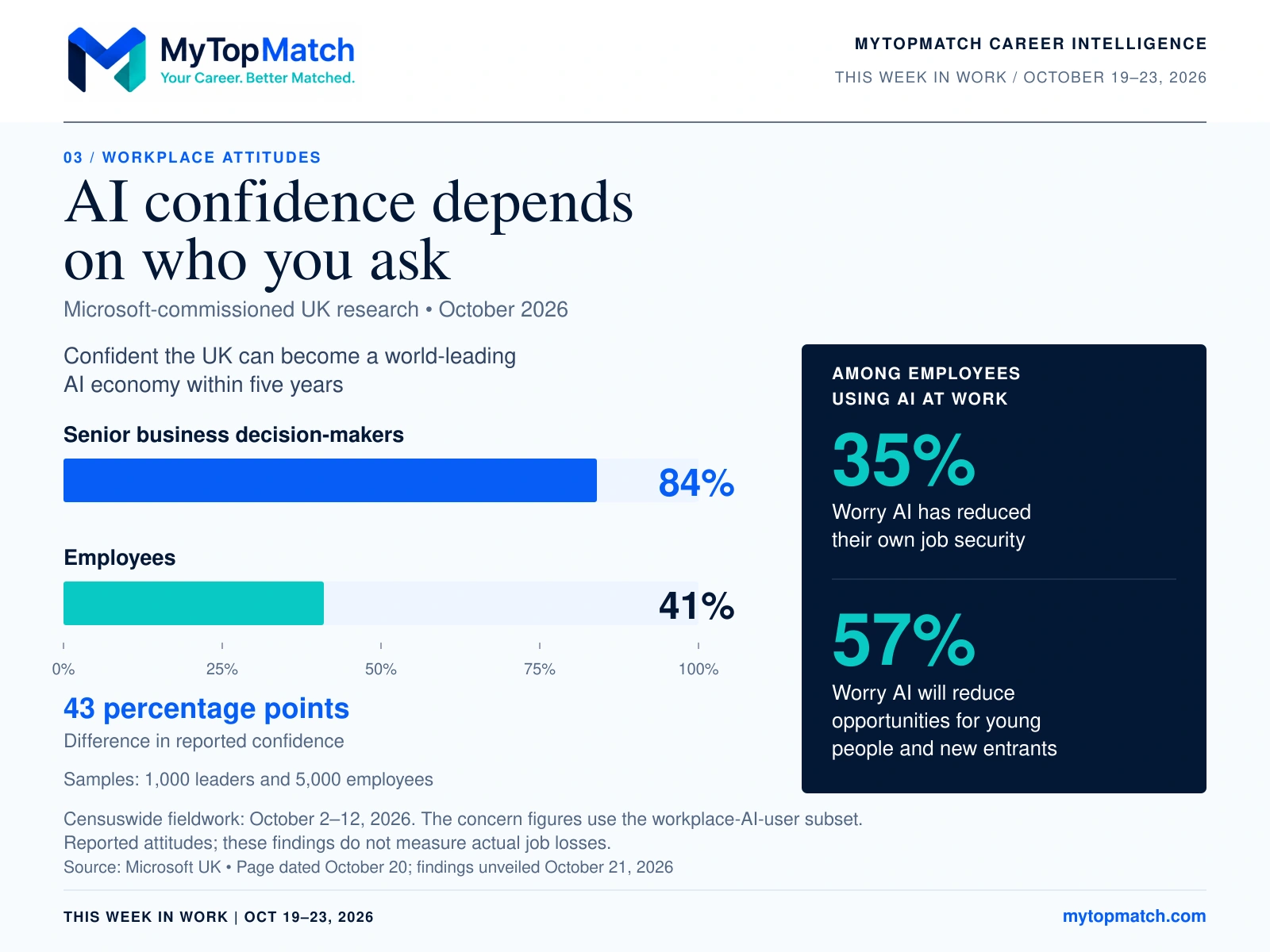
Microsoft-commissioned UK research reports different levels of confidence among senior business decision-makers and employees. The job-security and opportunity concerns refer to employees who use AI at work.
MyTopMatch analysis: Employees and executives can reasonably evaluate the same technology through different responsibilities.
A leader may see greater capacity, faster delivery, or a stronger competitive position. An employee may be trying to understand what happens to the role, the workload, the promotion path, or the value of years spent developing expertise.
Those questions deserve direct answers.
An announcement that a company has an AI strategy does not tell an employee what successful performance will look like next quarter. It does not explain whether time saved will support additional work, fewer working hours, higher expectations, or a smaller team.
Managers should make those choices understandable.
What is changing? What remains the employee's responsibility? What training will accompany the change? How will performance be evaluated? Where can someone move if the current role becomes smaller?
Clarity cannot remove every difficult consequence. It gives people information they can use to prepare, learn, and make decisions.
A $3.535 Billion Deal Shows Where Specialized Knowledge Still Matters
Workforce reductions were only one part of the week's business activity.
On October 22, London Stock Exchange Group announced an agreement to acquire Octus for $3.535 billion in cash. The transaction is expected to close in the first half of 2027, subject to regulatory approval. [9]
LSEG's announcement emphasizes Octus' proprietary credit information and expert analysis. Its teams obtain difficult-to-access documentation, including lending terms and covenants, and turn it into structured information used by financial professionals. That information can also be accessed through AI workflows. [9]
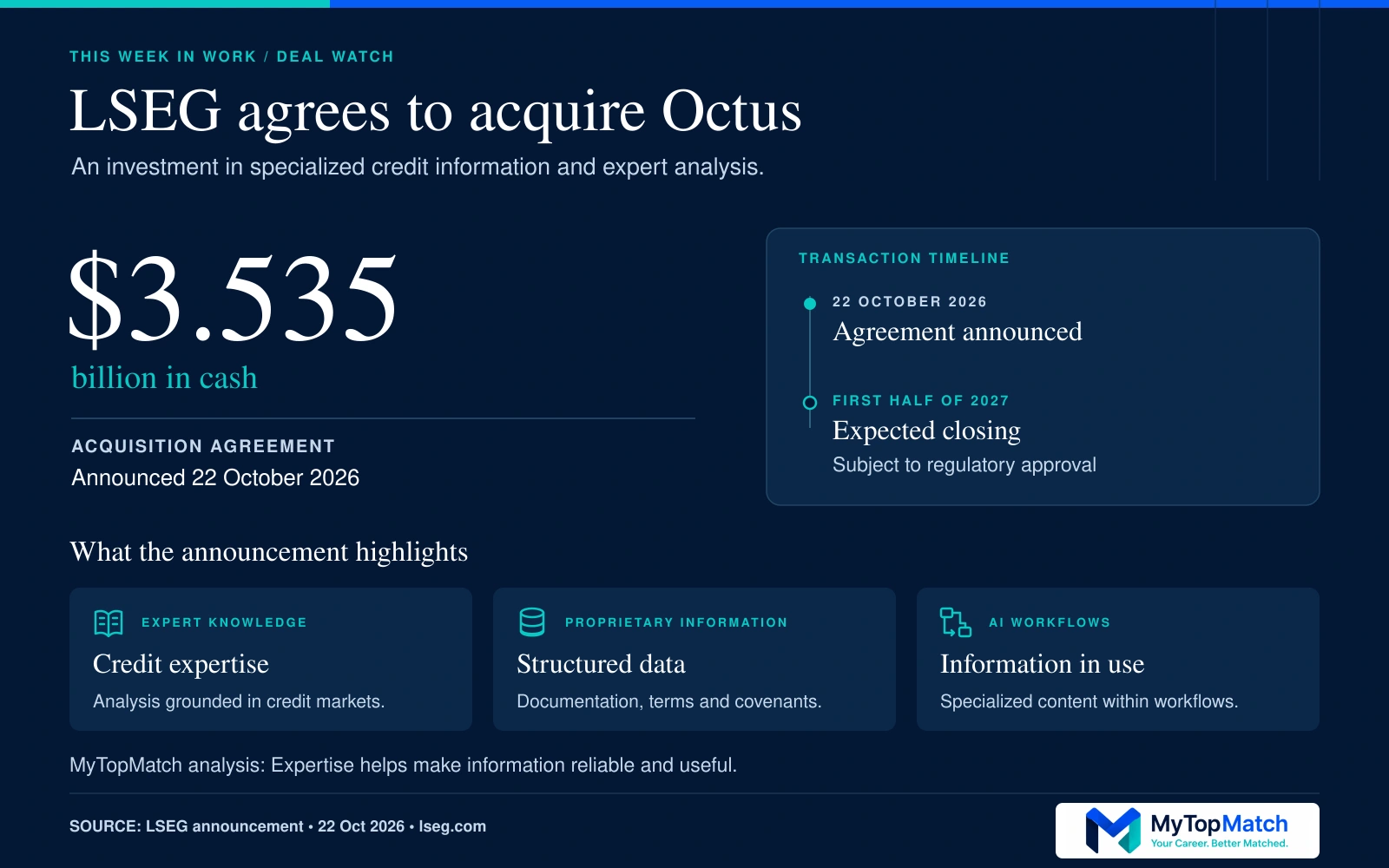
LSEG announced a $3.535 billion cash agreement to acquire Octus on October 22. Closing is expected in the first half of 2027, subject to regulatory approval.
MyTopMatch analysis: The deal offers a useful example of specialized knowledge becoming part of the infrastructure through which AI delivers value.
For a professional, the relevant question is which part of their expertise makes information reliable and useful.
An experienced practitioner may recognize that an apparently clear answer overlooks a contractual obligation, misreads a customer's needs, relies on an inappropriate comparison, or recommends something that cannot be implemented.
A résumé and an interview should reveal those contributions. Describe the decisions improved, the risks identified, the relationships managed, and the results supported by that knowledge.
The acquisition does not establish a general salary premium or a hiring commitment. It does provide a concrete example of a business investing heavily in information and expertise that support consequential decisions.
That is a more useful career signal than assuming that all knowledge work will move in the same direction.
What Professionals Can Do With This Week's Evidence
The practical response begins with a clear account of the work a person can perform and the reasons an employer would fund it.
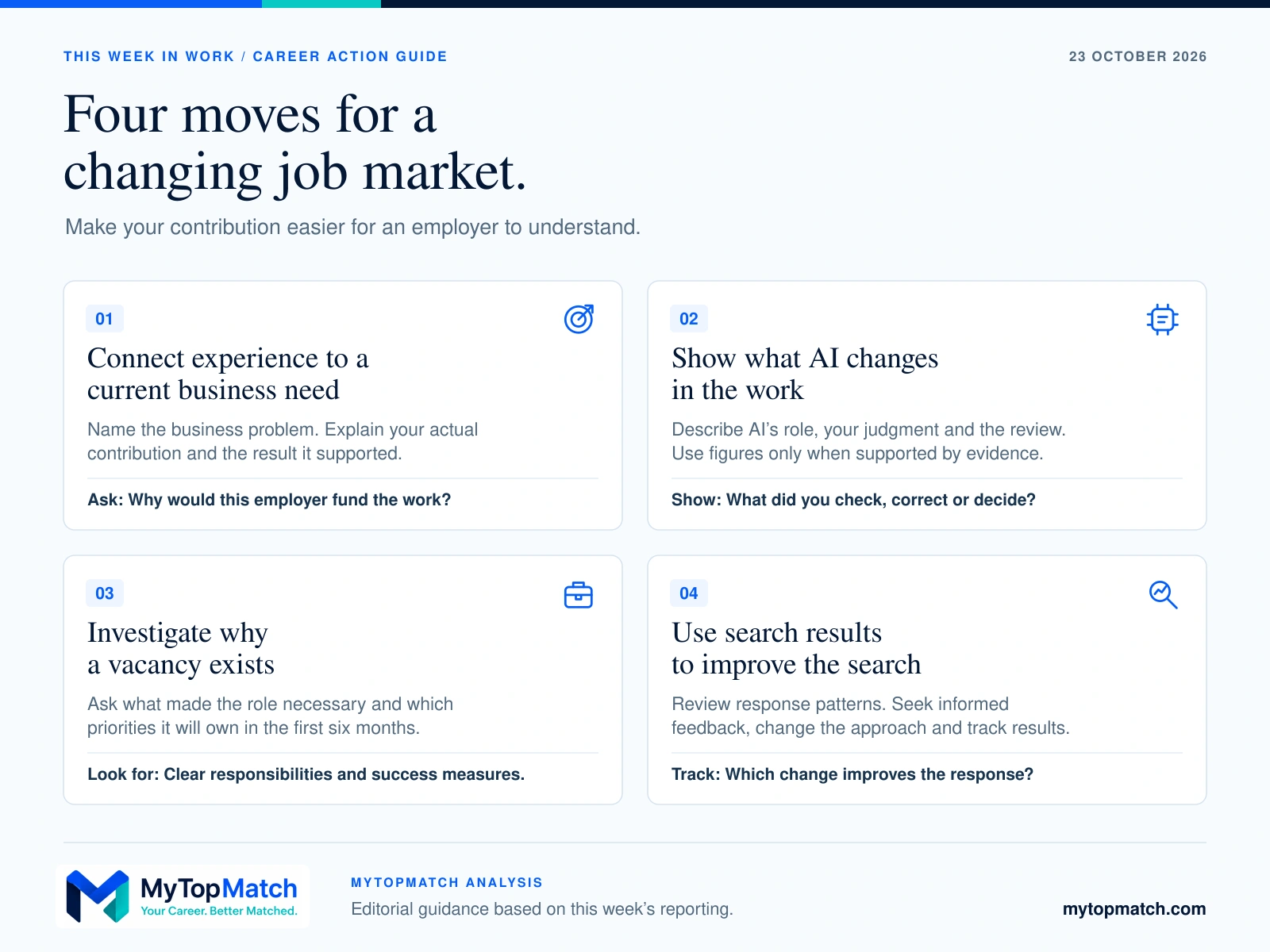
Four ways to make a professional contribution easier to understand: connect experience to a business need, explain AI’s role, investigate the vacancy, and learn from search results.
Connect Experience to a Current Business Need
A history of responsibilities gives an employer background. A clear explanation of relevant results gives the employer a basis for evaluating fit.
An operations professional might show how a process change improved service. A finance professional might explain how an analysis changed a decision. A manager might demonstrate how a team maintained quality while responsibilities expanded.
The evidence should connect the person's actual contribution to a problem the target organization needs to solve.
This also makes transferable experience easier to recognize. A change in industry does not erase everything a professional knows, but the connection to the new work needs to be explained.
Show What AI Changes in the Work
Naming several AI applications tells an employer very little about the quality of someone's work.
A stronger explanation describes the assignment, the technology's role, the professional's judgment, the review process, and the resulting improvement. Where an improvement has not been measured, describe the work accurately without inventing a percentage.
For example, a hypothetical account manager could explain how AI assisted with preparing customer briefings, how the underlying information was checked, and how the briefings supported more focused conversations. The account manager's contribution includes deciding what matters to the customer and taking responsibility for what is presented.
That is an intelligible professional capability. It can be discussed, examined, and compared with the employer's needs.
Investigate Why a Vacancy Exists
During an interview, ask what made the position necessary.
Is the organization replacing someone, expanding an existing service, entering a new market, or addressing a problem? Which priorities will the person own? How will success be assessed during the first six months?
The answers provide a more useful view of a role than its title alone.
For people already employed, similar questions belong in conversations with managers. Understanding where responsibilities are moving makes it easier to identify relevant development and internal opportunities.
Use Search Results to Improve the Search
Effort should produce information.
If applications consistently receive little response, examine a representative group of target roles and assess whether the résumé makes the required experience clear. If interviews stall, review the questions, examples, concerns, and decisions that repeatedly arise.
Where possible, obtain informed feedback and change a meaningful part of the approach. Track whether the response improves.
A difficult environment increases the importance of diagnosing the process. It does not make an ineffective approach more useful through repetition.
Employers Need to Evaluate the Whole Result
The organizational responsibility extends beyond announcing an efficiency target.
When technology changes a workflow, leaders should measure the complete result: preparation, execution, review, correction, customer response, and ongoing supervision.
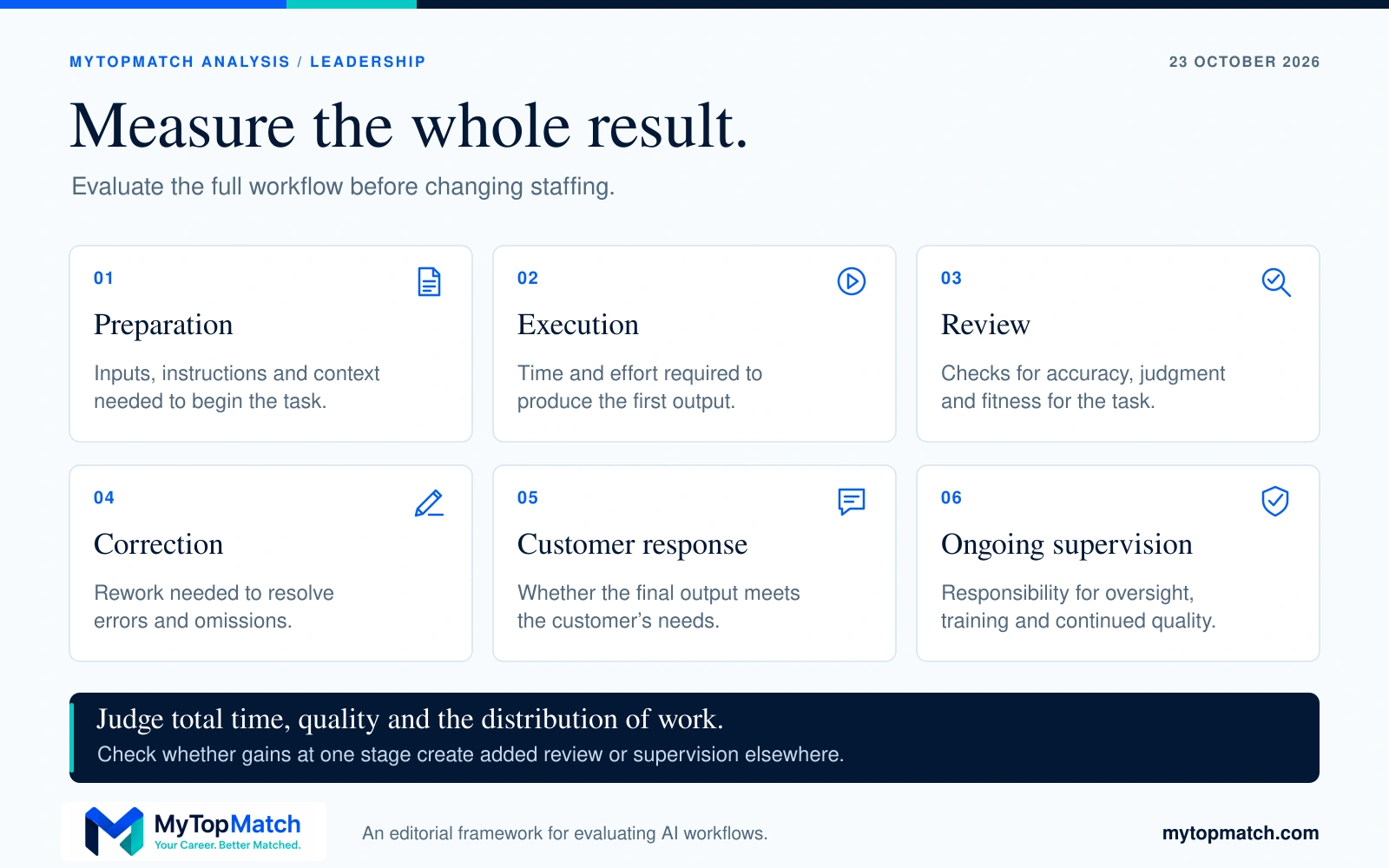
Evaluate preparation, execution, review, correction, customer response and ongoing supervision before drawing conclusions about AI-driven efficiency.
Consider a hypothetical team that produces initial proposals much faster with AI. Before changing staffing, management needs to establish whether the total time to an accepted proposal has fallen, whether quality has improved, and whether additional review has been transferred to a smaller group of employees.
The answer may support a different structure. It may also reveal a training need, a quality problem, or a bottleneck elsewhere.
Workforce decisions should follow that fuller account of performance.
Leaders also need to preserve responsibility for developing people. Experienced employees need time to teach. Newer employees need substantive assignments. Remaining teams need a realistic account of the work they will inherit after positions are removed.
Where a role is ending, clear communication, meaningful consideration for internal openings, and useful transition support belong in the execution plan.
An employee's future should receive the same seriousness as the spreadsheet that records the saving.
“An employee’s future should receive the same seriousness as the spreadsheet that records the saving.” Keith Lawrence Miller, M.A., MyTopMatch Career Intelligence.
What to Watch Next
The Federal Reserve's next scheduled meeting is October 27–28. The Bureau of Labor Statistics is scheduled to release September job-openings and turnover data on November 3 and the October employment report on November 6. [10][11]
The employment questions extend beyond whether one headline number improves.
Are employers filling vacancies? Are younger workers gaining access to substantive roles? Are companies reinvesting savings in growth and employee development? Do the results after restructuring support the reasons given for it?
At the individual level, the corresponding question is practical:
Can a prospective employer clearly understand what this person knows, what the person can accomplish, and why that contribution matters now?
A career strategy should make the answer easier to see. It should also prepare the professional to recognize when the surrounding organization has changed enough to require a different next step.
Sources and Reporting Notes
1. American Express, October 23, 2026. Q3 2026 earnings release (https://s26.q4cdn.com/747928648/files/doc_earnings/2026/q3/earnings-result/Q3-2026-Earnings-Press-Release.pdf). Company-reported financial results and outlook. The 13% figure concerns adjusted earnings per share, a non-GAAP measure.
2. Reuters, October 23, 2026. AmEx lifts 2026 profit forecast, plans to cut 5% of workforce (https://www.reuters.com/business/american-express-raises-2026-profit-forecast-affluent-customers-keep-spending-2026-10-23/). Reported plan for about 3,500 positions, not a count of completed departures.
3. eBay, SEC Form 8-K, signed October 22, 2026. October 20 restructuring announcement and financial outlook (https://www.sec.gov/Archives/edgar/data/1065088/000106508826000205/ebay-20261020.htm). Items 2.02 and 2.05. Expected results and implementation timetable remain forward-looking.
4. Banking Dive, October 22, 2026. Barclays to cut 5,000 employees this year (https://www.bankingdive.com/news/barclays-cut-5000-employees-ai-q3-earnings-venkat/833747/). Reporting of management's statements, including the approximately 1,000 reductions already made. The figure is global and covers 2026. The profit measure is also identified in Barclays Q3 earnings-call highlights (https://finance.yahoo.com/markets/stocks/articles/barclays-q3-earnings-call-highlights-150508731.html), October 22.
5. U.S. Department of Labor, October 22, 2026. Unemployment Insurance Weekly Claims (https://www.dol.gov/ui/data.pdf). Initial claims observation week: October 17. Continuing claims observation week: October 10. The linked PDF is a rolling release URL and may later show a newer release.
6. ADP Research, October 21, 2026. Canaries Dashboard: Employment in AI-exposed occupations shrank in September (https://www.adpresearch.com/research/canaries-dashboard-employment-in-ai-exposed-occupations-shrank-in-september). Table values are year-over-year employment changes for September 2026 within the research sample.
7. Stanford Digital Economy Lab and ADP Research. Canaries Dashboard and methodology (https://digitaleconomy.stanford.edu/project/indicators/canaries-dashboard/), updated October 21, 2026, accessed October 23. Observational data from a rolling five-year balanced employer sample; correlation does not establish causation.
8. Microsoft UK, page dated October 20, 2026; findings unveiled October 21. British bosses bullish on AI, but less than half the workforce confident in UK's ability to become leading AI economy (https://ukstories.microsoft.com/features/less-than-half-workforce-confident-in-uk-ability-to-become-leading-ai-economy-microsoft-research/). Microsoft-commissioned Censuswide survey, fieldwork October 2–12. The 35% and 57% findings concern employees using AI at work.
9. London Stock Exchange Group, October 22, 2026. Octus transaction announcement (https://www.lseg.com/content/dam/lseg/en_us/documents/investor-relations/press-releases/lseg-octus-transaction-announcement.pdf). Acquisition agreement, with expected closing in the first half of 2027 subject to regulatory approval.
10. Federal Reserve. FOMC meeting calendar (https://www.federalreserve.gov/monetarypolicy/fomccalendars.htm), checked October 23, 2026.
11. U.S. Bureau of Labor Statistics. November 2026 release schedule (https://www.bls.gov/schedule/2026/11_sched.htm), checked October 23, 2026.
The sections labeled MyTopMatch analysis and the practical recommendations are editorial interpretation. Company plans, survey attitudes, observed employment changes, and completed financial results retain their respective meanings.

Your Career. Better Matched. Explore career intelligence at MyTopMatch.com. https://mytopmatch.com