
Editorial review: September 12, 2026. Vendor descriptions are identified below; no employer ATS or paid résumé-review workflow was tested for this article.
A high résumé score can feel like permission to stop worrying about the application.
Before you rely on it, open the explanation. What was measured? Which job description was used? What changed in the document? Did the reviewer find stronger evidence, or simply more of the expected words?
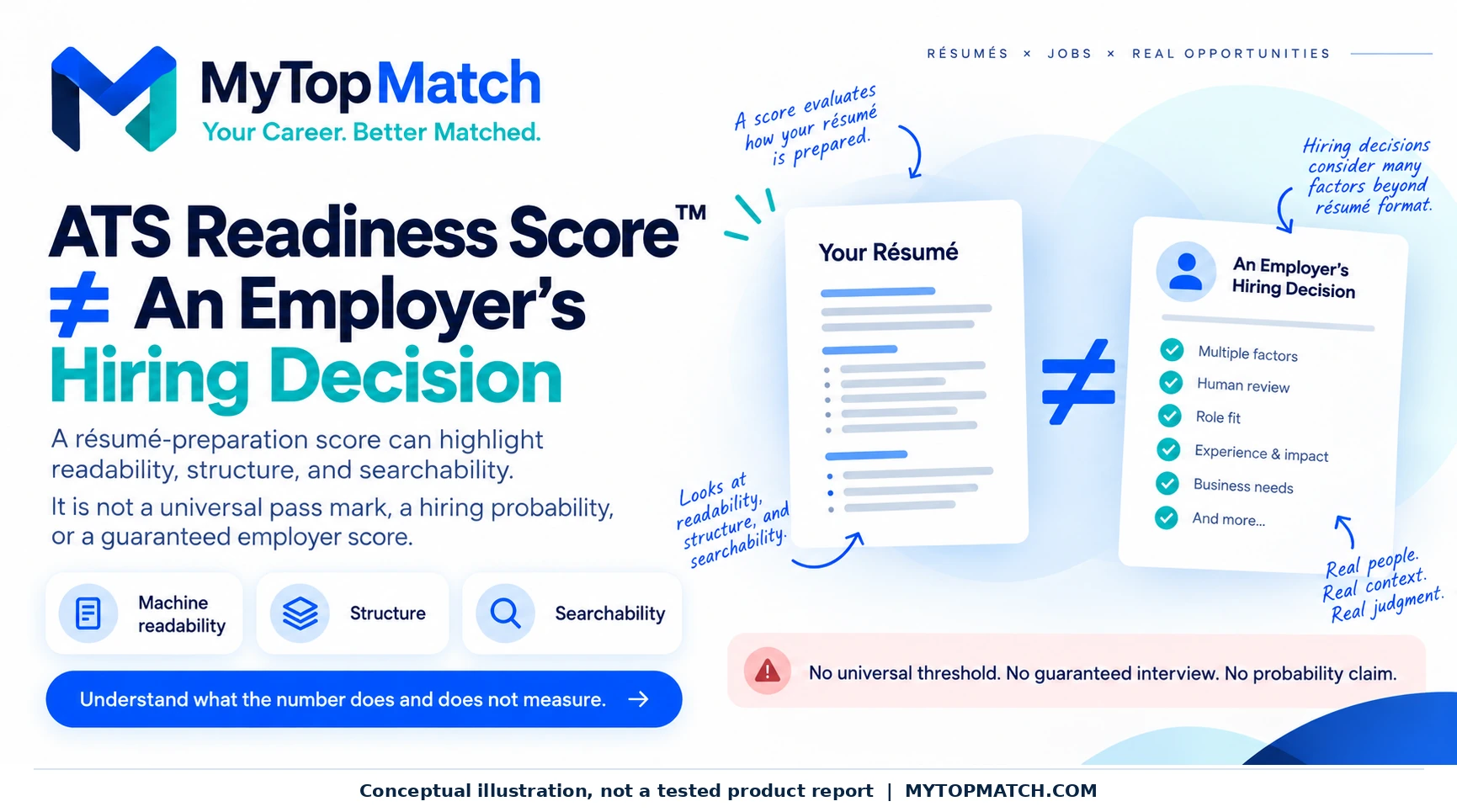
MyTopMatch’s public definition makes an important distinction: its ATS Readiness Score™ concerns machine readability, structure, and recruiter searchability. It is separate from a score generated inside an employer’s applicant tracking system and does not predict acceptance or rejection. [S1]
That boundary still leaves useful work for a review to do. It can identify what needs inspection, explain missing evidence, and help you make accurate improvements. Its value depends on the findings behind the number.
Use the score to locate a problem. Use the evidence to decide what to change.
Start by naming the score
This guide focuses on résumé-preparation scores produced outside an employer’s hiring process. Those should be distinguished from assessments or matching results generated within that process.
For example, Jobscan describes its match rate as a way to visualize how closely a résumé matches a supplied job description. That is a provider-defined preparation measure. It does not establish what a particular employer has configured or how the employer will evaluate an application. [S8]
Employer-side matching can exist. Greenhouse’s Talent Matching documentation describes match categories based on criteria and importance levels selected by the hiring team. It also states that the feature does not automatically advance or reject candidates. [S4]
These descriptions support a narrower, more useful conclusion than “ATS systems always score” or “ATS systems never score”: identify the product, the function, and the configuration before interpreting the result. [S4, S8]
There is no basis in these sources for treating a résumé-checker threshold as a universal employer pass mark. Nor does a score on a 100-point scale, by itself, represent the probability of an interview. That would require separate evidence connecting the measure to that outcome under defined conditions.
Record the tool, the résumé version, the target posting, and the evaluation date. Without those details, even a before-and-after comparison can become difficult to interpret.
Four functions that should not become one story
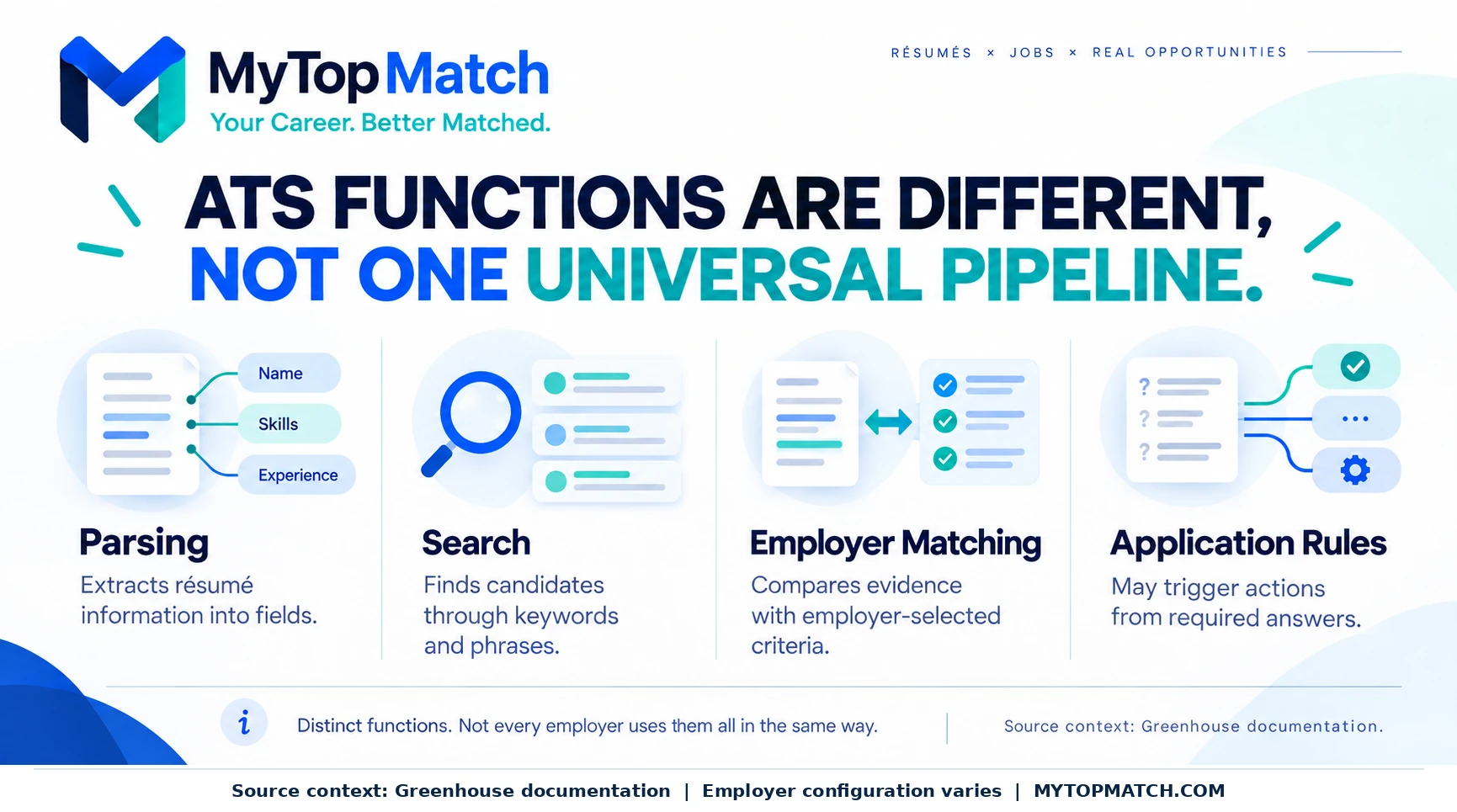
An applicant tracking system can support different activities. Greenhouse’s published documentation illustrates the distinctions below. These are documented product functions, not a claim that every employer uses them all or follows one fixed sequence. [S2–S6]
| Function | What the documentation describes | What a candidate should distinguish |
|---|---|---|
| Parsing | Extracting résumé information to populate candidate fields. | Correct extraction versus an evaluation of qualifications. |
| Search | Finding candidate information through keyword and phrase queries, including Boolean searches. | Matching a query versus being selected for an interview. |
| Talent matching | Comparing résumé evidence with employer-selected, weighted criteria. | That employer’s configured comparison versus an outside readiness score. |
| Application rules | Triggering actions, including rejection, from specified answers to application questions. | A response-based rule versus a résumé’s wording or layout. |
Sources: Greenhouse’s parsing, candidate-search, Talent Matching, and auto-reject documentation. These functions were not exercised in an employer account for this review. [S2–S6]
The distinction also matters when something goes wrong. Greenhouse explains that an unsuccessful parse can leave the résumé attached while requiring candidate fields to be entered manually. A parsing failure is therefore not, by itself, evidence that the candidate was rejected. [S2]
Separately, Greenhouse documents automatic rejection rules linked to answers to custom application questions. A polished résumé cannot change the truth of an answer to a required qualification question. Answer accurately and clarify an ambiguous requirement with the employer. [S6]
An outside reviewer normally needs additional employer-specific evidence to explain why a particular application ended. A low review score, a fast rejection email, or silence alone cannot identify which function or decision produced that result.
A useful review separates the document’s jobs
MyTopMatch’s public review description separates overall résumé effectiveness, ATS readiness, and targeted résumé alignment. It also distinguishes the broader career profile from what the current résumé communicates. [S1]
For your own review, keep these questions visible:
Can the information be extracted accurately? Inspect the relationship between names, employers, titles, dates, sections, and the text associated with them.
Does the résumé address the actual opportunity? Compare its evidence with the posting’s responsibilities, required qualifications, and stated preferences. A generic document review cannot establish alignment with a job it has never examined.
What supports the claims? Identify the work performed, the level of responsibility, and the basis for any result. A relevant term is more useful when the surrounding statement explains what the person did.
Can a person understand the value? Examine the order, clarity, and emphasis. Formatting that is readable by software still leaves content decisions to make.
These questions organize a professional review. They are not four newly validated scores, and this article assigns no numerical rating to them.
Sample review: improve the evidence without inventing the career
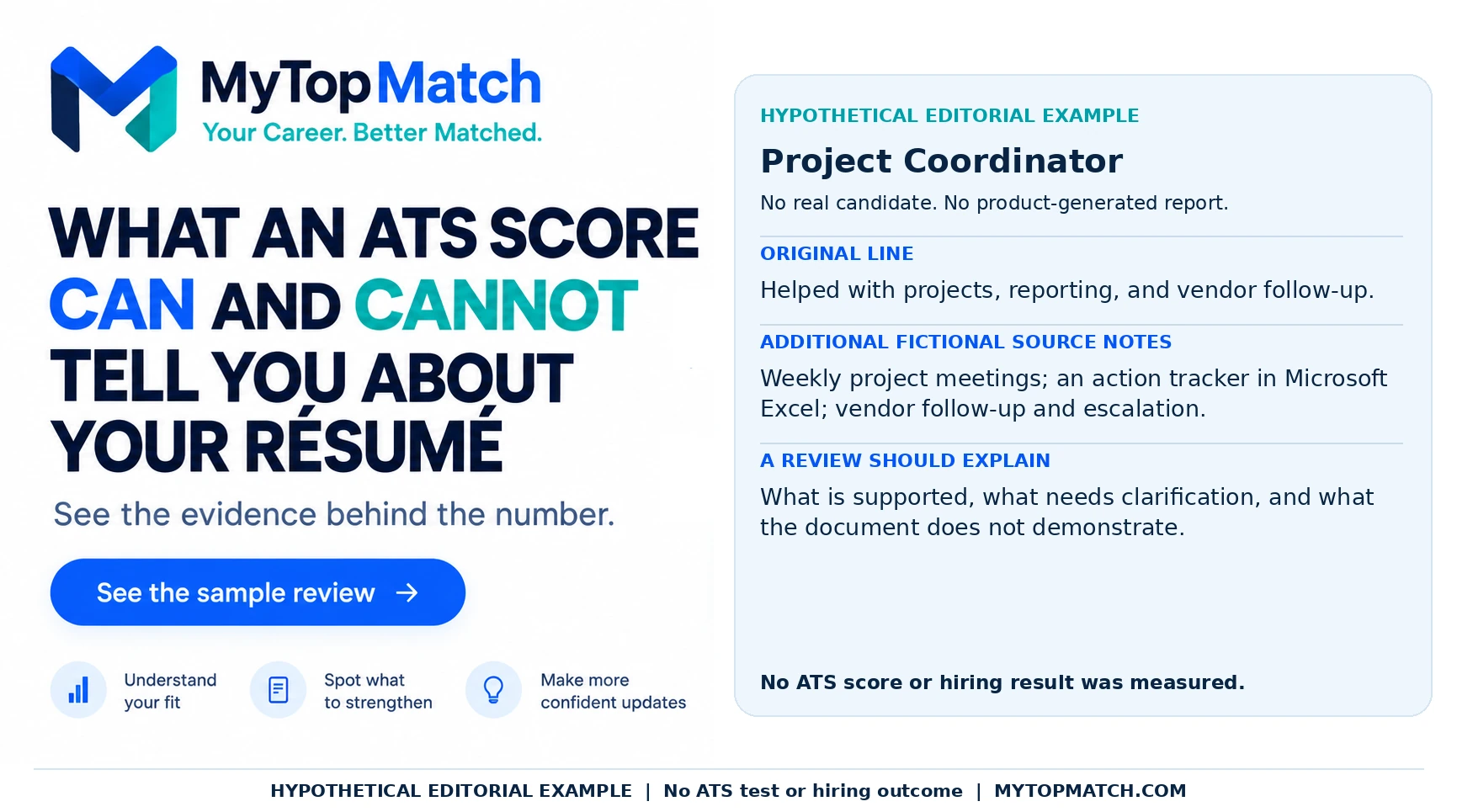
The complete case below is fictional. The vacancy, résumé excerpt, and follow-up notes were written for this article. This is an editorial teaching example, not a client case, a live job, a screenshot, or output from a tested MyTopMatch or employer system.
The target and the starting text
The fictional Project Coordinator posting asks for project-meeting coordination, Excel reporting, and vendor follow-up. It lists Jira experience and PMP certification as preferred, and three days of on-site attendance each week as required.
The starting résumé contains this line:
Helped with projects, reporting, and vendor follow-up.
The line suggests relevant activity. It does not explain the process, the tools, or the candidate’s responsibility clearly enough to establish the more specific experience.
A reviewer should ask for that information before adding it.
What the fictional follow-up confirms
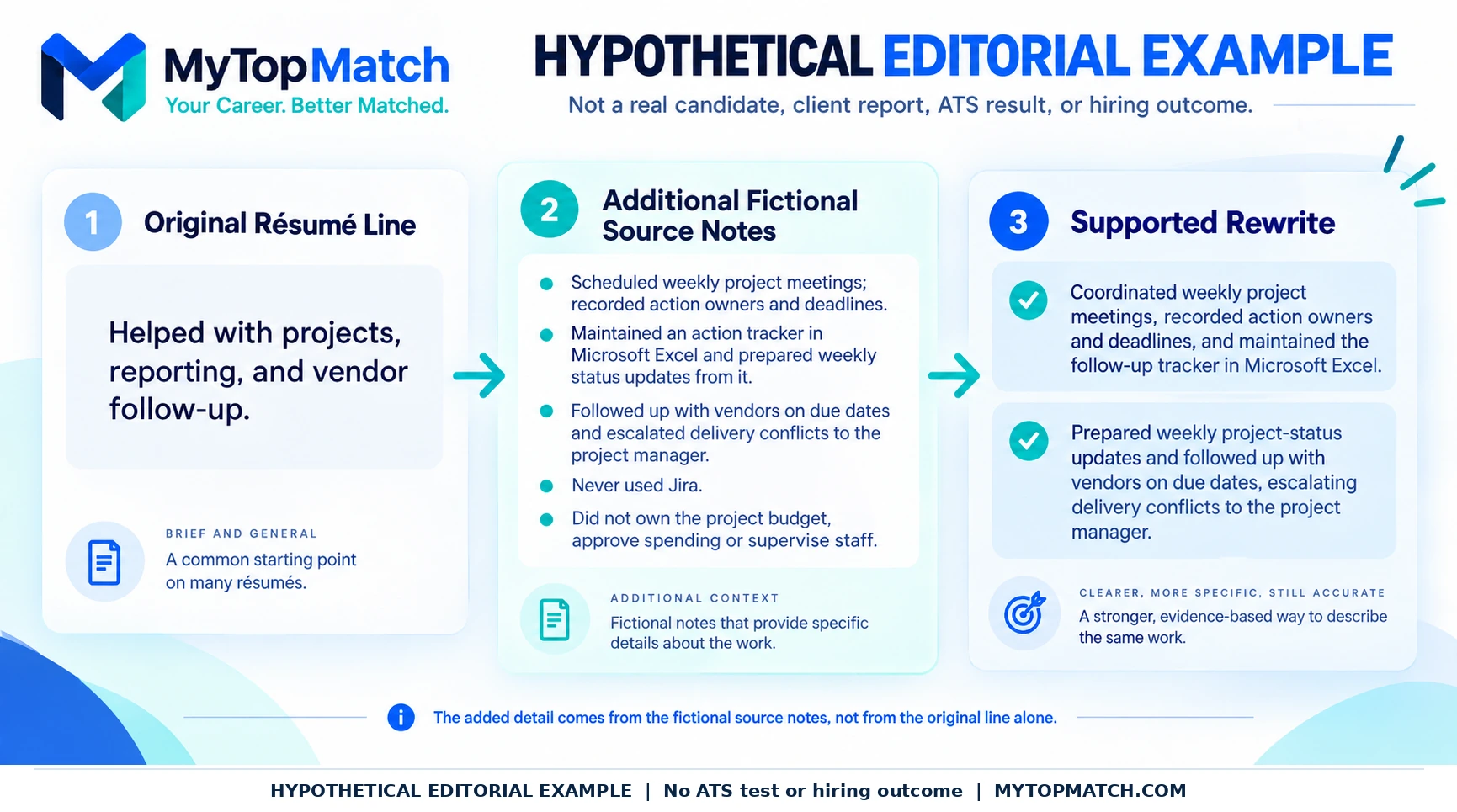
For this example, assume the candidate supplies these additional facts: they scheduled weekly project meetings, recorded action owners and deadlines, maintained the action tracker in Microsoft Excel, and prepared weekly updates from it. They followed up with vendors on due dates and escalated delivery conflicts to the project manager.
The candidate also states that they have never used Jira and did not own the project budget, approve spending, or supervise staff. Their PMP status and ability to meet the on-site schedule remain unanswered.
These follow-up notes are additional inputs. None of that detail should be inferred from the original sentence alone. In real work, obtain and confirm the information before incorporating it into a résumé.
The annotated findings
| Finding | Evidence and boundary | Next action |
|---|---|---|
| Meeting coordination is underrepresented. | The résumé says only “helped with projects”; the follow-up supplies a specific coordination process. | Add the confirmed meeting and action-tracking responsibilities. |
| Excel reporting is not yet explicit in the résumé. | The follow-up identifies the tool and the reporting work. | Name Microsoft Excel and describe the task actually performed. |
| Vendor responsibility needs a boundary. | Follow-up is confirmed; authority over purchasing or the budget is not part of the role. | Describe follow-up and escalation. Do not imply procurement ownership. |
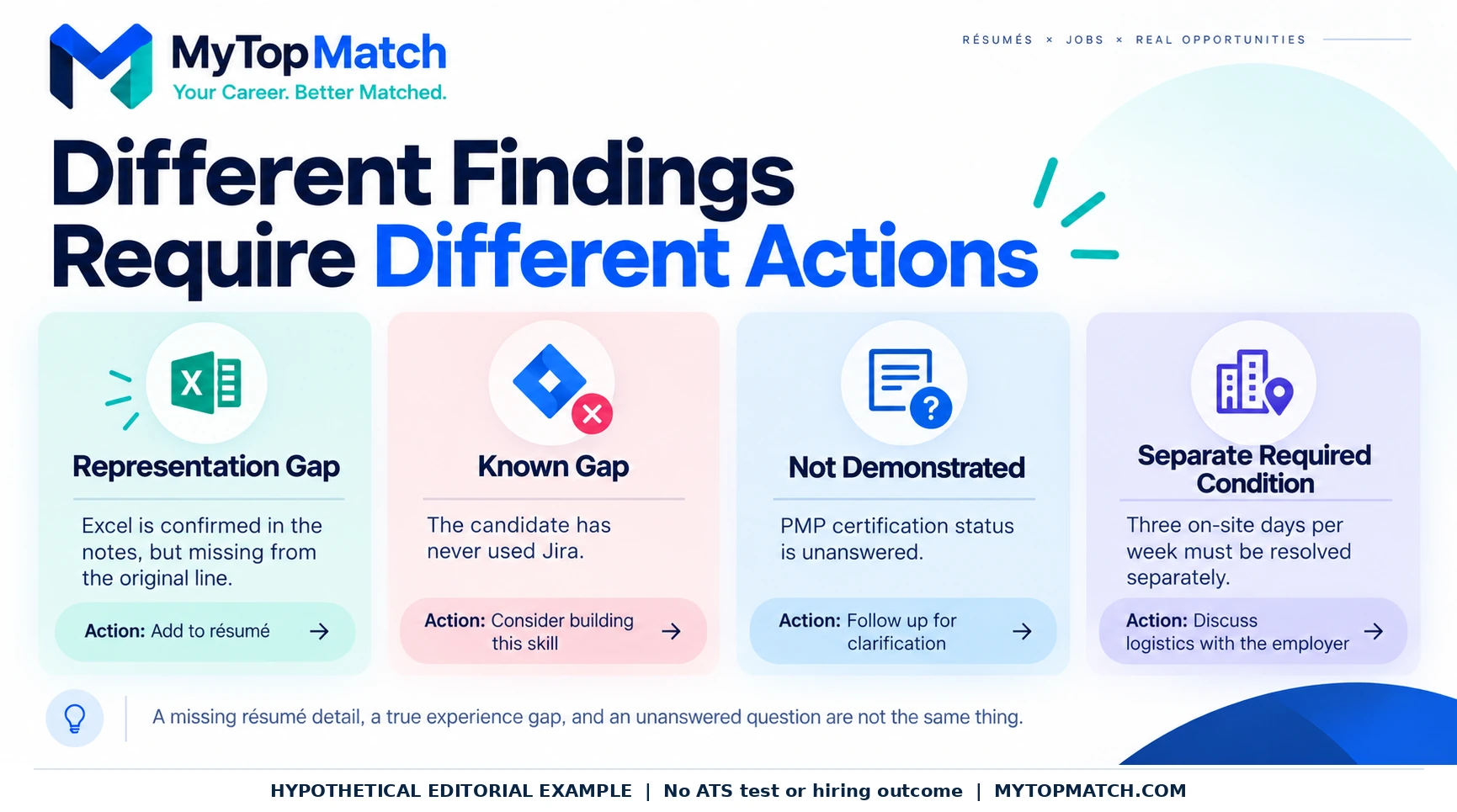
| Jira is a confirmed experience gap in this case. | The candidate says they have never used it. The posting calls it preferred. | Do not add Jira as a skill. Investigate how the employer weighs that preference. |
| PMP is not demonstrated. | Neither the résumé nor the follow-up establishes certification status. | Ask for the status. Do not add the credential or declare that the person lacks it. |
| On-site availability is unknown. | The posting states a requirement; the candidate has not answered it. | Resolve the work-arrangement question separately from résumé editing. |
This review produces several different actions. Some require clearer writing. One concerns an acknowledged skill gap. Others require answers. A single total would hide those distinctions unless the findings remained available beside it.
A stronger version using only the stated facts
Coordinated weekly project meetings, recorded action owners and deadlines, and maintained the follow-up tracker in Microsoft Excel.
Prepared weekly project-status updates and followed up with vendors on due dates, escalating delivery conflicts to the project manager.
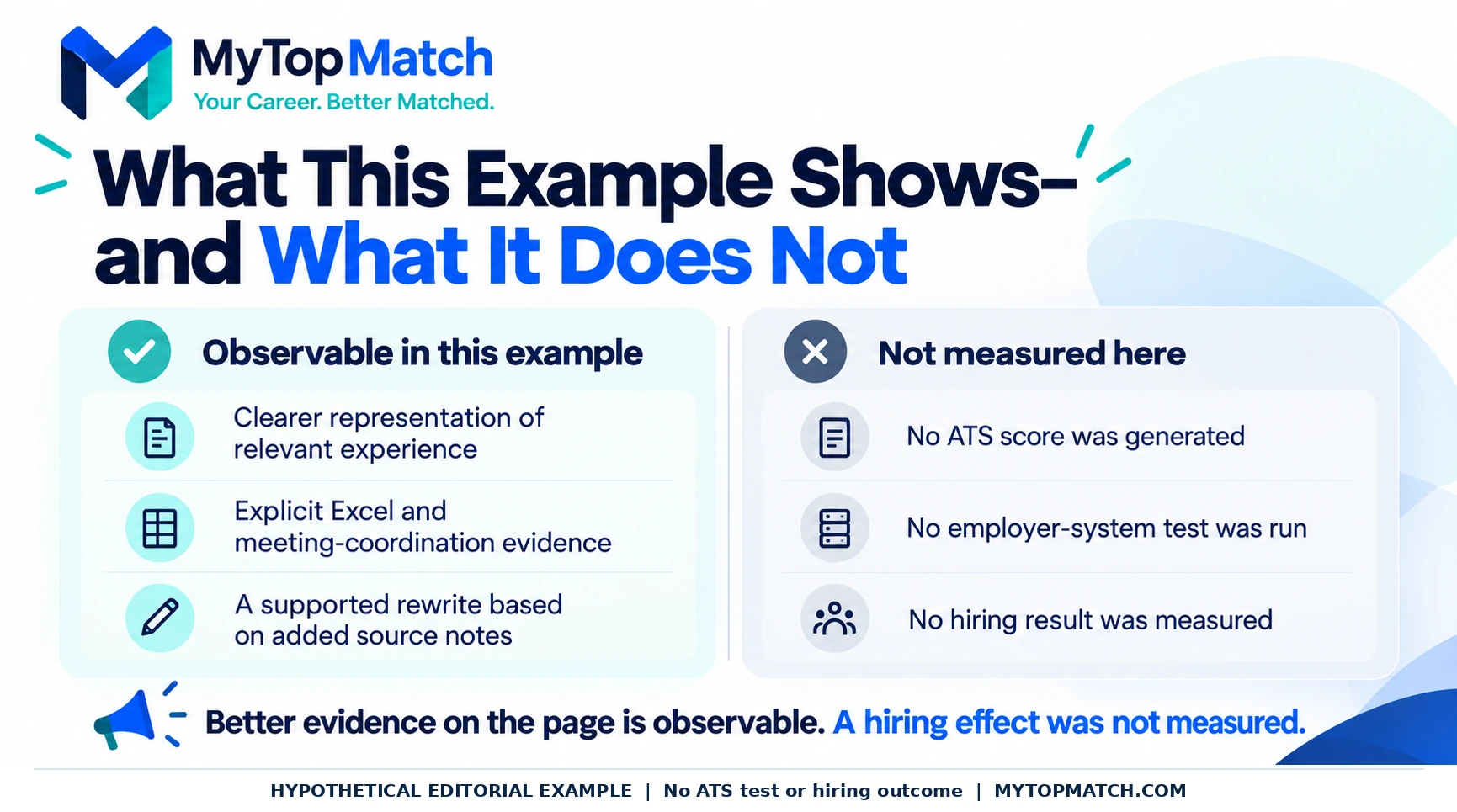
The revised wording is more specific because the fictional source notes support it. It adds no invented cost savings, completion rate, certification, or managerial authority. The actual employment title would remain unchanged.
We have not assigned a new ATS score or tested a hiring effect. The demonstrated change is in the document: relevant responsibilities are now explicit, with their limits intact.
“Not demonstrated” should lead to a question
A résumé is an account of someone’s experience, not a complete inventory of everything that person has done.
MyTopMatch’s document-review standard uses Not Demonstrated for a qualification the résumé does not show. The term must not be converted into a claim that the person lacks the qualification. [S10] Its public review description similarly emphasizes missing-information questions and fact-preserving rewrites. [S1]
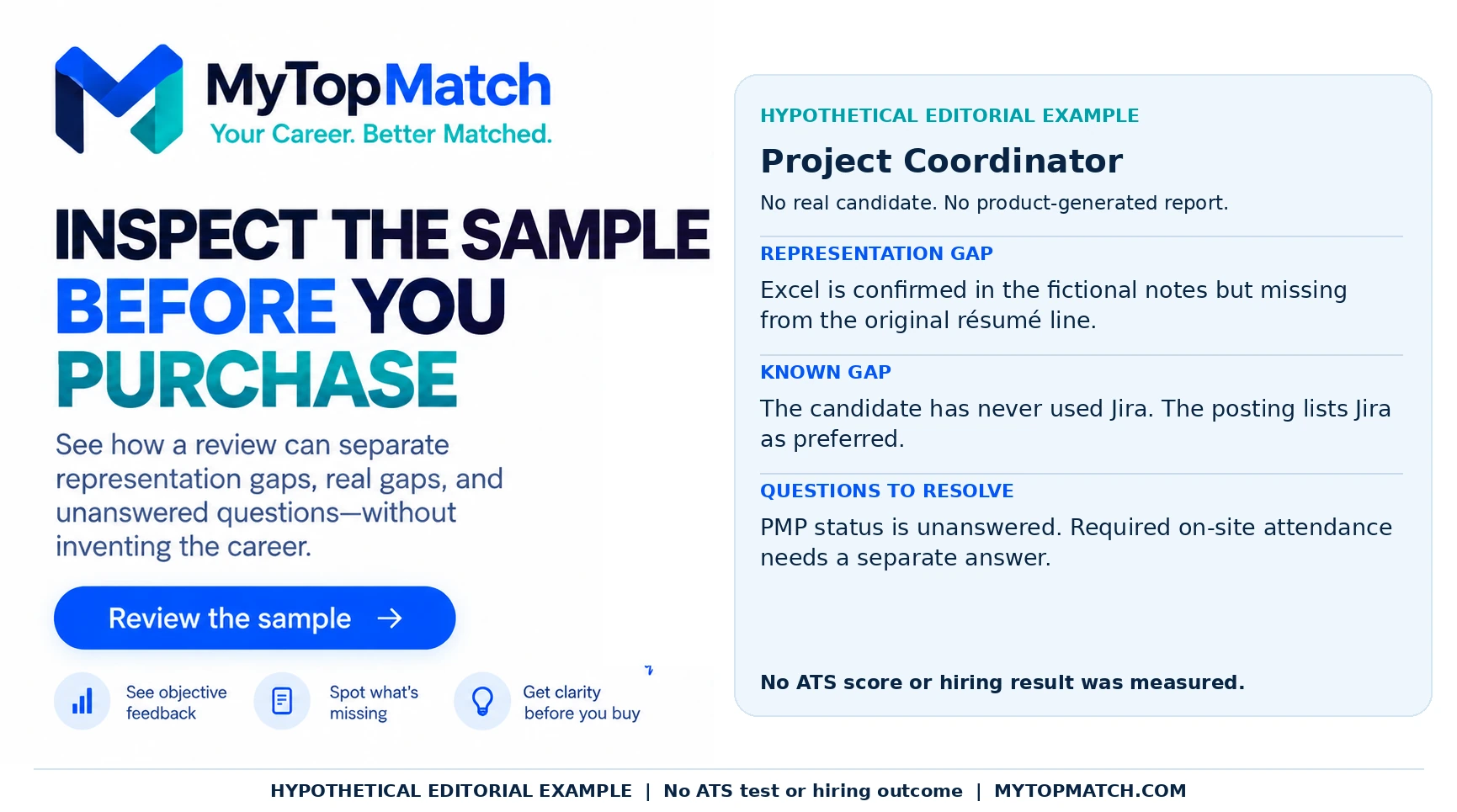
The sample’s Excel issue and Jira issue illustrate the difference. Excel was missing from the original representation but present in the confirmed notes. Jira was explicitly absent from the candidate’s experience. The PMP status remained unknown.
Do not solve all three by inserting keywords. Clarify a representation gap, acknowledge a genuine gap, and investigate an unknown.
The same principle applies to scope. “Worked with a budget” does not establish spending authority. “Supported a team” does not establish direct reports. A review should help the candidate explain the distinction rather than quietly promote them through stronger verbs.
Check the final file, not just the template
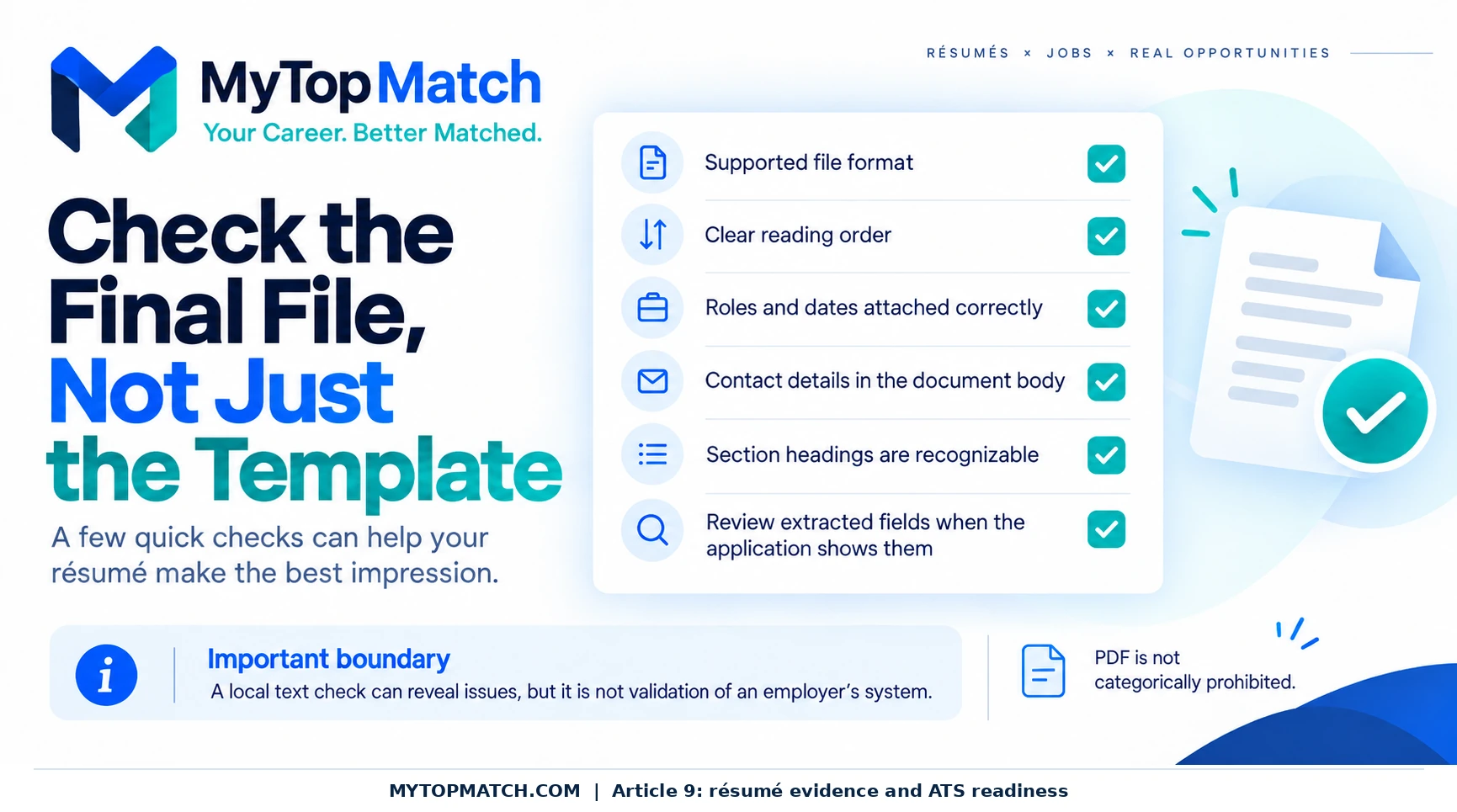
Greenhouse identifies several potential parsing problems, including columned layouts, complex tables, text boxes, image-based résumés, and contact information placed in document headers or footers. These are vendor-documented risks; they do not prove that every file containing one of those elements will fail. [S2]
Greenhouse also lists both Word and PDF among its supported candidate-upload formats. “All PDFs fail ATS” is therefore an unsupported rule. Acceptance of a file format and accurate extraction of a particular file are separate questions. [S7]
A practical starting point is a clear text-based document, a straightforward reading order, recognizable section headings, and contact details in the main document body. Follow the employer’s file instructions. MIT’s career guidance likewise recommends supported formats and inspecting a plain-text version for missing or reordered content. [S9]
Check the exact file you intend to send. Look for contact details, dates attached to the correct jobs, complete role descriptions, and a sensible sequence. When the application presents extracted fields for review, inspect and correct those fields as well.
A local copy-and-paste or text-export check can reveal a problem. It does not reproduce an employer’s parser or certify universal ATS compatibility. A plain-text preview produced by an outside tool has the same boundary unless that tool establishes exactly what was tested.
Keep the human reading experience in view. Clear headings and spacing can coexist with a professional design. Removing all structure until the résumé becomes a dense block of text is not the goal.
Use relevant language with its meaning intact
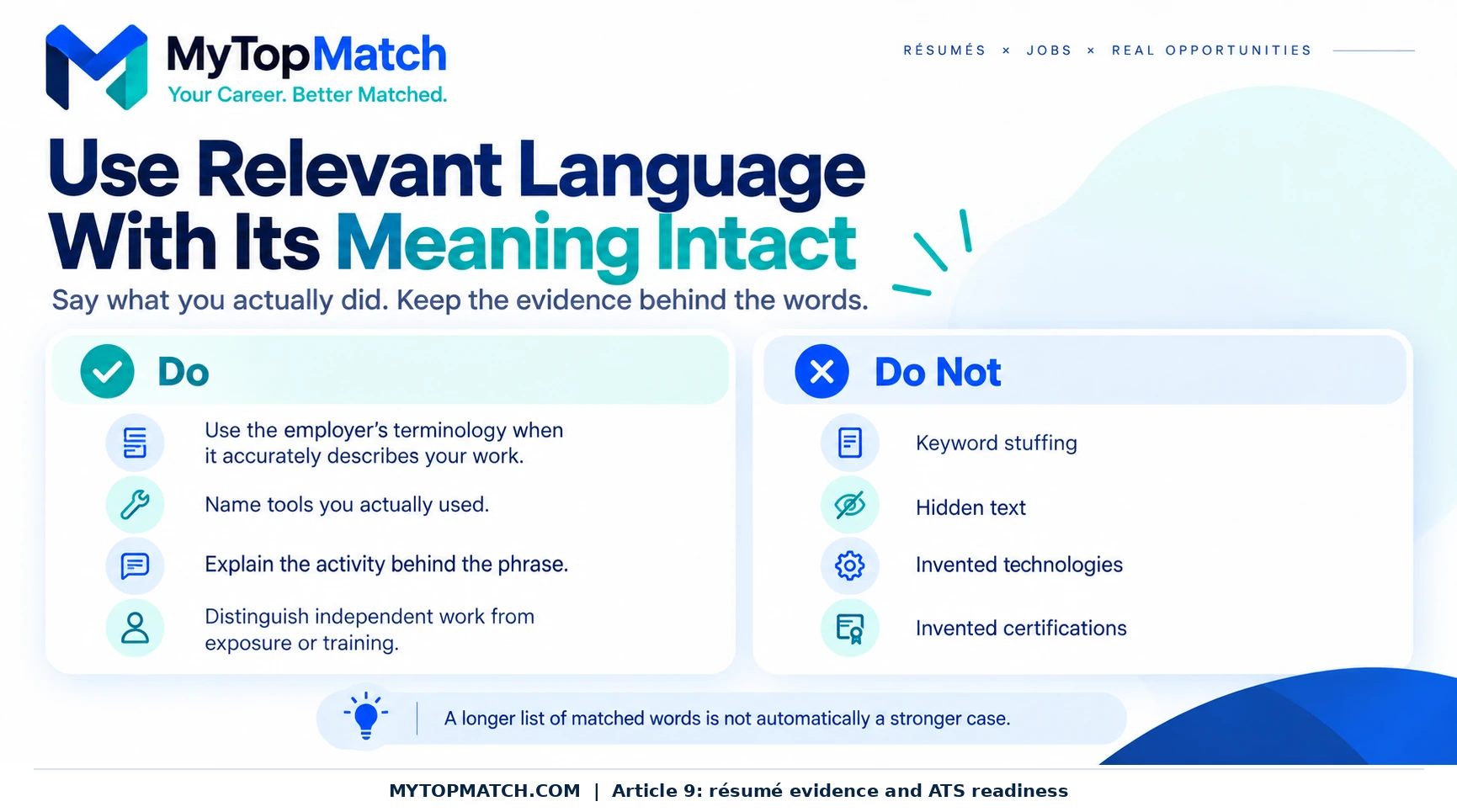
Keyword search and semantic matching create different reasons for language to matter. Greenhouse documents keyword and phrase searches, while its Talent Matching FAQ explains that related résumé terms can map to the same calibrated skill. It specifically notes that a longer list of matched terms does not always produce a higher match score. [S3, S5]
My recommendation is to use the employer’s terminology when it accurately describes your work, then explain the activity behind it. Include an acronym and its full term where that improves clarity. Name software you actually used and distinguish independent work from exposure or training.
For an unfamiliar internal title, a truthful functional explanation can help the reader understand the role. It should not erase the official title or imply a promotion you did not receive.
Avoid copying a posting into a skills section, hiding keyword text, or converting a preferred qualification into an invented credential. Those tactics make the document harder to defend, regardless of what a preparation tool reports.
The test is straightforward: Could you explain the statement in an interview, including what you did and what you did not do?
What an improved score would actually demonstrate
With the same tool, target posting, and evaluation method, a changed score can show that the tool reacted to the edited document. Inspect which component changed and why. Preserve the earlier file so the comparison is reviewable.
A score increase does not, by itself, demonstrate that an employer will rank the applicant higher or that interview probability increased. A formatting correction, clearer experience description, and newly earned credential are also different kinds of change. Keep them separate in the record.
Set a practical stopping point. Confirm that the final file is readable, the priority requirements are addressed honestly, unresolved questions are identified, and every claim remains supportable. Then decide how to proceed with the actual opportunity instead of treating another point on a checker as the purpose of the application.
This is a proposed review discipline. No rescan or outcome experiment was performed for the sample in this article.
Inspect a sample before paying for a review
A sample should let you judge the reasoning, not just the visual appeal of a scorecard.
Look for a traceable connection between the original text, the finding, and the recommendation. A useful sample explains the priority, identifies missing information, and shows how a rewrite preserves the facts. It should make clear which parts are illustrative and which were produced by an actual tested service.
MyTopMatch’s public résumé-review page includes a labeled synthetic demonstration and an illustrative scorecard. It describes a broader review with priorities, evidence links, missing-information questions, and rewrite examples. Those are public descriptions of the service; the paid analysis, report download, and billing flow were not tested for this article. [S1]
Begin with the sample in this guide and the public demonstration. Before purchasing, confirm the current scope, any separate charge for job-specific comparison or another analysis, and whether human review is included. No price or credit-cost estimate is needed to judge the sample’s reasoning.
For an unfamiliar paid workflow, start with one document after those terms are clear. Compare the delivered findings with the source before buying additional work. Upload only information you are permitted to share, and review the provider’s data-use and retention terms before supplying sensitive material.
The sample is evidence of a presentation approach. It is not proof of an interview result, a guarantee of product performance, or a substitute for reviewing your own delivered report.
Make the résumé easier to evaluate
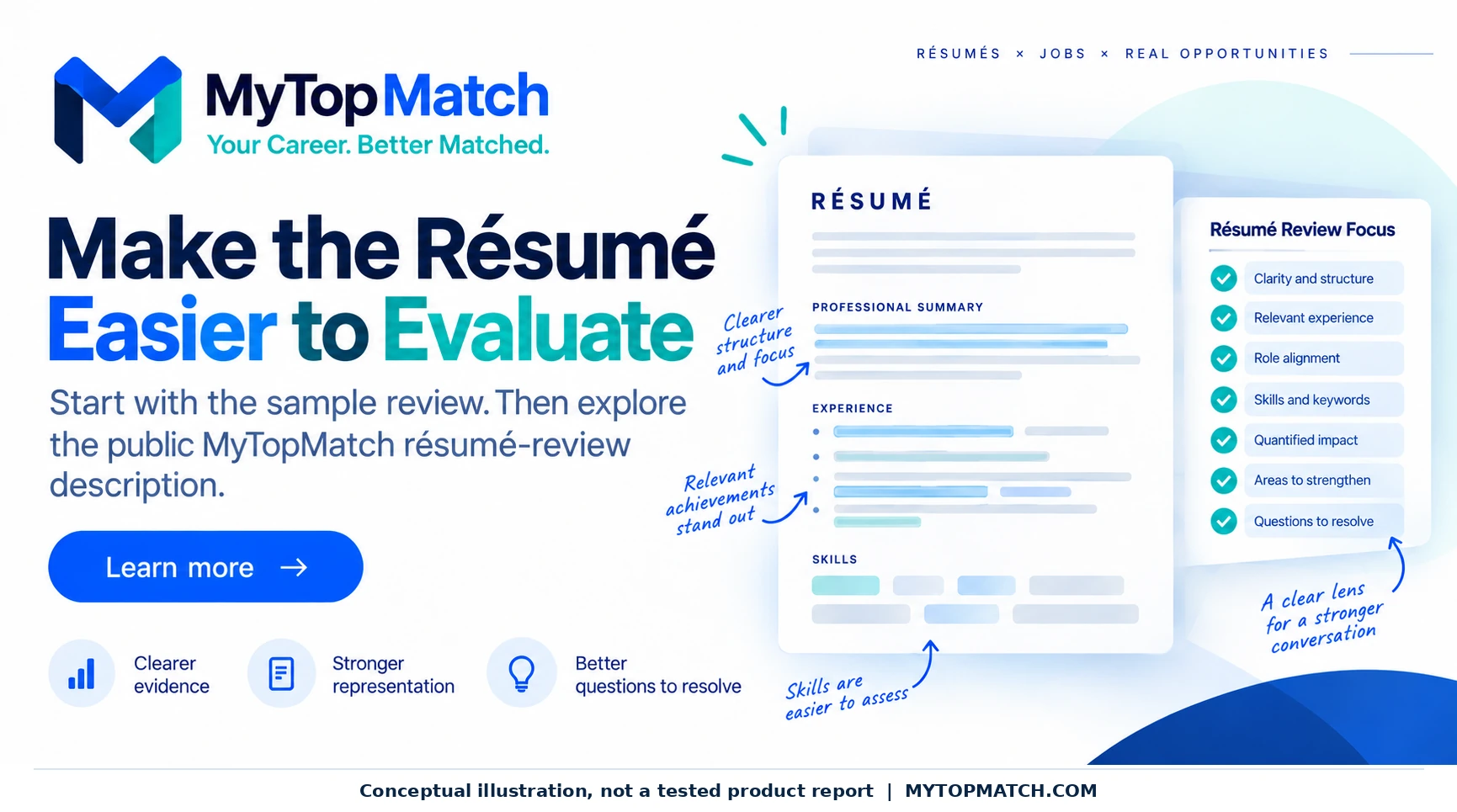
MyTopMatch’s approach keeps résumé readiness and job-specific representation connected to evidence. The employer’s decision remains outside that diagnostic. [S10]
Start with what your document actually says. Clarify the experience it undersells. Correct extraction problems you can identify. Keep real qualification gaps and unanswered questions visible.
Your résumé should make your relevant experience easier to understand and verify. A score earns its place when it helps you do that.
First: examine the sample review above. Then explore MyTopMatch Résumé Review and its public demonstration.
Evidence and verification note
This is an editorial guide, not a new ATS benchmark study. It draws on MyTopMatch’s existing résumé-review standards and public service description, with separately identified context from Greenhouse’s documentation, Jobscan’s explanation of its own match rate, and MIT career guidance. The original fictional case is independent of the demonstration shown on MyTopMatch’s website.
VERIFIED in this review: the cited public descriptions and the source-to-rewrite consistency of the fictional example. UNTESTED: employer parsing, recruiter search, matching, application rules, MyTopMatch’s signed-in analysis, paid checkout, and generated reports. No ATS score, hiring probability, performance improvement, or customer outcome was measured. Employer-specific settings and a reader’s likely results remain UNKNOWN. Public pages were reviewed September 12, 2026.
The owner-supplied engineering handoff is an editorial foundation, not proof of deployment. Its historical status and provisional scoring weights are not presented as current operating results. Neither Greenhouse, Jobscan, nor MIT has endorsed this article.
[S10] MyTopMatch: Career Document Intelligence Engine™ governing score and evidence requirements. Owner-supplied editorial standard, not publicly linked and not deployment evidence. The handoff is not reproduced here.
Explore MyTopMatch Résumé Review: https://mytopmatch.com/resume-review
Résumé review worksheet
MyTopMatch | Article 9 companion | Original planning aid
This worksheet records what a résumé review found and what you can verify. It does not generate an ATS score, predict hiring, or test an employer system. Use only information you are permitted to share.
Identify this review
| Record | Your entry |
|---|---|
| Target employer and role | ________________ |
| Posting source, date captured and version | ________________ |
| Exact résumé filename and version | ________________ |
| Reviewer or tool, evaluation date and method/version if supplied | ________________ |
| Purpose: overall document review or one-job comparison | ________________ |
| Inputs used: résumé only, résumé plus posting, or confirmed additional information | ________________ |
| Reported score and its actual definition, if supplied | ________________ |
| What was actually tested? What remains untested? | ________________ |
Separate the requirements
Label source wording as required, preferred, responsibility, or inferred context. A preference should not silently become a minimum requirement. Record the source rather than relying on memory.
| Posting language and source | Classification | Evidence currently in résumé | Additional confirmed evidence | Unresolved question / action |
|---|---|---|---|---|
| ________________ | ________________ | ________________ | ________________ | ________________ |
| ________________ | ________________ | ________________ | ________________ | ________________ |
| ________________ | ________________ | ________________ | ________________ | ________________ |
| ________________ | ________________ | ________________ | ________________ | ________________ |
| ________________ | ________________ | ________________ | ________________ | ________________ |
Interpretation: “Not demonstrated” refers to the document. A known experience gap requires an explicit factual basis. Unknown means you still need an answer. These are different findings, not severity scores.
Check the exact final file
| Check | Method and finding | Correction or remaining uncertainty |
|---|---|---|
| Employer’s accepted file type and any stated size limit | ________________ | ________________ |
| Contact information present as text | ________________ | ________________ |
| Employers, roles and dates stay associated | ________________ | ________________ |
| Section order and full sentences remain intact | ________________ | ________________ |
| Important content absent from images-only elements | ________________ | ________________ |
| Local text-export or copy/paste check | ________________ | ________________ |
| Application’s displayed extracted fields, when available | ________________ | ________________ |
A local text check is not the employer’s parser. A successful upload does not establish accurate extraction, recruiter visibility, or acceptance. Record the limit of each check.
Record each revision
| Original text | Proposed revision | Evidence source | Confirmation needed | Final decision |
|---|---|---|---|---|
| ________________ | ________________ | ________________ | ________________ | ________________ |
| ________________ | ________________ | ________________ | ________________ | ________________ |
| ________________ | ________________ | ________________ | ________________ | ________________ |
Before accepting a revision, check every title, date, credential, technology, quantity, outcome, and statement of authority. A result absent from the source should become a question, not an invented achievement. Keep additional candidate-confirmed information separate from evidence originally present in the résumé.
Decide the next action
Highest-priority factual correction: _______________________________
Most important missing-information question: _______________________
Known qualification gap to investigate: ____________________________
Work-arrangement or application condition to clarify: _______________
Remaining formatting test and its limits: ___________________________
Reason this version is ready for the intended use: ___________________
Keep the previous file, the final file, the target posting, and the review together. A score change is not evidence of a measured change in hiring probability.
Before using a paid service
Inspect a sample first. Confirm the current scope, cost, job-specific comparison or rescan charges, human involvement, and correction process. Review data-use terms before supplying sensitive information. Begin with one document and check the delivered findings against the source before scaling use.
Public demonstration: https://mytopmatch.com/resume-review
The public page was reviewed September 12, 2026. No purchase, signed-in analysis, or employer-system test was performed for this article. Source background and verification boundaries are in the companion article.