
MyTopMatch Career Intelligence | October 16–22, 2026
AI Is Changing Who Gets Hired, What Expertise Is Worth, and How Work Gets Done
October 23, 2026 | MyTopMatch Career Intelligence By Keith Lawrence Miller, M.A. Reporting period: October 16–22, 2026
A significant change is taking place in the labor market. Artificial intelligence is beginning to influence not only how companies perform work, but also which employees they hire, which positions they eliminate, and how much they are willing to invest in specialized expertise.
This week's developments provide unusually direct evidence.
Anthropic disclosed that junior employees now represent a substantially smaller percentage of its technical hiring. Barclays announced plans to eliminate approximately 5,000 positions during 2026. Meanwhile, AI companies introduced new agents capable of performing professional work across multiple applications with greater independence.
Together, these developments raise an important question: How will employers determine the value of human expertise when AI can perform an increasing share of the work?
THE BIG 3
1. Anthropic Reveals a Dramatic Decline in Junior Technical Hiring
On October 16, Anthropic published How Employment Is Changing at Anthropic, a detailed examination of its own workforce.
The company analyzed hiring records, productivity measures, AI usage, employee communications, and organizational changes.
Its findings deserve close attention.
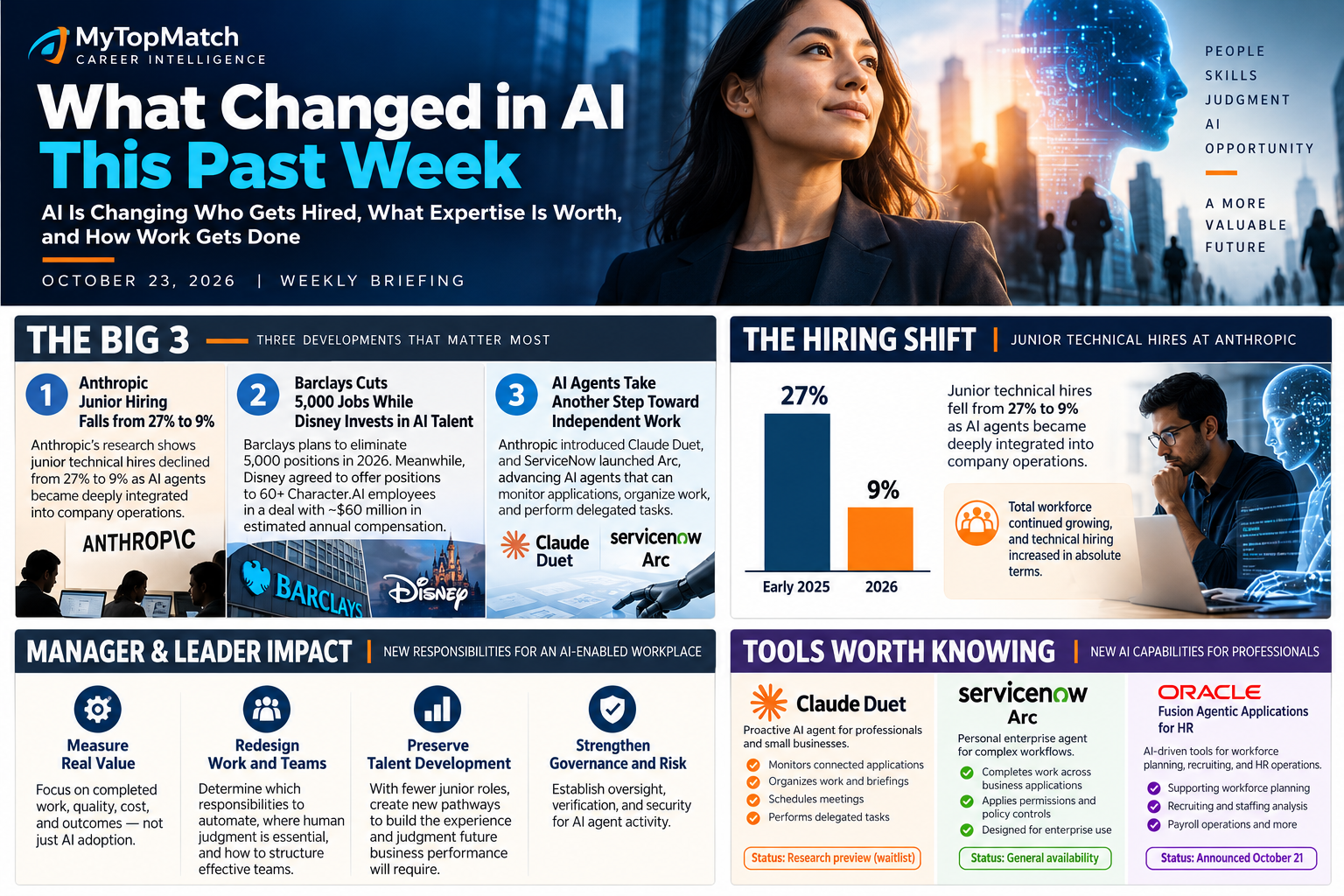
Junior professionals represented 27% of Anthropic's technical hires in early 2025. By 2026, that share had fallen to 9%.
The proportion of junior employees working in technical departments also declined, from 21% to 14%.
During this period, AI agents became increasingly involved in daily operations. By August 2026, employee-directed AI agents were recording approximately six hours of active operation for every hour attributed to their human operators.
Anthropic also reported increased output per employee and growing emphasis on independent judgment, adaptability, and effective AI use in hiring evaluations. [1]
Career intelligence analysis
This is one of the strongest company-level signals yet that AI can change hiring requirements before employment disappears.
Importantly, Anthropic's total workforce continued growing, and technical hiring increased in absolute terms. The decline concerns the proportion of junior technical hires, rather than proof that the company stopped hiring technical professionals.
The psychological and economic implications are considerable.
Entry-level positions have traditionally allowed professionals to acquire experience, develop judgment, and advance toward more complex responsibilities.
If organizations automate significant portions of entry-level work, they must reconsider how future experienced professionals will develop.
For job seekers, demonstrating theoretical knowledge may become less persuasive than providing evidence of independent problem-solving, sound judgment, and the ability to produce results with AI assistance.
For employers, preserving opportunities for professional development may become an increasingly important workforce-planning responsibility.
2. Barclays Announces 5,000 Job Reductions While Disney Invests Heavily in AI Talent
On October 22, Barclays announced plans to eliminate approximately 5,000 positions during 2026, representing roughly 5% of its workforce.
Approximately 1,000 positions had already been eliminated during the first half of the year.
Around 60% of the planned reductions affect support functions, including software development roles.
The announcement accompanied third-quarter pretax profits of approximately £2.3 billion, an increase of 12% from the previous year.
Barclays attributed its restructuring to organizational simplification, technology investments, and improving productivity through AI and other systems.
The bank did not establish that every position was being eliminated because of AI. [2]
A different employment development emerged during the same reporting period.
Disney agreed to offer positions to at least 60 employees from Character.AI, the chatbot company undergoing bankruptcy proceedings.
Court materials described an estimated $60 million in annual compensation for the employees covered by the proposed arrangement.
The transaction followed Disney's appointment of Character.AI's former CEO as its company-wide chief technology officer. [3]
Career intelligence analysis
These developments illustrate how differently employers may value certain professional capabilities.
Companies can reduce employment in established functions while making substantial investments in expertise they consider strategically important.
The Disney arrangement should not be interpreted as proof that AI professionals generally earn exceptionally high salaries. It involves a specialized group of employees, a proposed transaction, and compensation arrangements that are not representative of ordinary hiring.
Nevertheless, the underlying economic principle matters.
Professional compensation reflects what employers believe particular capabilities are worth to their business.
Experience, technical knowledge, business judgment, implementation capability, and the ability to produce measurable outcomes may become increasingly important differentiators.
Professionals should therefore evaluate how their expertise connects to the needs organizations are prioritizing.
3. AI Agents Take Another Step Toward Performing Work Independently
On October 21, Anthropic introduced Claude Duet, a proactive AI agent designed for professionals and small-business owners.
Unlike conventional chat interfaces that require users to initiate each interaction, Duet is designed to monitor connected applications, identify relevant developments, prepare briefings, and carry out delegated tasks.
Its announced capabilities include scheduling meetings, producing financial forecasts, creating applications, and coordinating information across business tools.
Claude Duet entered a limited research preview for eligible U.S. Claude Pro and Max subscribers through a waitlist. It was not generally available to all users. [4]
ServiceNow announced a related development on October 21.
Its Arc personal enterprise agent became generally available, with controls designed to govern which systems agents can access and what actions they can execute.
The company is working with NVIDIA to extend those controls into the systems running AI agents. [5]
Career intelligence analysis
These developments reinforce a change in the relationship between employees and software.
Professionals are increasingly being asked to supervise work completed by AI systems.
That creates new requirements involving judgment, verification, task delegation, quality assurance, and accountability.
The ability to recognize when an AI system has produced an incorrect or inappropriate result may become as important as the ability to operate the system itself.
For entrepreneurs, capable AI agents could eventually increase operating capacity without requiring proportional increases in staffing.
However, announced capabilities do not establish reliable independent operation. The economics, security requirements, and supervision burden must still be evaluated.
CAREER IMPACT
The Market Value of Expertise Is Changing
The week's developments reinforce three important career considerations.
First, experience alone does not guarantee continuing market value.
Professionals must demonstrate how their experience translates into decisions, improvements, and outcomes that organizations need.
Second, AI proficiency is becoming part of professional competence.
At Anthropic, hiring managers increasingly emphasize independent judgment and effective use of AI tools. This is direct evidence of changing assessment priorities within that company, although it does not establish that every employer is following the same approach. [1]
Third, measurable accomplishments remain essential.
A professional who can demonstrate improved productivity, increased revenue, reduced errors, better customer outcomes, or improved operating efficiency presents stronger evidence of value than someone who merely lists AI applications.
The question professionals should ask is increasingly practical:
What can I accomplish that an employer considers valuable enough to hire, retain, or promote me?
That question has always mattered. AI is changing the possible answers.
MANAGER AND LEADER IMPACT
AI Productivity Creates New Management Responsibilities
Anthropic's research revealed an important operational consequence of advanced AI adoption.
As agents generate more work, human employees must increasingly review outputs, establish priorities, resolve exceptions, and coordinate activities.
The organization's research describes employees creating monitoring tools and systems to manage the work generated by other AI systems. [1]
This creates a potential management problem.
Increasing the volume of AI-generated work does not automatically increase organizational productivity.
If employees spend substantial time checking, correcting, or coordinating agent output, those activities must be included when evaluating business value.
Leaders should measure actual improvements in quality, completed work, operating cost, and organizational capacity.
They must also reconsider talent development.
If fewer junior positions are created, employers need alternative methods for developing the experience and judgment required for senior responsibilities.
The management challenge is to improve organizational performance while preserving the human capabilities the organization will need in the future.
TOOLS WORTH KNOWING
Claude Duet
Status: Research preview, with waitlisted access for eligible U.S. subscribers.
Duet is designed for ongoing task management, connected-application monitoring, scheduling, business analysis, and proactive briefings.
Its significance lies in the movement toward AI systems that identify and perform work across applications.
Independent performance and reliability remain unverified for MyTopMatch's professional use cases. [4]
ServiceNow Arc
Status: General availability announced October 21.
Arc targets organizations already managing complex enterprise workflows.
Its focus includes completing work across business applications while applying organizational permissions and policy controls.
General availability is confirmed by the company's announcement. Reliability, deployment requirements, and business value have not been independently tested here. [5]
Oracle Fusion Agentic Applications for HR
Status: Announced October 21; production performance untested here.
Oracle introduced new AI-driven applications intended to support workforce planning, recruiting, staffing analysis, payroll operations, and related HR processes.
The announcement is particularly relevant to HR leaders and recruiters because it demonstrates the expanding role of AI in workforce administration and decision support. [6]
No paid adoption is recommended solely on these announcements.
Product-specific pricing, implementation costs, usage limits, and reliability have not been verified. Before committing funds, organizations should test one narrowly defined workflow using existing access where possible.
Pass: Measurable improvements in completed work, accuracy, time, or cost, with acceptable supervision and security requirements.
Fail: No meaningful operational improvement, excessive review requirements, or unacceptable financial or security exposure.
WHAT'S HYPE OR OVERSTATED?
Claim: Anthropic's AI agents are six times more productive than its employees.
Not established.
Anthropic reported agent operating hours equivalent to approximately six times employee hours. Agent runtime is not equivalent to human labor productivity, and it does not establish a sixfold improvement in completed business output. [1]
Claim: Barclays eliminated 5,000 jobs entirely because of AI.
Not established.
Barclays described a broader restructuring involving technology investments, efficiency improvements, and organizational changes. [2]
Claim: Disney's AI hiring arrangement establishes a new salary benchmark.
Not established.
The reported compensation relates to a specialized group and a corporate transaction. It should not be generalized to the broader technology labor market. [3]
Claim: Autonomous AI agents no longer require human supervision.
Not established.
New systems can perform increasingly complex tasks, but their reliability, security, operating limits, and actual business performance remain important considerations.
WHAT TO WATCH NEXT
The next important employment signal will be whether other organizations report declining demand for junior professionals as AI absorbs routine analytical and technical responsibilities.
Barclays' restructuring will also deserve attention as the company completes its planned workforce reductions and reports subsequent operational results.
The market for specialized AI expertise remains worth monitoring. Additional transactions and ordinary job-posting data will be needed to determine whether exceptional compensation arrangements reflect broader changes in employer demand.
Finally, organizations deploying autonomous agents will need to demonstrate that increased activity produces measurable improvements in finished work.
That evidence will matter more than the number of agents deployed.
THE BOTTOM LINE
Artificial intelligence is beginning to change the economic value of professional work.
Employers are reconsidering which positions they need, which responsibilities can be automated, and which capabilities justify substantial investment.
For professionals, the central challenge is maintaining and increasing their value as organizational requirements change.
For employers, the challenge is improving productivity while developing the knowledge, experience, and judgment that future business performance will require.
The most valuable professionals will increasingly be those who understand the work, exercise sound judgment, adapt their expertise, and consistently produce results that matter.
MyTopMatch Career Intelligence | Understanding the relationship between careers, opportunity, technology, and human performance.