
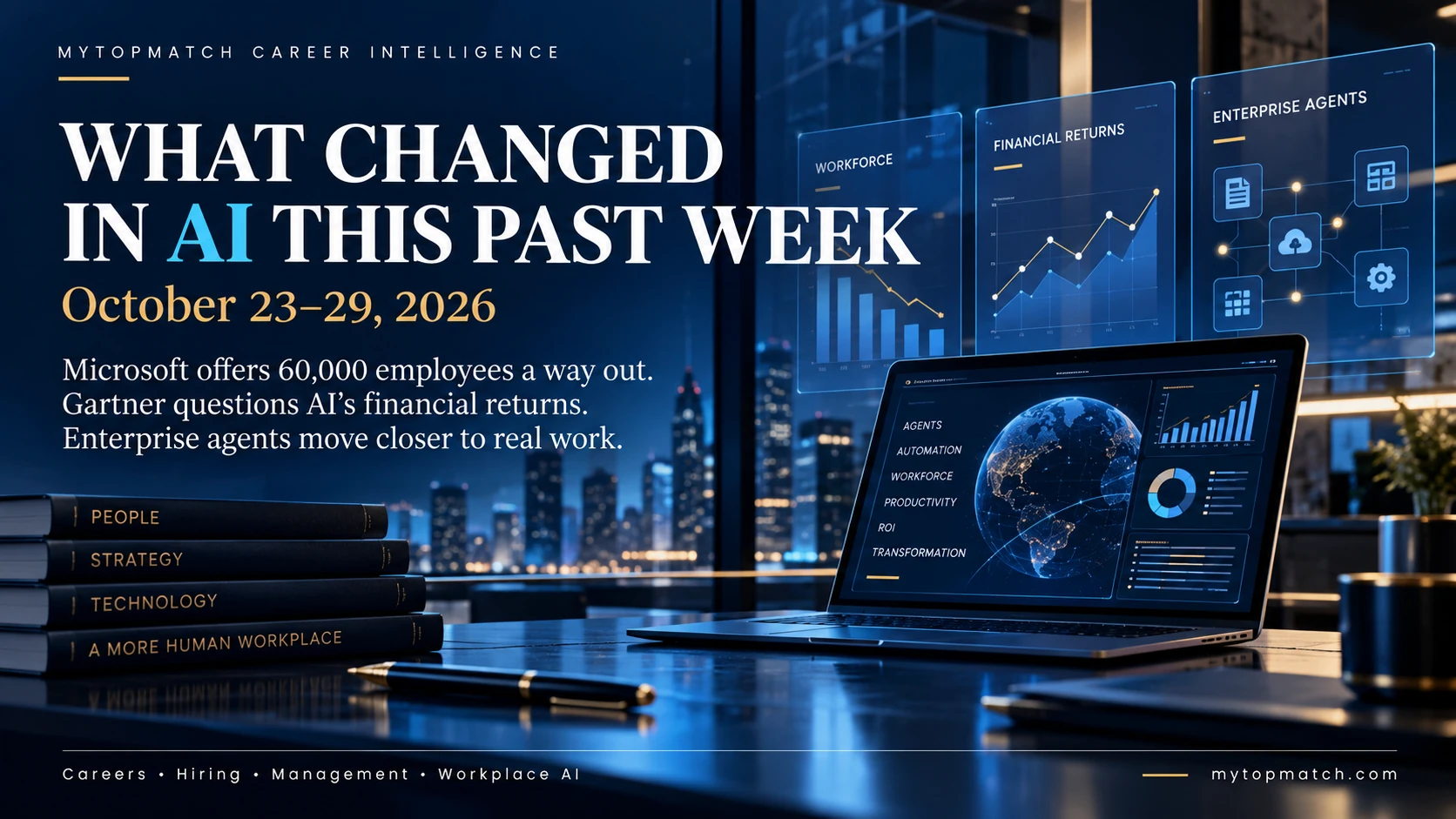
Microsoft Offers 60,000 Employees a Way Out. Gartner Questions AI’s Financial Returns. Enterprise Agents Move Closer to Real Work.
By Keith Lawrence Miller, M.A. | MyTopMatch Career Intelligence
October 30, 2026 edition | Reporting period: October 23–29, 2026
Artificial intelligence is changing the employment landscape, but this week's most important developments reveal something more consequential than another technological breakthrough.
Microsoft announced a voluntary exit program affecting approximately 60,000 eligible employees. American Express disclosed plans to reduce its workforce despite strong profits. Gartner released research questioning how much financial value organizations are actually capturing from AI productivity gains. [1–5]
Meanwhile, Microsoft and SAP introduced new capabilities for managing AI agents across business systems. [6–8]
MyTopMatch analysis: The connection is becoming clearer: companies are restructuring work around artificial intelligence before they have fully established its economic returns.
THE BIG 3
1. Microsoft and American Express Signal a New Phase of Workforce Restructuring
October 23 and 26 | Workforce impact
Microsoft: Approximately 60,000 employees eligible for voluntary exit offers, not confirmed departures.
American Express: Approximately 3,500 planned workforce reductions, roughly 5% of employees. [1–3]
On October 26, Microsoft announced a time-limited voluntary exit program for eligible employees in the United States, Canada, India, and the United Kingdom. Reuters reported approximately 60,000 employees would be eligible, including personnel working in Copilot, AI experiences, finance, HR, and other business divisions. [1, 2]
The program offers financial and career-transition support. It is not an announcement that 60,000 employees have been laid off. [1, 2]
On October 23, American Express announced plans to eliminate approximately 5% of its workforce, or roughly 3,500 positions, while reporting a 28% year-over-year increase in quarterly net income. Management described the restructuring as an efficiency initiative rather than a response to deteriorating business conditions. [3, 4]
MyTopMatch analysis: These announcements illustrate an important change in employment economics. Strong financial performance does not necessarily protect established staffing structures when management believes technology and organizational redesign can support different operating models.
Neither announcement establishes that AI directly caused every planned departure. Nevertheless, professionals should recognize that organizational restructuring is increasingly connected to strategic decisions about technology investment, productivity, and future capabilities.
2. Gartner Finds a Major Gap Between AI Expectations and Financial Results
October 26 | Research finding
3% exceeded cost-savings goals through productivity.
38% reported AI spending over budget.
21% of AI-freed time was redirected to innovation. [5]
On October 26, Gartner reported that just 3% of organizations exceeded their goals for cost savings achieved through productivity improvements. Its research also found that 38% of companies were over budget on AI, while 85% planned to increase spending the following year. [5]
A July survey of 297 chief human resources officers found that 78% reported a lack of leadership alignment on where AI creates value. A separate second-quarter survey of 1,865 employees found that only 21% of time freed through AI was redirected toward more innovative work. These studies were conducted earlier in 2026 and released or discussed in the October 26 announcement. [5]
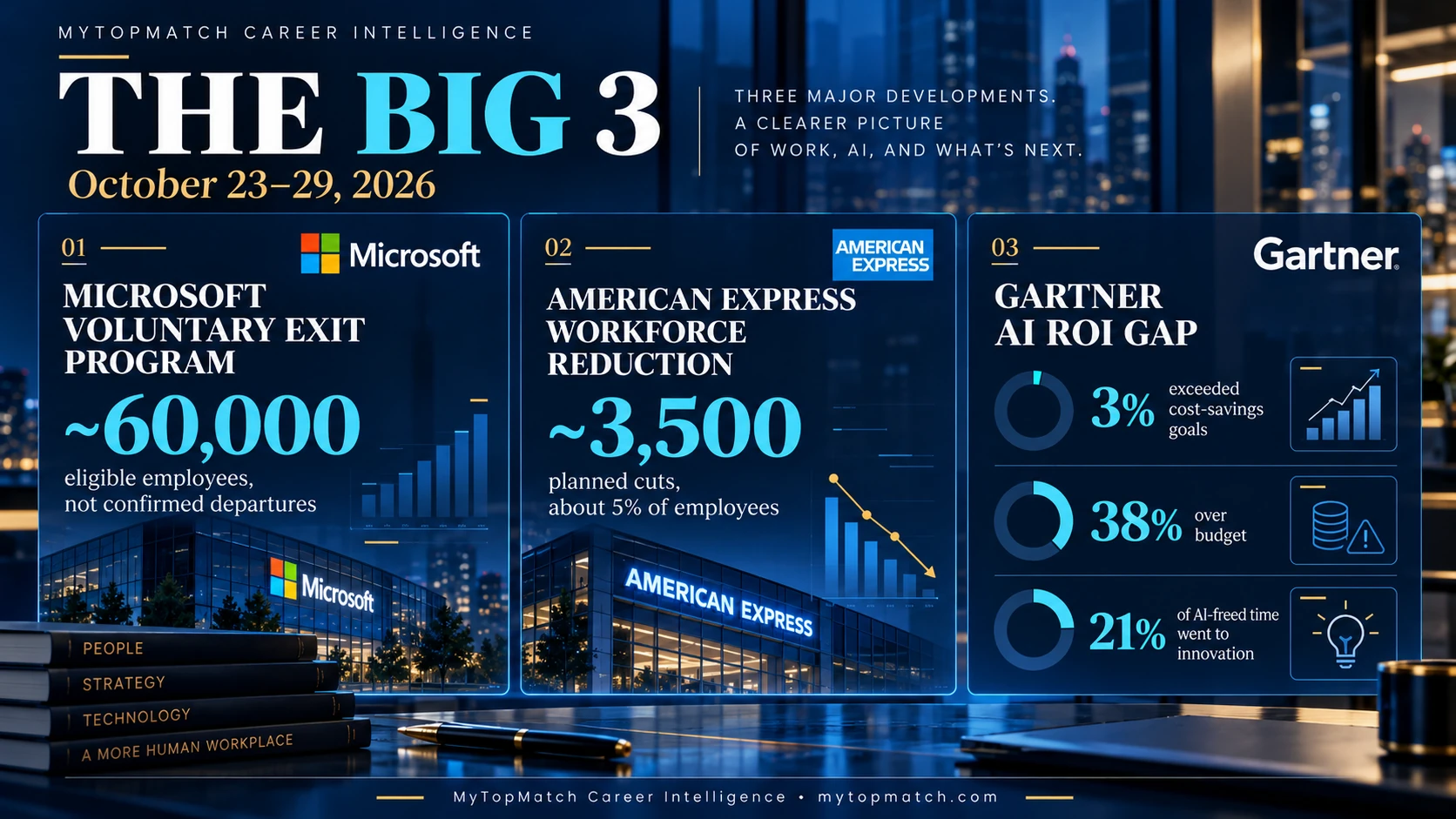
Graphic: Selected workforce announcements and Gartner findings from the first two developments. Microsoft’s figure is eligibility, not departures. The Gartner figures measure different outcomes and are not components of a single total. Sources: [1–5].
MyTopMatch analysis: Saving time is not the same as creating business value.
An employee completing a report in one hour instead of three may represent improved efficiency. But unless the recovered capacity produces better decisions, additional revenue, higher-quality service, or reduced operating costs, the organization may struggle to demonstrate financial returns.
This is particularly important for managers evaluating AI investments.
The relevant measure is not how frequently employees use AI. It is what the organization accomplishes because they use it.
3. Microsoft and SAP Advance the Infrastructure for Autonomous Business Work
October 27–28 | Enterprise technology
On October 28, Microsoft introduced its Copilot harness in Foundry Agent Service as a public preview.
The platform provides a managed environment for AI agents to perform multistep tasks using instructions, reusable skills, connected tools, and controlled execution. It supports different AI models without requiring developers to rebuild the surrounding agent infrastructure. [6]
At SAP TechEd, held during the same week, SAP presented expanded Joule capabilities, a generally available agent gateway, and additional governance tools for agents operating across enterprise applications. SAP also announced further Enterprise AI Gateway capabilities. [7, 8]
MyTopMatch analysis: The competitive emphasis is shifting from generating answers toward completing work.
This may create growing demand for professionals who understand business processes, identify appropriate automation opportunities, connect systems, manage permissions, and evaluate results.
However, the existence of an agent platform does not prove that its agents can reliably replace entire professional positions. Product availability, workflow reliability, and measurable operating results remain separate questions.
CAREER IMPACT
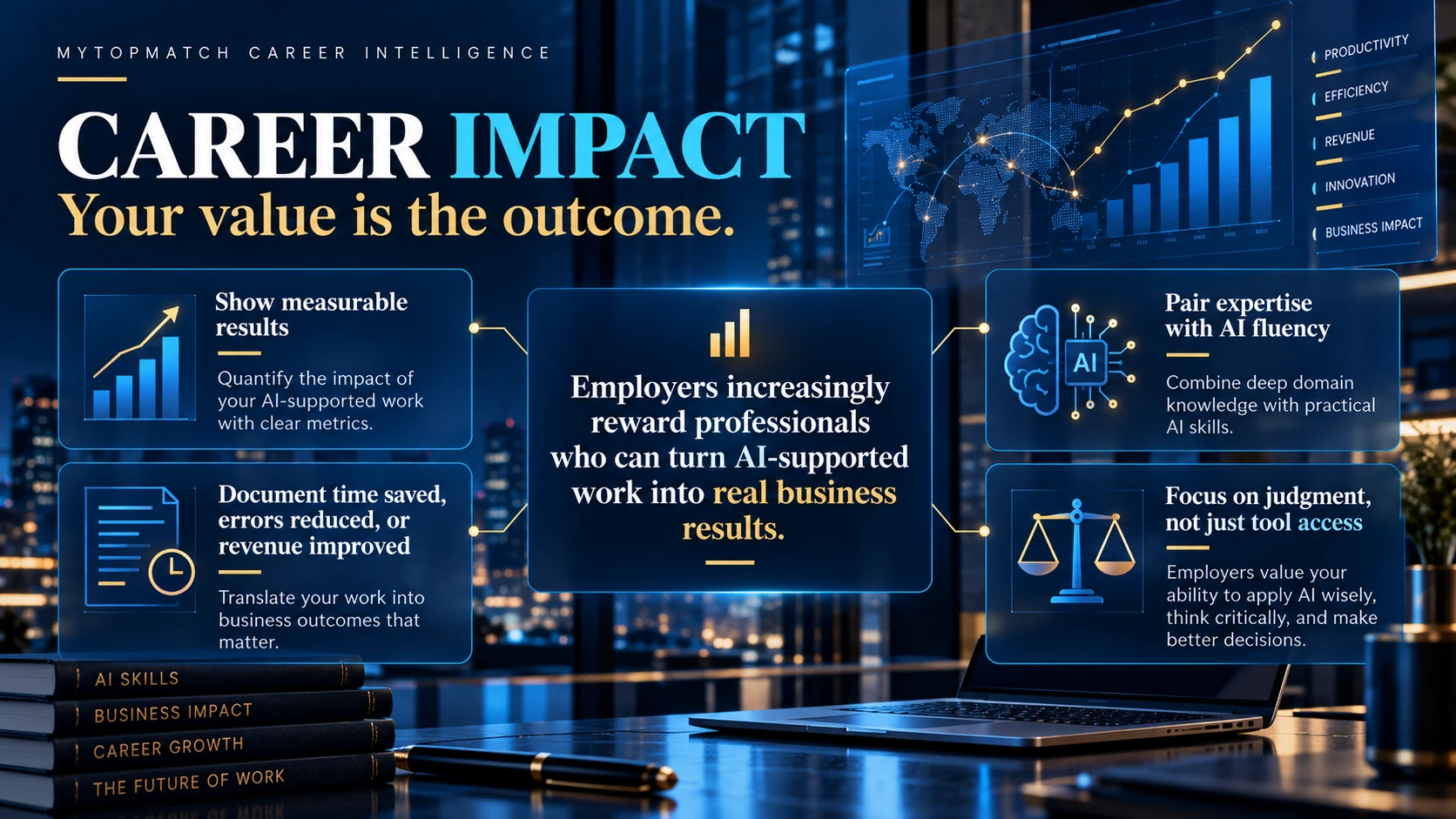
Graphic: MyTopMatch career analysis. The decorative charts are editorial illustrations, not measured labor-market data.
The immediate career lesson is not that every professional must become a programmer.
It is that employers have stronger reasons to value professionals who can combine subject-matter knowledge with effective AI use.
For résumés, interviews, and promotion discussions, professionals should emphasize concrete business outcomes: work improved, time reduced, errors prevented, revenue generated, customer problems resolved, and processes strengthened.
AI proficiency should support those accomplishments rather than replace them.
A professional's value increasingly depends on the results their expertise can produce, including when that expertise is supported by AI.
MANAGER AND LEADER IMPACT
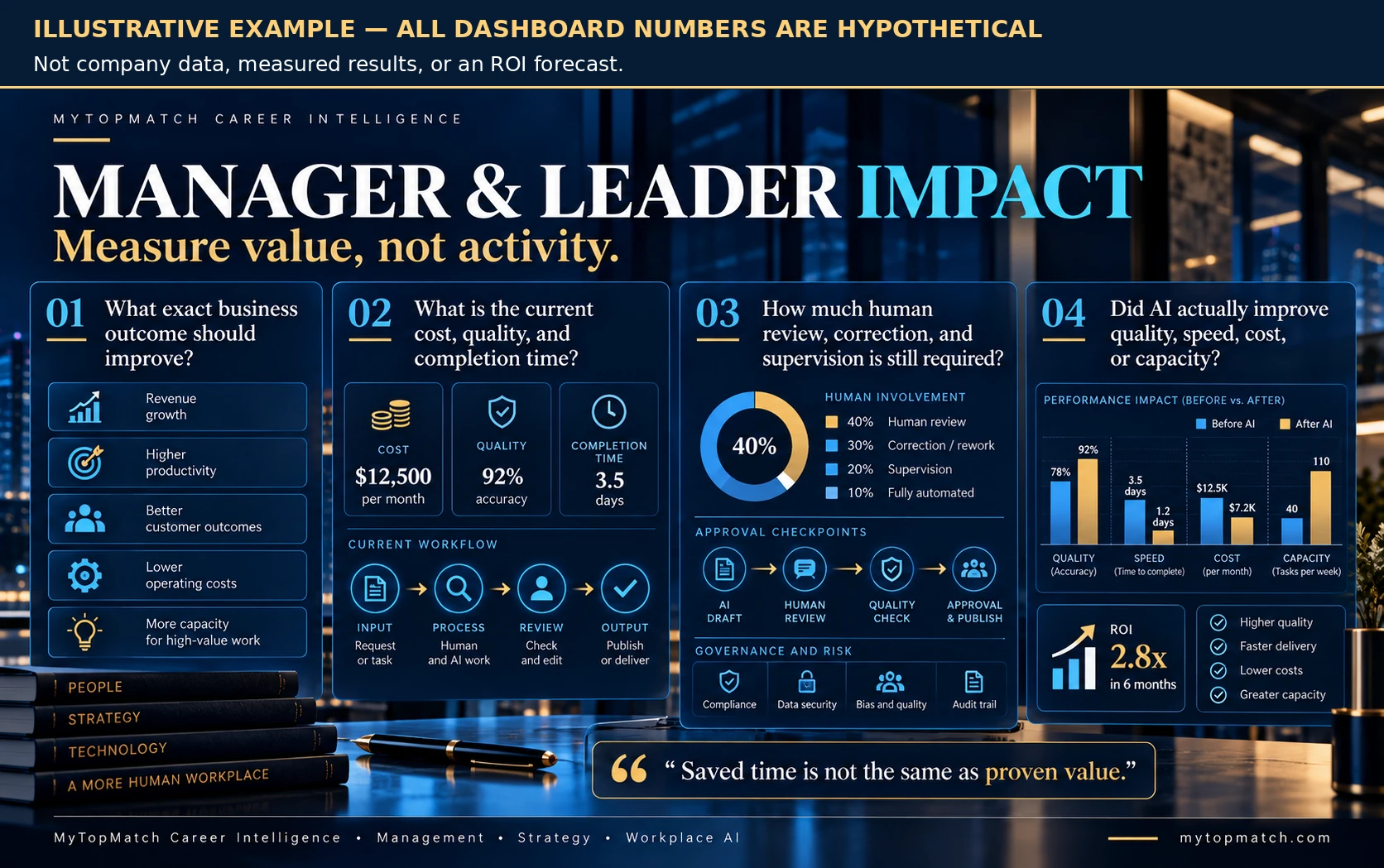
Illustrative dashboard only. All numbers in this management graphic—including costs, percentages, completion times, capacity, and the 2.8x ROI example—are hypothetical. They are not company results, research findings, measured MyTopMatch outcomes, or a forecast. The graphic illustrates questions to ask, not returns to expect.
This week's research creates a direct management obligation: demonstrate where AI contributes to actual business performance.
Managers should establish the current cost, quality, and completion time of a workflow before evaluating an AI alternative. They should also measure the human effort required to review, correct, and supervise its output.
The Gartner findings raise a second question: what happens to the capacity AI creates? [5]
Leaders who simply assign more activity may miss opportunities for business growth, improved service, innovation, and workforce development.
Organizations also need clear responsibility for agent permissions, sensitive data access, approvals, and operational failures.
TOOLS WORTH KNOWING
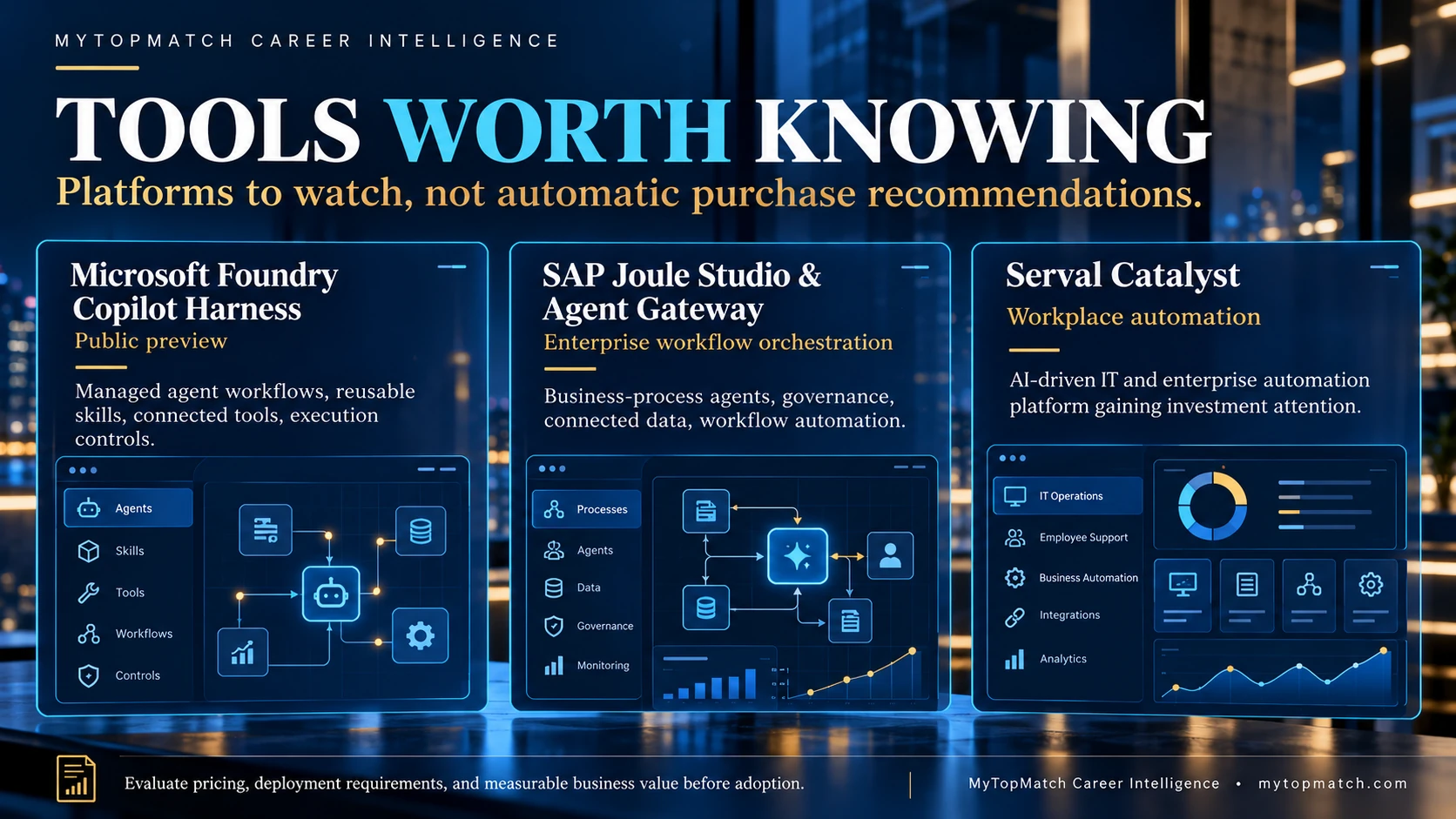
Graphic: Editorial representations of product categories. The interfaces are illustrations, not verified screenshots of the products. Availability varies by product and feature. Sources: [6–10].
Microsoft Foundry Copilot Harness
Public preview announced October 28.
Useful for developers and enterprise technology teams building managed agents with reusable skills, connected tools, and execution controls. Production reliability for a given organization remains untested. [6]
SAP Joule Studio and Agent Gateway
New capabilities presented October 27–28.
Relevant to enterprises building agents around SAP business processes, connected data, governance, and workflow automation. SAP reports that its agent gateway is generally available; availability of individual announced features varies. [7, 8]
Serval Catalyst
Enterprise automation platform gaining investment attention.
Reuters reported on October 29 that Serval raised $150 million at a $3 billion valuation to expand AI-driven workplace automation, initially focused on IT operations. Customer results and commercial suitability have not been independently evaluated here. [9, 10]
These are tools worth monitoring, not automatic purchase recommendations. Pricing, deployment requirements, and actual business value have not been independently tested for MyTopMatch readers.
WHAT’S HYPE OR OVERSTATED?
“Microsoft laid off 60,000 employees.” Incorrect. Approximately 60,000 employees are eligible for voluntary exit offers; the number who ultimately leave is unknown. [1, 2]
“Gartner proved that 97% of AI investments fail.” Incorrect. The 3% figure concerns organizations exceeding cost-savings goals through productivity, not every form of AI value or success. [5]
“AI caused every American Express job cut.” Not established by the evidence reviewed. [3]
“Autonomous agents can now operate without human accountability.” Not established. Enterprise agents still require appropriate permissions, evaluation, security measures, and human oversight. [6–8]
WHAT TO WATCH NEXT
Microsoft's eventual voluntary exit participation will offer a clearer measure of the program's employment impact.
Further corporate earnings and workforce announcements may reveal whether employers are redirecting savings into specialized talent, technology, or business expansion.
The next meaningful evidence from enterprise AI platforms will be completed workflows, error rates, supervision requirements, and independently demonstrated financial returns.
THE BOTTOM LINE
AI is not simply introducing new tools into established jobs. It is changing how organizations evaluate work, staffing, investment, and professional expertise.
For professionals, the priority is to demonstrate capabilities that produce measurable results. For organizations, it is to turn technological capacity into actual economic value.
MyTopMatch Career Intelligence. Facts are attributed to company announcements, independent reporting, and research releases; career guidance and forward-looking implications are editorial analysis. The reporting period remains October 23–29, 2026. Sources were rechecked before publication on October 31, 2026.
SOURCES
[1] Microsoft, voluntary exit offer announcement, October 26, 2026. https://blogs.microsoft.com/blog/2026/10/26/introducing-a-voluntary-exit-offer/
[2] Reuters, Microsoft buyout eligibility and cost-containment reporting, October 26, 2026. https://www.reuters.com/technology/microsoft-is-offering-buyouts-around-60000-employees-business-insider-reports-2026-10-26/
[3] Reuters, American Express restructuring and earnings outlook, October 23, 2026; syndicated by MarketScreener. https://www.marketscreener.com/news/amex-lifts-2026-profit-forecast-as-travel-entertainment-spending-drives-growth-ce785cdfdb8bfe26
[4] American Express, third-quarter 2026 Form 10-Q, filed with the U.S. Securities and Exchange Commission. https://www.sec.gov/Archives/edgar/data/4962/000000496226000409/axp-20260930.htm
[5] Gartner, HR research release on AI productivity, cost savings, and capacity, October 26, 2026. https://www.gartner.com/en/newsroom/press-releases/2026-10-26-gartner-hr-research-finds-77-percent-of-board-members-expect-ai-to-deliver-productivity-and-cost-savings-yet-just-3-percent-of-organizations-exceed-cost-savings-goals-via-productivity
[6] Microsoft Foundry, Copilot harness public-preview announcement, October 28, 2026. https://devblogs.microsoft.com/foundry/microsoft-copilot-harness-in-foundry/
[7] SAP, TechEd enterprise AI and developer announcements, October 27, 2026. https://news.sap.com/2026/10/sap-teched-ai-developers-build-what-matters-autonomous-execution/
[8] SAP, TechEd coverage documenting agent-gateway availability and governance, October 28, 2026. https://news.sap.com/2026/10/sap-teched-developers-you-can-build-autonomous-enterprise/
[9] Reuters, Serval financing and workplace-automation reporting, October 29, 2026. https://www.reuters.com/business/serval-triples-valuation-3-billion-businesses-adopt-ai-workflow-automation-2026-10-29/
[10] Serval, financing announcement, October 29, 2026, and Catalyst product background, August 20, 2026. Catalyst is not presented as a new launch this week. https://www.serval.com/blog/we-raised-150m-to-make-everyone-a-builder https://www.serval.com/blog/catalyst-general-availability