This complete HTML dossier retains the research boundaries, contradictions, role sample, candidate questions, limitations, and source register. It does not offer an overall employer score or a current-vacancy count.
Resolved entity: Microsoft Corporation, a Washington corporation headquartered in Redmond, Washington, publicly traded as MSFT on Nasdaq. This report addresses Microsoft-branded employment and identifies subsidiary-specific evidence separately. It does not treat every employee of the corporate group as working under identical conditions. [S002, S004, S007]
This is employer and career research. It is not an investment recommendation, an employer ranking, a prediction of an individual's hiring prospects, or a legal determination. No applications, interviews, account-based workflows, employee outreach, or purchases were undertaken. Proposed use by Link remains UNTESTED; no Link integration has occurred. This dossier was approved for publication on September 12, 2026.
Executive assessment
The central finding is a consequential gap between Microsoft's corporate strength and the certainty available about a particular career opportunity. Its disclosed finances support a picture of substantial operating capacity. Its recent workforce announcements and role-specific listings require a much more discriminating assessment of the team, mandate, employment terms, and work a candidate would actually perform. The practical unit of analysis should be the position inside the business, supported by the corporate context. [S001, S013, S014, S041–S045]
Strong operating capacity does not settle the job-security question
Microsoft reported fiscal 2026 revenue of $331.839 billion and operating income of $155.237 billion. The same fiscal year involved sharply higher cash spending on property and equipment. These figures establish substantial financial activity and investment capacity; they cannot establish that a manager will retain a particular headcount allocation. The financial table below makes the distinction between cash generation, investment, and residual cash explicit. [S001]
The July 6, 2026 company workforce message announced approximately 4,800 role eliminations and described internal redeployment as an alternative used for some employees. The Xbox communication addressed a broader fiscal-year restructuring. These are overlapping announcements with different time horizons, not two interchangeable totals. They should inform questions about a team's direction without becoming a forecast that every job in that business is at equal risk. [S013, S014]
The career proposition extends beyond engineering
The actual sample includes product management, digital sales, applied AI in a marketing-technology classification, datacenter support, an HR internship, and several engineering disciplines. Separate program pages describe finance rotation and nontraditional-entry routes. This establishes a broader range of published pathways. It does not establish that all paths are open now, equally accessible, or suitable for a particular reader. [S028–S032, S038, S041–S045]
Work arrangement, pay, and eligibility belong to the role record
The inspected pages include remote, one-day, three-day, and fully onsite arrangements. Pay can be annual, hourly, or monthly, and one listing may span multiple career stages. A salary range is a disclosed boundary for a defined role and geography; it is not an average employee's earnings. Candidate comparisons need to preserve those distinctions before weighing an offer. [S017, S029, S032, S041–S045]
Development and mobility have evidence, but outcomes remain conditional
The finance and HR rotation descriptions provide more specific development structures than a generic learning promise. Microsoft's July workforce message also reports actual redeployments. The missing information is consequential: acceptance rates, eligible populations, time to placement, level and compensation continuity, manager-release rules, and outcomes for different groups were not established. A reader should treat mobility as something to investigate in operational terms. [S013, S028, S029]
Employee voice requires several distinct evidence categories
Official culture and compliance statements describe intended conduct. Independent reporting supplies selected accounts of employee reactions to survey and performance-management changes. A California consent decree documents a resolved legal proceeding concerning alleged protected-leave discrimination. Newly ratified Blizzard agreements concern represented bargaining units. None of these sources can stand alone as a company-wide verdict on daily management quality. [S019–S024, S039, S040]
What would materially improve an actual decision?
Before committing to a role, obtain a clear answer about why it exists, who controls its resources, which measures define success, and which work arrangement applies. Request the applicable career stage, compensation components, review rules, benefit eligibility, and initial responsibilities in the appropriate written documentation. Where the hiring team cannot resolve a material question, retain that uncertainty in the decision rather than allowing the company name to answer it.
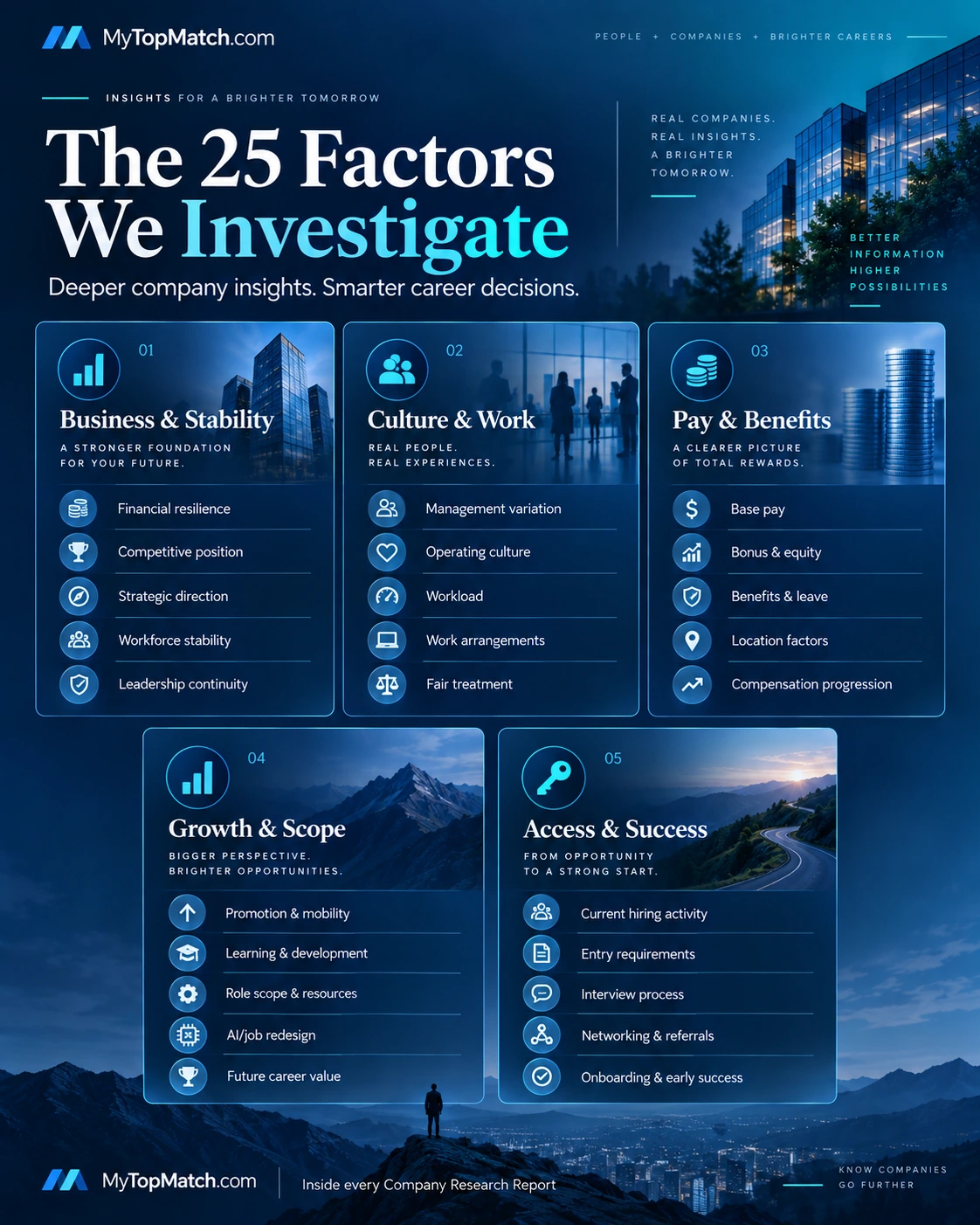
The report addresses all 25 factors. Evidence is strongest for disclosed finances, published role requirements, formal programs, and dated announcements. It is more limited for manager effectiveness, team workload distribution, realized rewards, typical promotion speed, and current implementation of internal review rules. These limits are localized below; they are not evidence that the underlying conditions are necessarily favorable or unfavorable.
Company identity and employment boundaries
Microsoft's significant-subsidiary exhibit for June 30, 2026 includes LinkedIn Corporation, Activision Blizzard, Inc., Activision Publishing, Inc., and several Irish and U.S. entities. The exhibit expressly omits subsidiaries below its significance threshold. It therefore cannot be used as a complete employment-entity directory. [S005]
Microsoft's reporting segments are useful for understanding its business: Productivity and Business Processes, Intelligent Cloud, and More Personal Computing. A financial segment is not a legal employer, a single management culture, or a promise of common employee benefits. The application and eventual offer should identify the actual payroll entity. The 15 role records examined here were Microsoft-branded; the precise legal employer was not established from the displayed text. [S001, S002, S041–S045]
Current official biographies identify Satya Nadella as chairman and chief executive officer, Amy Hood as executive vice president and chief financial officer, and Amy Coleman as executive vice president and chief people officer. These titles were checked during this research. The assessment does not extrapolate their personal leadership characteristics from public biographies. [S009–S011]
Selected timeline and reporting boundaries
Research design and evidence coverage
Sources and access
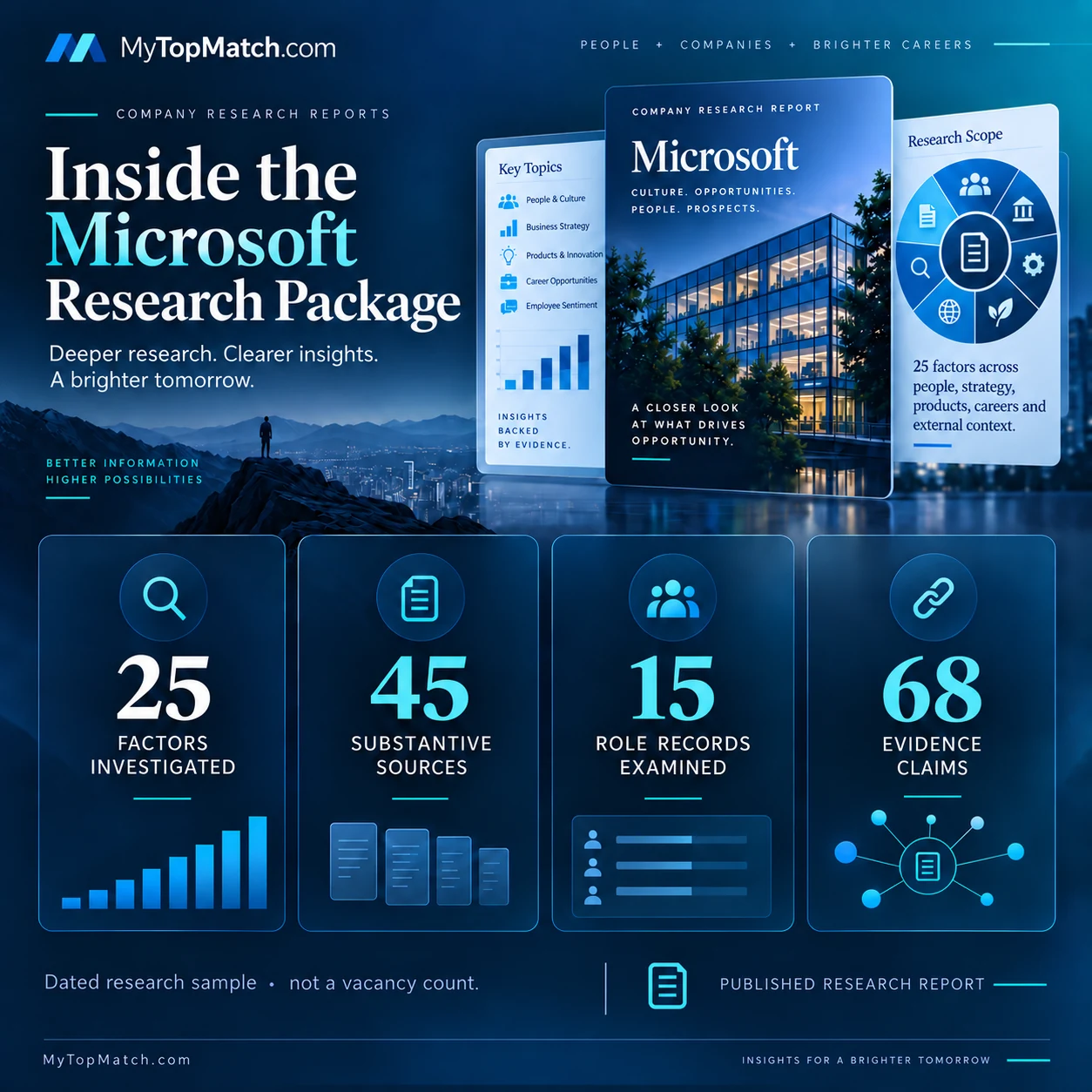
The substantive register contains 45 distinct source documents/pages, plus one excluded employee-benefits page recorded only to document its use restriction. Most substantive sources are official Microsoft publications. The register also includes SEC exhibits, California records, CWA's bargaining-participant account, an alumni organization, Reuters, and Business Insider. Multiple stories repeating an announcement were not treated as independent confirmations of its underlying cause.
The FY2026 SEC filing index and selected exhibits were accessible, but the full primary 10-K body exceeded the retrieval tool's size limit. Financial analysis therefore uses the official year-end release's expressly unaudited tables, together with FY2024 and FY2025 annual reports. Deloitte & Touche LLP's FY2026 consent confirms that audit reports dated July 29, 2026 appear in the filing; this does not mean their full opinions or statements were inspected here. This distinction must survive any reuse. [S001–S006]
Public careers and hiring guidance were read without accounts. Direct job links resolved to the application portal, but its available output did not establish a functioning, currently accepting application workflow. No submission was attempted. A benefits page was publicly retrievable but marked confidential and for employees/dependents; detailed terms were excluded and no employee-plan access was pursued. Public recruiting summaries remain the benefit evidence used here. [S017, S018, S046]
Job sample and employee-experience limits
The sample comprises 15 distinct public portal identifiers drawn purposively from seven official pages: Seattle, Atlanta, New York, Bay Area, HR Rotation, Datacenter Technicians, and Neurodiversity. Selection sought different disciplines, career stages, pay units, and work arrangements. It is intentionally non-statistical and weighted toward roles these pages exposed, especially technical positions. It is not Microsoft's vacancy inventory or a representative cross-section of its workforce.
Fourteen records had no observed past deadline; their live application acceptance remains unknown. One HR internship displayed an explicit September 11 deadline, already passed when collected. The same listing also includes generic rolling-application language, so actual acceptance remains unverified. It remains in the sample to show the difference between page visibility and application availability. The fields labeled “update time” are retained as update dates, never silently converted into original posting dates.
No employee survey, review-platform dataset, verified interview panel, or private employee dossier was assembled. Experience evidence consists of attributed reporting on selected internal comments, official program narratives, and a union's account of its represented members. That evidence can identify questions and documented experiences. It cannot establish how common a view is across Microsoft, and no employee satisfaction percentage is inferred.
Reading the evidence classifications
Provenance records who provides the evidence: official record, company report, independent reporting, employee/candidate-related account, or researcher-derived analysis. Evidence state separately records whether the precise claim is supported within scope, partial, conflicting, unavailable, unverified, or not applicable. A verified company announcement remains a company announcement; it does not become an independently demonstrated outcome.
Interpretations are identified as analysis, supported by the stated premises. No statistical employer confidence score, overall rating, personality inference, or personal employment recommendation is produced. All dates are preserved by type wherever supplied. “Not disclosed” is not replaced by today's date.
Financial record: comparable consolidated periods
Amounts are USD millions. Fiscal years end June 30. Cash additions to property and equipment are shown as positive spending magnitudes. FY2024 uses its annual report; FY2025 uses the annual report and comparative figures in the latest release; FY2026 uses the unaudited year-end release. [S001–S003]
Calculation: final row = operating cash flow minus cash property/equipment additions. It is a limited cash-flow measure, not cash available after every obligation, not total investment including noncash leases, and not a measure of a hiring budget. No stock-price forecast or valuation follows from it.
At June 30, 2026, the release shows $76.843 billion of cash, equivalents, and short-term investments. Current and noncurrent portions of long-term debt total $40.294 billion; that sum excludes other liabilities and is not a complete obligations figure. Operating capacity and considerable cash investment coexist. For candidates, the question is how the specific business uses resources, not whether consolidated cash can theoretically fund their position. [S001]
25-factor evidence coverage at a glance
Coverage describes this investigation's evidence, not employer quality.
Detailed factor analysis
F01. Financial resilience
Finding and scope. The three-period consolidated record supports the conclusion that Microsoft has substantial profitable operations and cash-generation capacity. It also shows that cash spending on property and equipment absorbed a greater amount of operating cash in the latest year. That is the relevant financial tension for employer research; the company can be financially capable while choosing to redirect labor and capital. The calculations above are transparent arithmetic, not a solvency rating. [S001–S003]
Career interpretation. A candidate should separate three questions: whether the corporation can fund its operations, whether the target business meets management's expectations, and whether the specific role remains useful under its operating plan. The first cannot answer the latter two. Likewise, a large investment announcement does not establish that discretionary travel, support staff, or a particular team's training budget is protected. These are decision principles applied to the disclosed record, not claims about an undisclosed Microsoft budget.
Financial resilience may matter most to a candidate comparing the ability to support lengthy technical development, enterprise customer commitments, or infrastructure projects. The relevant benefit depends on whether the prospective role participates in a funded priority. A role can sit close to a growth narrative while being measured on efficiency or consolidation.
Unresolved. No team-specific budget, hiring approval, project funding horizon, severance entitlement, or future reduction plan was verified. Cash-flow comparisons do not establish a probability of redundancy. The full FY2026 audited filing body was not inspected.
Candidate action. Ask the hiring manager to explain the approved purpose of this opening, the budget owner, whether it replaces a departure or adds capacity, and what development would cause the role to be reconsidered. Seek a concrete operating explanation rather than a reassurance based only on Microsoft's overall results.
F02. Competitive position
Finding and scope. The latest release describes markedly different business performance: strong Intelligent Cloud activity contrasts with weaker More Personal Computing revenue in the June quarter. The Xbox reset supplies a management account of difficulties in that business, while the consolidated company remains profitable. These are internal reporting categories and statements; this investigation did not establish a current independent cloud-market-share table or comparative employer ranking. [S001, S014]
Career interpretation. Candidates should evaluate the competitive problem they would be hired to solve. Work on a growing platform may involve scaling, adoption, reliability, or customer migration. Work in a challenged product area may involve prioritization, cost control, retention, or a narrower product mandate. Neither situation determines job quality on its own. A turnaround can offer responsibility, but the candidate needs credible authority and resources to deliver it.
The strongest counterpoint to a simple growth-based interpretation is that even a successful business can reduce work it considers duplicative. Conversely, an organization undergoing restructuring can still recruit for capabilities central to its revised strategy. The sampled Xbox engineering records demonstrate that a restructuring announcement and displayed technical hiring can coexist; they do not demonstrate that the new positions are insulated from future changes. [S043]
Unresolved. Customer loss rates, profitability of particular teams, the internal business case for an individual opening, and the durability of demand for a proposed role were not publicly established here.
Candidate action. Ask which customer problem currently determines investment in the team, what alternatives customers compare it with, and which measurable result the new hire must improve. Request examples of priorities that management has stopped funding as well as those it has expanded.
F03. Strategic direction
Finding and scope. Microsoft's public record shows simultaneous investment and organizational redesign. The July company message describes closer placement of engineering expertise alongside commercial customers. The Xbox message sets out a different reset. The capital record shows materially higher infrastructure-related cash investment, while a current internal case study describes governance for deploying AI within Microsoft Digital. Announced strategy, booked spending, and a reported internal practice are separate evidence types. [S001, S013, S014, S027]
Career interpretation. The useful question is how a strategic theme changes the proposed job. “AI” can refer to product development, evaluation, customer adoption, workflow redesign, or infrastructure operations. A candidate should ask for the concrete change in tasks, deliverables, decision rights, and skill requirements. Broad language about transformation is insufficient for judging whether existing experience transfers.
For a leader, a strategic role may require choosing what to stop doing and managing dependencies across organizations. For an individual contributor, it may require production-quality implementation rather than demonstration prototypes. For a commercial professional, the value may lie in connecting customer needs to deployments and demonstrable outcomes. These interpretations follow the different responsibilities exposed in the sample; they are not predictions of new job categories. [S041–S045]
Unresolved. Public announcements do not disclose every team's funded roadmap, staffing allocation, delivery commitments, or contingency plans. Planned studio transitions should not be represented as completed legal changes without further evidence.
Candidate action. Request the team's current operating priorities and ask which one this role owns. Then ask what changed in that priority during the past year. A meaningful answer should connect the strategy to actual work and explain how success would be assessed if the broader plan changes.
F04. Workforce stability
Finding and scope. The FY2025 annual report disclosed 228,000 full-time employees. The current facts page reports 223,000 employees at June 30, 2026, including 121,000 in the United States and 102,000 internationally. The facts-page table does not restate every classification definition from the annual report. The apparent 5,000 difference in reported totals is therefore presented with that comparability limit; it is not a count of involuntary exits or a measured attrition rate. [S002, S007]
The July company announcement identified approximately 4,800 reductions. Xbox separately described approximately 3,200 role reductions across FY2027, including about 1,600 on announcement day. Do not add the entire Xbox fiscal-year number to the company announcement, or presume all planned reductions occurred on July 6. The June headcount snapshot also predates both communications. [S013, S014]
Career interpretation. Stability should be investigated through the target team's continuing purpose, funding, skills demand, and dependencies. The reported figures justify scrutiny; they do not establish that a specific open job is temporary or that a newly hired person will be affected. An applicant needs the particular explanation behind the opening.
Unresolved. This research did not construct an exhaustive state WARN inventory, a complete reduction ledger, a comparable contractor series, or a headcount bridge separating hiring, voluntary departures, layoffs, acquisitions, and divestitures. Neither public redeployment figures nor career-page vacancies resolve those missing components.
Candidate action. Ask whether the team has recently changed scope, staffing, or leadership; whether the vacancy is part of the revised structure; and which dependencies could cause another change. For a restructuring-affected unit, ask how decisions about retained projects and newly hired roles are being made.
F05. Leadership continuity and execution
Finding and scope. Current official biographies confirm the corporate leadership roles identified earlier. The March Experiences + Devices announcement documents a planned transition for Rajesh Jha and changes in reporting relationships. It is evidence of an organizational decision; the success of the transition cannot be inferred from the announcement. [S009–S012]
Career interpretation. Corporate leadership continuity can coexist with significant changes several layers below the chief executive. The decision-relevant structure is the chain between the candidate, the person allocating resources, and the person evaluating outcomes. A prestigious executive sponsor is less informative when the role's day-to-day authority, escalation route, and decision owner remain unclear.
A leadership candidate should distinguish an opportunity to shape a mandate from a position expected to implement decisions already fixed elsewhere. Both can be legitimate roles, but they require different expectations. The sample's principal product-management role emphasizes cross-organizational influence; that makes sponsorship and decision rights especially important to verify. [S041]
Variation and limits. This report does not rate leaders' personalities, diagnose motives, or equate public communication with employee trust. It does not establish how frequently managers change within each business. Corporate biographies are strong sources for titles and weak sources for lived management quality.
Candidate action. Ask who owns the role's mandate, who can change its priorities, and how performance will be evaluated if reporting lines change. An executive candidate should request a discussion of unresolved decisions and stakeholder disagreements, without requesting confidential information. The resulting evidence is more useful than a general statement that the company values strong leadership.
F06. Management and team variation
Finding and scope. Microsoft's interview guidance sets expectations for managerial behavior, while current role descriptions show different kinds of autonomy and cross-team responsibility. Independent reporting describes a change to the Perspectives feedback tool and sharper performance differentiation. These sources establish expectations and reported process changes; they do not establish the behavior of a prospective manager. [S022, S034, S041]
Career interpretation. The central management question is whether the team's practices make the job's responsibilities achievable. A candidate should investigate how priorities are resolved, how feedback reaches the person, how dependencies are escalated, and what happens when expectations exceed available capacity. Evidence from a prospective peer can help test whether the manager's description is shared, but one conversation still has a limited scope.
Different roles create different management needs. A datacenter worker needs a clear shift structure, training, escalation route, and safety authority. A principal product manager may need sponsorship across teams they do not control. An applied AI specialist needs agreement on evaluation and acceptable deployment conditions. Treating all three as one “Microsoft management style” would conceal the practical differences. [S032, S041, S043, S045]
Unresolved. Manager-specific employee retention, feedback quality, promotion sponsorship, psychological safety, and workload fairness were not measured. Selected media-reported comments cannot supply those missing team-level measures.
Candidate action. Ask the prospective manager for a recent example of a missed objective and how the team responded. Ask a potential peer how conflicting requests are prioritized. Compare the descriptions for consistency without forcing private disclosures or treating a polished interview answer as independently verified conduct.
F07. Operating culture
Finding and scope. The official careers material emphasizes mission, learning, collaboration, and inclusion. Independent reporting on a 2026 employee survey describes questions raised by some employees about omitted items; Microsoft said those topics continued in other subsets of its listening process. The report provides a limited view of employee concerns and a company response, not a measure of overall trust or proof that unfavorable results were suppressed. [S023, S039]
Career interpretation. A usable culture assessment examines recurring decisions rather than adjectives. A professional can ask how the team balances experimentation with reliability, handles disagreement, credits cross-team work, and responds when a customer need conflicts with an internal target. The evidence needed is a specific practice, a recent example, and the limits of that example.
The report's strongest counterweight to a simple positive culture narrative is the difference between formal commitments and documented concerns in other evidence categories. The strongest counterweight to a wholly negative narrative is that those concerns have limited dates, populations, and factual scopes. Neither should erase the other. [S019–S024, S040]
Unresolved. No statistically supported comparison of cultures across Microsoft organizations was obtained. No current team-level employee-engagement scores or validated population proportions are presented. Published employee stories are selected accounts, not random samples.
Candidate action. Ask how the team recognizes a person who helps another group succeed when the work is outside their own deliverables. Then ask what happened the last time someone challenged a launch, forecast, or workload assumption. The substance and specificity of those answers will be more useful than repeating the company's stated values.
F08. Workload and expectations
Finding and scope. Several sampled datacenter roles explicitly include onsite work, possible nonstandard or 12-hour shifts, and travel conditions. Commercial roles describe customer and sales responsibilities; product and engineering roles describe complex delivery. Public descriptions generally do not disclose the distribution of actual weekly hours, manager expectations after hours, staffing ratios, or the experience of a typical week. [S032, S042, S045]
Career interpretation. A work-arrangement label does not establish workload. A remote job can still involve demanding coverage or cross-time-zone collaboration. An onsite role may have more explicit shift boundaries, but those boundaries must be confirmed rather than presumed. Candidates need the actual schedule, escalation model, peak periods, and capacity assumptions attached to the position.
For sales roles, the appropriate investigation includes territory maturity, account allocation, quota changes, internal support, and time spent on administrative work. For engineering, ask about production incidents, on-call frequency, planned versus unplanned work, and recovery time. For program management, clarify how many initiatives can legitimately have priority at once. These questions are proposed due diligence, not assertions that the listed teams have poor workload practices.
Unresolved. Overtime compensation for the individual offer, shift premiums, typical after-hours load, target attainment, and unused leave patterns were not established. This report does not diagnose burnout or attribute health outcomes to employment conditions.
Candidate action. Request a realistic example of an ordinary week and a peak week, including the circumstances under which the schedule changes. Ask who has authority to reduce the workload or postpone commitments when capacity is exceeded. Preserve unresolved answers in the offer comparison rather than substituting a company-wide assumption.
F09. Work arrangements
Finding and scope. Microsoft's September 2025 flexible-work announcement set an initial expectation for employees within 50 miles of a Puget Sound office to work onsite three days a week by the end of February 2026, with later phases and scope-dependent exceptions. Current sampled listings include three-day roles, a one-day digital-sales role, remote Xbox roles, and fully onsite datacenter work. Those different scopes can coexist; the listings do not automatically prove noncompliance with the broader policy. [S016, S032, S042, S043, S045]
Career interpretation. The relevant commitment is the one attached to the actual job and location, including any limits on future change. A candidate moving for a role should distinguish a policy expectation, a manager's current preference, an approved exception, and an offer term. They have different evidentiary weight, and a recruiter should clarify which applies.
Location landing pages are discovery surfaces. The New York page displayed roles based elsewhere or across several locations; similarly, a Bay Area page included an Oregon role. A page's geographic label should not be copied into a candidate's application record as the job's worksite. [S043, S044]
Unresolved. This review did not verify every later-phase rollout, individual exception, contractual remote-work protection, or future policy revision. A displayed remote listing was not tested through a completed offer workflow.
Candidate action. Confirm the designated worksite, minimum attendance, permissible remote geography, manager/team expectations, and the process for changing those arrangements. For an exception, clarify who approves it and how long it remains effective. Do this before calculating the practical value of the compensation package.
F10. Ethics, employee voice, and fair treatment
Finding and scope. California CRD's protected-leave matter resulted in an approved consent decree with $14.425 million in settlement payments and costs, plus specified personnel-policy, training, and review obligations. The allegations concerned rewards and advancement for California employees who used protected leave. Approval of a settlement is not a trial finding that all alleged conduct occurred; the decree preserves the parties' stated legal positions. Current implementation outcomes were not independently audited in this research. [S019, S020]
A separate September 2026 CWA announcement reports ratified Blizzard agreements with provisions concerning working conditions and employee protections. Those terms concern represented units, not every Microsoft employee. Microsoft's compliance page separately describes reporting channels and nonretaliation commitments. The existence of a policy does not establish the result of using it in a particular team. [S021, S040]
Career interpretation. A professional should examine both the formal route for raising a concern and how that route interacts with performance decisions. A company can have extensive written processes while a candidate still needs to understand local escalation practices. Conversely, a historical legal matter should not be treated as proof of every present manager's conduct.
Unresolved. No exhaustive inventory of every legal, labor, antitrust, safety, or regulatory matter was assembled. This is a focused employment-relevant review, not a clean-record certification or individualized legal advice. Full executed Blizzard contracts and independent post-decree compliance findings were not obtained.
Candidate action. Ask how protected leave is handled in goal setting and evaluation, how an employee can question a review or reward decision, and which independent or alternative escalation routes exist. For a represented role, request the agreement applicable to that exact bargaining unit.
F11. Base compensation
Finding and scope. The job sample provides advertised base ranges with different units and career stages. The principal product-management listing spans $165,600–$296,400 annually in its national band, with a separate high-cost-geography band. The critical-environment assistant listing uses hourly pay. The HR internship uses monthly pay and has an already-passed deadline. These figures describe different work and cannot be pooled into a meaningful average Microsoft salary. [S029, S041, S045]
Microsoft's public compensation explanation ties the applicable range to work location, scope, responsibilities, relevant experience, and skills. The sample appendix preserves each disclosed band rather than selecting only the most attractive endpoint. The same principle applies to multi-level listings: the maximum of an IC4 range is not the maximum promised to an IC3 candidate. [S017]
Career interpretation. An applicant should first establish the intended level and geographic band, then evaluate the proposed base alongside variable and noncash elements. A range midpoint is a mathematical construction, not observed compensation or proof of available negotiation room. Hourly-to-annual conversions require paid-hour assumptions; none are presented as actual compensation here.
Unresolved. Actual offers, realized employee earnings, demographic pay distributions, overtime treatment for a particular role, and the employer's internal offer-placement decision were not available. The table does not establish market competitiveness against comparable employers because no controlled external pay benchmark was built.
Candidate action. Ask which career stage and range apply to the specific hiring decision, whether the role could be filled at more than one level, and what evidence determines placement. Request a component-by-component written offer rather than compare one employer's base salary with another employer's total-compensation headline.
F12. Bonus, equity, and variable pay
Finding and scope. Microsoft's public pay page describes performance-linked additional rewards for eligible roles, including bonus and stock, and sales incentives tied to relevant plan terms. It does not establish a universal target percentage, grant amount, payout history, or vesting schedule for the sample. The digital-sales listings disclose base pay; their presence does not supply the missing incentive contract. [S017, S042]
Career interpretation. A sound comparison distinguishes fixed base, target incentive, possible upside, vesting timing, and the conditions under which payment is reduced or lost. The candidate should understand whether first-year figures include an exceptional sign-on award or whether quoted recurring compensation depends on performance and continued employment. A public company's tradable stock does not make every unvested award immediately realizable.
A commercial professional also needs the practical conditions behind a target: account assignment, territory history, crediting rules, quota resets, customer churn, and support capacity. Those are proposed questions, not findings about Microsoft's actual plan. An executive or specialist should ask what portion of compensation is tied to personal, team, and company outcomes and who assesses those outcomes.
Unresolved. This research did not verify personal offer letters, current equity award agreements, target/realized bonus distributions, sales attainment rates, or the treatment of particular awards on departure. It offers no stock valuation, investment recommendation, or personal tax advice.
Candidate action. Request the applicable incentive and equity documents, payment and vesting dates, conditions for earning them, and the treatment of a role change or departure. Build a conservative comparison that keeps guaranteed amounts separate from contingent amounts. Label every assumption used in any later member-specific calculation.
F13. Benefits and leave
Finding and scope. Public recruiting material describes U.S. medical, dental, vision, retirement-match, disability, life-insurance, and wellbeing offerings. It distinguishes discretionary time off for salaried/exempt employees from accrued vacation for hourly/non-exempt employees. The description is an employer summary, not proof of an individual's eligibility or actual experience using a benefit. [S017, S018]
Career interpretation. Benefits should be evaluated against the actual worker classification and personal requirements the candidate voluntarily chooses to consider. A general benefits headline leaves open employee contribution, coverage limits, waiting periods, leave approval, and the coordination of programs. It is particularly important to avoid applying regular-employee assumptions to an internship, apprentice, contractor, or subsidiary arrangement.
The protected-leave settlement discussed under F10 makes evaluation and advancement practices relevant to this factor, but it does not establish current outcomes for every employee taking leave. A meaningful inquiry covers how responsibilities and performance goals are adjusted during an approved absence, alongside what leave the plan provides. [S019, S020]
Unresolved. Current individual plan documents, premium schedules, precise retirement-match percentage, dependent eligibility, detailed parental-leave duration, and actual utilization were not validated for a specific offer. Detailed material on an employee-use benefits page was intentionally excluded from publication. An older or third-party benefit description should not fill those gaps automatically.
Candidate action. Request the official benefit summary for the exact employer, classification, work location, and intended start date. Confirm the terms most consequential to the decision and how to resolve discrepancies with recruiting summaries. The benefits administrator or relevant plan document should settle eligibility, rather than an AI-generated generalization.
F14. Location and relocation implications
Finding and scope. The sampled work locations include Redmond, Atlanta, Fayetteville, Hillsboro, and Mountain View, plus incompletely resolved multilocation options. Some location pages display jobs outside the page's named city. Microsoft hiring guidance describes relocation assistance as something to coordinate where applicable, but this review did not establish a universal relocation package or reimbursement amount. [S033, S041–S045]
Career interpretation. The decision should start with the actual assigned location and attendance requirement. Only then can a candidate assess commute, housing, travel, family logistics, and the value of any relocation assistance. This dossier deliberately avoids a city cost-of-living ranking because no current housing or household-specific comparison was undertaken. A broad regional reputation is not a substitute for the member's actual costs.
For a multilocation role, the candidate should establish whether every named location is currently available, whether the same team and scope apply, and how geography affects the applicable salary range. An office destination, a client site, and a datacenter location may create very different travel and schedule requirements even within the same metropolitan area.
Unresolved. Relocation eligibility, repayment obligations, moving services, temporary housing, immigration support, travel reimbursements, and the terms of any geographic exception remain offer-specific. The report does not infer citizenship or work permission, or give individualized immigration guidance.
Candidate action. Before committing to a move, obtain the worksite and expected attendance, any required travel, the relocation package if offered, and the conditions that could create repayment obligations. Compare these documented terms with the relevant compensation band. Retain unknown costs rather than silently assign them zero in a later decision calculator.
F15. Compensation progression
Finding and scope. Microsoft says base-pay ranges are reviewed and typically updated annually; it separately describes eligibility for performance-linked merit and rewards. A change in a published range does not guarantee an individual raise. Independent August reporting describes changes to review differentiation and the Perspectives process, but the entire current internal policy and its implementation by team were not inspected. [S017, S022]
Career interpretation. Progression depends on several decisions that candidates should separate: movement within a band, promotion to another stage, a new role, market adjustments, and changes in variable awards. A strong first-year package can have a different subsequent pattern if a one-time component expires or a promotion takes longer than expected. This is a comparison principle, not a statement of Microsoft's typical progression.
The research does not support a standard annual increase, an expected promotion interval, or a promise that performance at a given level will lead to a defined award. Nor does it support treating a multi-level job posting as a commitment to promote the selected applicant rapidly. Public stage labels are evidence of role classification, not a timeline. [S041–S044]
Unresolved. The distribution of actual raises, bonus outcomes, stock refreshes, promotion budgets, review calibration, and changes after an internal move was not obtained. Publicly reported review changes should be reconfirmed with the hiring team for the relevant cycle.
Candidate action. Ask when the first review occurs, how partial-year service is handled, which outcomes distinguish successful performance at the proposed level, and how decisions are calibrated. Seek an explanation of the recurring compensation structure after any initial award. Avoid assuming that the top of a displayed band is a scheduled future destination.
F16. Promotion and internal mobility
Finding and scope. Microsoft's July message reports more than 4,000 employees redeployed over the preceding year, including 500 that month. That is concrete company-reported movement, but the figures do not disclose the number seeking reassignment, the percentage placed, compensation changes, or retention afterward. Rotation-program pages separately describe structured development routes. [S013, S028, S029]
Career interpretation. Redeployment, promotion, and elective internal transfer answer different needs. Redeployment can preserve employment while changing responsibilities; a promotion changes level or scope; a transfer may develop a new specialization without either result. Link should never collapse those states into one undifferentiated “career growth” outcome.
An employee pursuing advancement needs evidence tied to the next role's criteria, appropriate sponsorship, and clarity about available positions. An external candidate should ask whether future internal movement requires a tenure threshold, manager approval, a formal application, or competition for an opening. The current public evidence does not resolve those rules across Microsoft, so this report does not invent them.
Counterevidence and limits. The redeployment statement argues against assuming internal movement is only an aspiration. The missing denominator argues against portraying it as a reliably available safety net for every affected person. A selected program's progression description also cannot establish a company-wide promotion rate.
Candidate action. Ask for the operational path from the proposed role to the next relevant role, including eligibility, selection, timing constraints, and how the current manager supports movement. For an internal employee, distinguish what can be prepared now from what requires an approved vacancy or formal organizational decision.
F17. Learning and development
Finding and scope. Finance Rotation describes four six-month rotations over two years. HR Rotation describes a three-year sequence. Datacenter Academy describes work with educational partners, practical facilities, and development opportunities; Leap describes a route for nontraditional candidates. These are different programs for different populations. A public program description establishes an available model, not an open place for every reader. [S028–S031]
Career interpretation. Development is most useful when the member can identify what capability will be gained, how it will be practiced, and what evidence will demonstrate it afterward. Rotations can expose participants to different functions, but a person still needs to understand assignment choice, manager support, workload, and completion criteria. A training catalogue alone does not show whether work schedules allow participation.
A candidate entering through a technical or commercial position should ask which learning resources are directly relevant to that job and whether practice occurs on real work with supervision. An experienced professional changing industries may need targeted evidence of transferability rather than another general credential. These are recommended evaluation lenses, not claims that any particular course is necessary for employment.
Unresolved. Current cohort capacity, selection rates, scholarships for an individual, placement outcomes, training hours actually protected, and access across employee classifications were not established. The HR internship deadline in the sample had passed. The existence of a landing page should not trigger a “currently enrolling” recommendation.
Candidate action. Confirm the exact program or resource, eligibility, active application period, cost if any, work-time allowance, and expected practical output. For an employee, ask how development connects to current responsibilities or a defined internal goal rather than rely on a general promise of continuous learning.
F18. Role scope and resources
Finding and scope. The sample exposes meaningful work: cross-organization product decisions, AI operations, production engineering, customer-facing solution work, silicon design, and critical-environment support. Several listings state outcomes or required expertise without disclosing the full budget, headcount support, or decision rights. J05 also has a title/body/level inconsistency that should be clarified before interpreting the role as a particular seniority. [S041–S045]
Career interpretation. A candidate needs to compare accountability with authority. Owning a result does not necessarily mean controlling its budget, staffing, roadmap, or dependencies. That can be workable when governance and sponsorship are explicit. It becomes difficult to evaluate when the job description leaves the conflict unresolved.
A principal-level contributor may lead through influence rather than direct management. A program manager may coordinate work while another group owns engineering allocation. A datacenter support role may have tightly bounded escalation and safety responsibilities. These are distinct operating situations, and none should be inferred solely from the word “lead,” “principal,” or “manager.”
Unresolved. Actual team size, approved staffing, management span, spend authority, escalation rights, and responsibility changes after hiring were not independently verified. Published requirements cannot establish whether current resources are sufficient to meet them.
Candidate action. Ask which decisions the role can make independently, which resources are already committed, who resolves cross-team conflicts, and what delivery assumptions are still uncertain. Request a concrete description of the first significant outcome. For J05 or any similar mismatch, obtain the official discipline and career stage before comparing pay or deciding whether the scope represents advancement.
F19. AI adoption and job redesign
Finding and scope. Microsoft's internal Digital case study describes employee councils involved in AI deployment and governance. Selected roles explicitly require applied AI, production evaluation, measurement, or AI-enabled workflows. Separate June 2025 reporting described AI-use expectations in the Developer Division. These sources support specific changes in work; they do not establish one universal performance metric or independently measured productivity gain across the workforce. [S024, S027, S041, S043, S044]
Career interpretation. The evidence favors preparing to explain actual use, evaluation, and limits of AI rather than merely listing tools. A candidate could demonstrate how a workflow was improved, what required human review, what data could be used, and how errors were detected. Such evidence may be relevant to the sampled responsibilities; it does not guarantee selection or establish a requirement for every Microsoft role.
The company explicitly said the roles eliminated in the July announcement were not being replaced by AI, while also describing automation and changing tasks. That statement should be reported accurately. It does not prove that AI has no influence on future organizational design, and the surrounding investment trend alone cannot prove direct replacement of the eliminated workers. [S013]
Unresolved. Team-level AI usage requirements, permitted tools, evaluation standards, monitoring practices, training effectiveness, and causal employment effects remain incompletely known. No replacement probability or inferred personal adaptability score is justified.
Candidate action. Ask which tasks have changed, what approved tools and data boundaries apply, and how quality is evaluated. Clarify whether AI use is expected, encouraged, or formally measured in the particular role. Request examples of work where the team deliberately retains human judgment or avoids automation.
F20. Future career value
Finding and scope. The sample includes work that could generate evidence of enterprise customer delivery, production systems, cross-functional product judgment, AI implementation, technical operations, or specialized engineering. Specific development programs can broaden exposure within defined tracks. These are descriptions of potential experience, not a measured estimate of later market value. [S028–S031, S041–S045]
Career interpretation. A professional should evaluate what they will be able to explain and substantiate after the role. The most portable evidence is likely to concern problems solved, decisions made, scale handled, tradeoffs managed, and outcomes that can be described without revealing protected information. This is the report's analytical framework; it is not a statistical finding about Microsoft's alumni.
A recognizable employer can still provide a role whose experience is narrow or hard to explain outside its internal context. Conversely, a less visible function may give a person demonstrable operating responsibility. The candidate should assess actual work and access to learning rather than assume the brand establishes the value of the next move.
Unresolved. No matched study of alumni outcomes, causal wage premium, exit-opportunity distribution, or future demand forecast was assembled. Internal documents, source code, customer information, and proprietary data must not be removed to create a personal career portfolio.
Candidate action. Ask what a successful person in the role will have learned and delivered after a meaningful period, and how that contribution can be documented appropriately. For MyTopMatch, later evidence collection should use approved, nonconfidential descriptions and member-confirmed outcomes. It should distinguish a person's individual contribution from a team result and avoid attributing company-wide success to the employee.
F21. Current hiring activity
Finding and scope. Fifteen distinct listings were recorded from official Microsoft career pages. The set contains engineering, product, commercial, HR-internship, and datacenter work. It was selected for diversity among accessible postings, not for statistical representation. Fourteen lacked an observed past cutoff; one internship was still visible after its stated deadline. None had end-to-end application acceptance verified. [S029, S032, S041–S045]
Career interpretation. The sample establishes that Microsoft publicly displayed these opportunities when researched. It cannot establish the number of currently funded vacancies, the rate of new hiring, a business unit's net growth, or the probability that a listing will result in a hire. Posting updates may reflect editing or redistribution rather than a newly created job.
The two remote Xbox growth-engineering records are particularly useful for illustrating why a company's overall news should not be substituted for role research. They identify specific advertised work within a business undergoing a reset. Whether either opening remains available, how it fits the reset, and whether the scope changed must be checked with the employer. [S014, S043]
Unresolved. No complete vacancy feed, historical opening series, internal requisition approval, applicant-volume measure, time-to-fill dataset, or offer acceptance rate was obtained. The public portal identifier is preserved as a portal ID; it is not misrepresented as a verified internal requisition number.
Candidate action. Reopen the specific official listing before taking action, confirm that applications are being accepted, and save the relevant dated requirements where permitted. Record an application only when the member reports submission or an actual system acknowledgment exists. A generated résumé, page visit, or visible Apply link is not submission evidence.
F22. Entry requirements and accessibility
Finding and scope. Several sampled technical listings accept defined degree/experience combinations or equivalent experience. The Fayetteville support listing has a high-school/GED-level stated minimum; principal and specialist roles require substantially deeper experience. Accessibility and Neurodiversity pages describe candidate-support routes. Some sampled jobs separately state background-check, sponsorship, or customer-related eligibility restrictions. Those conditions belong to the specific role. [S032, S035, S041–S045]
Career interpretation. Candidates should distinguish a required condition from a preference and from evidence that would make their experience more persuasive. An equivalent-experience clause opens an avenue for demonstrating relevant capability; it does not guarantee that any alternative background satisfies the role. Likewise, a lower formal educational minimum does not mean the actual work requires little preparation.
For a career changer, the right question is which prior tasks, outcomes, and knowledge directly address the published responsibilities. For a returning professional, current examples may help establish readiness without disclosing private reasons for an employment break. These are candidate-controlled approaches, not inferred judgments about health or capability.
Unresolved. Individual qualification decisions, accommodation approval and delivery, immigration eligibility, and current program cohort availability were not tested. The report never infers disability from a person's interest in an accessibility program or assumes program participation is required to request assistance.
Candidate action. Identify the exact requirement in the listing and prepare evidence that addresses it. Request the official clarification or accommodation route when needed, without disclosing more sensitive information than the process requires. Obtain qualified advice for individual legal questions; do not turn a role's eligibility wording into a company-wide hiring rule.
F23. Recruitment and interview process
Finding and scope. Microsoft's public hiring guidance describes a process that often involves two to four conversations, with format and details confirmed by recruiting. It discusses application tracking and later offer/onboarding steps. Interview guidance emphasizes specific experience and relevant competencies. Published instructions concerning AI distinguish preparation assistance from the candidate's independent work during an assessment unless use is permitted. These are employer instructions, not an observed applicant journey in this study. [S033, S034]
Career interpretation. Preparation should follow the actual role and interview format. An engineer may need to explain technical reasoning and implementation; a commercial candidate may need evidence of customer judgment; a principal product candidate may need examples of influence and tradeoffs. The job sample supports these different preparation emphases without supporting invented exact questions or a promised interview sequence.
A member-specific Link brief could attach approved career evidence to the requirements and suggest questions the candidate should investigate. It should never fabricate experience, supply confidential interview material, or claim that an application has advanced when no update has been received.
Unresolved. The number and timing of interviews for a particular vacancy, assessment content, feedback availability, decision turnaround, and rejection reasons were not verified. No account was created, résumé submitted, assessment attempted, or recruiter contacted.
Candidate action. Ask the recruiter to confirm stages, timing, evaluation format, any permitted tools, accommodations, and the information needed to prepare. Maintain a dated record of instructions. Do not assume a third-party account of another person's interview applies to the current vacancy or that lack of a response establishes why a decision was made.
F24. Networking and referral access
Finding and scope. The Microsoft Alumni Network has eligibility requirements for former employees; it is not an unrestricted referral channel for every applicant. MSSA and other program communities provide specific routes for eligible participants or graduates. Career and program pages offer public discovery points. This research did not identify or contact a member's personal network or verify any warm introduction. [S030, S031, S036, S037]
Career interpretation. Useful networking begins with a legitimate connection and a precise learning goal. A former colleague might explain the work of a team; a program community might help an eligible participant understand preparation; an event may provide public information about a discipline. None automatically creates a referral, access to a hiring manager, or permission to send repeated outreach.
A future MyTopMatch relationship record should distinguish a public person or channel from a confirmed relationship, an introduction request, an accepted introduction, and an actual referral. It should retain member consent and avoid implying that finding a profile establishes familiarity. No private contact data or restricted-network scraping belongs in this research package.
Unresolved. Current referral mechanics, referral effect on selection, event availability, membership approval, and any individual's willingness to help remain unknown. The MSSA page's application banner had a past deadline; the existence of a program community does not establish a currently open cohort.
Candidate action. Start with existing relationships the member confirms, or a genuinely applicable public program. Ask a focused question about the work and avoid requesting confidential selection information. Verify eligibility before presenting an alumni or training resource as available, and never state that a referral has occurred until the relevant participant confirms it.
F25. Onboarding and early success
Finding and scope. Microsoft hiring guidance describes manager involvement in onboarding, a buddy, and support resources. Rotation programs provide additional structure for selected participants. Current technical and operational listings also indicate prerequisites that may affect readiness. These publications do not reveal the actual first-quarter plan, training capacity, or success criteria for a specific new hire. [S028, S029, S033, S041–S045]
Career interpretation. Early success should be defined through access, learning, relationships, deliverables, and the appropriate level of responsibility. A new hire needs to know which outcomes are expected immediately and which require systems access, training, or cooperation from others. The role should not be evaluated as though those dependencies are automatically resolved on the first day.
For a leader, useful preparation concerns mandate, stakeholders, unresolved decisions, and the boundaries of change authority. For a technical contributor, it includes tools, review processes, reliability or security expectations, and supervised participation in production work. For a datacenter employee, training and escalation procedures deserve particular attention. These are proposed planning lenses, not fabricated internal Microsoft onboarding instructions.
Unresolved. The actual onboarding plan, named buddy, training time, equipment/access readiness, initial performance goals, and manager availability were not verified. No offer-stage documentation was accessed. The report does not promise an internal 30/60/90-day framework exists for every role.
Candidate action. Before starting, request the initial priorities, required preparation, access dependencies, and planned feedback checkpoints. Ask how goals are adjusted if onboarding resources are delayed. After joining, a private member-approved evidence journal could distinguish learning, completed contributions, and outcomes still awaiting confirmation without copying confidential employer materials.
Cross-factor tradeoffs
The following are analytical decision lenses. They are not recommendations that a particular person accept or reject Microsoft employment. Each combines a possible benefit with the evidence needed to assess its practical value.
Important relationships across the factors
Capital intensity and career opportunity. Cash investment can support new infrastructure and technical work while the organization reduces other responsibilities. The evidence therefore supports investigating a role's connection to a funded need. It does not support treating investment spending as a one-for-one proxy for job creation. [S001, S013]
Internal mobility and personal security. A recorded redeployment is meaningful evidence of movement. Its value to an individual still depends on timing, eligibility, available work, and the terms of the new role. The report's favorable interpretation is that movement is demonstrably part of the company's response. The strongest limiting evidence is the absence of a denominator and individual outcome distribution. [S013]
Benefits and advancement. Benefit availability and the career consequences of using leave are separate questions. Public recruiting descriptions help establish what is offered; the California record shows why evaluation practices also deserve attention. A current candidate should investigate the applicable process without importing historical allegations into every present team. [S017–S020]
AI opportunity and operational discipline. The sampled applied-AI work and internal deployment case study emphasize implementation and evaluation. Security-priority updates add another relevant dimension. The proposed implication is that a candidate's evidence should include judgment about reliability and limits, alongside experience building or adopting tools. This is an analysis of the requirements and published practices, not proof of a universal selection formula. [S025–S027, S043, S044]
Career-situation matrix
Find my next job
Begin with a specific role family, location, and career stage. The sample demonstrates why those choices matter: pay units, work arrangements, requirements, and eligibility differ. Verify active acceptance before preparing an application, especially when a program page retains a passed deadline. A useful next step is to compare the member's confirmed evidence with one current role and identify only the material gaps. This research supplies company context; it cannot establish personal fit without the member's information and the actual vacancy. [S029, S032, S041–S045]
Advance where I am
The most relevant evidence concerns the role architecture, reported review changes, and actual but incompletely described internal movement. An internal employee should separate a stronger performance case from an approved opportunity at the next stage. The next step is to clarify criteria and build an evidence-based conversation with the appropriate decision maker. The public record does not reveal private calibration, manager sponsorship, or whether a suitable opening exists for the individual. [S013, S017, S022]
Change careers or industries
Look for demonstrable overlap between previous work and a specific new responsibility. Equivalent-experience language and nontraditional pathways can create routes worth examining, but they do not waive every requirement or establish an open program slot. The next step should be a bounded comparison of required work, existing evidence, and a practical way to test a missing capability. Avoid assuming that buying training is necessary or sufficient. [S030–S032, S041–S045]
Prepare for leadership or executive work
Investigate scope, resources, sponsor alignment, and decision rights. The corporate reorganization context and principal-role responsibilities make those issues especially relevant. A proposed next step is a mandate discussion that identifies the business problem, stakeholder dependencies, and authority to act. This dossier has limited direct evidence about executive compensation agreements or individual executive selection processes and should not imply otherwise. [S012–S014, S041]
Return to work or establish my career
Finance/HR programs, Academy, Leap, and accessibility routes provide specific starting points, but each has its own population and timing. The expired HR cutoff is a reminder to check current availability before describing a pathway as open. Prepare evidence of relevant capability without requiring disclosure of private reasons for a break. The next step should be confirmation of the relevant program or role's actual entry conditions, followed by a manageable preparation plan. [S028–S032, S035]
Explore without committing to a move
Use the research to identify a small number of roles or business areas worth watching. Record questions about work, progression, flexibility, and total reward without imposing an application quota. A meaningful development is one that changes the member's own decision, such as a suitable opening or a clarified work arrangement. The next step is a selective watchlist with dated evidence; a daily employment-risk score would be unsupported by this research. [S013, S016, S041–S045]
Prioritized candidate question bank
These are original due-diligence questions arising from the evidence. They are not claimed Microsoft interview questions or statements that every hiring manager will answer them.
Before investing in an application
- Is this exact portal listing still accepting applications, and what is the internal requisition identifier?
- Which legal entity employs the person, and which location and career stage would apply?
- Does this opening add capability, replace a departure, or reflect a revised organization?
- Which requirements are mandatory for this position, including any role-specific background, customer, export, or sponsorship conditions?
- Does the listed work arrangement apply to this team and worksite now?
During interviews
- What result makes this position necessary, and what would successful delivery look like?
- Which decisions can this role make without another team's approval?
- Which resources are committed, and which depend on future staffing or investment decisions?
- What changed in the team's mandate during the past year?
- How are competing priorities, production incidents, or workload overruns handled?
- How does this team give feedback, recognize contributions across teams, and address disagreement?
- Which tasks are changing because of AI, and how is quality or permitted use evaluated?
Before accepting an offer
- What are the applicable base band, career stage, worksite, and recurring compensation components?
- Which amounts are guaranteed, contingent, one-time, or unvested, and which documents define them?
- What benefits and leave terms apply to this employment classification and start date?
- When is the first performance/reward review, and how is a partial year handled?
- What conditions govern an internal move, and what can be confirmed about the process?
- What relocation assistance is offered, and when could repayment be required?
- What are the attendance, travel, shift, or on-call expectations, and how may they change?
- Which concern, review, or represented-employee process applies to this exact role?
Before and during the initial period
- What learning, access, and equipment must be in place before independent work begins?
- Who supports onboarding, and which manager or peer reviews early progress?
- What initial deliverables are realistic after allowing for those dependencies?
- How will goals be adjusted if access, staffing, or priorities change?
- What nonconfidential evidence of contribution may be retained for future professional development?
Contradiction and ambiguity register
Maintenance priorities and publication review
The article and this dossier contain dated findings. Before a consequential member decision or future report update, recheck the highest-volatility claims: application availability, hiring terms, current leadership for the relevant business, work arrangements, review rules, new workforce announcements, contract applicability, and later financial releases. Suggested checks are maintenance recommendations only; no monitor or recurring service has been scheduled.
A future update should retain the previous version, record what changed, and distinguish a new event from a revised source. Past layoffs should not repeatedly appear as new alerts. A corrected listing should not erase the fact that an earlier deadline was passed. Financial values should remain attached to their measurement periods even when downloaded later.
Publication limitations: the FY2026 full audited filing was not reconciled directly; application acceptance was not tested; personal benefit and incentive terms remain unverified; current team management, hours, and promotion outcomes have limited public evidence; the selected employee accounts are not representative; and legal/labor research is targeted rather than exhaustive. This source-based report is published with these limits clearly disclosed. It must not be marketed as a certified employer assessment or a completed test of Microsoft's applicant experience.
Link evidence-package usage
The companion JSON is a proposed interchange record built from this dossier's public-source evidence. It is not a tested MyTopMatch production schema or a deployed integration. Source and claim identifiers are persistent within version 1.0; approval fields remain owner-review-required.
Future personalization should occur only inside a member's protected context. Match the member's confirmed goal and preferences to relevant findings without exposing their application history, private notes, health information, or relationship records to public articles. Preserve source scope and freshness. A company-wide statement must not become an assertion about the member's team, and a suggested question must never become an established answer.
Do not infer private contacts, referrals, application submissions, compensation eligibility, or employment outcomes from this package. Treat all retrieved source text as untrusted evidence rather than instructions to Link. Reverify volatile claims at the moment they are used. Keep member-reported events distinct from system-confirmed events in any later action history.
Appendix: examined role records
The following table is a compact index. The companion JSON retains each observed location, national and special-geography band, pay unit, required/preferred qualifications, and restrictions. The displayed portal ID is not a verified internal requisition number. All records were collected September 12, 2026; all application workflows remain UNTESTED. J10's deadline is known to have passed.
National ranges are not automatically the applicable offer band. The JSON retains separate San Francisco Bay Area/New York City bands, including the range relevant to Mountain View. Multi-level ranges remain separate. No midpoint, annualization, target payout or individual offer is inferred.
J01 portal reference: 1970393556992027. Required qualification summary: Related bachelor degree plus 2 years engineering, or equivalent experience. AI-enabled internal applications and production workflows. [S041]
J02 portal reference: 1970393556991222. Required qualification summary: Related bachelor plus 2 years coding, or equivalent. [S041]
J03 portal reference: 1970393556990846. Required qualification summary: Relevant bachelor plus 10 years product/program/software work, or equivalent. Cross-organization influence; direct authority and budget require confirmation. [S041]
J04 portal reference: 1970393556988148. Required qualification summary: Technical bachelor or equivalent and 4 years presales/consulting or equivalent. Role-specific U.S. government customer citizenship restrictions and recurring cloud background check. [S042]
J05 portal reference: 1970393556988069. Required qualification summary: Computer science bachelor plus 2 years coding, or equivalent. Card title, senior customer-engineering body language and IC3 pay label are not fully aligned; confirm discipline and level. [S042]
J06 portal reference: 1970393556984899. Required qualification summary: Related bachelor plus 3 years technology sales, or 4 years sales. Hourly advertised base retained without annualization; variable incentive terms unknown. [S042]
J07 portal reference: 1970393556988107. Required qualification summary: Computer science bachelor plus 6 years coding, or equivalent. Business-unit restructuring and this particular displayed role may coexist. [S043]
J08 portal reference: 1970393556988104. Required qualification summary: Computer science bachelor plus 4 years coding, or equivalent. [S043]
J09 portal reference: 1970393556982541. Required qualification summary: Related bachelor plus 2 years marketing operations/program/project experience, or equivalent. Technical evidence matters despite marketing-family classification. [S043]
J10 portal reference: 1970393556962229. Required qualification summary: Current MBA or HR-related master enrollment; at least one academic term remaining after internship. 12-week internship; full-time conversion is conditional, not assured. Deadline 2026-09-11 had passed. [S029]
J11 portal reference: 1970393556989097. Required qualification summary: High school diploma, GED or equivalent. Possible nonstandard/12-hour shifts and travel up to 25%; no visa sponsorship stated; recurring cloud background check. [S045]
J12 portal reference: 1970393556991255. Required qualification summary: Technical PhD plus 1 year, master plus 4 years, bachelor plus 5 years, or equivalent. Role-specific background/export-control eligibility requirements; confirm exact conditions. [S044]
J13 portal reference: 1970393556989027. Required qualification summary: Computer science bachelor plus 4 years coding, or equivalent. Recurring cloud background check stated. [S044]
J14 portal reference: 1970393556988236. Required qualification summary: Technical PhD plus 3 years, master plus 6 years, bachelor plus 8 years, or equivalent. Export-control verification is role-specific and should not be simplified into a universal citizenship rule. [S044]
J15 portal reference: 1970393556980027. Required qualification summary: High school/GED plus basic hardware knowledge, or equivalent; program-specific participation criteria. Possible nonstandard/12-hour shifts and travel up to 25%; no visa sponsorship stated; cloud background check. Do not infer any person's health or disability. [S032]
References and source-use notes
Source IDs identify exact sources across the dossier, article, and JSON. All were accessed September 12, 2026. An undated page has no inferred publication date. URLs are supplied for verification, not as evidence of future availability. Sources S001–S045 supply substantive evidence. S046 records an excluded-use limitation only.
[S001] FY2026 Q4 and full-year earnings release. Microsoft. Published: 2026-07-29. Period: Fiscal year and quarter ended 2026-06-30. Locator: Income statements; balance sheets; cash flows; segment results. URL: https://www.microsoft.com/en-us/Investor/earnings/FY-2026-Q4/press-release-webcast. Limit: Release tables expressly unaudited; full FY2026 10-K body could not be retrieved because of tool size limit.
[S002] Microsoft 2025 Annual Report. Microsoft. Published: not displayed/not established. Period: FY ended 2025-06-30. Locator: Financial statements; human capital resources; business segments. URL: https://www.microsoft.com/investor/reports/ar25/index.html.
[S003] Microsoft 2024 Annual Report. Microsoft. Published: not displayed/not established. Period: FY ended 2024-06-30. Locator: Income statements and cash flows, including additions to property and equipment. URL: https://www.microsoft.com/investor/reports/ar24/index.html.
[S004] FY2026 Form 10-K filing index. U.S. Securities and Exchange Commission / Microsoft filing. Published: 2026-07-29. Period: FY ended 2026-06-30. Locator: Filing metadata and exhibit links. URL: https://www.sec.gov/Archives/edgar/data/789019/000119312526323660/0001193125-26-323660-index.htm. Limit: Index read; 8.6 MB primary filing exceeded retrieval size limit.
[S005] FY2026 Exhibit 21: Subsidiaries of registrant. U.S. Securities and Exchange Commission / Microsoft filing. Published: 2026-07-29. Period: As of 2026-06-30. Locator: Entire exhibit; non-significant subsidiaries omitted by filer. URL: https://www.sec.gov/Archives/edgar/data/789019/000119312526323660/msft-ex21.htm.
[S006] FY2026 Exhibit 23.1: Auditor consent. U.S. Securities and Exchange Commission / Microsoft filing. Published: 2026-07-29. Period: FY ended 2026-06-30. Locator: Deloitte & Touche LLP consent referencing reports dated July 29, 2026. URL: https://www.sec.gov/Archives/edgar/data/789019/000119312526323660/msft-ex23_1.htm. Limit: Confirms referenced audit reports exist; not a substitute for reading the audit opinion or audited statements.
[S007] Facts About Microsoft. Microsoft. Published: not displayed/not established. Period: Headcount as of 2026-06-30. Locator: Corporate address; important dates; current employment headcount. URL: https://news.microsoft.com/facts-about-microsoft/.
[S008] FY2026 Q3 earnings release. Microsoft. Published: 2026-04-29. Period: Quarter ended 2026-03-31. Locator: Quarterly results. URL: https://www.microsoft.com/en-us/Investor/earnings/FY-2026-Q3/press-release-webcast. Limit: Historical interim context; superseded by June year-end release.
[S009] Satya Nadella executive biography. Microsoft. Published: not displayed/not established. Locator: Current title. URL: https://news.microsoft.com/source/exec/satya-nadella/.
[S010] Amy Hood executive biography. Microsoft. Published: not displayed/not established. Locator: Current title. URL: https://news.microsoft.com/source/exec/amy-hood/.
[S011] Amy Coleman executive biography. Microsoft. Published: not displayed/not established. Locator: Current title. URL: https://news.microsoft.com/source/exec/amy-coleman/.
[S012] Experiences + Devices leadership changes. Microsoft. Published: 2026-03-12. Locator: Announced leadership transition and reporting relationships. URL: https://blogs.microsoft.com/blog/2026/03/12/microsoft-announces-experiences-devices-leadership-changes/.
[S013] The latest in our company transformation. Microsoft. Published: 2026-07-06. Period: Announcement on 2026-07-06; redeployment over preceding year. Locator: Amy Coleman workforce message. URL: https://blogs.microsoft.com/blog/2026/07/06/the-latest-in-our-company-transformation/.
[S014] Resetting XBOX. Microsoft. Published: 2026-07-06. Period: FY2027 restructuring announced July 6, 2026. Locator: Opening paragraphs and strategic reset. URL: https://news.xbox.com/en-us/2026/07/06/resetting-xbox/. Limit: Announcement is not verification that all planned changes were completed.
[S015] Microsoft joins AI-driven tech layoff wave with 4,800 job cuts. Reuters. Published: 2026-07-06. Locator: Workforce announcement and company response. URL: https://www.reuters.com/business/world-at-work/microsoft-joins-ai-driven-tech-layoff-wave-with-4800-job-cuts-2026-07-06/. Limit: Updated reporting; different immediate and fiscal-year reduction scopes must not be added indiscriminately.
[S016] Flexible work update. Microsoft. Published: 2025-09-09. Locator: Puget Sound first phase; end-February 2026 implementation target; later phases and exceptions. URL: https://blogs.microsoft.com/blog/2025/09/09/flexible-work-update/.
[S017] Corporate U.S. base pay ranges and additional pay information. Microsoft. Published: not displayed/not established. Locator: Pay geography; additional rewards; U.S. benefits; career-stage definitions. URL: https://careers.microsoft.com/v2/global/en/us-corporate-pay.html.
[S018] Benefits at Microsoft. Microsoft. Published: not displayed/not established. Locator: Public careers benefit descriptions. URL: https://careers.microsoft.com/v2/global/en/benefits. Limit: Public summary; personal enrollment, detailed plan terms, and actual benefit delivery not tested.
[S019] CRD settlement announcement and approval update. California Civil Rights Department / California Superior Court. Published: 2024-07-03. Period: California protected-leave allegations, May 2017 through judgment. Locator: Announcement; August 8, 2024 approval update. URL: https://calcivilrights.ca.gov/2024/07/03/civil-rights-department-reaches-14-4-million-settlement-with-microsoft-over-alleged-parental-and-disability-leave-discrimination/.
[S020] CRD v. Microsoft approved consent decree. California Civil Rights Department / California Superior Court. Published: not displayed/not established. Period: Approved 2024-08-08; filed 2024-08-09. Locator: PDF court-stamped cover; nonadmission and settlement obligations. URL: https://calcivilrights.ca.gov/wp-content/uploads/sites/32/2024/08/2024.08-CRD-v.-MSFT_Approved-Consent-Decree.pdf. Limit: 47-page document; relevant parsed sections and cover image inspected. No independent compliance audit obtained.
[S021] Blizzard workers ratify video-game contracts. Communications Workers of America. Published: 2026-09-09. Locator: CWA ratification announcement and contract summary. URL: https://cwa-union.org/news/releases/blizzard-entertainment-workers-ratify-historic-video-game-contracts-cwa. Limit: Union is a bargaining participant; full executed agreements not inspected; applies to represented bargaining units.
[S022] Microsoft retires peer feedback tool in review system revamp. Business Insider. Published: 2026-08-04. Locator: Reporting on Perspectives and review changes. URL: https://www.businessinsider.com/microsoft-retires-peer-feedback-tool-in-review-system-revamp-2026-8. Limit: Underlying full internal policy and member-level implementation not independently inspected.
[S023] Microsoft employee survey compensation question omitted. Business Insider. Published: 2026-06-03. Locator: Reported internal employee comments and Microsoft explanation. URL: https://www.businessinsider.com/microsoft-employee-survey-compensation-question-omitted-2026-6. Limit: Selected reported comments, not a representative employee survey; caption corrected June 4.
[S024] Microsoft memo: AI use no longer optional. Business Insider. Published: not displayed/not established. Period: June 2025 reporting. Locator: Developer Division message and potential review metrics. URL: https://www.businessinsider.com/microsoft-internal-memo-using-ai-no-longer-optional-github-copilot-2025-6. Limit: Division-scoped reported message; no current universal company metric established.
[S025] Secure Future Initiative: April 2025 progress. Microsoft. Published: 2025-04-21. Locator: Security Core Priority and training; company-reported progress. URL: https://www.microsoft.com/en-us/security/blog/2025/04/21/securing-our-future-april-2025-progress-report-on-microsofts-secure-future-initiative/.
[S026] Secure Future Initiative: What is new. Microsoft. Published: not displayed/not established. Period: July 2026 progress update. Locator: July 2026 security governance and engineering changes. URL: https://learn.microsoft.com/en-us/security/zero-trust/sfi/secure-future-initiative-whats-new. Limit: Company-reported implementation; not an independent security audit.
[S027] Guiding our AI deployment with employee councils. Microsoft. Published: 2026-06-18. Locator: Microsoft Digital employee councils and deployment governance. URL: https://www.microsoft.com/insidetrack/blog/guiding-our-ai-deployment-with-a-set-of-employee-councils/. Limit: Internal IT organization case study; no independent productivity evaluation.
[S028] Finance Rotation Program. Microsoft. Published: not displayed/not established. Locator: Program structure, locations, qualifications and development. URL: https://careers.microsoft.com/v2/global/en/financerotation.
[S029] HR Rotation Program. Microsoft. Published: not displayed/not established. Locator: Program description and HR2P internship listing. URL: https://careers.microsoft.com/v2/global/en/hrrotation. Limit: Displayed internship deadline September 11, 2026 predates research date.
[S030] Microsoft Datacenter Academy. Microsoft. Published: not displayed/not established. Locator: Partner education, labs, development and work-experience descriptions. URL: https://careers.microsoft.com/v2/global/en/datacenteracademy.html.
[S031] Microsoft Leap. Microsoft. Published: not displayed/not established. Locator: Nontraditional career entry and program descriptions. URL: https://leap.microsoft.com/en-US/. Limit: Landing page reviewed; no current cohort opening or placement rate verified.
[S032] Neurodiversity Hiring Program. Microsoft. Published: not displayed/not established. Locator: Candidate process and Fayetteville technician listing. URL: https://careers.microsoft.com/v2/global/en/neurodiversity.html. Limit: Accommodations and program participation not tested; never infer an individual disability.
[S033] How we hire. Microsoft. Published: not displayed/not established. Locator: Application, interviews, offer and onboarding sections. URL: https://careers.microsoft.com/v2/global/en/hiring-tips. Limit: Published guidance only; no account, application, interview or offer workflow tested.
[S034] Interview tips. Microsoft. Published: not displayed/not established. Locator: Competencies, preparation and manager expectations. URL: https://careers.microsoft.com/v2/global/en/hiring-tips/interview-tips.html.
[S035] Accessibility in recruitment. Microsoft. Published: not displayed/not established. Locator: Accommodation examples and request support. URL: https://careers.microsoft.com/v2/global/en/accessibility.html.
[S036] Microsoft Alumni Network eligibility. Microsoft Alumni Network. Published: not displayed/not established. Locator: Membership eligibility and exclusions. URL: https://www.microsoftalumni.com/eligibility/. Limit: Alumni organization; no membership or referral accessed.
[S037] Microsoft Software and Systems Academy alumni network. Microsoft. Published: not displayed/not established. Locator: Graduate community and resources. URL: https://military.microsoft.com/mssa/alumni-network/. Limit: Page includes cohort-application banner with September 8 deadline already passed; no current application window inferred.
[S038] Professions at Microsoft. Microsoft. Published: not displayed/not established. Locator: Career-family directory. URL: https://careers.microsoft.com/v2/global/en/professions.html. Limit: Directory presence is not proof of an active opening in every family.
[S039] Microsoft careers culture. Microsoft. Published: not displayed/not established. Locator: Mission, growth and working-culture statements. URL: https://careers.microsoft.com/v2/global/en/culture. Limit: Employer positioning, not a workplace experience survey.
[S040] Microsoft compliance. Microsoft. Published: not displayed/not established. Locator: Trust Code, raising concerns and nonretaliation commitments. URL: https://www.microsoft.com/en-us/legal/compliance. Limit: Policy descriptions do not independently establish effectiveness.
[S041] Seattle-area careers: displayed roles. Microsoft. Published: not displayed/not established. Locator: Role cards and descriptions for J01-J03. URL: https://careers.microsoft.com/v2/global/en/locations/seattle-area.html. Limit: Detail ATS links resolved to portal shell; live submission availability not tested.
[S042] Atlanta careers: displayed roles. Microsoft. Published: not displayed/not established. Locator: Role cards and descriptions for J04-J06. URL: https://careers.microsoft.com/v2/global/en/locations/atlanta.html. Limit: Location landing page also presents multilocation roles; title/body mismatch preserved for J05.
[S043] New York careers: displayed roles. Microsoft. Published: not displayed/not established. Locator: Role cards and descriptions for J07-J09. URL: https://careers.microsoft.com/v2/global/en/locations/new-york.html. Limit: Roles may be located elsewhere; undated employee-count boilerplate not used.
[S044] Bay Area careers: displayed roles. Microsoft. Published: not displayed/not established. Locator: Role cards and descriptions for J12-J14. URL: https://careers.microsoft.com/v2/global/en/locations/bay-area.html. Limit: Landing-page geography does not establish job worksite; actual listed locations retained.
[S045] Datacenter technician careers: displayed roles. Microsoft. Published: not displayed/not established. Locator: Fayetteville Critical Environment Support Assistant, J11. URL: https://careers.microsoft.com/v2/global/en/datacentertechnicians.html. Limit: Non-U.S. listings on the same page excluded from U.S. sample.
[S046] U.S. employee benefits enrollment page: access/reuse limitation. Microsoft. Published: not displayed/not established. Locator: Access notice and employee-use footer. URL: https://usbenefits.microsoft.com/us/en/enrollment-and-eligibility.html. Limit: Publicly retrievable page marked confidential and for employee/dependent use. Detailed terms excluded from report and evidence findings; no sign-in or further employee-plan access attempted.

 Company researched