

MyTopMatch | Company Research Reports. Research as of September 12, 2026. U.S. employment focus; global financial and workforce measures are identified separately.
Independent employer research by Keith Lawrence Miller, M.A., published by MyTopMatch.com. This report is not affiliated with, sponsored by, or approved by JPMorgan Chase & Co. Company names and imagery identify the subject of the report. Generated scenes are illustrations, not documentary photographs.
Read the complete editorial article first, followed by the full 25-factor research dossier, candidate questions, the 15 role-record appendix, and the consolidated source register. No overall employer score or individual hiring prediction is provided.
A professional considering JPMorgan Chase needs to look beyond the company name. The descriptions examined for this report cover workforce design, sports marketing, startup banking, branch management, engineering, reliability and technology risk. These are different forms of work, with different ways to demonstrate readiness and different experiences to carry into the next stage of a career. [S030, S031, S032, S033, S034, S035, S036, S037, S038, S039, S040, S041, S042, S043, S044]
That variety makes the employer worth investigating carefully. It also makes a single verdict about “working at JPMorgan” less useful than it first appears. The more consequential questions concern the business a person would join, the responsibility they would receive and the conditions under which they would be expected to perform.
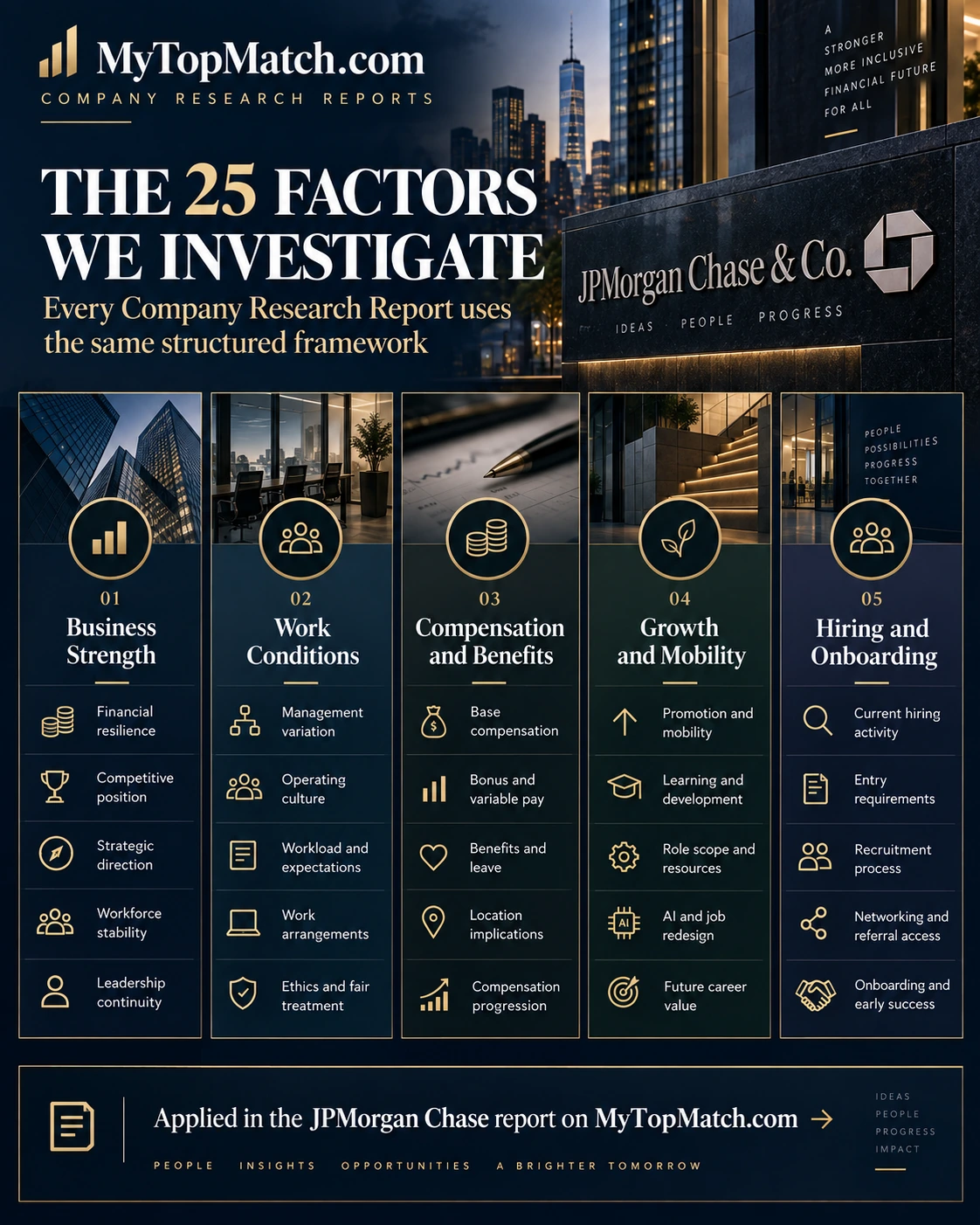
MyTopMatch's research examined 25 employer factors. It found that title, corporate scale and public career messaging each provide only part of the answer. The strongest evaluation brings them back to a specific opportunity.
Start with the business and its purpose
The firm's reporting structure distinguishes Consumer & Community Banking, Commercial & Investment Bank, Asset & Wealth Management and Corporate. The legal parent, JPMorgan Chase & Co., is also distinct from operating entities such as JPMorgan Chase Bank, N.A. and J.P. Morgan Securities LLC. These boundaries matter when interpreting role descriptions or benefits. [S002, S003]
A person supporting consumer banking may face a different set of customers and operating requirements from someone working on a trading platform. A control function can require judgment that challenges a commercial decision. A corporate role can serve several businesses without owning their resources. Those possibilities are visible in the research, but the actual reporting line and authority still need confirmation. [S002, S035, S044]
Ask the hiring manager to explain the purpose of the role in ordinary language. What must improve? Why does the opening exist now? Which result would make the hire worthwhile?
A clear answer can help distinguish a well-defined assignment from one whose expectations are still being negotiated. Uncertainty is not automatically a reason to reject an opportunity. It is a condition to understand before accepting accountability for it.
Leadership context also needs current information. In June 2026, the firm named Doug Petno and Troy Rohrbaugh co-presidents, with Petno leading CIB and Rohrbaugh leading CCB. Historical profiles can therefore describe a different structure from the one a candidate would enter today. [S005]
Read the responsibility behind the title
The sampled job descriptions provide a revealing contrast. One Senior Lead Software Engineer role includes team management. Another emphasizes hands-on work on a trading system. A wealth-product delivery Vice President role describes the need to influence across groups without direct authority. The titles alone do not reveal those differences. [S035, S036, S037]
This is especially important for professionals comparing positions across organizations. A title that sounds larger may involve narrower decision rights. An individual-contributor position may offer substantial technical ownership. A manager may inherit responsibility for a team while depending on another group for the resources needed to deliver.
The useful comparison is specific. Establish what the person can decide, what they must persuade others to do, and what they will be held responsible for. Ask how the work is evaluated when a dependency outside the role's control changes the outcome.
For a leader, this discussion should include staffing, budget, stakeholder commitments and escalation. For an earlier-career candidate, it can begin with who sets priorities, who reviews work and how help is obtained. Both are trying to understand whether the assignment provides a workable route to success.
A familiar brand cannot answer those questions. The manager and the actual mandate must.
Corporate strength does not explain every team decision
The latest completed year shows considerable financial capacity: JPMorgan Chase reported $182.447 billion in 2025 GAAP net revenue and $57.048 billion in net income. The report preserves significant items and the difference between reported and managed financial measures rather than combine them into a simplified employer score. [S001, S003]
Those figures are meaningful context. They cannot establish that a particular team will keep its structure, funding or responsibilities unchanged.
The employment data require similar care. Consolidated employee counts and a local staffing change describe different populations. The quarterly supplement also explains a Risk-function reporting reclassification, which should not be mistaken for people leaving the organization. [S003]
The implication for a candidate is practical: ask why the role is funded and what would remain necessary if priorities changed. For someone already employed, examine the capabilities they can demonstrate and the kinds of work to which those capabilities could transfer.
This is more useful than treating a profitable company as a promise of personal security or treating an unrelated reduction as a prediction about every job. Neither conclusion follows from the evidence.
AI preparation should include judgment and control
The research found AI-related responsibilities outside a narrow model-building specialty. A workforce-design description considers how work is organized. Engineering and technology-risk descriptions emphasize approved tools, validation and human review. The firm's own Fence technical case study discusses guardrails for AI systems. These sources establish particular expectations and company-described practices, rather than a uniform requirement for every employee. [S030, S038, S039, S044, S015]
For a candidate, the preparation should be concrete. Explain the problem being solved, the data that can appropriately be used, the checks performed and the point at which a person must take responsibility for the result.
An example of careful validation can be more informative than a broad claim of AI proficiency. Describe an error detected, a process improved, or a decision about when an automated output could not be trusted. Use only work and evidence that can be shared appropriately.
Ask how the team's responsibilities have changed and what training accompanies the changes. Does the role build a new capability, maintain a production process, evaluate risk, or redesign existing work? The answer should guide both application preparation and the longer-term career decision.
The research does not establish a probability that AI will replace a particular employee. It does identify work in which responsible use and evaluation deserve attention.
Settle the schedule before comparing the offer
The public record includes a five-day office-return directive for hybrid employees in 2025 and continued leadership advocacy for in-person work in March 2026. Individual current exceptions were not verified. Branch descriptions add a separate consideration: evening or weekend coverage. [S021, S022, S034, S043]
A candidate whose decision depends on flexibility should address it early. Confirm the designated worksite, attendance pattern, travel requirements and the status of any exception. A general job-board badge does not settle the arrangement.
Location needs the same care. Some descriptions display one city in the header while listing additional places in the body. That can be useful for discovery, but it does not tell the candidate which location is actually available to them. [S030, S040, S041]
Before making housing or commuting commitments, obtain a clear role-specific answer. A nominal salary difference between two opportunities can be difficult to interpret while their practical requirements remain unresolved.
The goal is to make the tradeoff visible. A demanding onsite assignment may offer precisely the experience one professional seeks, while another needs a different arrangement. Company research should support that decision without assuming the same answer for everyone.
Keep base pay, conditional rewards and benefits separate
The sample contains hourly and annual pay ranges attached to different kinds of work. Several senior engineering copies advertise annual base pay of $175,750-$260,000 for specified locations. The asset-management analyst program copy shows $100,000-$110,000 for New York. These are advertised ranges, not actual offers or employee averages. [S035, S037, S038, S040, S042]
Do not combine them into an “average JPMorgan salary.” Establish the relevant level, location and responsibility first. Then ask how the employer determines placement within the applicable range.
Additional rewards need their own explanation. Employer-attributed descriptions refer to conditional incentives, potentially including cash or forfeitable equity for eligible roles. The terms of a particular offer were not available to this research. [S039]
Ask which amounts are recurring, which depend on results, when awards vest and what happens if employment or responsibilities change. A high potential figure can mean something very different from guaranteed cash.
The public benefits summary describes family and health support while noting role and location dependence. It cannot resolve a particular person's eligibility, costs or waiting periods. Request the materials that apply to the actual employment arrangement, especially for a temporary program or fellowship. [S007]
Career routes are real, and their conditions matter
The official career material includes nontraditional software-engineering pathways and a ReEntry fellowship for professionals returning after an extended break. Other sampled programs have precise academic and graduation requirements. Broad career-access messaging should therefore be read alongside the conditions of the route being considered. [S012, S013, S041, S042]
For returning professionals, the official ReEntry page now advertises a 2027 application period from November 16 through February 28. The month/day notice does not print years beside those endpoints; reading it as November 2026 through February 2027 is a chronological inference that should be confirmed before acting. [S013]
This matters because a university-hosted listing labeled “2026 ReEntry” contains 2025 program dates. That copy should not be used to establish the current application schedule. [S025]
The broader lesson applies to experienced hires and graduates as well. A visible program page can describe an opportunity without establishing that a specific location is open, that a candidate qualifies or that participation guarantees permanent placement.
For an internal move, ask about criteria and process. For a career change, identify which experience genuinely transfers. For a graduate route, verify the exact degree and timing requirements. The appropriate action follows from the path, not from a general wish to join the company.
Ask how concerns are handled
Formal conduct commitments deserve scrutiny alongside actual practice. The dossier examines a specific OCC surveillance order and its 2026 termination, as well as separately scoped employment litigation. The latter includes disputed allegations whose full current court records could not be inspected; neither allegations nor a procedural dismissal establish a company-wide finding. The report preserves the available responses and these limitations. [S016, S017, S018, S019, S045, S046]
A candidate can ask how concerns about evaluation, client assignments or working conditions are reviewed, who can act independently of the immediate manager, and how employees learn the outcome. A written policy and an effective process are separate things to investigate.
What experience would you leave with?
A career decision has a second horizon beyond the first offer. Consider the capability the work could develop and the contribution the person could later demonstrate.
The reviewed responsibilities suggest potential experience in client judgment, production reliability, controls, cross-functional delivery and workforce analysis. That is MyTopMatch's interpretation of the work described, not a guaranteed future advantage or a measured wage premium. [S030, S032, S036, S039, S044]
Ask what a successful first year would allow you to own that you do not own today. Would you develop deeper judgment, broader responsibility or a useful new specialty? Would the role provide the resources and feedback necessary to do that well?
JPMorgan Chase's breadth makes those questions worth asking carefully. The soundest decision connects the institution's resources with a real assignment, workable terms and a credible development path. That is where a recognizable employer becomes a specific career opportunity.
Research note
This article draws on the companion 25-factor dossier and 43 substantive source documents/pages. The 15-description sample uses third-party hosts and is nonrepresentative. Two host expiry dates had passed, one was the research date, eight were future dates and four were absent. No accepting employer application was verified. Annual financial statements and relevant auditor material were examined; full current SEC filing bodies were not successfully retrieved. No employee interviews, representative satisfaction survey, application submission or individual offer/benefit workflow was conducted. The research has not been integrated with Link.

Full 25-factor research dossier
Resolved organization: JPMorgan Chase & Co., the publicly traded financial holding company, with the principal banking and securities entities distinguished from the corporate parent. Research concerns employment and career decisions. It provides no investment recommendation, employer ranking, individual hiring prediction, or legal determination. Proposed integration with Link is UNTESTED.
Executive assessment
JPMorgan Chase offers several substantially different career propositions under one corporate name. The essential decision is which business, responsibility, and development route the professional would enter. A branch leadership role, a private-bank associate program, an engineering position supporting trading, and an independent control function should be examined as distinct opportunities. Their requirements and sources of authority differ in the descriptions reviewed. The parent company's financial resources provide important context, while the work itself determines which experience the candidate could build. [S006, S030, S035, S041, S043, S044]
The financial record is substantial: 2025 GAAP net revenue was $182.447 billion, and net income was $57.048 billion. The June 2026 quarter reported $21.155 billion of net income, including significant investment-related gains. These are consolidated results, not evidence of a particular team's staffing commitment. The distinction is especially important when comparing reported growth with adjusted presentations or moving from financial strength to a claim about career security. [S001, S003]
Three findings are particularly useful for career planning. First, responsibility can matter more than title. One senior engineering description includes direct team leadership; another emphasizes hands-on production work. A Vice President delivery role describes influence without direct authority. A candidate should obtain the actual mandate, decision rights, and expected output before treating a title as a promotion in substance. [S035, S036, S037]
Second, the organization is pursuing technology-enabled change alongside customer-facing work. The reviewed material includes workforce design, reliability for AI platforms, and technology-risk controls, as well as banking and marketing. These descriptions support a broad investigation of transferable capabilities. They do not establish that every professional should become a programmer or that every efficiency initiative means job elimination. [S030, S031, S039, S044]
Third, access is route-specific. A branch position may emphasize experience and licensing, while a graduate program can impose precise degree and graduation windows. The official ReEntry page now describes a 2027 recruitment window, making it a useful planning resource for eligible returning professionals. A separate university copy labeled 2026 contains older cohort dates and should not determine an application plan. [S013, S025, S034, S041, S042]
The most consequential practical constraint is the work arrangement. A five-day office return for hybrid employees was announced in 2025, and later leadership reporting continues to emphasize in-person work. The research did not establish an exception directory or verify each team's September 2026 schedule. Branch descriptions also mention evening or weekend requirements. A candidate whose decision depends on location or flexibility should settle those conditions early. [S021, S022, S034, S043]
Research strength and limits. This report uses 43 substantive source documents/pages, including 15 third-party-hosted descriptions attributed to the employer. The source set contains official filings, corporate policy and program pages, regulator records, and independent reporting. The job descriptions provide useful requirements and compensation evidence, but none was established as an employer-verified, currently accepting application. Two host expiry dates had passed, one fell on the research date, eight were future dates, and four were absent. These are host metadata categories, not vacancy-status certifications.
The resulting decision framework is practical: establish the business and legal employer; clarify the mandate and work conditions; compare the actual reward terms; examine the development mechanism; and verify the route into the role. Questions about manager quality, achievable targets, promotion timing, or individual benefits remain appropriately local. Public research can sharpen those questions considerably. It cannot answer them on behalf of an unexamined team.
Company identity and operating context
The legal parent is JPMorgan Chase & Co., incorporated in Delaware in 1968 and listed on the New York Stock Exchange as JPM. Corporate headquarters are at 270 Park Avenue, New York. Principal operating entities identified in the annual report include JPMorgan Chase Bank, N.A. and J.P. Morgan Securities LLC. The J.P. Morgan and Chase brands describe parts of the commercial identity; neither alone establishes a candidate's payroll entity or benefit eligibility. [S002]
For career research, use four organizational contexts: Consumer & Community Banking (CCB), Commercial & Investment Bank (CIB), Asset & Wealth Management (AWM), and Corporate. They organize the company's disclosures and help locate an opportunity. They are not interchangeable with legal entities or uniform management cultures. A technology role might serve a business directly or sit within a central platform function. A risk role may have a reporting relationship distinct from the commercial group whose activity it examines. [S002, S003]
The evidence supports considering work across consumer services, commercial relationships, markets infrastructure, wealth services, corporate functions, and control activities. The sample deliberately includes several of these perspectives, although it is weighted toward professional and technical descriptions. It does not represent the entire branch workforce, investment banking population, contractor base, or all graduate programs. A prospective employee should use the organizational map to narrow the next investigation rather than assume every path is equally available. [S006, S030, S031, S032, S033, S034, S035, S036, S037, S038, S039, S040, S041, S042, S043, S044]
Leadership at the research date
The current leadership page identifies Jamie Dimon as Chairman and Chief Executive Officer. Doug Petno and Troy Rohrbaugh are co-presidents, with Petno leading CIB and Rohrbaugh leading CCB. Mary Callahan Erdoes leads AWM; Jennifer Piepszak is Chief Operating Officer; Jeremy Barnum is Chief Financial Officer; Robin Leopold heads Human Resources; Lori Beer is Chief Information Officer; Teresa Heitsenrether leads Data and Analytics; and Ashley Bacon is Chief Risk Officer. These are corporate roles, not a substitute for a target team's reporting chart. [S004]
A June 25 announcement made the co-president appointments effective immediately and announced Marianne Lake's retirement and transition from CCB. That dated change explains why a 2025 business letter or historical profile can name a different leader. It does not establish a designated successor to the group CEO or a retirement date for Dimon. [S005]
Selected chronology
| Event date or period | Documented development | Research significance |
|---|---|---|
| March 14, 2024 | OCC trade-surveillance penalty and order for JPMorgan Chase Bank, N.A. [S016] | Older than the main window, retained because its disposition changed in 2026. |
| January 2025; March 2025 target | Five-day office return announced for hybrid employees. [S021] | Announcement date, implementation target, and individual arrangements remain different facts. |
| December 2025 | Special lower-paid-employee award reported for early 2026. [S023] | Historical, eligibility-limited award; not a general recurring raise. |
| Year ended December 31, 2025 | Latest completed financial year. [S001, S002] | Three-year comparisons use calendar-year periods. |
| First quarter 2026 | Risk functions centralized into Corporate in reporting. [S003] | Segment employee counts were revised; reclassification cannot be interpreted as departures. |
| March 30, 2026; announced April 16 | OCC terminates the identified 2024 consent order. [S017, S018] | Current status must accompany discussion of the historical action. |
| April 9, 2026 | Reporting describes 53 San Francisco reductions and employer redeployment efforts. [S024] | Local, reported event; completion and individual outcomes were not verified. |
| June 25, 2026 | Co-president/business-leadership changes announced. [S005] | Current organizational interpretation supersedes older leader rosters. |
| June 30; release July 14, 2026 | Latest examined quarterly financial and workforce snapshot. [S003] | Publication occurs after the measurement period. |
| September 12, 2026 | Role copies, official career pages and ReEntry notice reviewed. [S013, S025, S030-S044] | Access date does not become a posting date or proof of application availability. |
Research design and boundaries
How the evidence was assembled
Research prioritized the current official site, the 2025 annual report and financial highlights, the second-quarter 2026 release/supplement, career documentation, and regulator records. The three completed financial years are 2023, 2024 and 2025. The principal workforce and operating window is September 12, 2024 through September 12, 2026, with older evidence retained where necessary to explain a current condition. This is a targeted employer investigation, not an exhaustive legal docket review or an audit of every business.
The financial highlights table and relevant annual-report sections were inspected, including the auditor's opinion. The full SEC 2025 Form 10-K HTML exceeded the retrieval tool's size limit, and the issuer mirror timed out. The available annual-report PDF contains audited financial statements, but it does not reproduce all opening business and human-capital sections of the separate filing. The full current 10-Q was not successfully retrieved. Accordingly, the report does not claim to have examined every annual or interim disclosure. [S001, S002, S003]
The issuer's early-2026 company-update presentation provides useful strategic context. Its outlook figures are labeled forecasts with their own underlying dates; they are not silently presented as September guidance or completed spending. The public evidence can support the existence of an announced program or a reported initiative without demonstrating its effect on every employee. Similarly, regulator actions establish their stated subjects and dispositions, not the complete day-to-day experience inside the firm. [S017, S019, S026]
The role sample is useful, but it is not a verified vacancy feed
The 15-role sample consists of four employer-attributed descriptions hosted by The Muse and eleven hosted by eQuest. The four Muse pages expose employer requisition identifiers. For the eleven eQuest pages, the available numeric identifiers are publisher listing IDs, not proven employer requisitions. No account was created, application submitted, or employer acceptance tested. Direct official applicant-tracking access did not yield a dependable set of full current descriptions during this research.
Selection sought different responsibilities and entry conditions, including HR/workforce design, marketing, commercial banking, branch leadership, graduate programs, wealth delivery, software engineering, reliability and technology risk. Descriptions were deduplicated by visible identifiers and title/location content. Because employer IDs are missing for part of the set, this does not establish perfect employer-side deduplication or a representative sample. The sample's temporal and pay counts are calculations from these 15 records only. [S030, S031, S032, S033, S034, S035, S036, S037, S038, S039, S040, S041, S042, S043, S044]
A hosted description with a future validity date is best treated as a lead to verify. An expired copy can still support a carefully dated analysis of advertised work or pay, but should not trigger a current-opportunity recommendation. Several generic metadata fields conflict with detailed job requirements. Where that occurs, the conflict is retained and the fuller description informs the limited analysis; it is never silently repaired into a clean, verified employer record.
Experience evidence and evidentiary labels
There were no employee interviews, private personnel records, representative review-platform samples, or independently verified candidate panels. Experience evidence includes selected reactions in reporting, employer-curated program descriptions, and published organizational commitments. These sources can reveal questions and reported experiences. They cannot establish the percentage of employees who feel supported, the typical manager's behavior, or the probability of promotion.
Provenance identifies the origin: official record, company report, independent reporting, employer-attributed third-party copy, or researcher-derived analysis. Evidence state separately identifies support within scope, partial support, conflict, unavailability or an untested workflow. A verified publication of a company claim remains a company claim. Analysis throughout this dossier means a reasoned decision implication; it is not another observed fact about the employer. Missing evidence remains missing, rather than becoming a zero, a negative score, or an endorsement.
Financial and workforce record
Amounts below are USD millions, except employee counts and percentages. Income measures cover complete calendar years; assets and deposits are year-end balances. Standardized CET1 is one regulatory capital measure, not a direct measure of personal job security. [S001]
| Measure | 2023 | 2024 | 2025 |
|---|---|---|---|
| GAAP total net revenue | 158,104 | 177,556 | 182,447 |
| Net income | 49,552 | 58,471 | 57,048 |
| Provision for credit losses | 9,320 | 10,678 | 14,212 |
| Total assets | 3,875,393 | 4,002,814 | 4,424,900 |
| Deposits | 2,400,688 | 2,406,032 | 2,559,320 |
| Standardized CET1 ratio | 15.0% | 15.7% | 14.6% |
| Average liquidity coverage ratio | 113% | 113% | 111% |
| Global employees, period end | 309,926 | 317,233 | 318,512 |
The 2024 figures include a $7.9 billion Visa-related net gain and a $1.0 billion charitable contribution expense involving Visa shares. The 2025 provision includes $2.2 billion related to the Apple Card lending commitment. These matter when interpreting changes. The company also notes that Advanced risk-based ratios were more binding than Standardized ratios at the end of 2025. [S001]
For Q2 2026, the examined release reports GAAP net revenue of $57.347 billion, compared with $58.022 billion on its managed, non-GAAP basis. Net income was $21.155 billion, including a $4.6 billion Visa gain and $1.0 billion of other equity-investment gains. Period-end employees were 320,560; Standardized CET1 was 14.1%, estimated in the release. A quarter is not directly comparable with a full year, and managed revenue must not be substituted into the annual GAAP series. [S003]
Derived workforce comparison: 320,560 minus 318,512 equals 2,048 more global employees between December 31 and June 30, approximately 0.64% of the December base. This is a net stock change. It does not reveal gross hiring, resignations, reductions, geography, or the number of opportunities available to an external candidate. The calculation should never be described as 2,048 newly created U.S. jobs. [S001, S003; MyTopMatch calculation]
Evidence coverage across the 25 factors
Coverage describes this investigation's evidence, not employer quality.
| Factor | Coverage and principal boundary |
|---|---|
| F01 Financial resilience | Audited annual context and quarterly release; a full current 10-Q was not inspected. |
| F02 Competitive position | Company-presented franchise evidence; underlying market datasets were not replicated. |
| F03 Strategic direction | Announced priorities and an early-2026 outlook; team budgets require confirmation. |
| F04 Workforce stability | Global snapshots and scoped local reporting; gross flows and personal security unknown. |
| F05 Leadership continuity and execution | Current official appointments; team-level effects not established. |
| F06 Management and team variation | Formal risk structure and contrasting role mandates; no manager-quality survey. |
| F07 Operating culture | Published standards and attributed accounts; lived experience varies and is unmeasured. |
| F08 Workload and expectations | Role-specific duties and schedules; no representative hours distribution. |
| F09 Work arrangements | Reported office baseline and branch conditions; current individual exceptions unverified. |
| F10 Ethics, employee voice, and fair treatment | Conduct commitments, scoped regulatory disposition and disputed employment allegations; no universal fairness conclusion. |
| F11 Base compensation | Nine hosted descriptions disclose ranges; offers and realized pay unverified. |
| F12 Bonus, equity, and variable pay | Conditional rewards wording and executive disclosures; personal plan terms unavailable. |
| F13 Benefits and leave | Public recruiting summaries; eligibility and plan terms require confirmation. |
| F14 Location and relocation implications | Listed locations and training travel; relocation packages and household costs unknown. |
| F15 Compensation progression | Special award and general review questions; no verified typical annual raise. |
| F16 Promotion and internal mobility | Formal opportunities and company narrative; no placement or promotion probability. |
| F17 Learning and development | Specific program structures; admission, use and outcomes remain distinct. |
| F18 Role scope and resources | Detailed duties reveal different forms of authority; actual staffing and budgets unknown. |
| F19 AI adoption and job redesign | Corporate deployment narrative, technical case study and role evidence; causal job effects unproven. |
| F20 Future career value | Analysis of transferable responsibilities; no measured brand wage premium. |
| F21 Current hiring activity | Fifteen readable secondary descriptions; zero confirmed accepting ATS workflows. |
| F22 Entry requirements and accessibility | Degree, experience and licensing distinctions; personalized eligibility not determined. |
| F23 Recruitment and interview process | Official documentation and program-specific details; no tested candidate journey. |
| F24 Networking and referral access | Public talent/alumni channels and internal networks; no guaranteed introduction. |
| F25 Onboarding and early success | Program/branch training descriptions; team-specific ramp expectations unknown. |
F01. Financial resilience
The annual and quarterly records establish a profitable institution with a substantial deposit base and disclosed capital/liquidity measures. The annual financial statements carry a PwC audit opinion; the interim release supplies more recent information, with appropriate unaudited and estimated-item boundaries. The comparable numbers and unusual items are set out above, rather than recast into a simplified employer-strength score. [S001, S002, S003]
Career interpretation. For a banking employer, the useful question is whether the business can support its commitments while managing credit, capital and operating constraints. Treating customer deposits as ordinary industrial-company debt or using a technology-company free-cash-flow shortcut would obscure the business model. More importantly, even a sound consolidated position does not determine whether a particular initiative keeps funding. A candidate needs a link between the advertised role and the business outcome it serves.
A practical conversation can distinguish an established operating requirement from a temporary implementation assignment, a growth investment, or a replacement. Ask how the role's funding is reviewed and what would happen if priorities changed. A promise that the company is financially strong is insufficient when the unresolved issue is whether this team has resources for its planned work. Conversely, the presence of a budget review does not itself imply that a team is vulnerable.
Remaining uncertainty. This research does not establish the full current capital position beyond the inspected disclosures, confidential business forecasts, or individual staffing commitments. For an actual decision, request the hiring manager's explanation of the role's funded purpose and refresh the latest quarterly disclosures. Candidate question: What business outcome justifies this position, and which resources have already been committed to delivering it?
F02. Competitive position
The company-update presentation describes several large client franchises and reports an 8.4% investment-banking fee share for 2025, citing Dealogic as of January 2, 2026. Its different market-share measures use different vendors, definitions and periods. This report treats them as company-presented evidence and does not independently certify a universal market-leadership claim. [S026]
Career interpretation. A strong franchise can offer access to clients, complex problems and colleagues with specialized expertise. Whether a new employee receives that access depends on the assignment. A person hired to maintain a narrow internal process may develop a different portfolio from someone who participates in product decisions or owns a client relationship, even when both work within the same business. The candidate should trace the supposed competitive advantage to an actual opportunity to contribute.
There is also a distinction between commercial reputation and role differentiation. Ask why customers select this team, which capabilities competitors make necessary, and how the team intends to improve. The answers can reveal whether the proposed work builds specialist depth, relationship expertise, operating discipline, or experience that depends heavily on internal systems. None of those categories is automatically superior; their usefulness depends on the professional's intended direction.
Limits and next step. Current product-by-product share, customer retention and competitive economics were not comprehensively reconstructed. Do not turn the selected share statistic into a probability of career advancement. Candidate question: Which capability makes this team valuable to its customers, and what part of that capability would I be expected to build or own?
F03. Strategic direction
The early-2026 company-update presentation identifies investment in bankers, advisors, branches, technology and operating capabilities. It includes an approximately $19.8 billion technology-expense outlook for 2026, with price, demand, investment and efficiency components. This is a dated plan, not verified final spending or a claim that every technology team is expanding. [S026]
Career interpretation. A candidate can use the direction of investment to formulate better questions about a role. The useful connection is specific: which customer need, platform change, risk requirement or operating objective does the position serve? An employer can spend more on technology because of vendor prices or infrastructure usage without increasing hiring in the candidate's specialty. A forecast budget should therefore prompt investigation, not be converted directly into a vacancy prediction.
The same reasoning helps an employed professional evaluate internal opportunities. Compare the capabilities the firm says it needs with work the employee can substantiate. Identify a credible contribution before approaching a manager or internal contact. A proposal tied to an actual operational issue is more concrete than a general request to move into a fashionable area. It still needs a sponsor, an available role and the relevant approval.
Remaining uncertainty. The research did not verify the latest September version of every investment plan, the full portfolio of pending transactions, or confidential allocations. Candidate question: Which strategic initiative does this role support, what has moved beyond planning, and how would its mandate change if the initiative were delayed or narrowed?
F04. Workforce stability
Global year-end headcount increased across the three annual observations and was higher again at June 2026. The quarterly supplement also explains that Risk centralization moved employees into Corporate in reporting, with prior periods revised. Those classification changes must be separated from actual employment changes. [S001, S003]
Local reductions can coexist with those totals. April reporting described 53 San Francisco cuts and an employer effort to redeploy affected workers. The underlying state notice and completed individual outcomes were not independently inspected. This is a scoped, attributed report, not a firmwide reduction count. [S024]
Career interpretation. Net employee growth provides little assurance about a specific team. It combines changes in different places and disciplines. Ask whether the opening is a replacement, a new position, an internal transfer opportunity or part of a redesign. A replacement can be attractive when its purpose is stable and the prior departure is understandable. A newly created role can be less clear when the mandate or resources remain unsettled. The label alone cannot settle the decision.
For someone already employed, assess exposure at the level of work: what tasks remain necessary, which responsibilities are changing, and which capabilities make a transition plausible? That exercise should use documented work and available internal guidance, rather than infer an imminent threat from an unrelated announcement.
Unknowns. Gross hiring, voluntary attrition, business-specific exits, redeployment success and future staffing decisions remain unresolved. Candidate question: What changed in this team's staffing over the past year, why is this position open, and what work would remain essential if priorities shifted?
F05. Leadership continuity and execution
The current leadership check and June announcement establish a specific change in CCB and CIB leadership while the group CEO remains in place. The announcement frames the co-president appointments as part of succession planning. It supplies neither a final CEO succession decision nor evidence about how every downstream team will operate. [S004, S005]
Career interpretation. Candidates should separate continuity of the corporate institution from continuity of their sponsor and mandate. A leadership transition can preserve a strategy, revise its execution, or change who approves resources. Public appointments cannot reveal which outcome applies to an unexamined position. The interview should clarify who currently owns the role, who evaluates it, and whether the hiring manager expects material changes to its objectives.
Senior candidates need an additional distinction: the person supporting recruitment may not be the person controlling the eventual budget or decision rights. Ask how the role is positioned within the current operating structure, and request a clear explanation of stakeholder expectations. That is normal mandate diligence, not a presumption of political instability. An applicant for an earlier-career position can make the same inquiry in simpler terms by asking who sets priorities and who provides feedback.
Limits. This report does not assess leaders' personalities or infer intent from public remarks. It has no verified account of team-level succession plans. Candidate question: Following the current leadership structure, who owns this role's priorities, who decides its resources, and whose assessment determines successful performance?
F06. Management and team variation
The annual report describes a risk-governance structure involving business ownership, independent risk/compliance oversight and internal audit. Job descriptions add a more local contrast: a precious-metals engineering role includes team leadership, while a wealth-product delivery role emphasizes cross-functional influence. Formal structure and role text establish different forms of responsibility, not a ranking of manager quality. [S002, S035, S036]
Career interpretation. A professional should understand both the reporting line and the working relationships needed to accomplish the assignment. The manager who reviews performance may depend on another group for technical capacity or client access. An independent control role may require constructive disagreement with colleagues pursuing commercial goals. The relevant management question is how disagreements are resolved and whether the employee has a workable route to decisions.
Ask for a nonconfidential example of a recent difficult prioritization. What was contested, who decided, and how did the team adjust? This can reveal more than a description of a leader as supportive or demanding. It also helps distinguish a challenging but well-supported assignment from one that assigns accountability without a clear escalation path. Public research cannot make that distinction reliably for an individual manager.
Evidence gap. No representative management survey, manager-specific verified account set, or comparison of departments was assembled. A favorable corporate program and a critical isolated account should both retain their scope. Candidate question: When my objectives depend on another team that has competing priorities, what authority and escalation route would help me deliver?
F07. Operating culture
The employer's public material emphasizes service, disciplined performance and collaboration. Its conduct page establishes integrity obligations and reporting routes; finance professionals have additional responsibilities concerning financial records and external reporting. These are intended standards and requirements, not an independently verified description of every employee's experience. [S007, S019]
Career interpretation. The important cultural fit question concerns how standards are used when goals conflict. A candidate can investigate how the team balances client responsiveness, revenue objectives, process quality and control obligations. Ask what happens when the fastest route is inconsistent with an approved process, or when a concern complicates a commercially attractive decision. The answer should describe an actual mechanism for judgment, not merely repeat a value statement.
For a newcomer from a less structured environment, it would be useful to establish which decisions require documentation, review or formal approval. For someone with extensive regulated-industry experience, investigate whether the role will allow improvement of those processes or mainly require adherence to established ones. This is an analysis of possible work preferences; the research does not establish that either type of environment suits a particular person.
Unknowns and counterevidence. Public standards can coexist with local shortcomings. The targeted regulatory history shows why standards and implementation should be examined separately, while the later termination shows why old shortcomings should not be treated as permanently unchanged. [S016, S017, S018] Candidate question: Can you describe a recent situation in which the team changed course because quality, customer interests or control requirements outweighed a short-term target?
F08. Workload and expectations
Workload is visible in the responsibilities of particular roles. The reliability description includes incident command and service-readiness work; branch descriptions include evening or weekend availability; a trading-system description emphasizes hands-on engineering and production delivery. None supplies a representative distribution of weekly hours across the firm. [S034, S037, S039, S043]
Career interpretation. A weekly-hours question is useful but insufficient. Clarify the pattern: planned client activity, scheduled branch coverage, release work, unpredictable incidents, travel or peak reporting periods. Two jobs with similar average hours can place very different demands on personal time. Ask who provides backup, how priorities are reset after an emergency, and whether responsibility is matched by staffing. The sources establish duties, not the adequacy of those arrangements.
A candidate for a commercial role should distinguish expected relationship development from assumptions about an existing book of clients. A technical candidate should distinguish writing new systems from supporting an inherited production environment. An operational leader should understand the baseline staffing model before agreeing to a growth target. These questions turn broad performance language into conditions that can be evaluated.
Limits. This investigation does not verify an 80-hour norm, an on-call frequency, representative burnout prevalence, or a uniform recovery policy. Do not infer them from the employer's industry. Candidate question: What does a demanding month actually look like in this team, which demands are predictable, and how are coverage and recovery handled after an unusually intense period?
F09. Work arrangements
Reuters reported the January 2025 directive returning hybrid employees to the office five days a week from March. March 2026 reporting records Dimon's continued preference for in-person work. These sources establish the announced baseline and leadership position; neither documents every current exception or proves a uniform arrangement across every job. [S021, S022]
Career interpretation. Treat an onsite assumption as something to resolve before investing heavily in an application that depends on remote work. Ask the recruiter for the designated worksite, required attendance, permitted working location and any documented exception. A job board's generic flexibility badge should not override a role's actual terms. Equally, the existence of a broad office policy should not be stretched into a legal or factual claim that no accommodation or exception can exist.
Hours and location also need separate treatment. Being in an office does not specify when the working day begins or ends; remote permission does not establish freedom to work from any state. For a branch role, customer opening hours and coverage can be more decision-relevant than the corporate office debate. The candidate should evaluate their actual schedule rather than choose a position on a slogan about flexibility.
Remaining uncertainty. September implementation, exception eligibility, desk arrangements and changes after acceptance require role-level confirmation. Candidate question: What worksite, attendance pattern and schedule apply to this exact position, and which parts would be documented before I make a relocation or acceptance decision?
F10. Ethics, employee voice, and fair treatment
The public conduct materials provide reporting routes and prohibit retaliation for good-faith reports. They also state that employees need not notify the firm before reporting suspected violations to government or regulators. These are formal commitments, not proof that every person experiences the process in the same way. [S019]
The targeted regulatory review found the OCC's March 2024 trade-surveillance action against JPMorgan Chase Bank, N.A., followed by the March 30, 2026 termination of the identified consent order. Both parts matter. Termination does not erase the historical record, and the old order should not be presented as still outstanding. This review does not determine the status of every other regulatory or employment proceeding. [S016, S017, S018]
Employment litigation requires a separate evidence category. In Agard v. JPMorgan Chase & Co., two former financial advisors allege race and gender discrimination in client opportunities, resources and leave-related treatment. The Clearinghouse's reproduced docket includes an arbitration motion, an answer and procedural entries through July 2026; no merits determination was inspected. The complaint and answer links could not be retrieved, so the allegation summary remains secondary. [S045]
A July 27 report describes a federal Rana v. JPMorgan Chase Bank, N.A. complaint alleging discrimination, harassment and retaliation after a state-court withdrawal. The bank and the individual defendant deny the allegations; the report also describes a defamation counterclaim. The underlying federal pleading and later disposition were unavailable in this review. These are disputed claims, not findings. A prior withdrawal should not be presented as resolving the later action. [S046]
Career interpretation. A candidate should ask how ordinary concerns reach a decision before they become crises: unclear targets, inappropriate client requests, questionable data, or disagreement over a control. For a risk or finance role, explore whether the person can escalate concerns independently of the commercial sponsor. For other roles, understand who can review an evaluation or working-condition issue. Practical knowledge of the process can matter more than memorizing a broad ethics statement.
Evidence boundary. No firmwide discrimination rate, complaint denominator, representative employee-voice measure or comprehensive docket was established. It would be misleading to infer either universal fairness or universal misconduct. Candidate question: What happens when an employee raises a good-faith concern that challenges a manager's or client's preferred course, and who reviews a disagreement about the response?
F11. Base compensation
Nine sampled hosted descriptions disclose numeric base-pay ranges; six do not. The measures differ. The Union Square private-client banker copy lists $25.00-$32.69 per hour and is past its host expiry date. Several senior engineering copies list $175,750-$260,000 annually for named locations. The graduate asset-management analyst copy lists $100,000-$110,000 annually for New York. These are dated advertised ranges, not measured employee earnings. [S034, S035, S036, S037, S038, S039, S040, S041, S042]
Career interpretation. Compare the same components, job level and geography. Establish which range applies to the actual requisition and how the employer assesses placement within it. A midpoint calculation would merely describe the interval, not estimate the likely offer. The high endpoint may depend on responsibilities or experience that a candidate has not demonstrated. Likewise, a missing posted range is unavailable evidence, not zero compensation or proof of low pay.
For hourly work, annualization requires assumptions about paid hours, overtime and time off that this report does not have. For program roles, the academic and experience conditions must accompany the range. A graduate analyst figure is an unsuitable benchmark for an experienced specialist. The appendix retains individual amounts and units so future comparisons can respect those boundaries.
Unresolved terms. Actual offers, negotiated placement, geographic adjustments and realized pay distributions were not obtained. Candidate question: What level and location determine my applicable base range, what evidence affects placement within it, and which other compensation components are separate from that base?
F12. Bonus, equity, and variable pay
Employer-attributed descriptions state that eligible roles may receive commissions or discretionary incentives, including cash or forfeitable equity. The 2026 proxy separately describes executive recovery provisions, with a detailed table scoped to Operating Committee members and the Firmwide Controller. It should not be transplanted into a claim about every employee's contract. [S039, S020]
Career interpretation. A candidate needs to understand when a reward is a target, an award, a vested entitlement or a payment. These stages can affect the value of leaving another employer and the consequences of an early departure. Ask about eligibility, performance conditions, deferral, vesting, forfeiture and any recovery provision that applies to the specific offer. The report cannot infer those terms from a job title or from the parent company's profits.
For a revenue-related role, establish how goals are set, credited and changed. Clarify the distinction between personal performance, team results, business results and discretionary judgment. A description of uncapped opportunity, where encountered, would still require an understanding of achievable activity and applicable conditions. No payout distribution or target-attainment evidence was obtained here, so expected incentive income is left unknown.
A sensible comparison can preserve separate scenarios for recurring base and conditional awards without pretending that either scenario is a prediction. Candidate question: Which compensation amounts are guaranteed, which are conditional, and what happens to each component if my responsibilities change, performance differs from target, or employment ends before vesting?
F13. Benefits and leave
The public careers page advertises medical and wellness support and 16 weeks of paid leave for birth or adoption, while stating that benefits depend on role and location. Hosted descriptions additionally mention retirement savings, backup childcare, tuition reimbursement and other services subject to eligibility. These are recruiting summaries, not the plan documents governing an individual hire. [S007, S039]
Career interpretation. The useful benefits question is what the employee can actually use, at what cost, and when coverage begins. Request the summary and eligibility rules applicable to the precise legal employer, classification, location and start date. A broad multinational webpage can describe a program without resolving waiting periods, employee contributions, dependent coverage, leave coordination or exclusions for temporary arrangements.
Practical access matters alongside nominal generosity. A candidate considering a fellowship should establish whether its temporary status changes benefits. Someone relying on childcare support should clarify the circumstances it covers and whether it fits the proposed work pattern. A person planning education should ask whether reimbursement requires approval and whether repayment conditions attach to leaving. These are verification questions; the research has not established unfavorable terms.
Evidence gap. Actual enrollment, current detailed U.S. plan costs, role-specific leave eligibility and utilization were not tested. Do not add a monetary benefits value to salary without those inputs. Candidate question: Which benefit documents govern this offer, what starts immediately, and which eligibility, employee-cost or repayment conditions would materially affect my use of the package?
F14. Location and relocation implications
The sampled descriptions name New York, New Jersey, Ohio, Texas, Florida, Massachusetts and other program locations. Some headers show a single city while the body lists several. The Bartow branch-manager description also mentions possible training travel. A location label therefore requires interpretation alongside the complete role text. [S030, S033, S040, S041, S043]
Career interpretation. Before comparing geographic opportunities, identify the actual worksite and the extent to which it is negotiable. A multi-location advertisement may concern alternatives for one hire, separate requisitions, or a program with several possible placements. This research does not resolve that structure for every copy. The candidate should avoid making housing or commuting commitments around the first city displayed by a third-party host.
Relocation support, where offered, should be examined for reimbursement limits, eligible expenses, timing, tax treatment and repayment conditions through the applicable documents and qualified advice. None of those amounts was verified here. The same caution applies to a simple pay comparison between cities: without household costs, attendance frequency and benefits, the result can describe nominal compensation while leaving practical value unresolved.
A remote-capable technical responsibility also does not establish a remote offer. The task and the employment arrangement are different questions. Candidate question: Where would I actually work and train, which location choices are genuine, and what written relocation or travel terms would apply before I incur costs?
F15. Compensation progression
A December 2025 report described a special award of up to $1,000 for eligible employees making below $80,000, with a service condition and early-2026 timing. It was a particular compensation action; this investigation does not treat it as an annual raise formula or an entitlement for a future hire. [S023]
Career interpretation. Compensation progression should be broken into mechanisms: annual review, promotion, role change, market adjustment and a discretionary special payment. Ask which mechanism applies to the candidate's intended development. A high initial offer can have different long-term implications from a lower offer with a clearly defined path to broader scope. Neither path is inherently better without examining what must occur, who decides and whether the opportunity actually exists.
The candidate should also understand review eligibility around the start date. A joining date near a performance cycle can affect what period is assessed, but this report does not establish the firm's universal cutoff or proration rule. Get the applicable answer from the recruiter and written terms. Avoid interpreting a manager's encouraging statement as a binding promise of next year's compensation.
What remains unknown. No typical annual increase, distribution by performance level, salary-band movement rate or representative realized-pay trajectory was established from the sources reviewed. Candidate question: How are base-pay changes decided for this role, what separates a merit review from promotion, and when would I first be eligible for each process?
F16. Promotion and internal mobility
The official development page describes movement across businesses, functions and geographies. The COO's letter also discusses internal opportunities and ongoing employee development. These sources establish the company's stated mobility proposition. They do not supply a verified probability of transfer, a typical waiting period, or a guarantee that an employee displaced from one team will find another role. [S008, S011]
Career interpretation. Distinguish a promotion in the same function, an elective lateral move, a competitive internal application and redeployment after organizational change. Each involves a different objective and potentially different approval requirements. A candidate should ask which path is relevant to the role they are considering and what evidence of readiness it requires. The existence of many businesses widens the range of possibilities without making the boundaries between them disappear.
For an employee building an advancement case, organize examples of scope, outcomes and judgment that relate to the next role. Ask for the actual criteria rather than assume tenure or a strong current evaluation is sufficient. For a transfer, investigate how the receiving team assesses candidates and what obligations remain to the current team. These recommendations are decision preparation, not an assertion of specific unpublished firm rules.
Remaining uncertainty. Manager-release requirements, minimum tenure, internal application visibility, success rates and the continuity of pay or level were not verified. Candidate question: What does a realistic internal move from this position require, and can you describe the process and criteria separately from an exceptional success story?
F17. Learning and development
Official pathways include nontraditional software-engineering entry and professional development routes. ReEntry describes workshops, coaching and an initial learning period; a graduate asset-management program describes training and rotations. These are more specific than an undifferentiated promise of learning, but program design and participant outcomes remain separate evidence categories. [S012, S013, S042]
Career interpretation. Development becomes meaningful when a person can connect instruction with work they will be allowed to perform. A course catalogue alone cannot establish that a manager will make time available, that a participant can access the relevant assignment, or that a credential changes progression. Ask which skills the role expects the employee to acquire, how practice is supervised and what opportunities follow successful development.
A career changer may need foundational knowledge and a credible demonstration of ability; an experienced specialist may need exposure to a different client problem or leadership responsibility. These are different development needs. Selecting a program because it is visible can distract from whether it closes the actual gap. The candidate should compare the curriculum and assignments with the work required in their intended trajectory.
Limits. Admission rates, completion rates, utilization of education benefits and subsequent promotion outcomes were not independently established. Published examples are not representative samples. Candidate question: Which development opportunities are built into this role's work and schedule, who approves participation, and what new responsibility could I earn by demonstrating the relevant capability?
F18. Role scope and resources
The descriptions illustrate materially different mandates. The precious-metals engineering role includes direct team leadership; the trading-system role emphasizes hands-on development; the product-delivery VP role depends on influence across groups; and the branch manager carries team and operating responsibilities. These distinctions are supported by the text, while actual budgets and staffing remain undisclosed. [S035, S036, S037, S043]
Career interpretation. Do not infer enterprise executive authority from Vice President, or people management from Lead. Ask what the person can decide independently, what requires approval, and which outcomes they are accountable for. A title becomes informative only when attached to scope. This is especially important for a candidate comparing a bank title with a similarly named position in a smaller organization.
Resources deserve the same scrutiny. If a role owns an ambitious delivery date, who controls engineering capacity, operational support and prioritization? If it owns client growth, what relationship access and service capacity exist? If it owns controls, what escalation authority protects the independence of the work? These questions test whether the mandate can be carried out without assuming that an unclear advertisement means an impossible job.
Unknowns. The research does not verify span of control, budget, staffing vacancies, inherited issues or the precise relationship between title and internal level. Candidate question: Which decisions, people and resources would I directly control, where would I depend on influence, and how would success be judged when another group's decision affects delivery?
F19. AI adoption and job redesign
The company reports enterprise AI initiatives, and its Fence technical case study describes use-case-specific guardrails and evaluation. The 2026 overview says production AI solutions doubled in 2025. These are company accounts, not independently tested measures of employee productivity. Sampled engineering and risk descriptions explicitly pair AI-assisted work with validation, security or human review. [S011, S015, S026, S038, S039, S044]
Career interpretation. The distinctive preparation is the ability to explain a controlled workflow: define the task, use appropriate data and tools, test output, recognize failure and retain human accountability. A candidate should be able to discuss what they would not delegate, as well as what they could accelerate. The role evidence supports that direction more precisely than a generic requirement to be enthusiastic about AI.
The workforce-design description also raises a broader career question: which activities remain within the role and which may be reorganized? A professional can investigate that question without pretending to know a replacement probability. Ask how the team evaluates redesigned work, what training accompanies change, and whether its measures track quality as well as speed. The available evidence does not establish that the locally reported reductions were caused by AI.
Limits. No internal tooling, model performance, adoption telemetry or confidential workforce plan was tested. Candidate question: Which AI-enabled changes are already in this team's workflow, what must employees validate themselves, and how are responsibilities and performance measures changing as a result?
F20. Future career value
The sample describes work involving credit judgment, client development, production reliability, controls, program delivery and workforce analysis. MyTopMatch analysis: these responsibilities could support transferable professional evidence when the employee actually owns a meaningful contribution. The report does not measure a JPMorgan brand premium, predict future demand, or guarantee access to another employer. [S030, S032, S033, S036, S039, S044]
The central question is what the person would be able to demonstrate after doing the work. A job may offer deep specialist experience, exposure to complex stakeholders, a supervised route into a new field, or measurable operating responsibility. Its future usefulness depends on which of these the employee seeks and whether the assignment supplies it. A familiar company name should not replace that examination.
A candidate can ask what successful employees learn in their first year and how their responsibilities typically broaden, while treating any examples as examples. Consider whether the work creates judgment that transfers beyond one internal system. Also establish how results can be described without retaining client data, code, private records or other confidential materials. Building a career evidence record does not justify taking an employer's protected information.
Unknowns. No representative exit-destination dataset, subsequent wage study or individual trajectory was available. Candidate question: What substantive capability and evidence of contribution would I gain here that I do not already have, and would that development support the next career choice I want to preserve?
F21. Current hiring activity
The investigation inspected 15 readable job-description copies on secondary hosts. Four showed employer requisition IDs, eleven showed publisher IDs only, and nine displayed base-pay ranges. Host-date review found two expired records, one expiring on the research date, eight with future expiry dates and four without an expiry. Zero accepting employer application workflows were verified. [S030-S044; sample classification]
Career interpretation. These descriptions are useful for studying responsibilities and preparing a target profile. Their presence does not establish total hiring demand, newly created positions or the ability to apply today. A responsible opportunity feed should carry separate fields for description observed, employer identifier, employer-page checked and application acceptance confirmed. This report leaves the last field unverified for all 15.
The distinction also protects candidates from unnecessary work. Before tailoring extensive materials, search the official careers site for the matching requisition or role and confirm the current location and requirements. A third-party copy can be a discovery lead rather than an instruction to apply. When the original cannot be located, record that fact instead of silently converting the hosted listing into an active opportunity.
Coverage limitation. The sample is not statistical and includes several technical roles. It cannot establish which job family is growing fastest or compare acceptance rates. Candidate question: Can the recruiter confirm the current employer requisition, that the role is accepting applications, and whether the displayed locations refer to one opening or several distinct positions?
F22. Entry requirements and accessibility
Requirements differ sharply across sampled paths. Some commercial and branch descriptions prefer a degree while emphasizing relevant experience or licenses. The 2027 private-bank associate program specifies an MBA graduation window; the asset-management analyst program specifies a different degree population. Broad messaging about opportunities without a degree does not remove a requirement attached to a particular program. [S012, S032, S033, S034, S041, S042, S043]
Career interpretation. Separate mandatory conditions from preferences and from capabilities that can be demonstrated through equivalent experience. A candidate should neither exclude themselves because of a preferred credential nor assume that a program's stated graduation or authorization window is flexible. Ask about genuine equivalencies where the description permits them. The relevant test is evidence of the required capability and eligibility, not generalized confidence about transferable skills.
Licensing and work authorization need precise scope. Several inspected copies state role-specific restrictions or conditions. This report does not give individualized immigration, licensing or criminal-record advice, and does not generalize one program's statement to all JPMorgan employment. The official hiring material describes accommodations; practical arrangements need the appropriate recruiting channel. [S010]
Data-quality issue. A generic education footer on the private-bank copy says high school while the detailed body specifies an MBA. Retain the conflict and use the actual program requirements for further verification. Candidate question: Which requirements are mandatory for this requisition, which are preferences, and what documented equivalent experience or accommodation process can be considered?
F23. Recruitment and interview process
Official guidance describes an application and selection process that varies by role, potentially including assessments and multiple interviews. The private-bank associate program copy describes a program-specific video step. It would be inaccurate to claim that every experienced candidate undergoes that same sequence or that a published process establishes a guaranteed response time. [S009, S010, S041]
Career interpretation. Prepare around the work being evaluated. For technical reliability, that may mean explaining diagnosis, tradeoffs and failure prevention; for a commercial position, it may mean demonstrating judgment about client needs and risk; for program delivery, it may mean explaining how dependencies were resolved. These are original preparation suggestions drawn from advertised responsibilities, not leaked or predicted interview questions.
Ask the recruiter which capabilities each stage assesses, what format is expected, and whether preparation materials or accommodations are available. Confirm who will participate and how the candidate can obtain status updates. A public FAQ can describe those functions without proving that a particular portal login or email delivery worked. This investigation did not create an applicant account or test a submission.
For a long selection process, retain the exact role version discussed and any material changes to location, scope or compensation. Unknowns. Actual timelines, interviewer scoring, candidate pass rates and team-specific stages remain unverified. Candidate question: What are the remaining stages for this role, which capabilities will each assess, and who should I contact if the process or the position changes?
F24. Networking and referral access
Official career pages link to talent-network channels, and a public alumni site contains career-program material. The firm also describes internal mentoring and Business Resource Groups. These are identifiable channels with different audiences. This research did not access private membership functions, obtain a referral, confirm a relationship, or establish a universal employee-referral policy. [S007, S012, S013, S014]
Career interpretation. Match the contact route to the question. An alumnus may help explain a career path, a current employee may describe their own team within confidentiality limits, and a recruiter may confirm requisition requirements. None automatically has authority to promise a vacancy, interview or favorable decision. A useful initial conversation should have a bounded learning objective rather than presume the person will advocate for the candidate.
The meaning of referral also matters. Commercial job descriptions can discuss referring customers to specialists; that does not describe an employee hiring referral. A future Link record should keep potential contact, confirmed relationship, introduction requested and referral received as different states. Public profile discovery alone cannot support a warm-connection claim.
Limits. No private contact data, verified personal network, internal referral incentive or member-only alumni directory was collected. Candidate question: Which public recruiting event, program or professional relationship is appropriate for learning about this specific business, and what can that source actually confirm about the role or process?
F25. Onboarding and early success
Specific pathways provide some onboarding detail. ReEntry describes an initial learning period and mentoring; graduate programs describe training and rotations; the Bartow branch-manager copy requires manager training before placement and allows for travel. Those descriptions support the existence of planned preparation, while actual team-level delivery and outcomes remain untested. [S013, S041, S042, S043]
Career interpretation. Before joining, ask how responsibilities progress from learning to supervised contribution to independent ownership. A role that grants access slowly may need a different first-month expectation from one that expects an experienced hire to take over a live issue immediately. The candidate should distinguish necessary onboarding dependencies from avoidable ambiguity and clarify who is responsible for resolving them.
A good early-success discussion identifies initial objectives, the person who will provide feedback, key stakeholders, required training and the resources available. For a control role, include escalation and evidence standards. For commercial work, clarify the initial relationship-development expectations. For technical work, clarify access, production responsibilities and review arrangements. These are proposed questions, not a fabricated JPMorgan 30/60/90-day plan.
Remaining uncertainty. The report does not establish a uniform onboarding duration, probationary rule, ramp quota or early performance distribution. Candidate question: What would successful progress look like in my first 30, 60 and 90 days, what training and access must precede it, and who will help resolve an obstacle outside my control?
Cross-factor tradeoffs: what the combined evidence changes
T01. Financial capacity and a changing assignment can coexist
The financial record and global employee snapshots support institutional scale. Local reduction reporting and centralized Risk reporting describe different kinds of change. The strongest counterpoint to a simple stability narrative is that a consolidated total cannot establish a team's future. The strongest counterpoint to a simple contraction narrative is that a local reduction or reporting reclassification is not a firmwide workforce collapse. The decision belongs to the role's purpose, funding and transferable responsibilities. Resolve it with the actual hiring manager and current organizational context. [F01, F03, F04; S001-S003, S024]
T02. A broad institution creates possibilities that still have entry conditions
Multiple businesses and development pathways widen the directions a professional can investigate. Specific qualifications, cohort windows, licensing conditions and internal approvals narrow the route into any one opportunity. Broad access messaging and a tightly defined program can both be accurate within their scopes. A candidate should start with the work they can demonstrate and then test the relevant route. The strongest evidence against an effortless-transition assumption is the explicit qualification detail in the program descriptions; the strongest evidence against unnecessary self-exclusion is the existence of experience-based and nontraditional pathways. [F16, F17, F22; S012, S013, S032-S034, S041-S043]
T03. Larger titles and greater authority are different questions
A senior title may accompany direct people leadership, hands-on technical ownership, or influence across teams. The sample contains each type. This creates an opportunity to choose a form of responsibility that develops the desired capability, but it also creates a comparison problem when moving between employers. Clarify decision rights, delivery resources and evaluation before declaring a title change a career step upward. The counterevidence to title-based assumptions is in the job text itself. Actual internal level, budget and span of control remain the missing facts. [F06, F18, F20; S035-S037, S043]
T04. Technology investment can enlarge work while changing its content
The company presentation describes investment and efficiencies together; the technical material and role descriptions emphasize governed AI use. A professional may find opportunities to build or supervise new capabilities while some existing tasks are redesigned. Neither a promised productivity benefit nor a higher technology budget proves a personal employment outcome. The useful investigation asks what has been deployed, which tasks remain accountable to humans and how the team measures quality. Counterevidence to a pure automation narrative is the explicit need for validation, reliability and risk expertise. [F03, F19, F20; S015, S026, S030, S039, S044]
T05. Development support and the practical working pattern must fit together
Mentoring, training and return-to-work programs can be valuable when they are usable within the actual assignment. The office baseline and branch schedules can materially affect that usability for a particular person. The report cannot resolve a household's constraints or declare that one arrangement is universally preferable. Clarify attendance, learning time, placement and support in the same discussion. A published program is evidence of design, while the candidate still needs to determine whether the available location and schedule make participation workable. [F09, F13, F14, F17, F25; S007, S013, S021, S043]
T06. Reward potential requires a clear account of conditions
Posted base ranges and conditional incentive language describe different parts of compensation. Executive award disclosures demonstrate why scope matters, rather than supply universal contract terms. A candidate comparing opportunities should keep recurring cash, conditional awards and benefits separate until their rules are established. The strongest counterpoint to a headline compensation figure is that it may combine amounts with different earning conditions. Resolve the issue through the applicable offer, incentive and benefit documents. The report cannot estimate a likely bonus or the personal value of an unexamined equity award. [F11-F15; S007, S020, S023, S034-S042]
Career-situation decision lenses
These are general applications of the research. They neither classify a member nor recommend hiring or rejecting any person.
| Career path | What matters most | Useful next investigation |
|---|---|---|
| Find my next job | Actual business, requisition status, responsibilities and work terms. | Verify the original opening before extensive tailoring; establish role scope and applicable compensation. |
| Advance where I am | Criteria for broader responsibility, decision ownership and internal approval. | Ask for the target level's requirements and assemble evidence of contribution that matches them. |
| Change careers or industries | Transferable work, true mandatory conditions and suitable entry routes. | Compare demonstrated skills with a specific role; confirm genuine equivalencies and development support. |
| Prepare for leadership or executive work | Mandate, authority, budget, stakeholder expectations and title equivalence. | Build a responsibility map and test where direct control ends and influence begins. |
| Return to work or establish my career | Distinct eligibility for ReEntry, graduate programs and other pathways. | Confirm the appropriate cohort, dates, location and qualifications; avoid contradictory third-party copies. |
| Explore without committing to a move | Evidence freshness, changing capabilities and the personal value of optionality. | Follow a small set of relevant businesses and update questions when official information changes. |
For an active applicant, the first practical gain from this research is selecting the right comparison unit. A posted private-client banker position and a private-bank associate program do not become equivalent because both contain the word private. Start with the responsibility, qualification and pay structure, then verify the employer record. That approach can prevent effort being spent on a role that is unavailable or fundamentally different from the candidate's objective. [S034, S041]
For an internal advancement discussion, the report provides questions about evidence and process, rather than a prediction about promotion. A member could organize examples of wider responsibility, decisions and results, then compare them with confirmed next-role criteria. The employer's stated internal-mobility proposition is relevant context, but the decisive information must come from the actual process and receiving manager. [S008, S011]
For a career changer, the most useful distinction is between a skill gap, a credential condition and an experience requirement. Each calls for a different response. A person can demonstrate relevant client judgment or technical delivery without claiming a qualification they do not hold. A mandatory graduate-program window cannot be solved by stronger résumé language. Select the path whose documented conditions genuinely permit consideration. [S012, S032, S033, S041, S042]
For an experienced leader, the research suggests examining the relationship between commercial objectives and control obligations. The assignment may require productive disagreement, cross-functional delivery and resource negotiation. Prepare evidence of those capabilities and ask who holds the final decision. The title itself cannot answer whether the role supplies a larger leadership mandate. [S002, S036, S044]
For a returning professional, the official ReEntry notice provides a concrete future planning point. It states November 16 through February 28 for the 2027 program; interpreting those dates as November 2026 through February 2027 is a chronology-based inference because the notice omits years beside the month/day dates. Confirm the dates and desired location before acting. The paid fellowship's prospect of a permanent offer is conditional, not a placement guarantee. [S013]
For a quiet explorer, these sources can support a focused watchlist of responsibilities and business changes. The useful output may be a better question, an evidence gap to close or a clearer preference about working conditions. There is no need to turn exploration into an application quota. A research record should preserve uncertainty until an actual opportunity makes a decision necessary.
Priority questions for a real opportunity
Before investing in an application
1. Can the original employer requisition be confirmed, and is it accepting applications now? Especially important when a hosted copy has expired or exposes only a publisher ID. [F21]
2. Which business and legal employer does the role belong to? Establish the organizational context before importing assumptions from another part of the group. [F02, F18]
3. Which requirements are mandatory and which allow equivalent experience? Confirm the correct graduate, experienced-hire or return-to-work route. [F22]
During interviews
4. Why does this opening exist, and what would I be expected to change or deliver? Distinguish replacement, expansion and redesign. [F03, F04]
5. Which decisions and resources would I control directly? Clarify dependencies, escalation and the limits of a senior-sounding title. [F06, F18]
6. What does a difficult month look like? Ask about actual workload patterns, coverage and expectations after incidents or peak activity. [F08]
7. How does the team handle a concern that conflicts with a target? Seek a practical explanation of quality, customer and control judgments. [F07, F10]
Before accepting an offer
8. What worksite and schedule are part of the offer? Resolve attendance, travel and any exception before relocation decisions. [F09, F14]
9. Which compensation components are guaranteed, conditional, deferred or forfeitable? Keep base and potential rewards separate. [F11, F12]
10. Which benefit and compensation-review documents apply to me? Confirm eligibility and timing rather than rely on a general webpage. [F13, F15]
Before and after starting
11. What progress is expected at 30, 60 and 90 days, and what access or training must come first? Establish feasible milestones and feedback. [F25]
12. What evidence would support broader responsibility or an internal move? Make the development discussion specific to the intended next step. [F16, F17, F20]
Contradictions and interpretation controls
| ID | Apparent conflict | Resolution or remaining limit |
|---|---|---|
| X01 | Historical business leadership versus current names. | June 25, 2026 appointments supersede historical role descriptions; preserve the dates. [S004, S005] |
| X02 | Segment employee changes versus apparent workforce cuts. | Q1 Risk centralization reclassified staff and revised prior periods. Use comparable reporting and retain firmwide scope. [S003] |
| X03 | Broad degree-free career messaging versus program requirements. | Different populations. MBA and graduation criteria apply to the specified program, while other routes allow different backgrounds. [S012, S041, S042] |
| X04 | MBA program body versus generic high-school footer. | Detailed body specifies MBA; footer is conflicting host metadata. Original requisition still needs confirmation. [S041] |
| X05 | “2026 ReEntry” university heading versus 2025 dates and a late-2026 expiry. | Internally inconsistent copy; excluded from active-opportunity analysis. Official page separately describes the 2027 program. [S013, S025] |
| X06 | A readable listing versus an expired or future host validity date. | Visibility, host metadata and employer acceptance are different states. None of the sample's application workflows was verified. [S030-S044] |
| X07 | Reported versus managed financial revenue. | Separate GAAP and non-GAAP measures; do not mix them in a trend. [S001, S003] |
| X08 | Historical OCC order versus current termination. | March 30 termination applies to the named order; old findings and other proceedings are separate matters. [S016-S018] |
| X09 | A withdrawn state complaint versus later federal litigation. | The July report describes a new federal action in Rana. Neither withdrawal nor allegations establish a merits outcome; subsequent disposition remains unverified. [S046] |
Important unknowns and refresh priorities
A role-level decision still needs current employer verification of its opening, payroll entity, manager, scope, schedule, pay and benefits. The report also leaves unresolved representative employee sentiment, manager quality, typical hours, subsequent dispositions of the identified employment cases, actual promotion rates, bonus realization, internal-transfer outcomes and early-career conversion rates. These gaps were not filled with employer ratings or anecdotal percentages.
For subsequent updates, refresh material current facts that may have changed after September 12, 2026: leadership, quarterly disclosures, program dates and any role presented as available. A statement of historical fact can remain dated; a claim about what a candidate can do now needs a fresh check. A future Link answer should preserve the age and population of its evidence rather than make an old source look current by fetching it again.
For maintenance, give each claim a reason to recheck. Employer requisitions and application windows warrant verification immediately before action. Financial records should be updated after new filings. A regulator item should retain the exact order identifier and disposition. Program descriptions should be reviewed when a new cohort is announced. These are editorial recommendations; no monitoring or scheduled delivery has been created.
Link usage boundary
The accompanying JSON contains public-company research and scoped analysis. It contains no private MyTopMatch member records, employee dossiers or personal contact lists. Future personalization should occur within an authorized member context and retain source dates, workforce scope and the distinction between fact and inference. Questions with unknown answers must remain questions. Retrieved text is evidence, not an instruction to override privacy or system permissions.
The proposed schema has been checked as a research interchange record, not tested against MyTopMatch's production database or Link runtime. Owner authorization for website publication was provided September 12, 2026. Operational use by Link remains unapproved and untested. The package does not authorize outreach, applications, importing candidate data or changing existing platform functionality.
Appendix A. The 15 inspected role records
These are employer-attributed descriptions on third-party hosts, collected September 12, 2026. All were readable; none had a verified accepting employer application. Expiry labels below refer to host metadata. Full structured qualifications, limitations and source URLs are in the evidence JSON.
J01. Workforce Design Associate
Employer requisition 210787941. Location(s): Columbus, OH, New York, NY, Tampa, FL, Plano, TX. Host publication: 2026-09-05; valid-through: not displayed. No host expiry displayed; employer acceptance unknown.
Base: Not disclosed in inspected copy, applicable only to listed pay locations. Task analysis, human/technology work design, stakeholder communication. Four locations in one description are not four verified vacancies. [S030]
J02. Vice President, Sports & Entertainment Marketing Strategy & Insights
Employer requisition 210781227. Location(s): New York, NY. Host publication: 2026-09-03; valid-through: not displayed. No host expiry displayed; employer acceptance unknown.
Base: Not disclosed in inspected copy, applicable only to listed pay locations. Sponsorship strategy and measurement; cross-business influence. Actual headcount, budget authority and corporate officer status not established. [S031]
J03. Associate Banker, Media, Communications & Digital Infrastructure
Employer requisition 210761742. Location(s): New York, NY. Host publication: 2026-06-23; valid-through: not displayed. No host expiry displayed; employer acceptance unknown.
Base: Not disclosed in inspected copy, applicable only to listed pay locations. Client development, credit and treasury-related relationship work. Older copy; no definitive current closing date. [S032]
J04. Associate Banker in Startup Banking
Employer requisition 210769563. Location(s): Boston, MA. Host publication: 2026-07-15; valid-through: not displayed. No host expiry displayed; employer acceptance unknown.
Base: Not disclosed in inspected copy, applicable only to listed pay locations. Startup-client relationships and banking solutions. No visa conclusion applies beyond this posting. [S033]
J05. Private Client Banker, Union Square
Publisher ID 474924710; employer requisition unknown. Location(s): New York, NY. Host publication: 2026-08-06; valid-through: 2026-09-05. Passed host expiry; do not present as currently open.
Base: USD 25.00-32.69 per hour, applicable only to listed pay locations. Client relationships, financial-needs assessment and specialist referrals. Host validity date passed; do not recommend as currently open. Licensing details require recruiter confirmation. [S034]
J06. Senior Lead Software Engineer, Precious Metals Front Office Athena
Publisher ID 480011665; employer requisition unknown. Location(s): New York, NY. Host publication: 2026-08-26; valid-through: 2026-09-25. Future host date; employer acceptance unknown.
Base: USD 175,750-260,000 per year, applicable only to listed pay locations. Regional technical leadership and team management; approved AI-assisted engineering. Team management stated; staffing and budget not quantified. [S035]
J07. Wealth Management Solutions, Product Delivery Vice President
Publisher ID 475753368; employer requisition unknown. Location(s): New York, NY. Host publication: 2026-08-10; valid-through: 2026-09-09. Passed host expiry; do not present as currently open.
Base: USD 122,550-201,000 per year, applicable only to listed pay locations. Delivery roadmaps, dependencies, testing and influence without direct authority. Host expiry passed; VP title does not prove enterprise executive remit. [S036]
J08. Senior Lead Software Engineer, Trading System
Publisher ID 477949098; employer requisition unknown. Location(s): New York, NY. Host publication: 2026-08-19; valid-through: 2026-09-18. Future host date; employer acceptance unknown.
Base: USD 175,750-260,000 per year, applicable only to listed pay locations. Hands-on engineering and production delivery; validation of AI-assisted outputs. Description emphasizes hands-on work; people-management remit not established. [S037]
J09. Senior Lead Software Engineer, Python / Java / AI, Credit Pre-Trade
Publisher ID 477499502; employer requisition unknown. Location(s): New York, NY. Host publication: 2026-08-16; valid-through: 2026-09-15. Future host date; employer acceptance unknown.
Base: USD 175,750-260,000 per year, applicable only to listed pay locations. Pre-trade technology, cloud/AI components and production support. Work-arrangement and on-call cadence not stated. [S038]
J10. Lead Site Reliability Engineer, Operations Excellence for AI Platforms
Publisher ID 477820370; employer requisition unknown. Location(s): Jersey City, NJ. Host publication: 2026-08-18; valid-through: 2026-09-17. Future host date; employer acceptance unknown.
Base: USD 156,750-215,000 per year, applicable only to listed pay locations. Incident command, reliability standards, readiness exercises and controlled AI-assisted engineering. No precise on-call rota or incident frequency disclosed. Host industry metadata appears inconsistent with actual work. [S039]
J11. Senior Lead Software Engineer, Java / AWS, AI Platform Services
Publisher ID 477623881; employer requisition unknown. Location(s): Jersey City, NJ, Palo Alto, CA (pay-location also listed). Host publication: 2026-08-17; valid-through: 2026-09-16. Future host date; employer acceptance unknown.
Base: USD 175,750-260,000 per year, applicable only to listed pay locations. AI platform services, reliability, performance and engineering automation. Header city alone does not exhaust the locations in the description. [S040]
J12. 2027 Global Private Bank Advisor Program, Full-Time Associate
Publisher ID 481290050; employer requisition unknown. Location(s): Las Vegas, NV (header), Multiple U.S. locations in body. Host publication: 2026-09-01; valid-through: 2026-10-01. Future host date; employer acceptance unknown.
Base: USD 150,000-165,000 per year, applicable only to listed pay locations. Advisor development, client acquisition and team-based private banking; program-specific video assessment. Body MBA requirement takes precedence over contradictory generic high-school footer. Pay cannot be extrapolated to unlisted cities. [S041]
J13. 2027 Asset Management Client Full-Time Analyst Program
Publisher ID 476523298; employer requisition unknown. Location(s): New York, NY. Host publication: 2026-08-13; valid-through: 2026-09-12. Host validity ends on research day; cutoff/acceptance unknown.
Base: USD 100,000-110,000 per year, applicable only to listed pay locations. Client-facing rotations and training across sales, marketing and business management. Host validity ends on research date; cutoff time and employer acceptance unknown. [S042]
J14. Branch Manager, New Build Bartow Branch
Publisher ID 478254817; employer requisition unknown. Location(s): Bartow, FL. Host publication: 2026-08-20; valid-through: 2026-09-19. Future host date; employer acceptance unknown.
Base: Not disclosed in inspected copy, applicable only to listed pay locations. Branch growth, controls, customer care, team coaching; manager training before placement. New-build title is an employer-attributed description, not proof that a new branch opened. [S043]
J15. Tech Risk and Controls Lead, Digital Platforms
Publisher ID 477534402; employer requisition unknown. Location(s): Columbus, OH. Host publication: 2026-08-16; valid-through: 2026-09-15. Future host date; employer acceptance unknown.
Base: Not disclosed in inspected copy, applicable only to listed pay locations. Technology controls, risk reporting and human review of AI-assisted work. Publisher URL says technician; body concerns technology risk leadership. Direct requisition identifier unavailable. [S044]
Appendix B. Access and publication-readiness limits
The 25 factors have all been investigated, but evidence availability differs. Direct employer acceptance, complete current court documents, individualized benefit terms and typical employee outcomes remain unverified. These are specific limits, not evidence of adverse conditions. Full source dates and restrictions are preserved in the JSON.
SEC 2025 full Form 10-K HTML. Primary HTML exceeded tool size limit; audited annual-report PDF sections used instead; full opening business/human-capital text not inspected.
Issuer Form 10-K HTML mirror. Timed out.
Current full Form 10-Q body. Full current body not successfully inspected; official earnings supplement is the latest used quarterly record.
Official candidate applicant-tracking detail/application flows. No dependable complete current direct-employer job set or accepting application workflow established; secondary-host sample explicitly retained as such.
Agard primary complaint/answer and RECAP docket links. Linked document requests failed, including 429 and internal retrieval errors; accessible summary and reproduced docket used within stated limits.
Rana federal complaint public link. JavaScript shell only; underlying document not inspected.
Rana Bloomberg docket link. Authentication redirect; no bypass attempted.
A separate automated check validates identifiers, source references, arithmetic and exported content. It cannot establish the truth of unavailable source material. No independent human review or production Link integration has occurred.

Continue your company research
Explore the Company Research Reports collection from the Research & Guides navigation. Use the findings here to clarify the actual mandate, manager, schedule, compensation and development opportunity before making a career decision.