
Research edition: OTB-1.0 / MTM-OTB-001. Wage reference: May 2025. Employment outlook: 2025–2035. Review prepared September 12, 2026.

A job can be easier to qualify for and still be hard to do.
It can also be difficult to fit around transportation, care responsibilities, or the hours you need to earn. A short list of credentials leaves those questions unanswered.
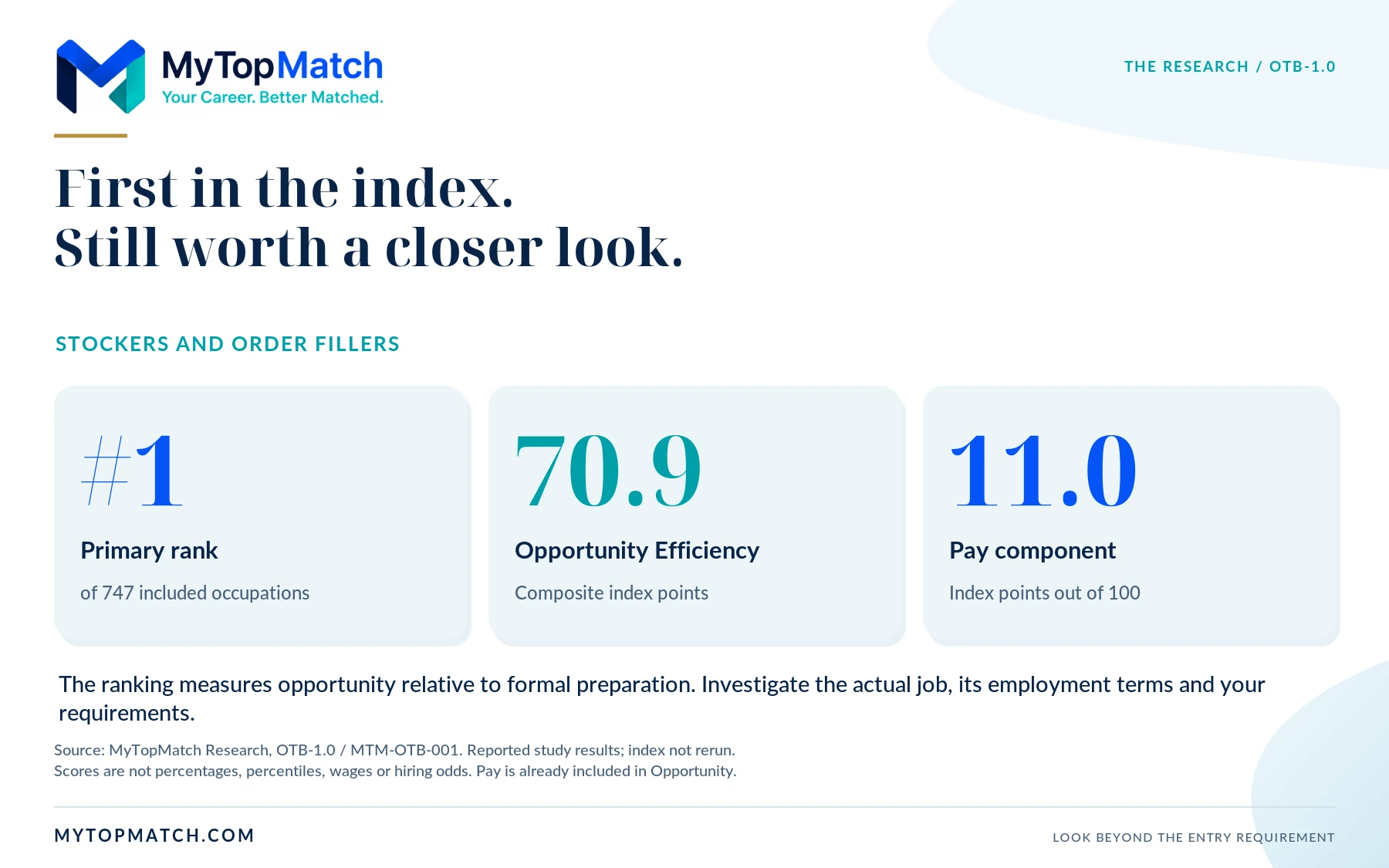
MyTopMatch’s Opportunity-to-Barrier research gives that distinction a concrete example. Stockers and order fillers ranked first among 747 occupations for measured opportunity relative to formal preparation. Their Opportunity Efficiency score was 70.9, while their pay component scored 11.0 out of 100. [S1]
The occupation led the index without leading on pay. The index also leaves working conditions, benefits, schedule predictability, and advancement quality outside its primary score. [S1]
That creates a second stage of investigation: What would this job require from you, provide for you, and help you build?
A role with limited formal prerequisites can be a deliberate, valuable career choice. The decision becomes stronger when the actual work and employment terms are visible.
What the first-place result measures
The MyTopMatch index combines an Opportunity pillar covering pay, projected openings, growth, employment scale, and geographic breadth with a Barrier pillar covering typical education, related experience, on-the-job training, and O*NET Job Zone preparation. The six opportunity inputs and four preparation inputs receive equal weights within their respective pillars. [S1]
For stockers and order fillers, the reported scores were:
| Measure | Reported result | What to keep in view |
|---|---|---|
| Opportunity | 79.27 | A composite of national labor-market measures, including pay. |
| Formal Barrier | 37.50 | The included preparation measures; higher scores mean more measured preparation. |
| Opportunity Efficiency | 70.885, rounded to 70.9 | The balance between the two pillars under the study’s formula. |
| Pay component | 11.0 / 100 | One normalized component, not a wage, a percentile, or a hiring probability. |
Source: MyTopMatch Research, OTB-1.0, finding MTM-OTB-001. The formula is 50 + 0.5 × (Opportunity − Barrier). These index scores do not measure overall job quality. [S1]
The first-place position reflected the combination of a large occupational market and comparatively limited measured formal preparation. The occupation stayed between first and fourth when the study removed one component at a time. [S1]
That is a useful reason to investigate. It still does not identify the best employer, establish your eligibility, or show whether a particular shift would work for you.
Separate entry preparation from the demands of the job
BLS classifies stockers and order fillers as typically requiring no formal educational credential, no related work experience, and short-term on-the-job training. BLS defines that training category as one month or less to attain competency. These describe a typical occupational entry path, rather than every employer’s rules or a personal learning deadline. [S2][S3]
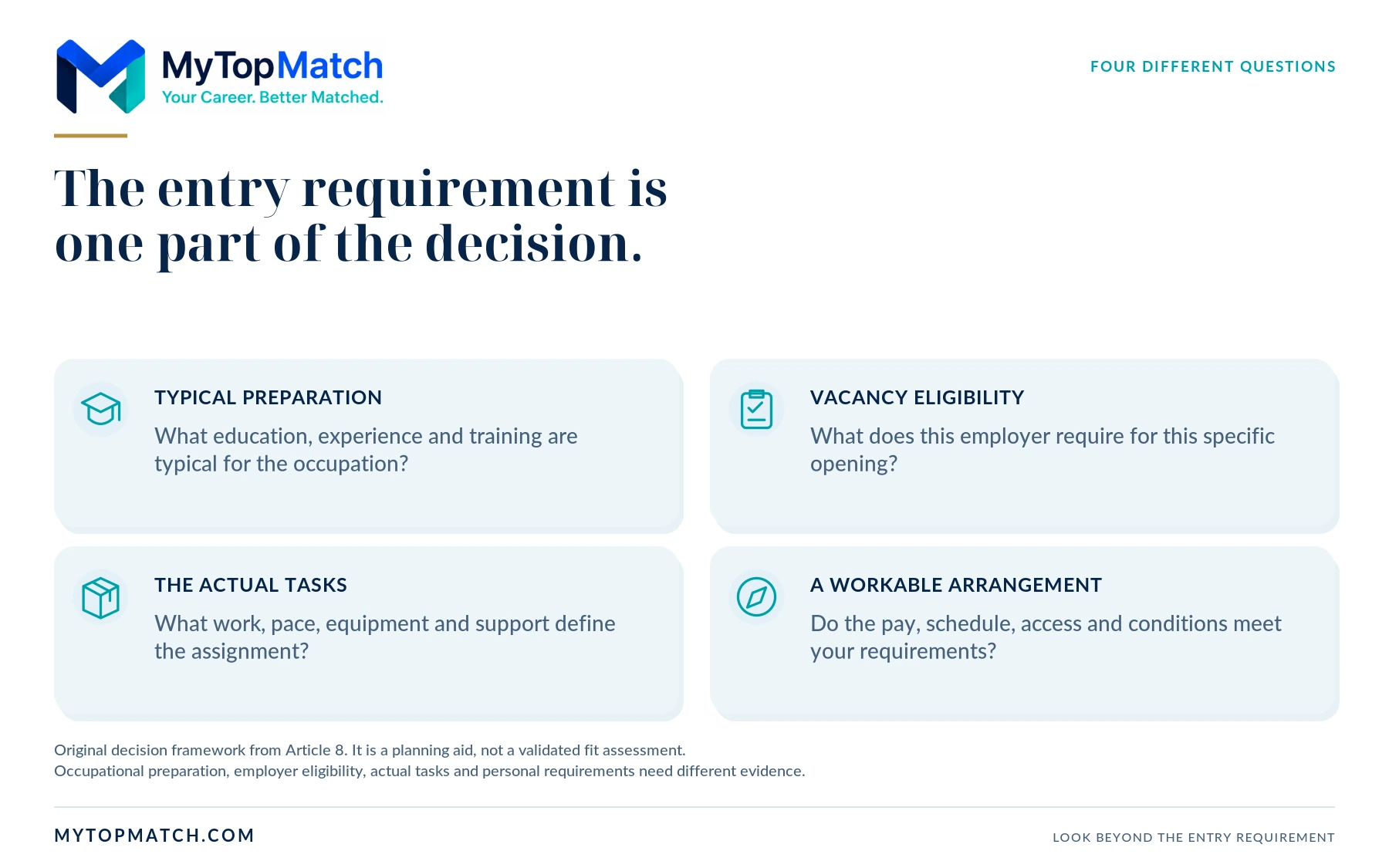
Four questions help keep the distinction clear:
| Question | Evidence needed |
|---|---|
| What preparation is typical? | Occupational education, experience, and training classifications. |
| Can I qualify for this vacancy? | The employer’s actual requirements and any applicable credentials or permissions. |
| What will doing the work involve? | Tasks, pace, equipment, physical and social demands, and supervision. |
| Is the arrangement workable for me? | Pay terms, schedule, transport, benefits, personal requirements, and development goals. |
This table is an original decision framework. The national index addresses the first question and part of the opportunity context. It cannot answer the other three for an individual vacancy. [S1]
A training category should never become a judgment about the value of the worker. Learning a process quickly does not remove the need to perform it accurately and consistently.
O*NET’s stocker and order-filler profile includes receiving and counting stock, recording information, inspecting merchandise, and filling orders. Its listed technologies include inventory systems, warehouse-management software, handheld-device software, and spreadsheets. Those are concrete capabilities to investigate and document. [S5]
What the shift can ask of you
The occupational context below supplements the MyTopMatch index. It is not part of its score.
BLS’s broader hand-laborer and material-mover profile describes work that can involve carrying heavy objects, repetitive activity, and awkward postures. That profile includes stockers alongside several other occupations, so its descriptions should not be treated as identical requirements for every stocking job. [S4]
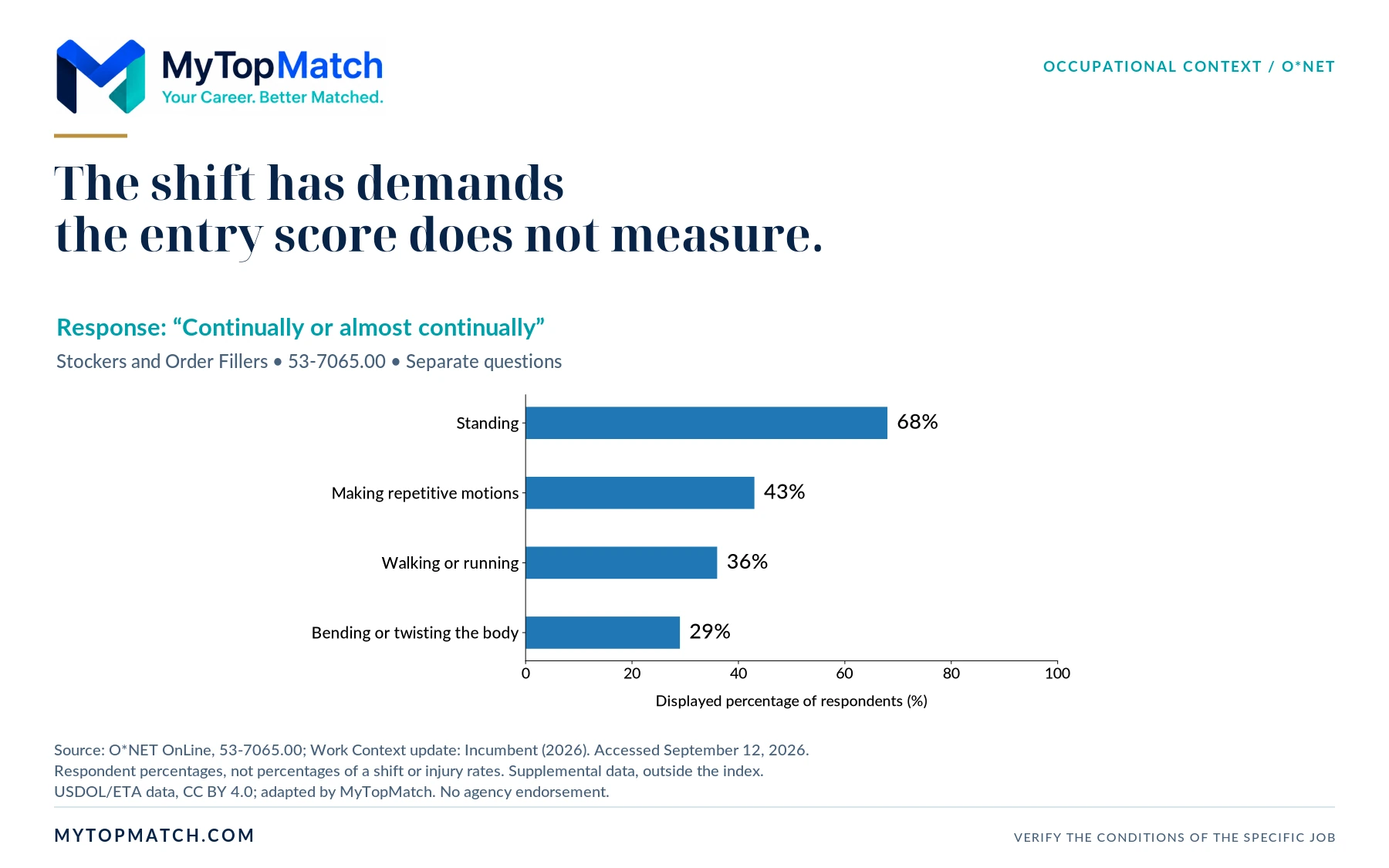
The O*NET OnLine profile for Stockers and Order Fillers, 53-7065.00, supplies more specific context. It reports these responses to separate questions about time spent on physical activities:
| Activity | Respondents selecting “Continually or almost continually” |
|---|---|
| Standing | 68% |
| Making repetitive motions | 43% |
| Walking or running | 36% |
| Bending or twisting the body | 29% |
Source: ONET OnLine, accessed September 12, 2026. Its update record identifies Work Context as incumbent data updated in 2026. These are displayed respondent percentages for separate questions, not percentages of a shift, injury probabilities, or a census of every workplace.* [S5][S6][S7]
The figures create useful questions for an employer. What would you lift or move, how frequently, and with what equipment or assistance? How much of the shift involves standing or repetitive movement? What changes during peak periods? How are accuracy and pace assessed?
Ask how training is delivered and how readiness is checked before independent equipment use. Ask who handles an unsafe condition or an unclear instruction. Where a task or access requirement needs clarification, discuss the actual function and available arrangements rather than guessing from the job title.
These are due-diligence questions. The research does not evaluate a specific workplace’s safety or an individual’s ability to perform its tasks.
The schedule is part of whether you can take the job
BLS notes that schedules in the broader hand-laborer and material-mover group vary and may include nights and weekends. Part-time work is also common within that group. This is context to investigate, not evidence that every stocker has an irregular schedule. [S4]
A useful employer conversation moves beyond “Are you flexible?”
Ask which hours belong to the vacancy, when schedules are issued, and how changes are handled. Clarify weekend expectations, shift rotations, and whether overtime is optional, required, or simply possible. Ask how many hours are being offered rather than treating the largest number mentioned as a commitment.
Then test the arrangement against an ordinary week. Can you reach the site at the actual start time? Can you get home after the shift? Would the schedule leave the time you need for care responsibilities, study, or another commitment?
A role can match your experience and still have hours you cannot work. That is a condition to resolve, not a failure of ambition.

Read the pay and employment terms together
The study reported a May 2025 median annual wage of $37,330 for stockers and order fillers, compared with $50,980 across all occupations. The difference between those medians was $13,650. The same values appear in the BLS sources checked for this review. [S1][S2][S4]
| May 2025 U.S. wage measure | Median annual wage |
|---|---|
| Stockers and order fillers | $37,330 |
| All occupations, including stockers and order fillers | $50,980 |
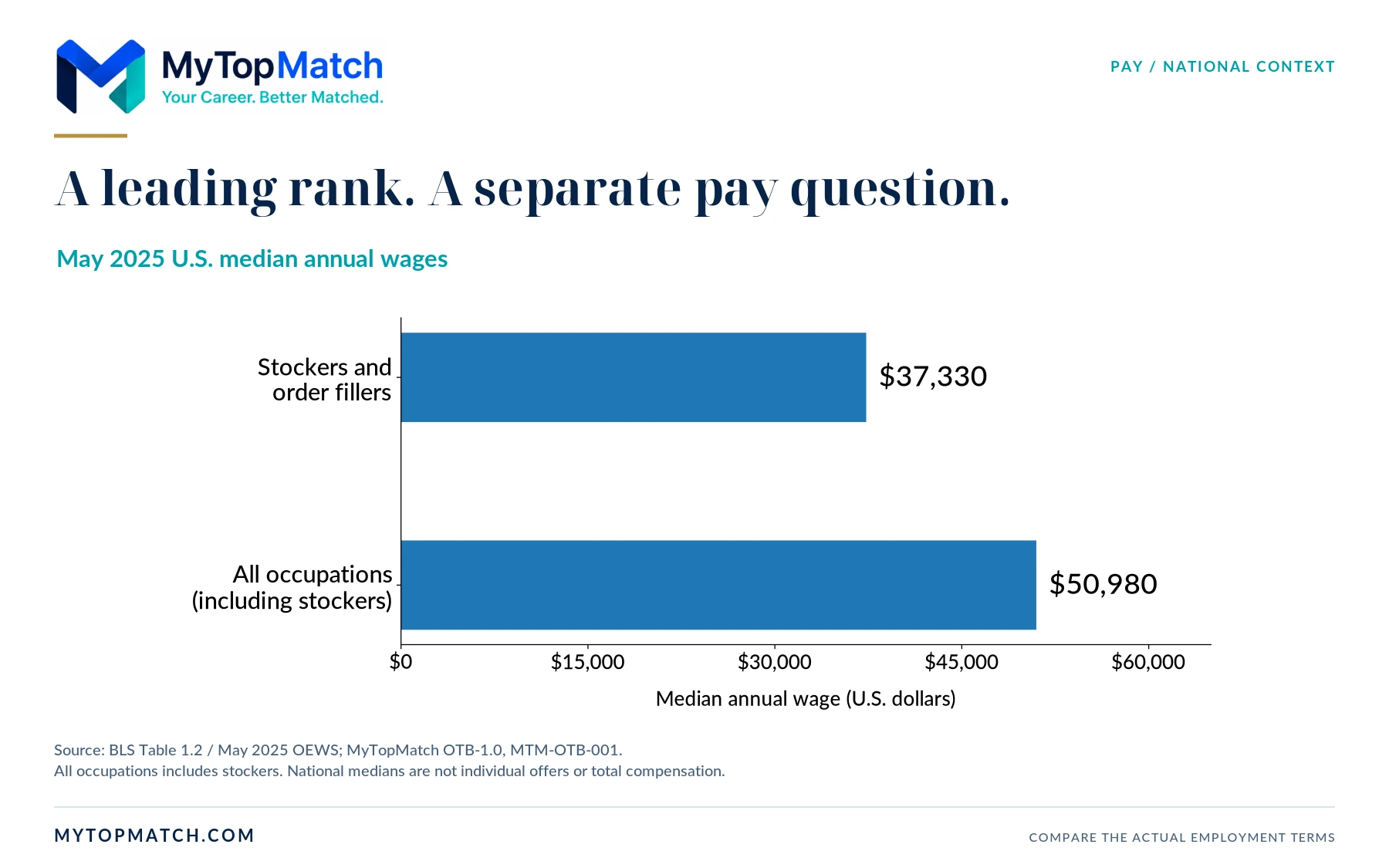
These are occupational wage estimates, not actual offers, guaranteed yearly earnings, or a personal wage penalty. The groups overlap, and the comparison does not adjust for worker or workplace differences. [S1][S2]
OEWS measures straight-time gross pay under a defined wage concept. It excludes overtime pay, shift differentials, and employer costs for supplementary benefits. Those omissions make the actual terms important when comparing jobs. [S9]
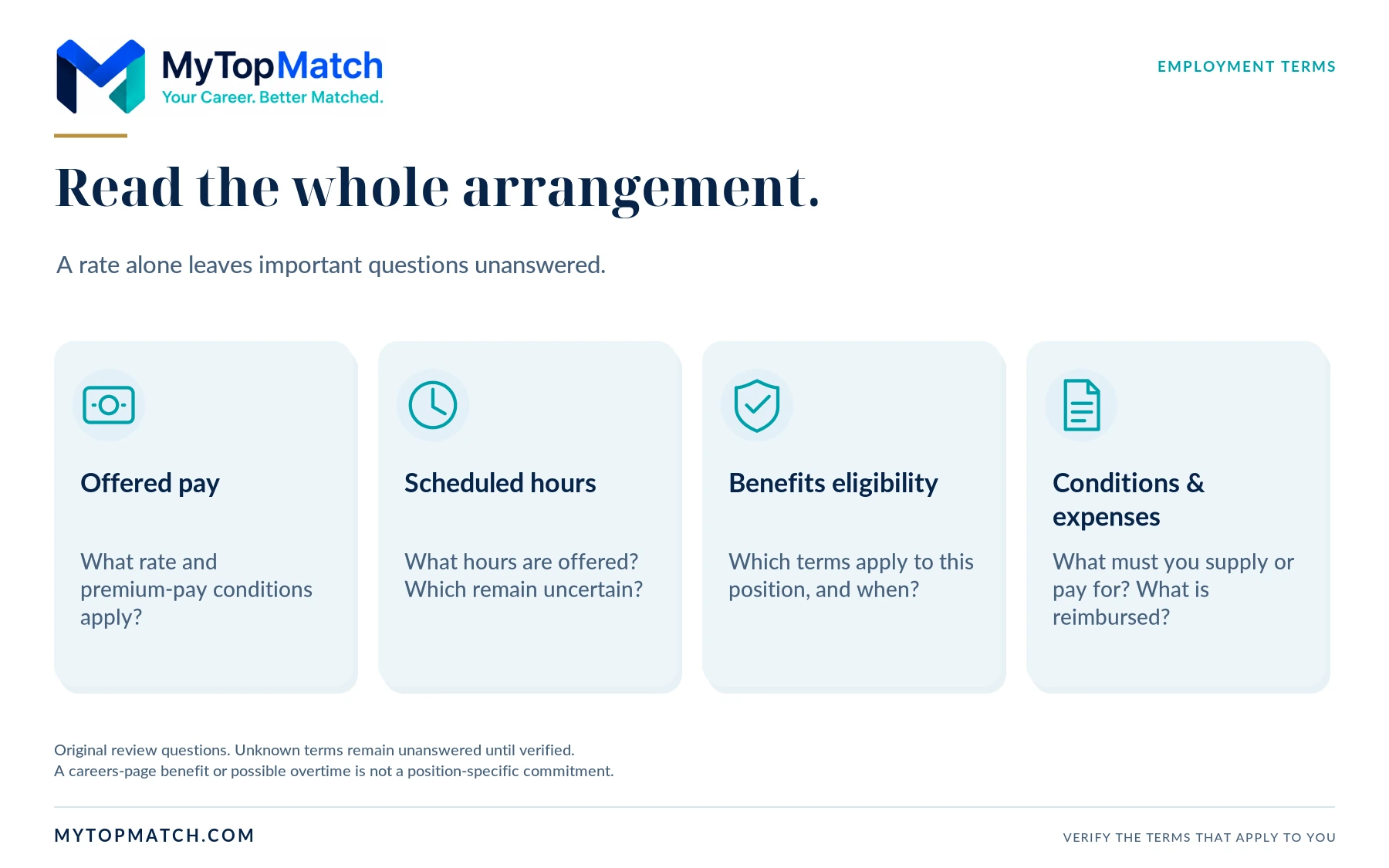
For an offer, separate the hourly or salary rate from scheduled hours, any premium-pay conditions, and benefits. Request the terms that apply to this position: eligibility, employee contributions, waiting periods, and what happens if hours change. A benefit mentioned on a careers page still needs to be connected to your employment arrangement.
Identify required expenses, such as travel or items you are expected to supply, and ask who pays. Do not assume an unknown cost is zero or count possible overtime as assured income.
The national median can anchor research. Your decision needs the employer’s terms and your own circumstances.
Many projected openings do not settle the local question
BLS reports 2,804,300 stocker and order-filler jobs in 2025, projects 8.9% growth through 2035, and estimates 430,700 annual openings on average over that decade. These are important reasons the occupation attracts attention in a national opportunity analysis. [S2]
Keep the three measures separate. Employment is the size of the occupation. Growth is the projected change in that size. Annual openings also include needs arising when workers leave the labor force or transfer to other occupations. BLS’s openings measure excludes moves between employers when the worker remains in the same occupation. [S8]
The annual-opening estimate is neither a count of today’s advertisements nor an employer-turnover rate. It cannot establish why one business is hiring repeatedly or whether its working conditions are good.
At a particular employer, ask whether the vacancy reflects expansion, seasonal demand, replacement, or a change in how the work is organized. Check the current opening and its location directly.
A national opportunity can only become your opportunity through a specific route into actual work.
The same occupation can support different choices
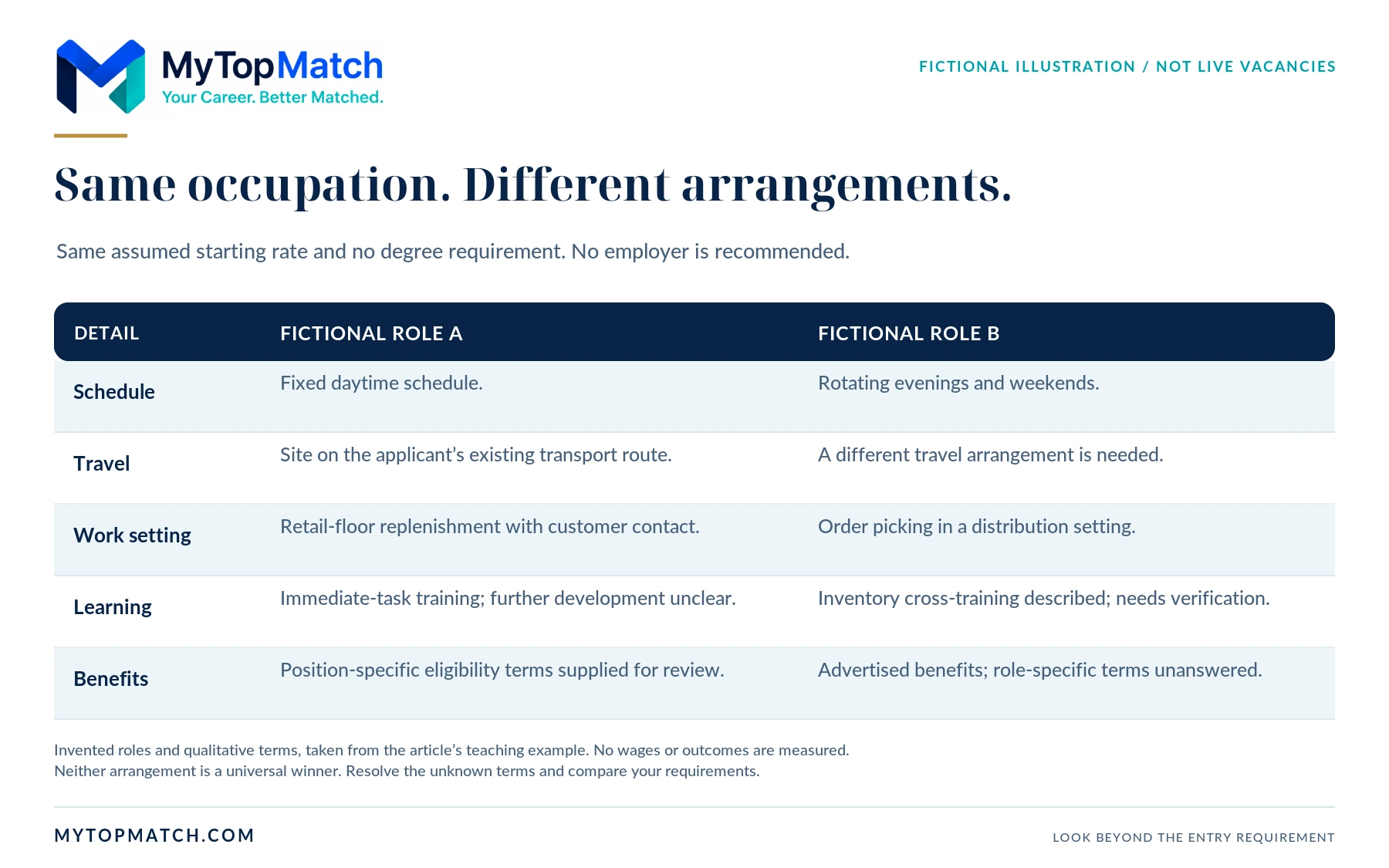
The following comparison is fictional. It illustrates questions that the index cannot answer; it is not a pair of current vacancies, an employer evaluation, or a tested career recommendation.
Imagine two stocking roles advertising the same starting hourly rate and no degree requirement.
| Detail to compare | Fictional role A | Fictional role B |
|---|---|---|
| Schedule | A fixed daytime schedule. | A rotating evening-and-weekend schedule. |
| Travel | A site accessible on the applicant’s existing transport route. | A site requiring a different travel arrangement. |
| Work setting | Retail-floor replenishment with customer contact. | Order picking in a distribution setting. |
| Learning | Training for the immediate assignment. Further development is unclear. | A described inventory cross-training plan that still needs verification. |
| Benefits | Eligibility terms are supplied for review. | Benefits are advertised, but position-specific terms remain unanswered. |
Someone whose available working hours align with role A may prioritize it. Someone seeking evening work and inventory experience may investigate role B more closely. Neither interpretation makes the unanswered terms acceptable by default.
The purpose of the comparison is to reveal the decisive questions. The same national occupation score cannot distinguish these workplaces, and an attractive development claim cannot substitute for evidence that the arrangement works.
Advancement deserves evidence of its own
The source research identifies inventory control, shipping and receiving, logistics, supervisory work, and specialized equipment roles as directions to investigate. It does not establish a transition rate, promotion timetable, or guaranteed pathway into them. [S1]
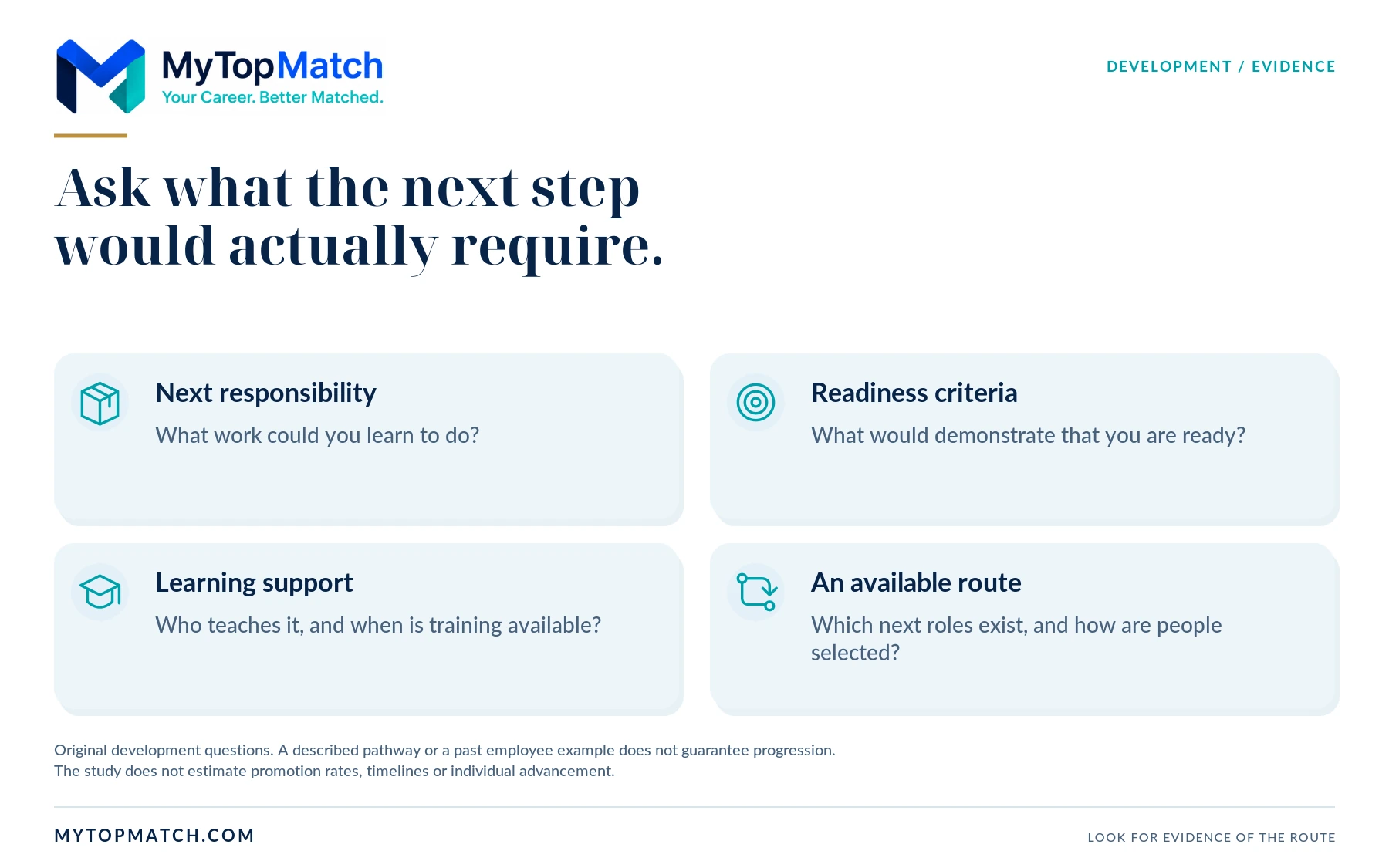
Ask what advancement would actually involve at the employer you are considering.
Which responsibilities would you learn? What would demonstrate readiness? Who decides? Are the next roles located at the same site? Does cross-training come with protected learning time, a different assignment, or a pay review? What conditions would still have to be met?
A recent example of an employee moving into another role can make the discussion concrete. It remains an example rather than a promise about your outcome. Ask what that person had to demonstrate and whether the same route is available now.
It is also reasonable to choose a job for immediate income or a workable schedule without making promotion its main purpose. Define the role you need the job to play in your life. Then evaluate it against that purpose.
A lower entry hurdle can create a starting point. The next step still needs a route.
Make the capability visible while you do the work
For a professional already in an accessible-entry role, my recommendation is to document what you learn and contribute. This is original career guidance, with untested effects on hiring or advancement.
Record the processes you can carry out, the systems you actually use, the exceptions you know how to recognize, and the limits of your authority. Keep safety and accuracy visible alongside speed. Retain only information you are permitted to share.
A fictional résumé example shows the distinction:
“Stocked shelves and helped in the warehouse.”
A more specific version, only where accurate, could be:
“Checked incoming stock against delivery records, recorded discrepancies in the inventory system, replenished assigned locations, and referred damaged items to the supervisor.”
That statement describes capabilities without inventing a percentage improvement, a supervisory title, or control over the entire operation. It gives an interviewer a basis for asking about your judgment and process knowledge.
Add results when they are measured and attributable. Mark training as training; do not describe a brief demonstration as independent equipment proficiency. Experience becomes more useful in a career discussion when the account is both specific and defensible.
Employers should explain the work behind “entry level”
For employers and workforce programs, the index supplies a reason to examine the route from application to sustained employment. It does not diagnose the quality of that route at a particular organization. The source report explicitly identifies employer records as necessary for evaluating hiring barriers, retention, and advancement. [S1]
A practical review could compare the recruitment message with the actual assignment. Does “training provided” explain who teaches the work and how progress is assessed? Does “flexible schedule” say who controls the flexibility? Does “growth opportunity” identify a role, criteria, and a learning process?
Examine which prerequisites are essential before hire and which capabilities the organization is prepared to teach. Keep job-specific equipment and authorization requirements explicit. Ask workers where the description and daily work differ.
These are proposed audit questions, not a claim that changing a posting will necessarily improve retention or performance. Evaluate any change using appropriate local evidence.
A recruitment message should give candidates enough detail to make a realistic decision about the work they are being asked to accept.
Before you commit, resolve the question that could change your answer
Use the occupational research to build a shortlist. Then take a short list of unresolved questions into a conversation about the actual vacancy.
The following review sheet is a proposed decision aid, not a validated assessment:
| Area | A question worth resolving |
|---|---|
| Entry and training | What must I demonstrate before starting, and what will I be taught after hire? |
| The actual shift | What tasks, physical demands, pace, equipment, and support define the assignment? |
| Schedule and access | Which hours are offered, how can they change, and can I reliably reach the site? |
| Pay and benefits | Which compensation and benefit terms apply to this position, with what conditions? |
| Development | What could I learn or progress toward, and what evidence supports that possibility? |
Record the answer, where it came from, and the date. Keep a commitment, an estimate, and a general recruiting statement distinct. Where the information is missing, identify who can answer it.
Before paying for training, confirm that it addresses a requirement relevant to the employers you are targeting. This article has not tested a training provider, priced a credential, or estimated a personal return on that expense.
Your shortlist should become more specific as the evidence improves. A good result may be choosing a role, negotiating a condition, or recognizing that another opportunity deserves investigation.
Choose the work with the whole arrangement in view
MyTopMatch’s public Professional Passport page describes organizing skills, achievements, qualifications, career goals, work preferences, and dealbreakers. Those categories provide a useful starting point for the personal evidence a national opportunity score cannot supply. [S10]
Clarify the work you can demonstrate, the conditions you need, and the direction you want to explore. Bring those priorities to the employer-specific questions in this guide.
A career does not have to begin with a long list of credentials to deserve serious consideration. The work, its conditions, and its possibilities deserve the same attention as the entry requirement.
An accessible starting point is valuable. Choose it with a clear view of the work and the life around it.
Explore the Professional Passport → (https://mytopmatch.com/professional-passport)

Research and evidence note
This article adapts MyTopMatch Opportunity-to-Barrier Index OTB-1.0, finding MTM-OTB-001. The source analysis uses BLS 2025–35 Employment Projections, May 2025 OEWS, and O*NET 31.0. This is Article 8 in the promotional series; the underlying study is numbered Article 04 in its source files. The complete source report, its approved manuscript, and the published research page were reviewed. [S1]
Verification: Reported index values were cross-checked; the displayed formula and wage difference were recalculated. The full index, mappings, and sensitivity analyses were not independently rerun. BLS figures and definitions were checked September 12, 2026. The O*NET physical-activity responses are separately sourced occupational context added for this adaptation; the underlying respondent data were not reanalyzed. [S2][S3][S4][S5][S6][S7][S8][S9]
The fictional comparison, résumé example, and practical frameworks are original additions with UNTESTED career outcomes. A reader’s employer terms and individual results remain UNKNOWN until investigated. The public Passport description was checked; its signed-in workflow was not tested. [S10]
This article includes information derived from the O*NET 31.0 Database, produced by the U.S. Department of Labor, Employment and Training Administration and used under CC BY 4.0. MyTopMatch transformed, combined, selected, and summarized source information. USDOL/ETA has not approved, endorsed, or tested those modifications. O*NET® is a trademark of USDOL/ETA. [S11]