
A national file can cover every jurisdiction and still leave decisive gaps
A career ranking can look precise while overlooking a basic question: must a worker obtain government permission before performing the job?
Licensing can change the time, cost, portability, and legal feasibility of entering an occupation. It may involve education, supervised practice, examinations, fees, background checks, continuing education, or a separate application in each state. A career-access measure that ignores these requirements risks understating barriers. A measure that treats every missing record as zero risk can be more misleading, because it rewards incomplete reporting.
MyTopMatch audited the strongest public sources available to its Phase II research before adding licensing to any national index. The audit identified two useful signals and one firm research boundary: neither signal establishes the current legal requirements for every occupation in every jurisdiction.
That boundary matters. Original research becomes more credible when it records what the data fail to establish.
What MyTopMatch audited
The licensing audit combined four components:
- The CareerOneStop / Analyst Resource Center occupational-license flat extract, COSFlatExport.zip, dated October 14, 2024.
- Current Population Survey Basic Monthly public-use files from January 2024 through July 2026, excluding October 2025 because CPS data were not collected during the federal funding lapse.
- The 2025 BLS National Employment Matrix to O*NET crosswalk.
- The primary MyTopMatch Opportunity-to-Barrier and Requirements-to-Pay research files.
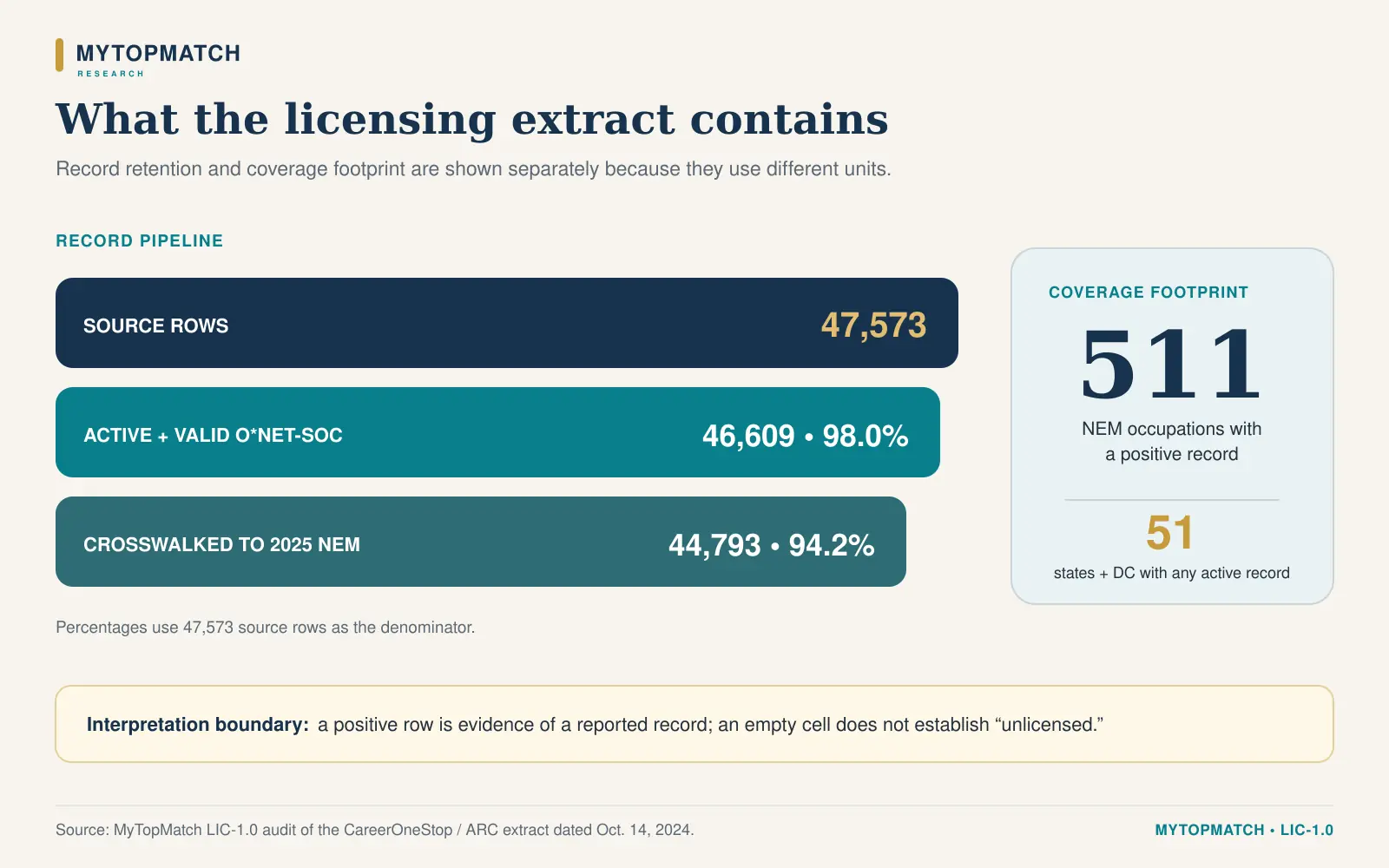
The CareerOneStop extract contained 47,573 rows. MyTopMatch identified 46,609 active rows with valid O*NET-SOC codes. Of those, 44,793 mapped to the 2025 National Employment Matrix crosswalk. Those stages retained 98.0% of source rows at the active-valid step and 94.2% of source rows after the crosswalk.
The crosswalked data produced positive records for 511 National Employment Matrix occupations. Every state and the District of Columbia had at least one active record. Record update dates in the acquired extract ranged from 2010 through September 2024.
These figures describe the frozen file. They do not establish complete reporting within a state, complete occupation coverage, or current legal status on the publication date.
Audit counts
| Measure | Result | Evidence type |
|---|---|---|
| CareerOneStop source rows | 47,573 | Source data |
| Active rows with valid O*NET-SOC | 46,609 | Derived filter |
| Rows crosswalked to 2025 NEM | 44,793 | Derived join |
| NEM occupations with a positive record | 511 | Derived aggregate |
| States plus DC with any active record | 51 | Derived coverage count |
Source: MyTopMatch LIC-1.0 audit of the CareerOneStop / Analyst Resource Center flat extract dated October 14, 2024. Absence remains unknown.
The missing-record problem
CareerOneStop states that license information is collected from states through the Analyst Resource Center. The same official page warns that some states do not submit and that it cannot guarantee each state collects all license information.
That warning controls how the data may be analyzed. A positive record supports a narrow statement: a license record was reported for that occupation and jurisdiction in the acquired extract. An empty cell supports only “no record observed.” It cannot support “no license required.”
This is a classic missing-data problem with an unusually consequential direction of bias. Coding an unreported requirement as zero would lower the measured barrier. Occupations or states with weaker reporting could appear easier to enter. The error would be embedded inside the ranking and might be invisible to readers.
MyTopMatch therefore preserved missingness. CareerOneStop records were used only where a positive footprint existed, and the results were limited to covered-subset sensitivity analysis.
CPS answers a different question
The CPS adds evidence from workers. Its certification and license questions identify whether a person holds a currently active professional certification or state or industry license, whether a credential was issued by a federal, state, or local government, and whether a credential is required for the person’s job.
BLS documentation makes the interpretation boundary explicit: “required” can mean legally required or required by an employer. A worker may also hold a credential that is helpful, unrelated to the main job, or paired with another credential. Occupational titles alone are insufficient because state rules vary.
MyTopMatch calculated occupation-level incumbent government-license prevalence only for occupations with at least 200 unique CPS respondents. This threshold reduces unstable small-sample estimates. The resulting measure describes workers who currently hold government-issued credentials. It does not enumerate state statutes or prove what a new entrant must obtain.
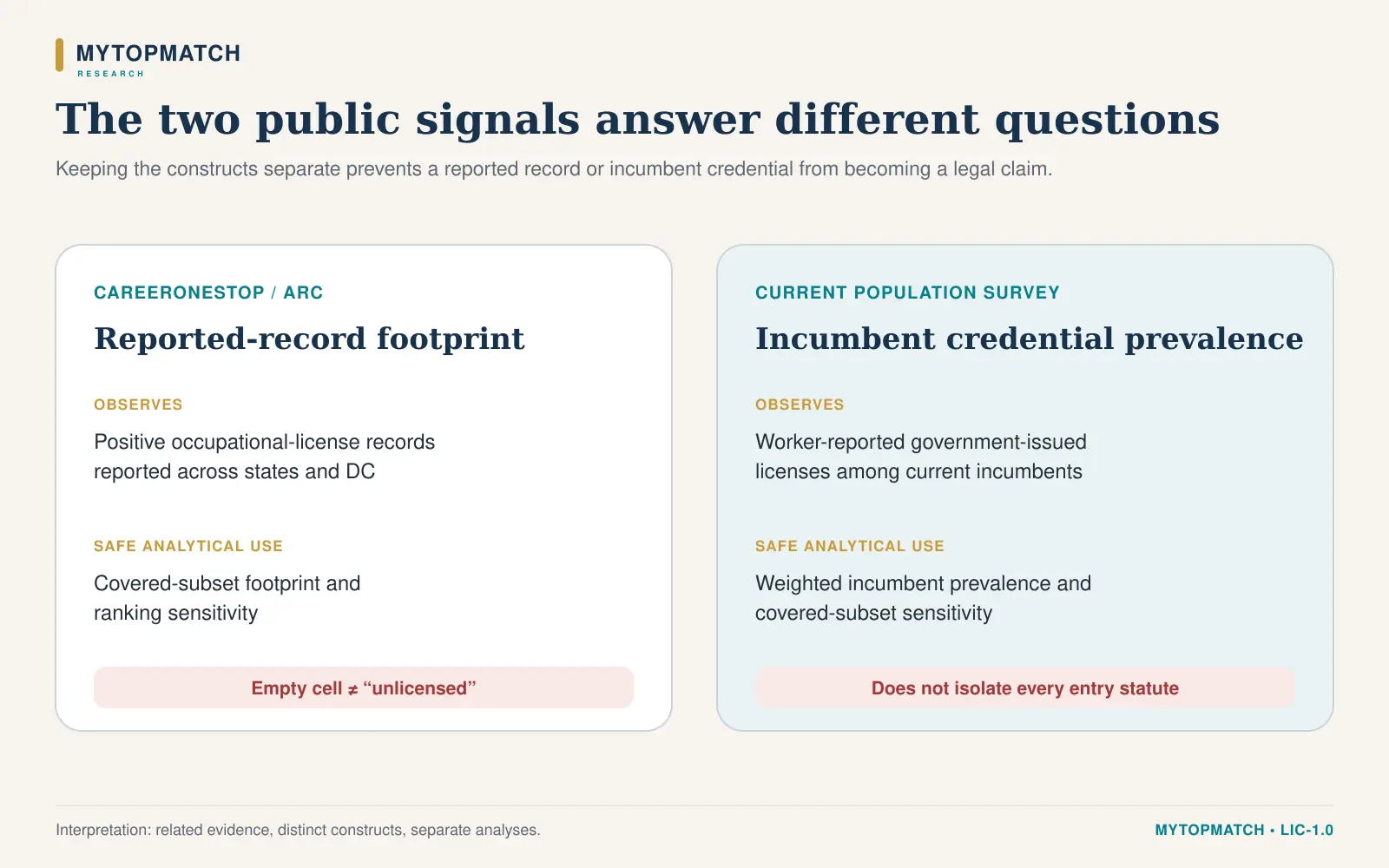
The two sources therefore measure related constructs from different directions:
| Signal | What it observes | Primary limitation |
|---|---|---|
| CareerOneStop positive-record footprint | Reported license records across states and DC | Submission and within-state completeness are not guaranteed |
| CPS incumbent government-license prevalence | Share of workers reporting a government-issued license | Incumbent status; does not isolate every statutory entry rule |
Treating the signals as interchangeable would erase the meaning of each measure. MyTopMatch analyzed them separately.
Licensing changed the order of career-opportunity results
The primary Opportunity-to-Barrier index evaluates opportunity relative to measured formal preparation. Its Barrier pillar is built from BLS typical entry education, related work experience, and on-the-job training, plus O*NET Job Zone preparation. Licensing is excluded from the primary score because the public sources did not pass the coverage and interpretation gates.
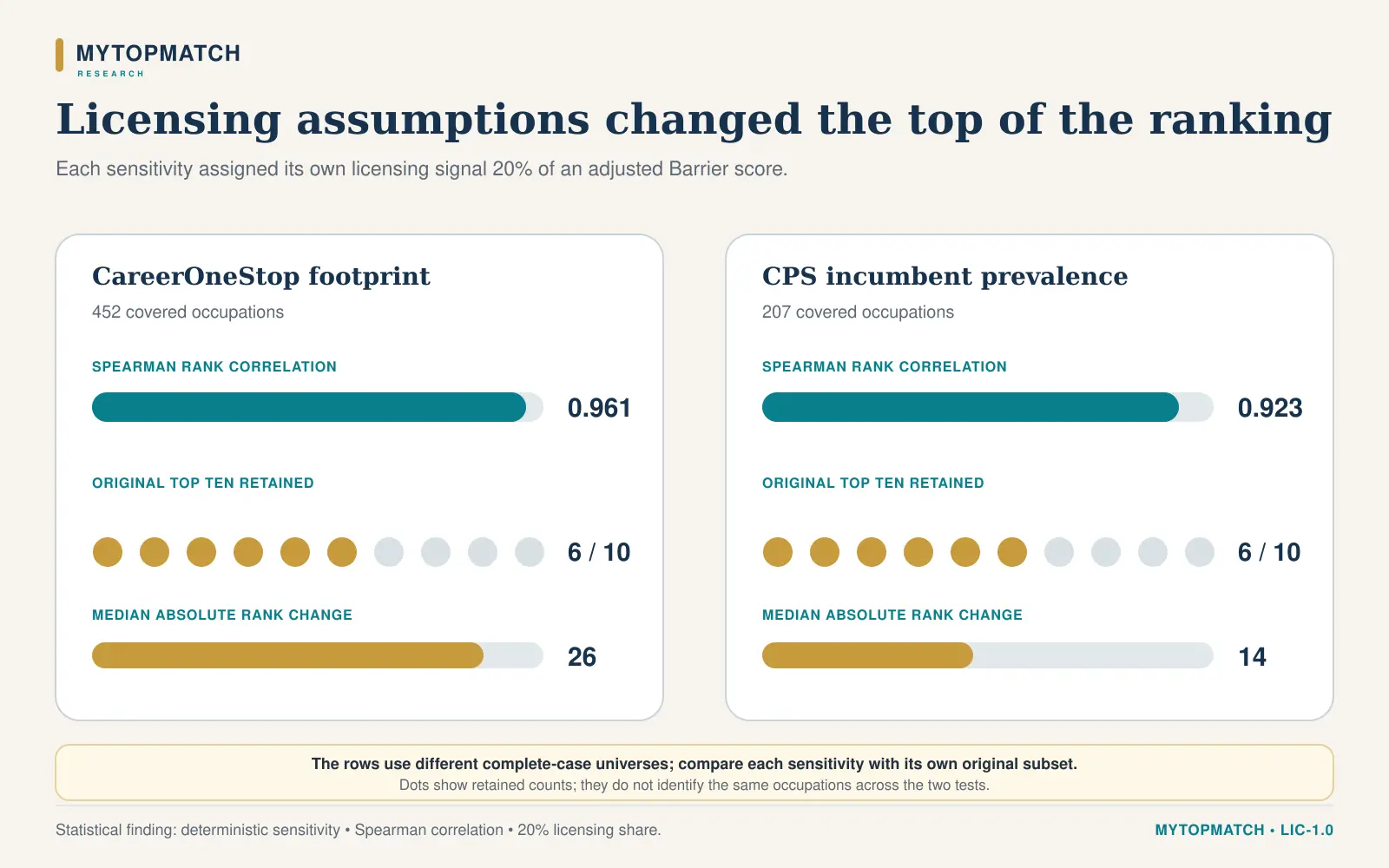
For the audit, MyTopMatch created two covered-subset sensitivities. Within each subset, the licensing signal was percentile-ranked and assigned 20% of an adjusted Barrier score; the original Barrier score supplied 80%. The Opportunity pillar was unchanged.
The CareerOneStop sensitivity covered 452 Opportunity-to-Barrier-eligible occupations with positive licensing records. Its adjusted ranking had a Spearman correlation of 0.961 with the original covered-subset ranking. The high overall correlation indicates broad similarity across the list. The top of the ranking was less stable: six of the original top ten remained, and the median occupation moved 26 positions in absolute terms.
The CPS sensitivity covered 207 eligible occupations with at least 200 unique respondents. Its Spearman correlation was 0.923. Again, six of the original top ten remained. The median absolute rank change was 14 positions.
Ranking sensitivity results
| Licensing signal | Covered occupations | Spearman correlation | Original top ten retained | Median absolute rank change |
|---|---|---|---|---|
| CareerOneStop reported-state footprint | 452 | 0.961 | 6 of 10 | 26 |
| CPS incumbent government-license prevalence | 207 | 0.923 | 6 of 10 | 14 |
Statistical finding: deterministic sensitivity under a prespecified 20% licensing share. The two rows use different complete-case universes and should not be compared as estimates of the same population.
The audit answers the research question. Licensing signals materially affect which occupations appear at the very top, even when overall rank correlation remains high. The result justifies a change in language: the current Opportunity-to-Barrier index measures opportunity relative to formal preparation. It does not claim to measure full legal or practical access.
The wage sensitivities reinforce the measurement distinction
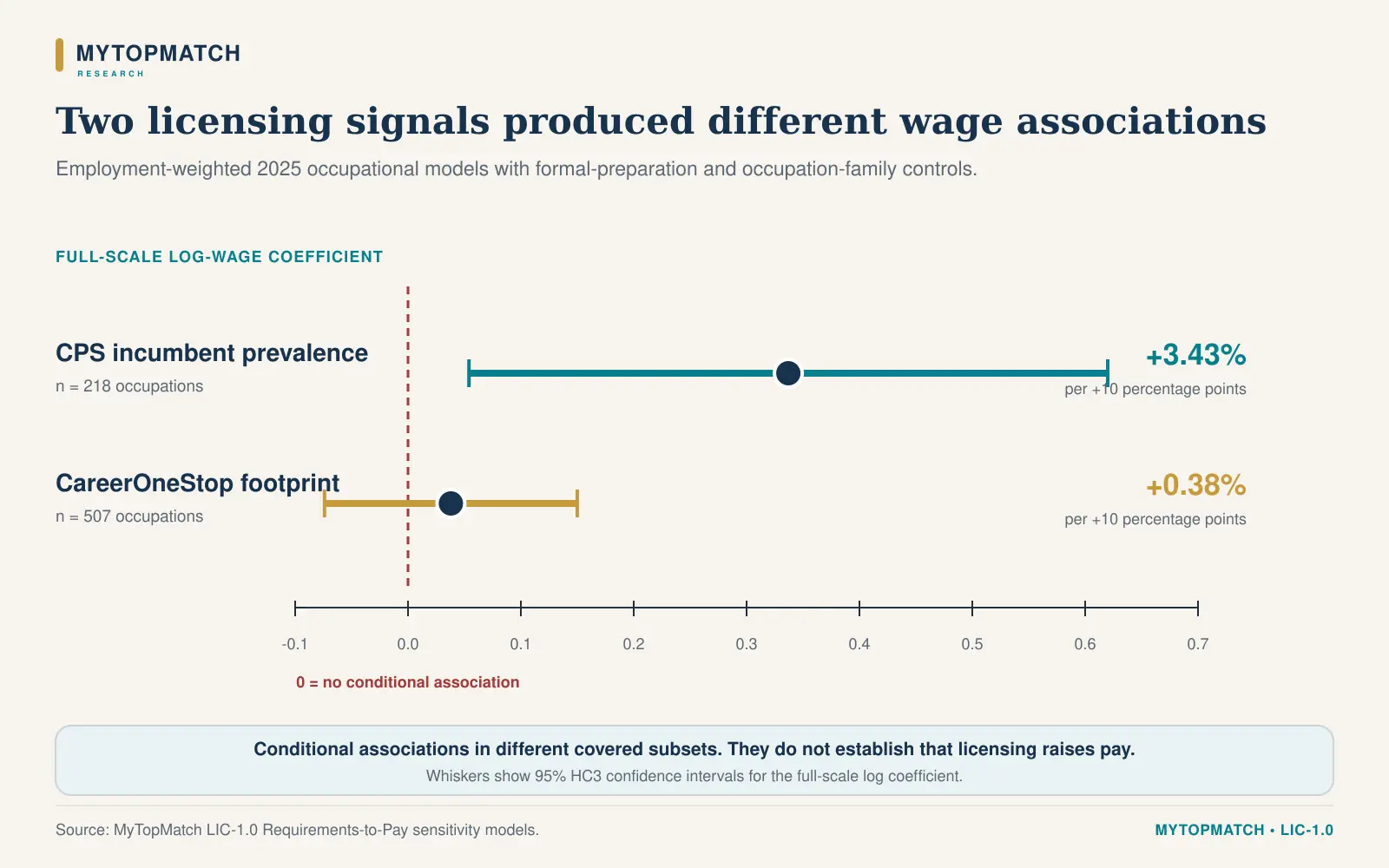
MyTopMatch also added each licensing signal separately to the Requirements-to-Pay model. The model relates log median annual wage to education, experience, on-the-job training, occupation family, and a licensing signal, with 2025 occupational employment weights and HC3 robust standard errors.
Within the 218-occupation CPS-covered subset, a 10-percentage-point increase in incumbent government-license prevalence was associated with approximately 3.43% higher median annual pay after the model controls. The 95% confidence interval for the full-scale log coefficient was 0.054 to 0.620.
Within the 507-occupation CareerOneStop-covered subset, a 10-percentage-point increase in the positive-record state footprint was associated with approximately 0.38% higher median pay. Its 95% confidence interval for the full-scale log coefficient ranged from -0.074 to 0.150 and crossed zero.
These are conditional, noncausal associations in different covered subsets. They do not show that licensing raises pay. Occupational selection, worker composition, regulation, bargaining power, industry structure, and unmeasured job characteristics can influence both licensing and wages. The divergent results also show why a record footprint and incumbent prevalence should remain separate variables.
Why MyTopMatch withheld a national licensing score
The audit applied an adversarial question to every potential claim: how could this result be wrong?
Several failure paths remained open:
- A state may not submit records.
- A submitting state may not report every licensed occupation.
- A record may be stale relative to current law.
- Several O*NET occupations may map into one broader BLS occupation.
- A license can apply to a title, specialty, task, setting, or scope of practice instead of every worker in an occupation.
- Reciprocity and interstate compacts can change portability without removing the underlying license.
- CPS respondents may report employer-required credentials, legal licenses, or both.
- Incumbent prevalence can differ from the requirement facing a new entrant.
Any national legal-access score would need explicit occupation-by-jurisdiction statuses: required, conditionally required, voluntary, exempt, or unknown. It would also need statutory authority, effective date, license level, scope, fees, examinations, education, supervised experience, renewal, reciprocity, and source provenance.
The audited public sources do not supply that matrix. MyTopMatch did not infer it.
What the current research can support
The evidence supports four public conclusions:
- The CareerOneStop extract is substantial and useful for identifying reported licensing footprints.
- CPS microdata provide a distinct measure of government-license prevalence among incumbent workers.
- Licensing assumptions materially affect the top of the Opportunity-to-Barrier ranking within covered subsets.
- Current MyTopMatch opportunity research should use “measured formal preparation” and avoid claims of full legal access.
The evidence does not support a definitive list of the easiest occupations to enter legally, a complete state licensing burden ranking, or a national estimate that treats missing CareerOneStop records as unlicensed occupations.
What would make a future licensing index defensible
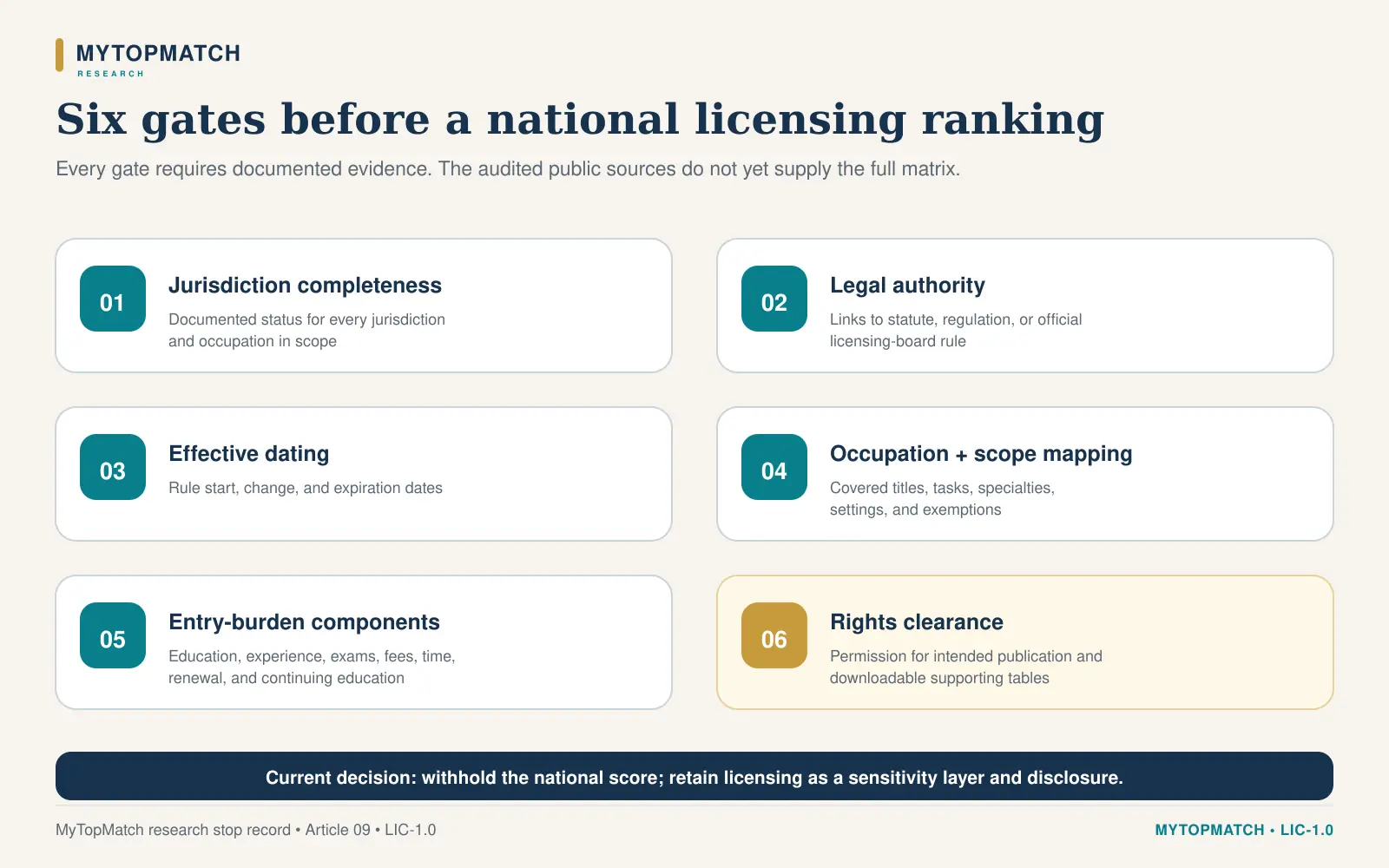
A future MyTopMatch licensing index should proceed only after a source or audited data build satisfies six gates:
- Jurisdiction completeness: every state and DC has a documented reporting status for every occupation in scope.
- Legal authority: each requirement links to a statute, regulation, or official licensing-board rule.
- Effective dating: records show when a rule took effect, changed, or expired.
- Occupation and scope mapping: requirements identify the covered title, tasks, specialties, settings, and exemptions.
- Entry-burden components: education, experience, examinations, fees, processing time, renewal, and continuing education are separately recorded.
- Rights clearance: source and derived-data reuse terms permit the intended research publication and downloadable tables.
Until those gates pass, licensing should remain a sensitivity layer and a disclosure in national career indices.
What this means for job seekers and researchers
For job seekers, national rankings are a starting point. The final access decision is local. Workers should confirm requirements with the state licensing board that governs the occupation and check reciprocity before moving.
For researchers and journalists, a state count should be described as a reported-record footprint when the source has incomplete submission. A worker-prevalence measure should be described as incumbent credential prevalence. Neither label is cosmetic; each protects the claim from overstating what was observed.
For MyTopMatch, the publication rule is now explicit: an attractive ranking cannot outrun its least complete barrier measure. The research program will publish the limitation and preserve the unfinished measurement problem as a documented next step.
Methodology summary
CareerOneStop processing. MyTopMatch parsed the frozen flat extract, standardized eight-digit O*NET-SOC identifiers, retained active records, limited jurisdiction counts to the 50 states and DC, and mapped valid occupations through the 2025 BLS NEM-to-O*NET crosswalk. Positive records were aggregated; absence remained unknown.
CPS processing. MyTopMatch used person weights and conservative person deduplication across the pooled January 2024–July 2026 Basic Monthly files. Occupation estimates required at least 200 unique respondents. The credential variable used government-issued license status; interpretations remained at the incumbent level.
Opportunity-to-Barrier sensitivity. Each licensing signal was analyzed in its own complete-case subset. The signal’s percentile rank supplied 20% of the sensitivity Barrier score, with 80% from the primary Barrier score. Rank stability was evaluated with Spearman correlation, top-ten overlap, and median absolute rank change.
Requirements-to-Pay sensitivity. Separate employment-weighted linear models predicted log 2025 median annual wage from BLS education, experience, and training ordinals; occupation-family indicators; and one licensing signal. HC3 standard errors were used. Coefficients are associations, not causal effects.
Verification. The frozen package recorded 24 of 24 core-source checksum passes and 36 of 36 transition/licensing checksum passes. The licensing archive passed ZIP integrity testing. For Article 09, MyTopMatch independently checked the audit counts across the frozen JSON and finding record and recalculated both coefficient confidence intervals and percentage transformations. The row-level file was not republished or reprocessed in the publication workspace.
Limitations
- The CareerOneStop source file is dated October 14, 2024; legal rules may have changed.
- State submission and within-state collection are incomplete by the publisher’s warning.
- Record dates in the acquired extract vary widely.
- The NEM-to-O*NET crosswalk can aggregate narrower occupations into broader categories.
- CPS responses measure workers and can include employer-required credentials.
- The CPS 200-person threshold improves stability while excluding smaller occupations.
- The two sensitivity analyses use different complete-case universes.
- The 20% licensing share is a prespecified diagnostic assumption, not a validated social valuation of licensing burden.
- Rank correlations and top-ten overlap are deterministic sensitivity statistics; they do not have sampling confidence intervals.
- The wage models are conditional associations and may retain substantial confounding.
- The CareerOneStop flat extract has an UNKNOWN redistribution status in the MyTopMatch rights register. Row-level data and licensing-derived downloads remain internal pending qualified counsel.
Frequently asked questions
Does a missing CareerOneStop record mean an occupation is unlicensed?
No. The official documentation says state submission and within-state collection may be incomplete. MyTopMatch treats absence as unknown.
Does the CPS identify legal requirements for new entrants?
No. It measures credentials reported by workers. BLS states that a job-required credential can be required by law or by an employer.
Why did MyTopMatch use two licensing signals?
They observe different constructs. CareerOneStop records reported jurisdiction footprints; CPS records incumbent credential prevalence. Keeping them separate makes the limitations visible.
Does licensing cause higher pay?
This analysis cannot establish causation. One covered-subset association was positive with a confidence interval above zero; the other was small with a confidence interval crossing zero. Selection and unmeasured occupational differences remain plausible explanations.
Can the Opportunity-to-Barrier index be called an access ranking?
The approved language is “opportunity relative to measured formal preparation.” Full access includes licensing, certification, costs, local rules, hiring practices, and other barriers that the current primary index does not completely observe.
When could MyTopMatch publish a licensing ranking?
After jurisdiction completeness, legal authority, effective dates, occupation scope, burden components, and reuse rights pass documented release gates.
Citation and reuse
Suggested citation: MyTopMatch Research. (2026). “Why Public Licensing Data Cannot Yet Support a National Career-Access Ranking.” MyTopMatch. https://mytopmatch.com/publications/public-occupational-licensing-data-audit-2026
When reusing findings, identify the work as original analysis by MyTopMatch Research, identify the underlying public data publisher where relevant, and link to this canonical article. Source publishers do not endorse MyTopMatch's calculations or interpretations.