
KEY FINDINGS
The finding at a glance
The weighted content model best recovered O*NET related-occupation links.
The middle 90% of 200 perturbed-weight AUC values ranged from 0.919 to 0.928.
At ten suggested neighbors, the model recovered an average of 45.7% of available related links.
Linked CPS or SIPP transition validation has not passed the publication gate.
A MyTopMatch analysis of O*NET 31.0 and BLS occupational data found that a transparent four-domain content model recovered O*NET related-occupation links with a receiver operating characteristic area under the curve of 0.924. The result validates occupational-content resemblance. It does not yet validate the probability, accessibility, or direction of a worker's career transition.
What the model measures
The pilot compares occupations on skills, knowledge, abilities, and work activities. The frozen specification assigns weights of 30%, 20%, 20%, and 30%, respectively. Importance and level values are scale-normalized, suppression-recommended and not-relevant cells are excluded, and mapped O*NET suboccupations are averaged to the canonical detailed occupational spine.
O*NET related-occupation links are excluded from the similarity score. They are used as an external validation target. This separation prevents the model from being graded on a relationship it already contains.
The combined profile performed best
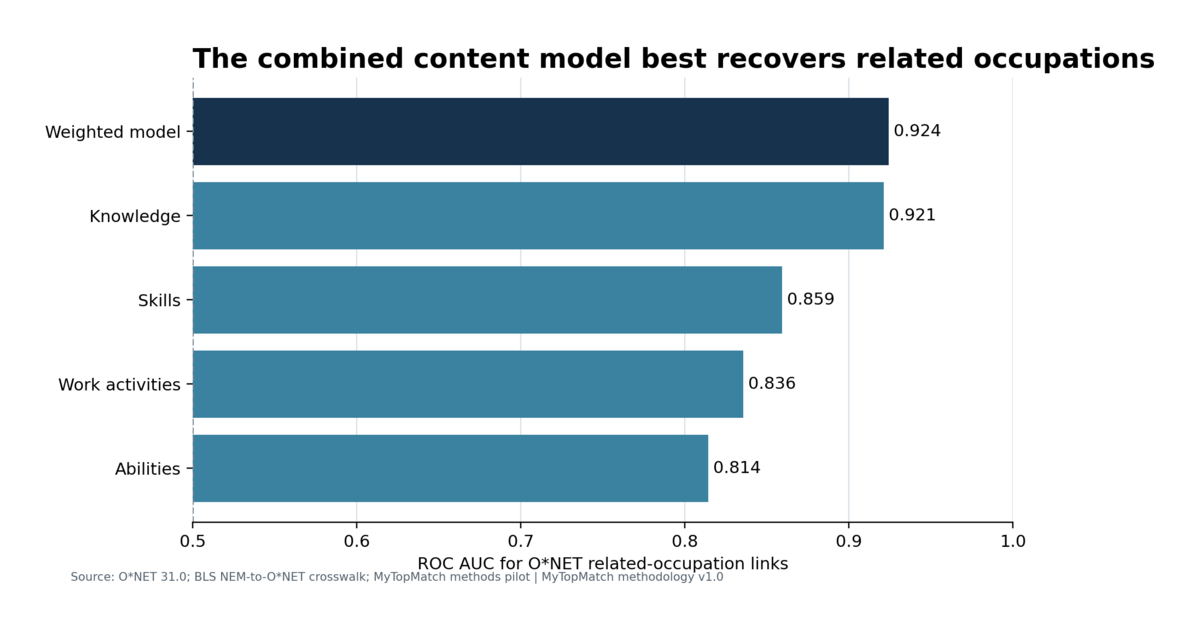
The weighted model produced an AUC of 0.924, compared with 0.921 for knowledge alone, 0.859 for skills, 0.836 for work activities, and 0.814 for abilities. At ten suggested neighbors, the combined model recovered an average of 45.7% of available related-occupation links.
The result was also stable to reasonable weight changes. Across 200 perturbations of the domain weights, the middle 90% of AUC values ranged from 0.919 to 0.928. That narrow band supports the conclusion that the validation result is not dependent on one exact weighting choice.
Why transition rankings remain withheld
Occupational resemblance is only one part of a feasible move. Real transitions also depend on work history, education, training, licensing, geography, hiring practices, and whether comparable workers have actually made the move. The current research package does not contain the linked CPS or SIPP transition samples needed to train and evaluate that second stage.
MyTopMatch therefore withholds Occupational Mobility, Career Switchability, and Career Resilience rankings. Before those products can pass the publication gate, the transition model must be trained and tested on separate cohorts and evaluated for calibration, AUC, top-k recall, subgroup error, wage-direction accuracy, and rank stability.
What job seekers can use now
The similarity model can support a research shortlist. A worker can use content resemblance to identify occupations worth investigating, then verify current credentials, licenses, local demand, pay, and actual hiring pathways. The pilot pair file should not be interpreted as a recommendation or transition probability.
What this study cannot establish
- The probability that a particular worker will be hired into a target occupation.
- Whether a transition is legally or practically accessible in a specific location.
- Whether an adjacent occupation will raise an individual's pay.
- Whether the model performs equally well across demographic groups or career stages.
- A public ranking of the most switchable or resilient careers.
Content-model validation results
| Model | ROC AUC |
|---|---|
| Weighted four-domain model | 0.924 |
| Knowledge | 0.921 |
| Skills | 0.859 |
| Work activities | 0.836 |
| Abilities | 0.814 |
Source: MyTopMatch Research using O*NET 31.0 related-occupation links and the BLS NEM-to-O*NET crosswalk.
METHODOLOGY
How the analysis was built
Methodology CMM-1.0. The conservative profile gate requires at least 85% coverage in every domain and complete BLS/OEWS outcomes. The validation target is kept outside the similarity score. This release is a methods-and-status finding rather than a transition ranking.
Read the MyTopMatch research standards and methodology framework →
EVIDENCE STANDARD
How to read this research
- SOURCE DATA
- Facts reported by the cited government or occupational-data publishers.
- DERIVED CALCULATIONS
- Values calculated by MyTopMatch from the source data using the documented method.
- STATISTICAL FINDINGS
- Relationships that passed the stated analytical and validation checks.
- INTERPRETATION
- Practical meaning and hypotheses kept separate from directly observed facts.
FREQUENTLY ASKED QUESTIONS
Questions about the finding
Does the model predict whether I can change careers?
No. It measures occupational-content resemblance. Observed transition feasibility has not passed the required validation gate.
Why publish a study with rankings withheld?
The validation result is independently useful and documents exactly which evidence is ready and which decision products remain blocked.
What evidence is still required?
Linked CPS or SIPP transition samples, frozen training and held-out cohorts, calibration, predictive and subgroup-error tests, wage-direction accuracy, and rank stability.
PRIMARY SOURCES
Sources and citations
- BLS Occupational Projections and Worker Characteristics, 2025–35U.S. Bureau of Labor Statistics
- BLS Occupational Employment and Wage Statistics TablesU.S. Bureau of Labor Statistics
- O*NET 31.0 DatabaseU.S. Department of Labor, Employment and Training Administration
- O*NET 31.0 Database Content LicenseU.S. Department of Labor, Employment and Training AdministrationO*NET 31.0 is used under CC BY 4.0. MyTopMatch modified and combined some information; USDOL/ETA has not approved, endorsed, or tested those modifications.
Source agencies have not approved or endorsed MyTopMatch's transformations, analysis, or conclusions. BLS cannot vouch for analyses created from its data.
This page includes information from the O*NET 31.0 Database by the U.S. Department of Labor, Employment and Training Administration (USDOL/ETA), used under the CC BY 4.0 license. O*NET® is a trademark of USDOL/ETA. MyTopMatch modified and combined some information; USDOL/ETA has not approved, endorsed, or tested those modifications.
CITATION AND REUSE
Cite this original research
MyTopMatch Research. “The American Career Mobility Study 2026: What the Evidence Can Support.” MyTopMatch Labor Market Research, 2026. Methodology CMM-1.0. Finding MTM-MOB-VAL-001. https://mytopmatch.com/research/american-career-mobility-study-2026.
When quoting, summarizing, or reproducing MyTopMatch-created analysis, identify MyTopMatch Research as the analyst and link to this canonical page. The cited government agencies and O*NET remain the underlying data publishers.