
KEY FINDINGS
The finding at a glance
Construction managers below the bachelor's typical-entry benchmark; 90% CI 58.0%–61.2%.
Facilities managers below the benchmark; 90% CI 60.7%–66.2%.
Both occupations have one-to-one Census-to-BLS mappings and passed sample and relative-standard-error gates.
The U.S. Bureau of Labor Statistics classifies a bachelor's degree as the education typically needed to enter both construction management and facilities management. A MyTopMatch analysis of 2024 American Community Survey public-use microdata found that most incumbent wage-and-salary workers in both occupations held less than a bachelor's degree.
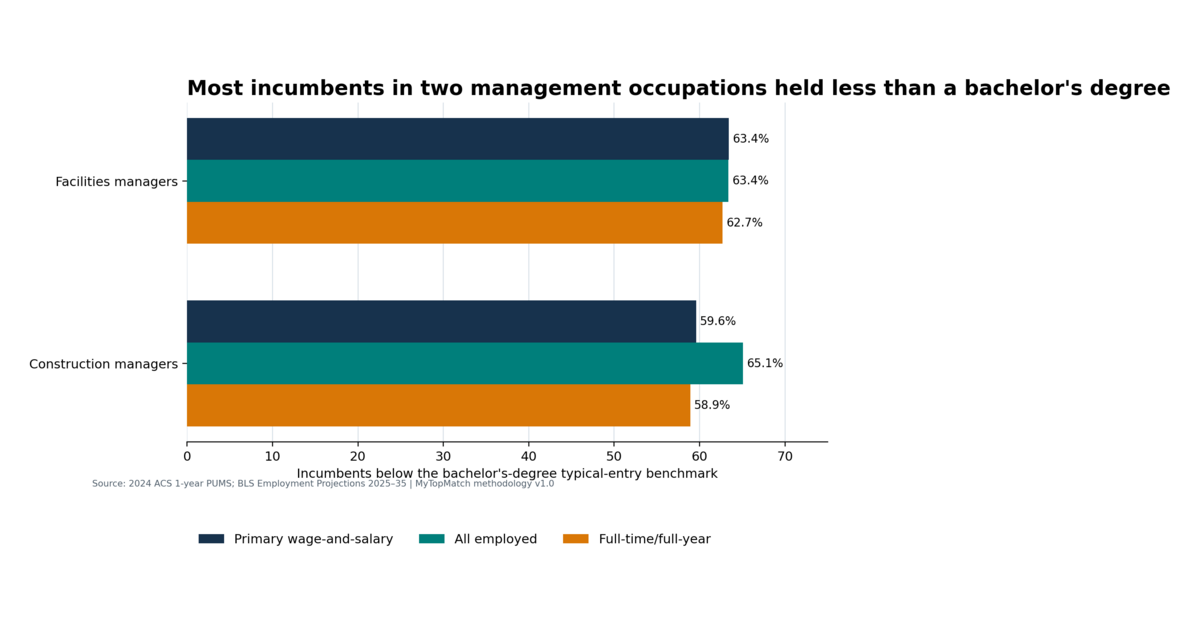
Among workers ages 25 to 64, 59.6% of construction managers held less than a bachelor's degree, with a 90% confidence interval of 58.0% to 61.2%. The corresponding estimate for facilities managers was 63.4%, with a 90% confidence interval of 60.7% to 66.2%.
The benchmark and the workforce answer different questions
BLS assigns each detailed occupation one category for typical education needed for entry, one category for related work experience, and one category for on-the-job training. The category summarizes a typical occupation-level pathway. It is not a legal requirement, an employer-by-employer rule, or a count of credentials held by incumbent workers.
ACS records a respondent's highest educational attainment at the time of the survey. MyTopMatch compared that observed incumbent attainment with the current BLS entry benchmark. The comparison is a Degree Gap; it does not reveal what credential each worker held when entering the occupation.
The pattern survives alternate worker definitions
Construction managers' below-benchmark share ranged from 58.9% among full-time, full-year wage-and-salary workers to 65.1% among all employed workers. Facilities managers remained near 63% in all three tested universes. Across 312 occupations eligible for detailed reporting, below-benchmark rankings correlated at least 0.997 across the alternate universes.
How job seekers can use the finding
Workers with substantial construction, maintenance, operations, project, budgeting, safety, or supervisory experience have evidence-based reasons to investigate experience-based pathways. They should still verify current employer requirements, applicable licenses, project scope, and the type and duration of experience expected for a specific role.
Applicants can strengthen the inquiry by documenting project scope, budget size, schedule control, safety outcomes, vendor coordination, compliance, team leadership, and the complexity of facilities or construction work already managed. These are practical implications, not tested hiring-effect estimates from ACS.
What employers can investigate
Employers can compare degree screens in job descriptions with the preparation and performance of successful incumbents. Employer hiring and performance records are required to determine whether particular combinations of education, experience, certification, or work-sample evidence predict outcomes.
Important limits
- Education at entry is unknown because ACS records attainment at the survey date.
- Current employer requirements and hiring outcomes are unobserved.
- A national workforce share cannot predict individual access.
- The headline does not quantify how much or what type of experience may substitute for education.
- State and local licensing requirements require separate verification.
Incumbents below the bachelor's typical-entry benchmark
| Occupation | Unweighted sample | Primary estimate | 90% CI | All employed | Full-time/full-year |
|---|---|---|---|---|---|
| Construction managers | 6,512 | 59.6% | 58.0%–61.2% | 65.1% | 58.9% |
| Facilities managers | 1,223 | 63.4% | 60.7%–66.2% | 63.4% | 62.7% |
Source: MyTopMatch Research using 2024 ACS one-year PUMS and BLS Employment Projections 2025–35.
METHODOLOGY
How the analysis was built
Methodology DG-1.0; findings MTM-DG-001 and MTM-DG-002. The primary universe is employed civilian wage-and-salary workers ages 25–64 with valid occupation and education data. Estimates use PWGTP and all 80 ACS person replicate weights with the Census 4/80 factor; 90% margins use 1.645.
Read the MyTopMatch research standards and methodology framework →
EVIDENCE STANDARD
How to read this research
- SOURCE DATA
- Facts reported by the cited government or occupational-data publishers.
- DERIVED CALCULATIONS
- Values calculated by MyTopMatch from the source data using the documented method.
- STATISTICAL FINDINGS
- Relationships that passed the stated analytical and validation checks.
- INTERPRETATION
- Practical meaning and hypotheses kept separate from directly observed facts.
FREQUENTLY ASKED QUESTIONS
Questions about the finding
Does BLS require a bachelor's degree for these occupations?
No. BLS reports the education typically needed for entry; the category is not a legal rule.
Does the study show that most workers entered without a degree?
No. ACS records education at the survey date and does not identify education at occupational entry.
Can a career changer use the result?
Use it as a signal for targeted employer and pathway research, then verify current requirements, licenses, and experience expectations.
PRIMARY SOURCES
Sources and citations
- BLS Education and Training Assignments by Detailed Occupation, 2025U.S. Bureau of Labor Statistics
- BLS Occupational Projections and Worker Characteristics, 2025–35U.S. Bureau of Labor Statistics
- 2024 ACS PUMS DocumentationU.S. Census Bureau
- Construction Managers, Occupational Outlook HandbookU.S. Bureau of Labor Statistics
- Administrative Services and Facilities Managers, Occupational Outlook HandbookU.S. Bureau of Labor Statistics
Source agencies have not approved or endorsed MyTopMatch's transformations, analysis, or conclusions. BLS cannot vouch for analyses created from its data.
CITATION AND REUSE
Cite this original research
MyTopMatch Research. “Most Construction and Facilities Managers Held Less Than the Bachelor's Degree BLS Lists as Typical for Entry.” MyTopMatch Labor Market Research, 2026. Methodology DG-1.0. Finding MTM-DG-001 / MTM-DG-002. https://mytopmatch.com/research/degree-gap-management-careers.
When quoting, summarizing, or reproducing MyTopMatch-created analysis, identify MyTopMatch Research as the analyst and link to this canonical page. The cited government agencies and O*NET remain the underlying data publishers.